
 My Inquiry
 My Account


STMicroelectronics VN06SPTR-E
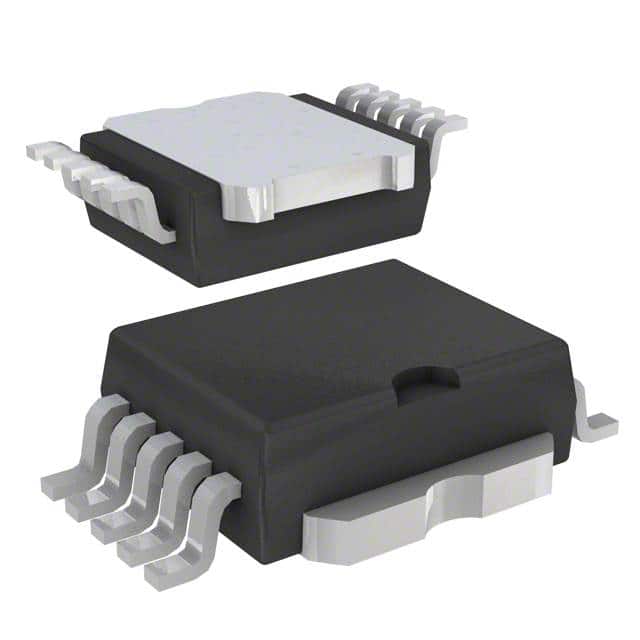
- Part No.:
- VN06SPTR-E
- Manufacturer:
- STMicroelectronics
- Package:
- PowerSO-10 Exposed Bottom Pad
- Datasheet:
-
 VN06SPTR-E.pdf
- Description:
- IC PWR DRIVER N-CHAN 1:1 PWRSO10
- Quantity:
- Payment:

- Shipping:

Inventory:4,023
Please send an inquiry. Send us your inquiry, and we will respond immediately.
Product details
Overview
VN06SPTR-E from STMicroelectronics is a high-side smart power solid-state relay in PowerSO-10™ package, designed for automotive-grade resistive and inductive load control with one side grounded. It delivers 1.9 A nominal current (ISO-defined), 0.18 Ω on-resistance at 25 °C, 60 V drain-source breakdown voltage, and integrated thermal shutdown, under-voltage protection, and open-drain diagnostic output. Used in body electronics modules for controlling lamps, solenoids, and valves.
For engineers reviewing the VN06SPTR-E datasheet, VN06SPTR-E pinout, VN06SPTR-E application, or VN06SPTR-E equivalent, key selection criteria include its 9 A continuous output current at Tc = 85 °C, -18 V inductive demagnetization clamp, 5 V logic-compatible input, open-load detection timing (t1(on)/t1(off) = 1–10 ms), and ISO 7637-2 Pulse 5 Level II compliance without external components.
Technical Context
The VN06SPTR-E integrates a VIPower MOSFET with embedded protection logic and diagnostics. Its high-side architecture enables direct battery-switching of grounded loads, while the internal negative-voltage clamp (-18 V typ.) ensures fast inductive energy dissipation during turn-off. The device implements ISO-compliant open-load detection with dual filtering windows (on/off states) and fault latching behavior per truth table.
Thermal management relies on junction-to-case resistance of 2.4 °C/W, enabling 27 W power dissipation at Tc = 85 °C. Protection functions include overtemperature shutdown at 140 °C (reset at 125 °C), undervoltage lockout at 5 V, and short-circuit current limiting with <10 μs response time due to on-die sensing.
Key Specifications
| Parameter | Value and Actual Design Meaning |
|---|---|
| VDSS | 60 V - Maximum drain-source blocking voltage; supports 24 V automotive systems with margin against load dump transients. |
| RDS(on) | 0.18 Ω (typ. @ Tj = 25 °C) - Low conduction loss enables efficient 1.9 A nominal operation with ≤2.75 V drop at 8.5 A. |
| IOUT cont. | 9 A @ Tc = 85 °C - Continuous current rating defined at case temperature; requires thermal pad design per FR-4 layout guidelines. |
| Vdemag | -18 V (typ.) - Internal clamping voltage during inductive turn-off; reduces demag time and power dissipation by ~3× vs. freewheeling diode. |
| t1(on)/t1(off) | 1–10 ms - Open-load detection filter window; prevents false faults from brief disconnections (<5 ms) in vehicle harnesses. |
| VUSD | 5 V - Undervoltage shutdown threshold; disables output below battery threshold to prevent erratic switching during cranking. |
| ESD Rating | 2000 V (HBM, 1.5 kΩ/100 pF) - Robustness against handling and board-level ESD events in manufacturing and service environments. |
Pinout & Package
Package: PowerSO-10™ - Exposed die-pad thermally enhanced surface-mount package with 10 terminals; requires minimum copper pad area on FR-4 for Rthj-case = 2.4 °C/W.
| Pin/Terminal | Circuit Role | Design Meaning |
|---|---|---|
| 1 (IN) | Logic Input | 5 V CMOS-compatible control signal; 0.8 V low / 2 V high thresholds with 0.5 V hysteresis for noise immunity. |
| 2 (GND) | Power Ground Reference | Return path for load current and internal bias; separate from signal ground in reverse-battery protection configurations. |
| 3 (VCC) | Supply Input | Battery rail connection (5.5–26 V); withstands ISO 7637-2 Pulse 5 Level II (46.5 V) without external clamping. |
| 4–5, 7–8 (OUT) | Power Output Terminals | Parallel-connected high-side switch outputs; rated for 9 A continuous current with shared thermal path to exposed pad. |
| 6 (STAT) | Open-Drain Diagnostic | Active-low status output indicating open load (off/on state), short-to-VCC, or overtemperature; 1.6 mA sink capability. |
| 9–10 (NC) | No Connect | Internally unconnected pins; must be left floating or tied to GND per layout guidelines to avoid parasitic coupling. |
Key Features
| Feature | Design Value |
|---|---|
| Integrated Inductive Demagnetization | Clamps load voltage to -18 V typ. at turn-off, reducing demag time and eliminating need for external flyback diodes or Zener networks. |
| ISO-Compliant Open-Load Detection | Two-stage filtering (t1/on, t1/off, t2/off) meets ISO 16750-2 requirements for automotive high-side drivers in lighting and actuator applications. |
| Reverse Battery Protection Ready | Supports Schottky diode insertion at GND pin (Fig. 3) or signal-ground re-referencing (Fig. 4) to tolerate -26 V continuous reverse supply without damage. |
| Load Dump Immunity | Withstands ISO 7637-2 Test Pulse 5 Level II (46.5 V) without external components; Level III supported with 150 Ω + 1000 μF RC network. |
Applications
| Headlamp Control Module | Engine Cooling Fan Driver |
|---|---|
Use Scenario: Switching 12 V halogen or LED headlamps in A-pillar or front-end modules with CAN/LIN-controlled body domain ECUs. IC Role / Device Role / Timing Role: High-side power switch with real-time open-load reporting to ECU for lamp-out diagnostics and error logging. Use Value: Eliminates discrete fuse + relay + sense resistor solution; reduces BOM count by 4 parts and improves fault detection latency to <10 ms. | Use Scenario: Controlling brushed DC cooling fans in engine bay under wide ambient temperature (-40 to 125 °C) and vibration conditions. IC Role / Device Role / Timing Role: High-current (up to 9 A) inductive load driver with fast demagnetization (-18 V) to suppress arcing and reduce MOSFET stress during PWM cycling. Use Value: Enables 100% duty-cycle fan operation without thermal derating; extends MOSFET lifetime by lowering peak junction temperature during turn-off. |
| Transmission Solenoid Actuator | Door Lock Actuator Driver |
Use Scenario: Driving 12 V transmission pressure control solenoids requiring precise current regulation and stall detection. IC Role / Device Role / Timing Role: Protected high-side switch with overcurrent detection (60 A short-circuit limit) and diagnostic feedback via STAT pin. Use Value: Replaces mechanical relay + current-sense op-amp solution; provides cycle-by-cycle short-circuit response and eliminates contact wear. | Use Scenario: Controlling bi-directional door lock/unlock actuators in central locking systems with wake-up via LIN bus. IC Role / Device Role / Timing Role: Low-quiescent-current (50 μA off-state) high-side driver with open-load detection to verify actuator coil continuity before engagement. Use Value: Reduces standby power consumption by >95% vs. legacy relay-based designs; enables reliable "lock confirmation" feedback without additional sensors. |
Equivalent & Alternatives
The following parts are listed as comparable options for similar high-side automotive switch applications.
| Alternative Part | Technical Difference | Application Difference | Selection Advice |
|---|---|---|---|
| VNQ7E050TR-E | Lower RDS(on) (0.05 Ω), higher INOM (5 A), same PowerSO-10 package; lacks integrated -18 V demag clamp. | Optimized for low-loss, high-current resistive loads (e.g., heaters); not recommended for inductive loads without external clamp. | Select when minimizing conduction loss dominates over inductive turn-off speed; verify external clamp circuit if driving solenoids. |
| IPS1032HTR | Higher VDSS (65 V), lower IOUT cont. (4.5 A), includes current-limit foldback; no open-load filtering per ISO standard. | Suited for industrial PLC outputs where fast trip response matters more than automotive diagnostics. | Prefer for non-automotive 24 V systems needing programmable current limit; avoid where ISO-compliant open-load reporting is mandatory. |
Compared with VNQ7E050TR-E and IPS1032HTR, the VN06SPTR-E uniquely balances 9 A continuous drive, integrated -18 V demagnetization, and full ISO open-load timing compliance-making it optimal for cost-sensitive automotive body control modules requiring both inductive and resistive load support in a single footprint.
Availability
VN06SPTR-E is available at Aetrix Electronics and suitable for headlamp control modules, engine cooling fan drivers, transmission solenoid actuators, and door lock actuator drivers requiring stable component supply across automotive production lifecycles.
Supply support for VN06SPTR-E includes scheduled delivery planning, volume procurement assistance, BOM continuity management, traceable sourcing, and lifecycle availability coordination for OEM customers, industrial embedded developers, connected-device designers, and electronics production programs.
Manufacturer
STMicroelectronics is a global semiconductor leader headquartered in Geneva, Switzerland, specializing in automotive, industrial, and power management ICs with vertical manufacturing capabilities and AEC-Q100 qualified product lines.
The VN06SPTR-E belongs to ST's VIPower® M0-7 family of high-side drivers, engineered specifically for ISO 16750-compliant automotive body electronics where robustness, integrated diagnostics, and thermal resilience are critical.
FAQ
What is the maximum inductive load energy the VN06SPTR-E can safely demagnetize without external components?
The VN06SPTR-E safely demagnetizes inductive loads up to 1 mH at 1.9 A using its internal -18 V clamp, as verified in the datasheet's electrical characteristics table (Vdemag = -14 to -24 V). For larger inductances or higher currents, thermal rise must be calculated using Pdem = 0.5 × L × I² × [(VCC + Vdemag) / Vdemag] × f to ensure junction temperature stays below 150 °C.
Can the VN06SPTR-E be used in 24 V commercial vehicle applications?
Yes-the VN06SPTR-E supports VCC up to 26 V and withstands ISO 7637-2 Pulse 5 Level II (46.5 V) transients without external protection. Its 60 V VDSS and thermal shutdown at 140 °C make it suitable for 24 V truck and bus body control units, provided PCB layout maintains Rthj-case ≤ 2.4 °C/W and ambient temperature remains within -40 to 125 °C.
How does the STAT pin behave during overtemperature shutdown?
During overtemperature shutdown, the STAT pin goes low immediately (no delay) to signal fault. After junction temperature drops to 125 °C (TR), the device auto-recovers and STAT returns high after a fixed 50–700 μs delay (tpol). This behavior differs from open-load detection, which applies 1–10 ms filtering to avoid false triggers from harness noise.
Is the VN06SPTR-E pin-compatible with earlier VN06SP variants?
Yes-VN06SPTR-E is the tape-and-reel packaged version of the VN06SP, sharing identical PowerSO-10™ pinout, electrical specifications, and thermal characteristics. The "TR-E" suffix denotes RoHS-compliant, halogen-free packaging per ST's standard revision control; no functional or layout changes are introduced.
VN06SPTR-E Specifications
- Product attributes
- Attribute value
- Manufacturer:
- STMicroelectronics
- Package/Case:
- PowerSO-10 Exposed Bottom Pad
- Series:
- -
- Packaging:
- Tape & Reel (TR)
- Product Status:
- Active
- Switch Type:
- General Purpose
- Number of Outputs:
- 1
- Ratio - Input:Output:
- 1:1
- Output Configuration:
- High Side
- Output Type:
- N-Channel
- Interface:
- On/Off
- Voltage - Load:
- 5.5V ~ 26V
- Voltage - Supply (Vcc/Vdd):
- Not Required
- Current - Output (Max):
- 9A
- Rds On (Typ):
- 180mOhm (Max)
- Input Type:
- Non-Inverting
- Features:
- Status Flag
- Fault Protection:
- Open Load Detect, Over Temperature
- Operating Temperature:
- -40°C ~ 150°C (TJ)
- Grade:
- -
- Qualification:
- -
- Mounting Type:
- Surface Mount
- Supplier Device Package:
- 10-PowerSO
VN06SPTR-E FAQ
1.How can I place an order for VN06SPTR-E through Aetrix?
Please submit a Request for Quotation (RFQ) for VN06SPTR-E on Aetrix. Our sales agent will provide a competitive quotation and guide you through the order confirmation once you accept the terms.
2.Are the price and stock information for VN06SPTR-E reliable?
The price and inventory of VN06SPTR-E are updated periodically and may fluctuate due to market conditions. Stock and pricing data are typically refreshed every 24 hours. Quotation validity for VN06SPTR-E is usually 5 days.
3.What payment methods are accepted for VN06SPTR-E?
We accept Wire Transfer, PayPal, Credit Card, Western Union, MoneyGram, and Escrow for VN06SPTR-E transactions.
Note: Certain payment methods may incur a processing fee.
4.How is shipping managed for VN06SPTR-E?
VN06SPTR-E orders can be shipped via leading logistics carriers, including DHL, UPS, FedEx, TNT, or Registered Mail.
Once your VN06SPTR-E order is processed, you will receive an email with the shipment details and tracking number.
Note: Tracking information may take up to 24 hours to appear. Express delivery typically takes 3–5 business days.
5.How can I obtain technical support or documentation for VN06SPTR-E?
For technical support, including VN06SPTR-E datasheets, pinout diagrams, or application guidance, please contact our engineering support team. They can provide detailed documentation and assistance for your VN06SPTR-E requirements.
6.How does Aetrix verify that VN06SPTR-E is sourced from the original manufacturer or authorized distributors?
All VN06SPTR-E products on Aetrix are procured from qualified distributors and authorized channels. Our dedicated quality assurance team conducts strict verification, including traceability checks and, if necessary, third-party testing. This ensures that VN06SPTR-E meets industry standards.
7.What is the process for return or replacement of VN06SPTR-E?
All VN06SPTR-E units undergo pre-shipment inspection (PSI). If there is an issue with VN06SPTR-E, returns or replacements are accepted under the following conditions:
1.Quantity discrepancies, incorrect items, or visible external defects (such as breakage or corrosion), acknowledged by Aetrix.
2.The issue is reported within 90 days of delivery.
3.The VN06SPTR-E part is unused and in its original packaging.
Return procedure for VN06SPTR-E:
1.Submit a request within 90 days.
2.Obtain a Return Material Authorization (RMA) from Aetrix.
VN06SPTR-E Tags
-
TPS22919DCKR
Texas Instruments
-
MIC2091-1YM5-TR
Microchip Technology
-
MIC2090-1YM5-TR
Microchip Technology

-
TPS22995RZFR
Texas Instruments
-
TPS22975DSGR
Texas Instruments
-
SIP32510DT-T1-GE3
Vishay Siliconix
-
ULN2003D1013TR
STMicroelectronics
-
MIC2005A-1YM5-TR
Microchip Technology

-
MIC2005A-1YM6-TR
Microchip Technology
-
TPS22916BYFPR
Texas Instruments

-
TPS22917DBVR
Texas Instruments
-
ULN2003APWR
Texas Instruments
Tech Hub

Operational amplifier guide covering op amp basics, feedback, ideal vs real op amps, common configurations, buffer circuits, offset, bias current, gain-bandwidth, slew rate, rail-to-rail limits and sel…

Jumper cables guide covering safe connection order, red and black clamp placement, final ground connection, cable gauge, length, clamp quality, copper vs CCA cables, jump starter comparison and battery…

LDO regulator guide covering low dropout voltage, power dissipation, thermal design, PSRR, output noise, capacitor stability, adjustable LDO circuits, LDO vs buck converter and datasheet selection chec…

Conditional Access Module guide covering CAM meaning, CI/CI+ interface, smart card authorization, DVB security workflow, TV and set-top box compatibility, internal electronics, ESD protection, connecto…

Guide to electronic component obsolescence covering EOL risk, PCN/PDN notices, last-time buy planning, replacement options, form-fit-function validation, counterfeit risk and BOM lifecycle management.

18650 battery guide covering lithium-ion cell basics, 3.6V/3.7V voltage, 4.2V charging, mAh and Wh capacity, protected cells, chargers, BMS, series-parallel packs, holders, welding and sourcing checks.…

Hall effect sensor guide covering working principle, linear and digital sensors, Arduino circuits, current sensing, speed detection, automotive applications, A3144 examples, signal filtering and datash…

Product Change Notification guide for electronic components, covering PCN meaning, PCN vs PDN/EOL, common change types, risk levels, form-fit-function review, engineering validation, BOM control, LTB/L…

A practical guide to blend door actuators, covering HVAC function, symptoms, location, AC and heater issues, reset and calibration, replacement cost, electrical diagnosis, compatibility checks, and rep…

Engineering guide to Raspberry Pi alternatives, covering chip-level differences, Orange Pi, ROCK, Jetson, Banana Pi, NanoPi, Compute Module, Pico, GPIO, camera, HAT compatibility, and replacement risks…


