
 My Inquiry
 My Account


STMicroelectronics VNQ810PEPTR-E
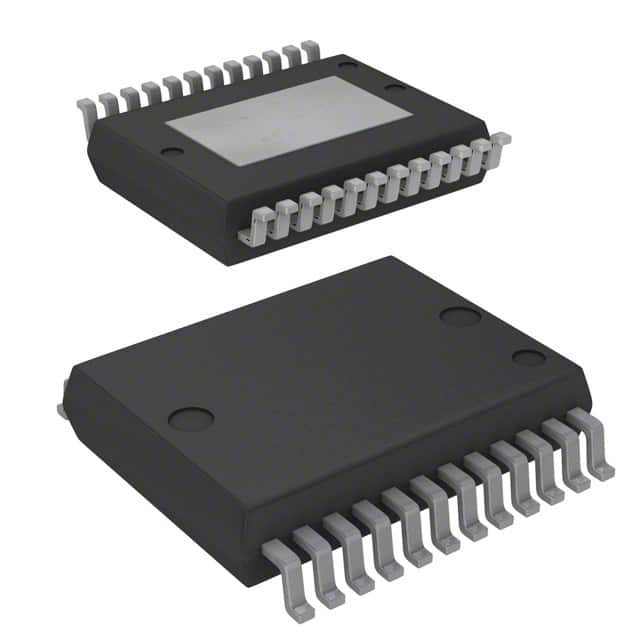
- Part No.:
- VNQ810PEPTR-E
- Manufacturer:
- STMicroelectronics
- Package:
- 24-PowerBSOP (0.295", 7.50mm Width)
- Datasheet:
-
 VNQ810PEPTR-E.pdf
- Description:
- IC PWR DRVR N-CHAN 1:1 PWRSSO24
- Quantity:
- Payment:

- Shipping:

Inventory:4,136
Please send an inquiry. Send us your inquiry, and we will respond immediately.
Product details
Overview
VNQ810PEPTR-E from STMicroelectronics is a quad-channel high-side driver IC designed for automotive and industrial load switching, featuring 160 mΩ RDS(on) per channel, 5 A continuous output current, 36 V maximum supply voltage, CMOS-compatible inputs, and integrated open-load detection in both on- and off-states. It operates in PowerSSO-24 package and is used to drive resistive, inductive, or capacitive loads with one side grounded-common in body control modules and lighting systems.
For engineers reviewing the VNQ810PEPTR-E datasheet, VNQ810PEPTR-E pinout, VNQ810PEPTR-E application, or VNQ810PEPTR-E equivalent, this page delivers verified technical context, real-world protection behaviors (e.g., loss-of-ground shutdown, reverse-battery immunity), thermal performance under PCB copper area variation, and precise diagnostic timing (e.g., 200 µs on-state open-load detection delay).
Technical Context
The device integrates four independent VIPower M0-3 high-side switches with active current limiting, thermal shutdown with 150°C trip and 135°C reset hysteresis, and dual-mode open-load detection: on-state threshold at 20–80 mA and off-state voltage threshold at 1.5–3.5 V. Each channel includes dedicated status pins with open-drain outputs and internal clamping (6–8 V).
It implements VCC clamp protection compliant with ISO 7637 transient pulses (Classes C/E across all test levels), reverse battery protection via GND network interface, and undervoltage (4 V typ.) / overvoltage (36 V) shutdown. The PowerSSO-24 package provides 1.9 °C/W junction-to-case thermal resistance and supports up to 66 W power dissipation per island at Tlead = 25°C.
Key Specifications
| Parameter | Value and Actual Design Meaning |
|---|---|
| RDS(on) | 160 mΩ max per channel at IOUT = 1 A, Tj = 25°C - ensures low conduction loss and <1 W dissipation at 5 A. |
| IOUT Continuous | 5 A per channel - supports high-current solenoids, lamps, and motors without external heatsinking under defined PCB copper area. |
| VCC Range | 5.5–36 V - compatible with 12 V and 24 V automotive battery systems including load dump transients. |
| Open-load Detection | On-state: 20–80 mA threshold; Off-state: 1.5–3.5 V threshold - enables reliable fault reporting without external circuitry. |
| Thermal Shutdown | 150°C trip, 135°C reset (15°C hysteresis) - prevents latch-up during sustained overload and allows automatic recovery. |
| Status Output | Open-drain, 0.5 V max low-level voltage at 1.6 mA - directly interfaces with 3.3 V/5 V MCU GPIO with external pull-up. |
| ISO 7637 Compliance | Class C for pulses 1–4; Class E for pulse 5 - validated against automotive electrical disturbance standards. |
Pinout & Package
Package: PowerSSO-24 (exposed thermal pad connected to VCC). 24-pin thermally enhanced surface-mount package with 0.5 mm pitch, optimized for high-power dissipation in automotive PCB layouts.
| Pin/Terminal | Circuit Role | Design Meaning |
|---|---|---|
| VCC | Positive supply input | Primary power rail; clamped internally to protect against low-energy transients (ISO 7637 pulse 1/2/3a/3b). |
| GND | Ground reference | System ground return; disconnect triggers automatic shutdown (loss-of-ground protection). |
| INPUT1–4 | Digital control inputs | CMOS-compatible (VIL ≤ 1.25 V, VIH ≥ 3.25 V); 0.5 V hysteresis prevents noise-induced switching. |
| OUTPUT1–4 | High-side switched outputs | Four independent N-channel DMOS outputs; each drives load between OUTPUTx and GND. |
| STATUS1–4 | Fault/status open-drain outputs | Report open-load, overtemperature, overvoltage, undervoltage, and current-limit events per channel. |
| N.C. | No-connect terminal | Internally unused; must be left floating or tied to GND via 10 kΩ resistor per datasheet Table 2. |
| TAB | Exposed thermal pad | Internally connected to VCC; requires soldered thermal land on PCB for heat dissipation. |
Key Features
| Feature | Design Value |
|---|---|
| Quad-channel integration | Four independent high-side drivers in single PowerSSO-24 package - reduces board space and interconnect complexity vs. discrete solutions. |
| Loss-of-ground protection | Automatic shutdown when GND pin disconnects - prevents uncontrolled load activation and system damage in wiring fault conditions. |
| Reverse battery immunity | Protected via external GND-line resistor/diode network (Fig 24) - eliminates need for upstream diode in 12 V systems. |
| Diagnostic-ready status pins | Per-channel open-drain outputs with 6–8 V clamp - enable direct MCU monitoring without level-shifting or additional protection components. |
| Low standby current | 20 µA max at VCC = 13 V, Tj = 25°C - meets automotive "always-on" module quiescent current requirements. |
Applications
| Automotive Body Control Module | Industrial PLC Output Stage |
|---|---|
|
Use Scenario: Driving door locks, interior lighting, and seat actuators from a centralized BCM microcontroller. IC Role / Device Role / Timing Role: High-side switch providing controlled 12 V power delivery with real-time fault feedback via STATUS pins. Use Value: Eliminates need for external flyback diodes and current-sense amplifiers; on/off-state open-load detection confirms actuator connection integrity before and after operation. |
Use Scenario: Controlling solenoid valves and indicator lamps in DIN-rail mounted programmable logic controllers. IC Role / Device Role / Timing Role: Robust output stage handling 24 V DC industrial supplies with built-in short-circuit and thermal protection. Use Value: Withstands repetitive inductive kickback (EMAX = 22 mJ) and maintains operation across -40°C to +150°C ambient - reducing field failure rates in harsh environments. |
| Truck Lighting System | Off-Highway Equipment Monitoring |
|
Use Scenario: Switching LED headlamps and fog lights in commercial vehicles subject to load dump transients up to +86.5 V. IC Role / Device Role / Timing Role: High-voltage-tolerant high-side driver with ISO 7637 pulse 5 Class E compliance and VCC clamp. Use Value: Survives 400 ms, 86.5 V transients without latch-up or parameter shift - avoids costly external TVS arrays. |
Use Scenario: Managing hydraulic valve coils and sensor power in construction and agricultural machinery. IC Role / Device Role / Timing Role: Fault-aware power switch enabling predictive maintenance via STATUS pin diagnostics (e.g., gradual open-load drift). Use Value: 200 µs on-state open-load detection delay allows fast response to coil disconnection, preventing overheating of downstream drivers. |
Equivalent & Alternatives
The following parts are listed as comparable options for similar high-side driver applications.
| Alternative Part | Technical Difference | Application Difference | Selection Advice |
|---|---|---|---|
| VNQ830PEPTR-E | RDS(on) = 160 mΩ (same), but rated for 5 A per channel with higher thermal derating margin; identical pinout and protection features. | Optimized for higher ambient temperature operation (Tc up to 150°C) - preferred in engine bay placements. | Select when operating case temperature exceeds 105°C or when tighter thermal margin is required. |
| TPS27082LARVCR | Single-channel, 85 mΩ RDS(on), 3.6–36 V VIN, no off-state open-load detection; smaller WSON-10 package. | Lacks multi-channel integration and diagnostic completeness - suitable only for non-critical, space-constrained single-load use. | Choose only for low-channel-count designs where board area is critical and diagnostics are handled externally. |
Compared with VNQ810PEPTR-E, VNQ830PEPTR-E offers identical functionality with enhanced thermal robustness for under-hood deployment, while TPS27082LARVCR trades channel count and diagnostics for compactness - making it unsuitable as a drop-in replacement but viable for simplified subsystems.
Availability
VNQ810PEPTR-E is available at Aetrix Electronics and suitable for automotive body control modules, industrial PLC output stages, truck lighting systems, and off-highway equipment monitoring requiring stable component supply and long-term lifecycle support.
Supply support for VNQ810PEPTR-E includes scheduled delivery planning, volume procurement assistance, BOM continuity management, traceable sourcing, and lifecycle availability coordination for OEM customers, industrial embedded developers, connected-device designers, and electronics production programs.
Manufacturer
STMicroelectronics is a global semiconductor leader headquartered in Geneva, Switzerland, specializing in automotive-grade power ICs, microcontrollers, and sensors with ISO/TS 16949-certified manufacturing.
The VNQ810PEPTR-E belongs to ST's VIPower™ high-side driver family, engineered specifically for automotive and industrial load switching applications demanding integrated protection, diagnostics, and ruggedized transient immunity.
FAQ
What is the maximum safe operating voltage for VNQ810PEPTR-E?
The absolute maximum VCC rating is 41 V, but the recommended operating range is 5.5–36 V. Operation above 36 V triggers overvoltage shutdown (typ. 36 V), and the device remains latched off until VCC drops below the hysteresis threshold (~34 V). Sustained exposure to >41 V risks permanent damage per Table 3.
Does VNQ810PEPTR-E require external components for reverse battery protection?
Yes - reverse battery protection requires an external resistor (RGND) or diode (DGND) in the ground path, as shown in Figure 24 and Section 3.1. The IC itself does not include internal reverse-polarity blocking; the external network limits reverse current to safe levels (<200 mA) while maintaining functional operation.
How does off-state open-load detection work, and what load conditions trigger it?
Off-state detection monitors output voltage: if VOUT rises above 1.5–3.5 V while INPUT = low, the STATUS pin asserts low, indicating an open circuit (e.g., broken wire). This occurs when the load is disconnected but the output node floats or couples to VCC - confirmed in Table 11 and Figure 25, with 1000 µs detection delay.
Can VNQ810PEPTR-E drive inductive loads like solenoids without external flyback diodes?
No - external flyback diodes are required. Although the device includes Vdemag clamping (VCC − 41 V to VCC − 55 V), this only handles limited demagnetization energy (EMAX = 22 mJ at VCC = 13.5 V). For typical solenoids, external diodes remain necessary to absorb full inductive kickback and prevent voltage overshoot beyond clamp limits.
VNQ810PEPTR-E Specifications
- Product attributes
- Attribute value
- Manufacturer:
- STMicroelectronics
- Package/Case:
- 24-PowerBSOP (0.295", 7.50mm Width)
- Series:
- VIPower™
- Packaging:
- Tape & Reel (TR)
- Product Status:
- Active
- Switch Type:
- General Purpose
- Number of Outputs:
- 4
- Ratio - Input:Output:
- 1:1
- Output Configuration:
- High Side
- Output Type:
- N-Channel
- Interface:
- On/Off
- Voltage - Load:
- 5.5V ~ 36V
- Voltage - Supply (Vcc/Vdd):
- Not Required
- Current - Output (Max):
- 5A
- Rds On (Typ):
- 160mOhm (Max)
- Input Type:
- Non-Inverting
- Features:
- Auto Restart, Status Flag
- Fault Protection:
- Current Limiting (Fixed), Open Load Detect, Over Temperature, Over Voltage
- Operating Temperature:
- -40°C ~ 150°C (TJ)
- Grade:
- -
- Qualification:
- -
- Mounting Type:
- Surface Mount
- Supplier Device Package:
- PowerSSO-24
VNQ810PEPTR-E FAQ
1.How can I place an order for VNQ810PEPTR-E through Aetrix?
Please submit a Request for Quotation (RFQ) for VNQ810PEPTR-E on Aetrix. Our sales agent will provide a competitive quotation and guide you through the order confirmation once you accept the terms.
2.Are the price and stock information for VNQ810PEPTR-E reliable?
The price and inventory of VNQ810PEPTR-E are updated periodically and may fluctuate due to market conditions. Stock and pricing data are typically refreshed every 24 hours. Quotation validity for VNQ810PEPTR-E is usually 5 days.
3.What payment methods are accepted for VNQ810PEPTR-E?
We accept Wire Transfer, PayPal, Credit Card, Western Union, MoneyGram, and Escrow for VNQ810PEPTR-E transactions.
Note: Certain payment methods may incur a processing fee.
4.How is shipping managed for VNQ810PEPTR-E?
VNQ810PEPTR-E orders can be shipped via leading logistics carriers, including DHL, UPS, FedEx, TNT, or Registered Mail.
Once your VNQ810PEPTR-E order is processed, you will receive an email with the shipment details and tracking number.
Note: Tracking information may take up to 24 hours to appear. Express delivery typically takes 3–5 business days.
5.How can I obtain technical support or documentation for VNQ810PEPTR-E?
For technical support, including VNQ810PEPTR-E datasheets, pinout diagrams, or application guidance, please contact our engineering support team. They can provide detailed documentation and assistance for your VNQ810PEPTR-E requirements.
6.How does Aetrix verify that VNQ810PEPTR-E is sourced from the original manufacturer or authorized distributors?
All VNQ810PEPTR-E products on Aetrix are procured from qualified distributors and authorized channels. Our dedicated quality assurance team conducts strict verification, including traceability checks and, if necessary, third-party testing. This ensures that VNQ810PEPTR-E meets industry standards.
7.What is the process for return or replacement of VNQ810PEPTR-E?
All VNQ810PEPTR-E units undergo pre-shipment inspection (PSI). If there is an issue with VNQ810PEPTR-E, returns or replacements are accepted under the following conditions:
1.Quantity discrepancies, incorrect items, or visible external defects (such as breakage or corrosion), acknowledged by Aetrix.
2.The issue is reported within 90 days of delivery.
3.The VNQ810PEPTR-E part is unused and in its original packaging.
Return procedure for VNQ810PEPTR-E:
1.Submit a request within 90 days.
2.Obtain a Return Material Authorization (RMA) from Aetrix.
VNQ810PEPTR-E Tags
-
TPS22919DCKR
Texas Instruments
-
MIC2091-1YM5-TR
Microchip Technology
-
MIC2090-1YM5-TR
Microchip Technology

-
TPS22995RZFR
Texas Instruments
-
TPS22975DSGR
Texas Instruments
-
SIP32510DT-T1-GE3
Vishay Siliconix
-
ULN2003D1013TR
STMicroelectronics
-
MIC2005A-1YM5-TR
Microchip Technology

-
MIC2005A-1YM6-TR
Microchip Technology
-
TPS22916BYFPR
Texas Instruments

-
TPS22917DBVR
Texas Instruments

-
ULN2003APWR
Texas Instruments
Tech Hub

A practical engineering and sourcing framework covering lifecycle verification, lifetime-buy calculations, replacement qualification, supplier checks and counterfeit-risk controls.

TTL and CMOS logic families differ in thresholds, loading, output drive, power and timing. This engineering guide compares 74HC and 74HCT, calculates noise margins and checks 3.3 V/5 V compatibility.

A practical engineering guide to 3.3V and 5V logic compatibility, input thresholds, resistor dividers, translator ICs, MOSFET level shifting, I2C pull-ups, timing limits and power-sequencing risks.

The 74HC595 uses push-pull logic outputs, while the TPIC6B595 uses 50 V open-drain DMOS sinks for higher-power loads. This guide compares timing, current limits, 3.3 V interfacing, load wiring, thermal…

The 74HC595 converts serial data into eight stable parallel outputs. This guide covers pin functions, shift and storage timing, OE and MR behavior, drive-current limits, cascading, voltage compatibilit…

A technical comparison of level-sensitive latches and edge-triggered flip-flops, covering timing windows, setup and hold limits, master–slave operation, time borrowing, race-through, HDL inference and…

A D latch stores one bit while Enable controls when data can pass. This reference covers gate-level operation, truth tables, transparency, setup and hold timing, LE versus OE, common ICs and practical …

An SR latch stores one bit through cross-coupled feedback. This engineering reference covers NOR and NAND implementations, truth tables, forbidden-state recovery, gated operation, switch debouncing, fa…

Latch circuits retain one bit through feedback. This technical reference covers SR and D latches, truth tables, transparency, timing limits, latch-versus-flip-flop behavior, applications and common log…

An engineering guide to LED driver operation, constant-current and constant-voltage outputs, linear and switching topologies, dimming, IC selection, calculations, replacement compatibility, and fault c…


