
 My Inquiry
 My Account


Winbond Electronics Corporation W74M12JWZPIQ TR
- Part No.:
- W74M12JWZPIQ TR
- Manufacturer:
- Winbond Electronics Corporation
- Category:
- Memory
- Package:
- 8-WDFN Exposed Pad
- Datasheet:
-
 W74M12JWZPIQ TR.pdf
- Description:
- IC FLASH 128MBIT SPI/QUAD 8WSON
- Quantity:
- Payment:

- Shipping:

Inventory:1,499
Please send an inquiry. Send us your inquiry, and we will respond immediately.
Product details
Overview
W74M12JWZPIQ TR from Winbond is a 128Mb (16MB) secure authentication flash memory IC with integrated HMAC-SHA-256 crypto accelerator, four HMAC-signed monotonic counters, and WSON-8 (8×6 mm) package. It provides hardware-rooted integrity verification, replay attack resistance, and timestamped counter updates for firmware and IP protection in resource-constrained IoT edge nodes.
For engineers reviewing the W74M12JWZPIQ TR datasheet, W74M12JWZPIQ TR pinout, W74M12JWZPIQ TR application, or W74M12JWZPIQ TR equivalent, key selection criteria include authenticated counter persistence, SHA-256 acceleration latency, WSON-8 thermal performance under industrial temperature range (–40°C to +85°C), and support for standard SPI command set with secure read/write lock.
Technical Context
The W74M12JWZPIQ TR implements a dedicated hardware crypto engine that executes HMAC-SHA-256 operations independently of host CPU, reducing software overhead and eliminating timing side-channel exposure. Its four monotonic counters are each bound to unique secret keys stored in tamper-resistant non-volatile memory.
Each counter value is cryptographically signed before readout, enabling remote verification of both value authenticity and sequence integrity. The device operates at 3V supply and supports standard SPI clock up to 104 MHz with dual/quad I/O modes enabled via configuration registers.
Key Specifications
| Parameter | Value and Actual Design Meaning |
|---|---|
| Flash Density | 128Mb (16MB) - sufficient for storing boot code, firmware images, and cryptographic keys with redundancy |
| Supply Voltage | 3.0V ±0.3V - compatible with standard 3.3V logic rails and industrial power domains |
| Crypto Engine | HMAC-SHA-256 hardware accelerator - offloads host MCU, prevents software-based hash collisions |
| Monotonic Counters | 4 independent counters, each HMAC-signed with unique secret key - enables multi-domain state tracking (e.g., firmware version, calibration cycles, usage hours) |
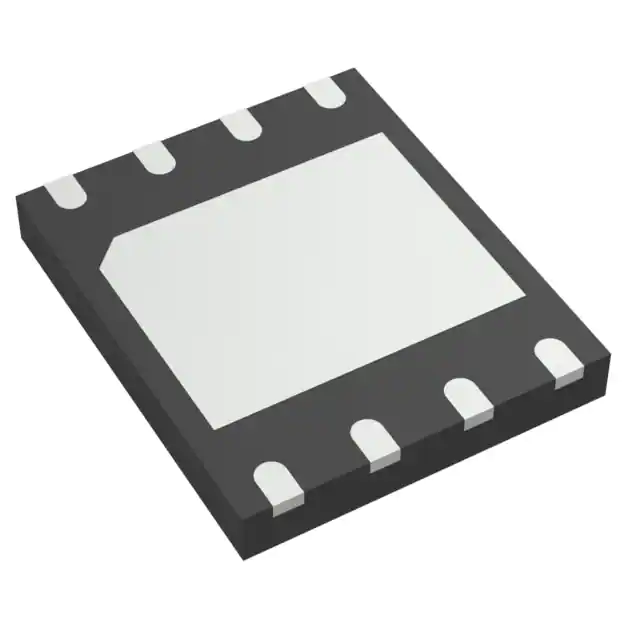
| Package | WSON-8 (8 × 6 mm, 0.5 mm pitch) - surface-mount, thermally enhanced, JEDEC-compliant footprint |
| Operating Temp | –40°C to +85°C - qualified for industrial and extended-temperature embedded deployments |
| SPI Interface | Standard Quad SPI (QSPI) mode supported - enables fast secure firmware readout at up to 104 MHz |
Pinout & Package
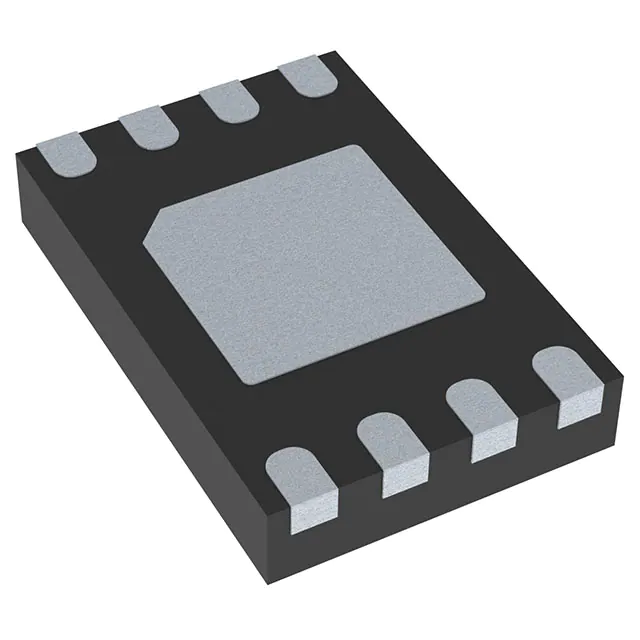
W74M12JWZPIQ TR uses an 8-pin WSON (8 × 6 mm) package with wettable flank terminations for automated optical inspection (AOI). Thermal pad on underside improves power dissipation during crypto operation.
| Pin/Terminal | Circuit Role | Design Meaning |
|---|---|---|
| 1 / /CS | Chip Select | Active-low enable for SPI command decoding; must be held low during transaction |
| 2 / DO / IO1 | Data Output / Quad I/O | Serial data output in standard mode; bidirectional in quad I/O mode |
| 3 / /WP | Write Protect | Hardware lock for status register and security registers; tied high for full write access |
| 4 / GND | Ground | Reference return path for VCC and I/O; connected to exposed thermal pad |
| 5 / VCC | Power Supply | 3.0V core and I/O supply; requires local 100nF decoupling near pin |
| 6 / /HOLD | Hold Control | Pauses ongoing SPI transfer without deselecting device; useful for interrupt handling |
| 7 / DI / IO0 | Data Input / Quad I/O | Serial data input in standard mode; bidirectional in quad I/O mode |
| 8 / CLK | Clock Input | Master-generated SPI clock; max 104 MHz in QSPI mode with proper signal integrity |
Key Features
| Feature | Design Value |
|---|---|
| Hardware HMAC-SHA-256 Engine | Executes full SHA-256 hash + HMAC generation in <100 µs - eliminates host CPU dependency and side-channel leakage |
| Four Independent Monotonic Counters | Each counter increments only, signed with unique secret key - enables separate trust domains (e.g., bootloader, application, calibration, diagnostics) |
| Secure Read Lock | Read-protects monotonic counter values and secret keys after initial programming - prevents extraction even with physical probe access |
| WSON-8 Wettable Flank Package | Enables AOI-compatible solder joint inspection - critical for automotive and industrial PCB assembly traceability |
| Industrial Temperature Range | Validated operation from –40°C to +85°C - supports deployment in uncontrolled ambient environments without derating |
Applications
| PCBA Anti-Copy Protection | IP/Software License Enforcement |
|---|---|
Use Scenario: Prevent unauthorized duplication of production PCBAs by embedding unique, cryptographically signed identifiers and usage counters into firmware storage. IC Role / Device Role / Timing Role: W74M12JWZPIQ TR serves as immutable root-of-trust anchor, storing HMAC-signed board serials and clone-detection counters. Use Value: Blocks counterfeit replication by requiring valid signature verification before firmware execution - no external secure element needed. | Use Scenario: Enforce per-device software licensing in smart home hubs where firmware features unlock based on paid subscription tiers. IC Role / Device Role / Timing Role: W74M12JWZPIQ TR stores and signs license state counters (e.g., feature activation count, trial expiry) with hardware-bound keys. Use Value: Prevents license file tampering or reuse across devices - each counter update is cryptographically chained and time-ordered. |
| Root-of-Trust for Edge Firmware | Anti-Cloning in Industrial Modules |
Use Scenario: Secure boot chain in battery-powered sensor nodes where firmware integrity must survive power loss and field updates. IC Role / Device Role / Timing Role: W74M12JWZPIQ TR holds signed firmware hashes and monotonic boot attempt counters used during secure boot validation. Use Value: Guarantees firmware authenticity and detects rollback attacks - counter signature proves last-boot timestamp and sequence. | Use Scenario: Protect proprietary motor control algorithms in industrial PLC modules against reverse engineering and cloning. IC Role / Device Role / Timing Role: W74M12JWZPIQ TR stores encrypted algorithm parameters and signs runtime calibration counters tied to hardware identity. Use Value: Renders cloned modules non-functional without original secret keys - counter signatures bind firmware to specific hardware instance. |
Equivalent & Alternatives
The following parts are listed as comparable options for similar secure authentication flash applications.
| Alternative Part | Technical Difference | Application Difference | Selection Advice |
|---|---|---|---|
| Infineon SLB9670 | Dedicated TPM 2.0 chip with RSA/ECC engine; no integrated flash; requires external memory | Designed for PC-class platform trust anchors; lacks built-in code storage | Choose when full TPM 2.0 compliance and PC client OS integration are required over embedded flash consolidation |
| Microchip ATAES132A | 16KB EEPROM + AES-128 engine; no SHA-256 or monotonic counters; SOIC-8 package | Targeted at low-density key storage and simple challenge-response; limited counter capability | Choose for cost-sensitive, low-capacity authentication where SHA-256 and multi-counter support are not required |
Compared with SLB9670 and ATAES132A, W74M12JWZPIQ TR uniquely integrates 128Mb flash, HMAC-SHA-256 acceleration, and four independent monotonic counters in a single WSON-8 package - enabling consolidated root-of-trust with firmware storage, eliminating external memory and reducing BOM count.
Availability
W74M12JWZPIQ TR is available at Aetrix Electronics and suitable for industrial control systems, smart home gateways, and mobile accessory authentication requiring stable component supply across long-lifecycle product programs.
Supply support for W74M12JWZPIQ TR includes scheduled delivery planning, volume procurement assistance, BOM continuity management, traceable sourcing, and lifecycle availability coordination for OEM customers, industrial embedded developers, connected-device designers, and electronics production programs.
Manufacturer
Winbond Electronics Corp. is a Taiwan-based integrated IC company specializing in design, fabrication, and marketing of low-to-medium-density memory solutions, including NAND flash and Mobile DRAM.
The W74M product line delivers hardware-accelerated secure authentication for IoT edge devices, combining flash storage with cryptographic primitives to establish tamper-resistant roots of trust in constrained environments.
FAQ
What security functions does the W74M12JWZPIQ TR provide beyond standard flash memory?
The W74M12JWZPIQ TR adds hardware-accelerated HMAC-SHA-256 signing, four independent monotonic counters each signed with unique secret keys, and secure read-lock for cryptographic assets. Unlike standard flash, W74M12JWZPIQ TR ensures firmware integrity, prevents replay attacks, and binds counter updates to device identity - all enforced in silicon without host software involvement.
Does the W74M12JWZPIQ TR support standard SPI commands?
Yes, the W74M12JWZPIQ TR is fully compatible with standard SPI command sets (including Read, Write, Erase, and Status Register access) and extends them with secure opcodes for counter read, HMAC verification, and key programming. It supports single/dual/quad I/O modes and maintains backward compatibility with legacy SPI controllers.
How is the W74M12JWZPIQ TR's monotonic counter protected against rollback or tampering?
Each monotonic counter in the W74M12JWZPIQ TR can only increment; decrements or resets are physically blocked in hardware. Before readout, the counter value is HMAC-signed using a unique secret key stored in tamper-resistant memory. Any attempt to alter the value invalidates the signature, causing verification failure during host-side authentication.
What is the purpose of the /WP and /HOLD pins on the W74M12JWZPIQ TR?
The /WP (Write Protect) pin hardware-locks security registers and monotonic counter configuration; tying it high enables full write access, while pulling it low disables writes. The /HOLD pin pauses active SPI transfers without deselecting the device - allowing the host MCU to service interrupts while preserving transaction context on the W74M12JWZPIQ TR.
Is the W74M12JWZPIQ TR qualified for industrial temperature operation?
Yes, the W74M12JWZPIQ TR is specified and tested for continuous operation from –40°C to +85°C. This qualification covers all security functions, including HMAC-SHA-256 computation latency, monotonic counter persistence, and SPI interface timing - making it suitable for uncontrolled industrial and outdoor embedded deployments.
W74M12JWZPIQ TR Specifications
- Product attributes
- Attribute value
- Manufacturer:
- Winbond Electronics Corporation
- Series:
- SpiFlash®
- Package/Case:
- 8-WDFN Exposed Pad
- Packaging:
- Tape & Reel (TR)
- Product Status:
- Active
- Programmable:
- Not Verified
- Memory Type:
- Non-Volatile
- Memory Format:
- FLASH
- Technology:
- FLASH - NAND
- Memory Size:
- 128Mbit
- Memory Organization:
- 16M x 8
- Memory Interface:
- SPI - Quad I/O
- Clock Frequency:
- 104 MHz
- Write Cycle Time - Word, Page:
- -
- Access Time:
- -
- Voltage - Supply:
- 1.7V ~ 1.95V
- Operating Temperature:
- -40°C ~ 85°C (TA)
- Grade:
- -
- Qualification:
- -
- Mounting Type:
- Surface Mount
- Supplier Device Package:
- 8-WSON (6x5)
W74M12JWZPIQ TR FAQ
1.How can I place an order for W74M12JWZPIQ TR through Aetrix?
Please submit a Request for Quotation (RFQ) for W74M12JWZPIQ TR on Aetrix. Our sales agent will provide a competitive quotation and guide you through the order confirmation once you accept the terms.
2.Are the price and stock information for W74M12JWZPIQ TR reliable?
The price and inventory of W74M12JWZPIQ TR are updated periodically and may fluctuate due to market conditions. Stock and pricing data are typically refreshed every 24 hours. Quotation validity for W74M12JWZPIQ TR is usually 5 days.
3.What payment methods are accepted for W74M12JWZPIQ TR?
We accept Wire Transfer, PayPal, Credit Card, Western Union, MoneyGram, and Escrow for W74M12JWZPIQ TR transactions.
Note: Certain payment methods may incur a processing fee.
4.How is shipping managed for W74M12JWZPIQ TR?
W74M12JWZPIQ TR orders can be shipped via leading logistics carriers, including DHL, UPS, FedEx, TNT, or Registered Mail.
Once your W74M12JWZPIQ TR order is processed, you will receive an email with the shipment details and tracking number.
Note: Tracking information may take up to 24 hours to appear. Express delivery typically takes 3–5 business days.
5.How can I obtain technical support or documentation for W74M12JWZPIQ TR?
For technical support, including W74M12JWZPIQ TR datasheets, pinout diagrams, or application guidance, please contact our engineering support team. They can provide detailed documentation and assistance for your W74M12JWZPIQ TR requirements.
6.How does Aetrix verify that W74M12JWZPIQ TR is sourced from the original manufacturer or authorized distributors?
All W74M12JWZPIQ TR products on Aetrix are procured from qualified distributors and authorized channels. Our dedicated quality assurance team conducts strict verification, including traceability checks and, if necessary, third-party testing. This ensures that W74M12JWZPIQ TR meets industry standards.
7.What is the process for return or replacement of W74M12JWZPIQ TR?
All W74M12JWZPIQ TR units undergo pre-shipment inspection (PSI). If there is an issue with W74M12JWZPIQ TR, returns or replacements are accepted under the following conditions:
1.Quantity discrepancies, incorrect items, or visible external defects (such as breakage or corrosion), acknowledged by Aetrix.
2.The issue is reported within 90 days of delivery.
3.The W74M12JWZPIQ TR part is unused and in its original packaging.
Return procedure for W74M12JWZPIQ TR:
1.Submit a request within 90 days.
2.Obtain a Return Material Authorization (RMA) from Aetrix.
W74M12JWZPIQ TR Tags
-
M24C02-WMN6TP
STMicroelectronics
-
AT24C02C-XHM-T
Microchip Technology
-
AT21CS01-STUM10-T
Microchip Technology

-
AT24C02C-SSHM-T
Microchip Technology
-
24LC01BT-I/OT
Microchip Technology
-
M24C02-FMC6TG
STMicroelectronics
-
AT24CS02-SSHM-T
Microchip Technology

-
93LC46BT-I/OT
Microchip Technology
-
AT24C04C-SSHM-T
Microchip Technology

-
24LC01BT-I/SN
Microchip Technology
-
24AA02UIDT-I/OT
Microchip Technology
-
AT24C08C-STUM-T
Microchip Technology
Tech Hub
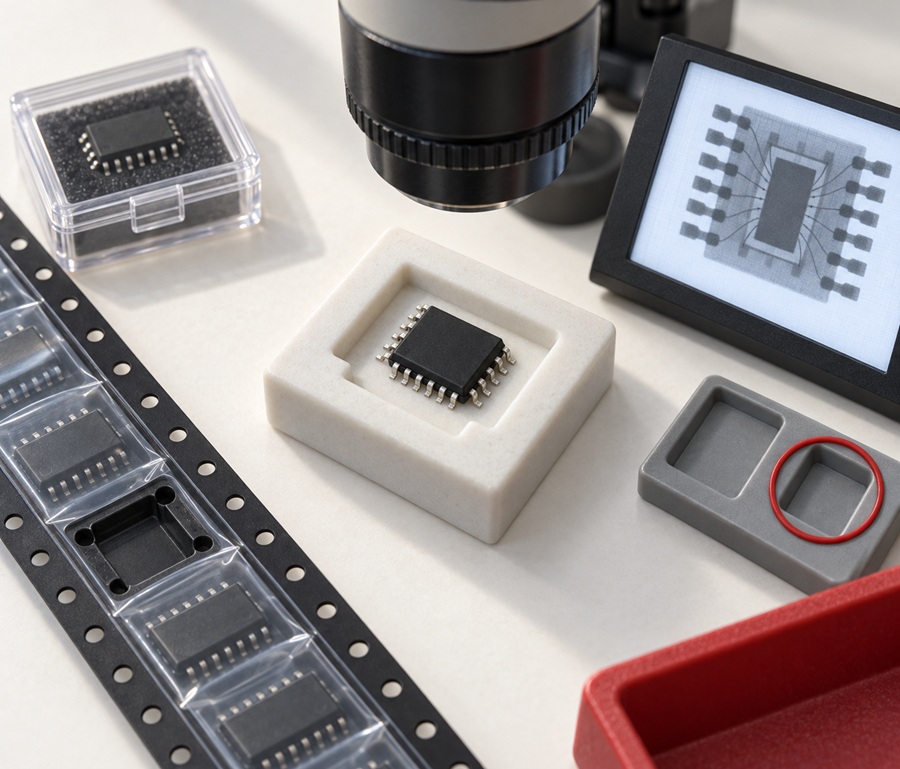
Counterfeit components can hide behind convincing markings and passing basic function tests. This engineering reference covers source traceability, external inspection, X-ray, XRF, electrical testing, …

A practical engineering and sourcing framework covering lifecycle verification, lifetime-buy calculations, replacement qualification, supplier checks and counterfeit-risk controls.

TTL and CMOS logic families differ in thresholds, loading, output drive, power and timing. This engineering guide compares 74HC and 74HCT, calculates noise margins and checks 3.3 V/5 V compatibility.

A practical engineering guide to 3.3V and 5V logic compatibility, input thresholds, resistor dividers, translator ICs, MOSFET level shifting, I2C pull-ups, timing limits and power-sequencing risks.

The 74HC595 uses push-pull logic outputs, while the TPIC6B595 uses 50 V open-drain DMOS sinks for higher-power loads. This guide compares timing, current limits, 3.3 V interfacing, load wiring, thermal…

The 74HC595 converts serial data into eight stable parallel outputs. This guide covers pin functions, shift and storage timing, OE and MR behavior, drive-current limits, cascading, voltage compatibilit…

A technical comparison of level-sensitive latches and edge-triggered flip-flops, covering timing windows, setup and hold limits, master–slave operation, time borrowing, race-through, HDL inference and…

A D latch stores one bit while Enable controls when data can pass. This reference covers gate-level operation, truth tables, transparency, setup and hold timing, LE versus OE, common ICs and practical …

An SR latch stores one bit through cross-coupled feedback. This engineering reference covers NOR and NAND implementations, truth tables, forbidden-state recovery, gated operation, switch debouncing, fa…

Latch circuits retain one bit through feedback. This technical reference covers SR and D latches, truth tables, transparency, timing limits, latch-versus-flip-flop behavior, applications and common log…


