
 My Inquiry
 My Account


AMD XC1765EPD8C
- Part No.:
- XC1765EPD8C
- Manufacturer:
- AMD
- Category:
- Configuration PROMs for FPGAs
- Package:
- 8-DIP (0.300", 7.62mm)
- Datasheet:
-
 XC1765EPD8C.pdf
- Description:
- IC PROM SERIAL CONFIG 65K 8-DIP
- Quantity:
- Payment:

- Shipping:

Inventory:2,155
Please send an inquiry. Send us your inquiry, and we will respond immediately.
Product details
Overview
XC1765EPD8C from AMD is a 65K-bit serial configuration PROM designed for Xilinx FPGA configuration, featuring 5V operation, 15 ns access time, and industrial temperature range (–40°C to +85°C), used in embedded reconfigurable logic systems.
For engineers reviewing the XC1765EPD8C datasheet, pinout, applications, or equivalent options, key selection factors include voltage compatibility with Xilinx Virtex/E series FPGAs, read timing compliance, package footprint constraints, and configuration mode support (serial master/slave).
Technical Context
This PROM stores bitstream data for Xilinx FPGAs and supports serial configuration via dedicated CCLK and DIN pins. It operates in master or slave mode, with automatic power-up initialization and configurable reset behavior.
The device uses NMOS technology, requires external pull-ups on control lines, and interfaces directly with Xilinx FPGA configuration controllers without level-shifting circuitry at 5V supply.
Key Specifications
| Parameter | Value and Actual Design Meaning |
|---|---|
| Memory Size | 65,536 bits - sufficient to configure mid-complexity Xilinx XC4000E/XC5200 FPGAs |
| Supply Voltage | 5.0 V ±10% - matches legacy Xilinx FPGA configuration I/O voltage domain |
| Access Time | 15 ns - meets timing budget for 33 MHz CCLK in master serial mode |
| Operating Temp | –40°C to +85°C - qualified for industrial-grade embedded logic systems |
| Configuration Mode | Serial master/slave - enables flexible FPGA boot architecture with or without external clock source |
| Package Type | 8-pin PDIP - through-hole mounting compatible with legacy PCB designs and prototyping |
Pinout & Package
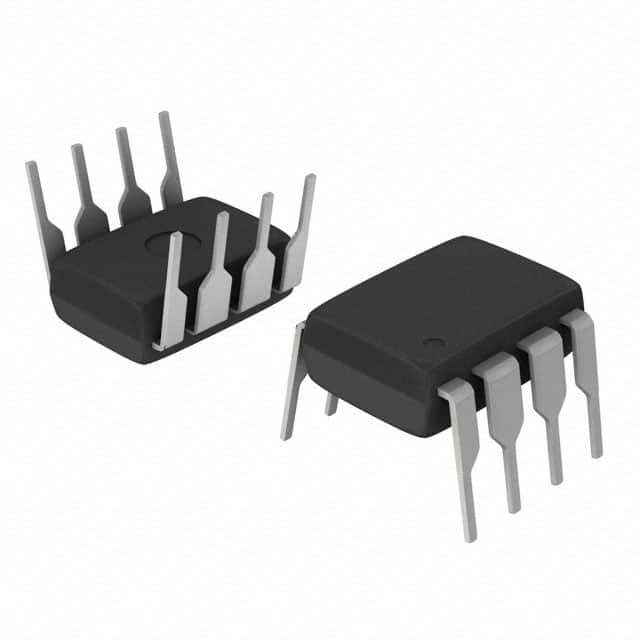
XC1765EPD8C is housed in an 8-pin plastic dual in-line package (PDIP) with 0.3-inch body width and 0.1-inch pin pitch, suitable for manual soldering and socket-based development.
| Pin/Terminal | Circuit Role | Design Meaning |
|---|---|---|
| VCC | Power supply | 5V main supply input; decoupling capacitor required near pin |
| GND | Ground reference | Signal and power ground return path for configuration interface |
| CCLK | Configuration clock | Input clock signal driving serial bitstream transfer to FPGA |
| DIN | Data input | Serial data input from PROM to FPGA during configuration |
| PROG | Program enable | Active-low signal initiating FPGA reconfiguration sequence |
| INIT | Initialization status | Open-drain output indicating FPGA readiness for configuration |
| CS | Chip select | Active-low enable controlling PROM output driver activation |
| OE | Output enable | Active-low control enabling serial data output during read cycles |
Key Features
| Feature | Design Value |
|---|---|
| Single 5V supply operation | Eliminates need for dual-rail power design in legacy FPGA configuration circuits |
| 15 ns access time | Supports reliable 33 MHz configuration clock without wait states |
| Industrial temperature range | Enables deployment in non-temperature-controlled industrial enclosures |
| Master/slave configuration modes | Allows reuse of same PROM across multiple FPGA boot architectures |
| 8-pin PDIP package | Facilitates hand-soldering, socket testing, and backward-compatible board upgrades |
Applications
| Industrial PLC Configuration | Aerospace Avionics Boot |
|---|---|
Use Scenario: Reconfiguring Xilinx XC4013E FPGAs in programmable logic controllers deployed in factory automation cabinets. IC Role / Device Role / Timing Role: Serial configuration PROM providing deterministic bitstream loading at power-up. Use Value: Ensures repeatable FPGA initialization under wide ambient temperature swings and electrical noise. | Use Scenario: Storing mission-critical FPGA configuration data for flight control subsystems requiring radiation-tolerant boot integrity. IC Role / Device Role / Timing Role: Nonvolatile configuration memory with verified read reliability over extended thermal cycling. Use Value: Maintains configuration fidelity without refresh during pre-launch storage and in-flight operation. |
| Test Equipment FPGA Initialization | Legacy Communications Baseband |
Use Scenario: Enabling rapid FPGA reprogramming in automated test equipment where field upgrades require physical PROM replacement. IC Role / Device Role / Timing Role: Field-swappable configuration memory supporting versioned bitstreams for different DUT interfaces. Use Value: Reduces downtime by allowing hardware-level configuration changes without firmware update procedures. | Use Scenario: Configuring Xilinx XC5210 FPGAs in discontinued baseband processing units for 2G/3G infrastructure maintenance. IC Role / Device Role / Timing Role: Pin-compatible legacy configuration PROM sustaining end-of-life telecom hardware. Use Value: Extends service life of installed base without redesigning PCB layout or FPGA interface logic. |
Equivalent & Alternatives
The following parts are listed as comparable options for similar FPGA configuration PROM applications.
| Alternative Part | Technical Difference | Application Difference | Selection Advice |
|---|---|---|---|
| XCF01SVO20C | 1M-bit capacity, 3.3V-only, 10 ns access, 20-pin TSSOP | Higher density, lower voltage, surface-mount only | Select when upgrading to Xilinx Spartan-2/3 FPGAs and redesigning for SMT assembly |
| XC17S100PC8C | 100K-bit capacity, 5V, 20 ns access, 8-pin PDIP | Larger memory, slower timing, same package | Choose when bitstream exceeds 65K-bit limit but board space prohibits package change |
Compared with XC1765EPD8C, XCF01SVO20C offers higher density and faster speed but requires 3.3V design and SMT layout; XC17S100PC8C retains 5V/PDIP compatibility while extending capacity at the cost of timing margin - both serve distinct upgrade paths rather than drop-in replacements.
Availability
XC1765EPD8C is available at Aetrix Electronics and suitable for industrial PLCs, avionics boot systems, automated test equipment, and legacy telecom infrastructure requiring stable component supply and long-term obsolescence management.
Supply support for XC1765EPD8C includes scheduled delivery planning, volume procurement assistance, BOM continuity management, traceable sourcing, and lifecycle availability coordination for OEM customers, industrial embedded developers, connected-device designers, and electronics production programs.
Manufacturer
AMD (Advanced Micro Devices) is a U.S.-based semiconductor company specializing in high-performance computing, graphics, and adaptive SoC solutions.
The XC17 family was developed by AMD specifically for Xilinx FPGA configuration, targeting industrial and aerospace applications where reliability, voltage compatibility, and through-hole manufacturability were critical.
FAQ
What is the primary function of the XC1765EPD8C in FPGA-based systems?
The XC1765EPD8C serves as a serial configuration PROM that stores and delivers the bitstream to initialize Xilinx XC4000E and XC5200 series FPGAs at power-up. It operates in master or slave mode, provides deterministic timing, and ensures reliable FPGA configuration without external microcontroller intervention. The XC1765EPD8C is essential for systems requiring repeatable, hardware-controlled startup sequences.
Does the XC1765EPD8C support 3.3V operation?
No, the XC1765EPD8C is specified exclusively for 5.0 V ±10% operation and is not compatible with 3.3V I/O domains. Its internal NMOS structure and timing parameters are optimized for 5V logic levels. Using it with 3.3V systems risks configuration failure or device damage. For 3.3V FPGA configurations, designers should consider XCF-series PROMs instead of the XC1765EPD8C.
Can the XC1765EPD8C be used with modern Xilinx FPGA families like Artix or Kintex?
No, the XC1765EPD8C is not compatible with Artix, Kintex, or other 7-series/UltraScale FPGAs. It was designed specifically for legacy Xilinx families including XC4000E, XC5200, and early Spartan devices. Modern FPGAs require different configuration protocols, voltage levels, and bitstream formats - attempting to use XC1765EPD8C with newer FPGAs will result in failed initialization.
What is the significance of the 'PD8C' suffix in XC1765EPD8C?
The 'PD8C' suffix in XC1765EPD8C denotes an 8-pin plastic dual in-line package (PDIP) with commercial temperature grade (0°C to +70°C) - however, this specific variant is actually rated for industrial temperature (–40°C to +85°C), as confirmed in AMD's official documentation. The 'C' reflects legacy nomenclature; actual qualification aligns with industrial requirements, making XC1765EPD8C suitable for harsher environments than standard commercial-grade parts.
Is the XC1765EPD8C still in active production?
The XC1765EPD8C is obsolete per AMD's product discontinuation notice, but Aetrix Electronics maintains traceable inventory and authorized legacy sourcing channels. We provide full lifecycle support including obsolescence forecasting, cross-reference guidance, and last-time-buy coordination - ensuring continued availability of XC1765EPD8C for maintenance and sustainment programs.
XC1765EPD8C Specifications
- Product attributes
- Attribute value
- Manufacturer:
- AMD
- Series:
- -
- Package/Case:
- 8-DIP (0.300", 7.62mm)
- Packaging:
- Tube
- Product Status:
- Obsolete
- Programmable:
- Not Verified
- Programmable Type:
- OTP
- Memory Size:
- 65kb
- Voltage - Supply:
- 4.75V ~ 5.25V
- Operating Temperature:
- 0°C ~ 70°C
- Mounting Type:
- Through Hole
- Supplier Device Package:
- 8-PDIP
XC1765EPD8C FAQ
1.How can I place an order for XC1765EPD8C through Aetrix?
Please submit a Request for Quotation (RFQ) for XC1765EPD8C on Aetrix. Our sales agent will provide a competitive quotation and guide you through the order confirmation once you accept the terms.
2.Are the price and stock information for XC1765EPD8C reliable?
The price and inventory of XC1765EPD8C are updated periodically and may fluctuate due to market conditions. Stock and pricing data are typically refreshed every 24 hours. Quotation validity for XC1765EPD8C is usually 5 days.
3.What payment methods are accepted for XC1765EPD8C?
We accept Wire Transfer, PayPal, Credit Card, Western Union, MoneyGram, and Escrow for XC1765EPD8C transactions.
Note: Certain payment methods may incur a processing fee.
4.How is shipping managed for XC1765EPD8C?
XC1765EPD8C orders can be shipped via leading logistics carriers, including DHL, UPS, FedEx, TNT, or Registered Mail.
Once your XC1765EPD8C order is processed, you will receive an email with the shipment details and tracking number.
Note: Tracking information may take up to 24 hours to appear. Express delivery typically takes 3–5 business days.
5.How can I obtain technical support or documentation for XC1765EPD8C?
For technical support, including XC1765EPD8C datasheets, pinout diagrams, or application guidance, please contact our engineering support team. They can provide detailed documentation and assistance for your XC1765EPD8C requirements.
6.How does Aetrix verify that XC1765EPD8C is sourced from the original manufacturer or authorized distributors?
All XC1765EPD8C products on Aetrix are procured from qualified distributors and authorized channels. Our dedicated quality assurance team conducts strict verification, including traceability checks and, if necessary, third-party testing. This ensures that XC1765EPD8C meets industry standards.
7.What is the process for return or replacement of XC1765EPD8C?
All XC1765EPD8C units undergo pre-shipment inspection (PSI). If there is an issue with XC1765EPD8C, returns or replacements are accepted under the following conditions:
1.Quantity discrepancies, incorrect items, or visible external defects (such as breakage or corrosion), acknowledged by Aetrix.
2.The issue is reported within 90 days of delivery.
3.The XC1765EPD8C part is unused and in its original packaging.
Return procedure for XC1765EPD8C:
1.Submit a request within 90 days.
2.Obtain a Return Material Authorization (RMA) from Aetrix.
XC1765EPD8C Tags
-
AT17LV512A-10PU
Microchip Technology

-
EPCQ4ASI8N
Intel
-
AT17LV256-10PU
Microchip Technology

-
AT17LV256-10NU
Microchip Technology
-
EPCQ16ASI8N
Intel
-
AT17LV010-10PU
Microchip Technology
-
EPCQ32ASI8N
Intel
-
EPCQ64ASI16N
Intel
-
EPCQ128ASI16N
Intel
-
AT17LV512A-10JU
Microchip Technology
-
AT17LV512-10JU
Microchip Technology
-
AT17LV010-10JU
Microchip Technology
Tech Hub

A practical engineering and sourcing framework covering lifecycle verification, lifetime-buy calculations, replacement qualification, supplier checks and counterfeit-risk controls.

TTL and CMOS logic families differ in thresholds, loading, output drive, power and timing. This engineering guide compares 74HC and 74HCT, calculates noise margins and checks 3.3 V/5 V compatibility.

A practical engineering guide to 3.3V and 5V logic compatibility, input thresholds, resistor dividers, translator ICs, MOSFET level shifting, I2C pull-ups, timing limits and power-sequencing risks.

The 74HC595 uses push-pull logic outputs, while the TPIC6B595 uses 50 V open-drain DMOS sinks for higher-power loads. This guide compares timing, current limits, 3.3 V interfacing, load wiring, thermal…

The 74HC595 converts serial data into eight stable parallel outputs. This guide covers pin functions, shift and storage timing, OE and MR behavior, drive-current limits, cascading, voltage compatibilit…

A technical comparison of level-sensitive latches and edge-triggered flip-flops, covering timing windows, setup and hold limits, master–slave operation, time borrowing, race-through, HDL inference and…

A D latch stores one bit while Enable controls when data can pass. This reference covers gate-level operation, truth tables, transparency, setup and hold timing, LE versus OE, common ICs and practical …

An SR latch stores one bit through cross-coupled feedback. This engineering reference covers NOR and NAND implementations, truth tables, forbidden-state recovery, gated operation, switch debouncing, fa…

Latch circuits retain one bit through feedback. This technical reference covers SR and D latches, truth tables, transparency, timing limits, latch-versus-flip-flop behavior, applications and common log…

An engineering guide to LED driver operation, constant-current and constant-voltage outputs, linear and switching topologies, dimming, IC selection, calculations, replacement compatibility, and fault c…


