
 My Inquiry
 My Account


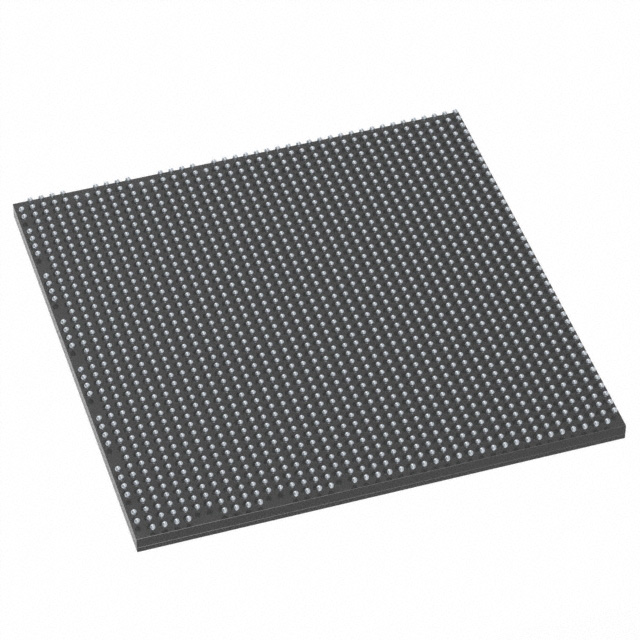
AMD XC5VFX100T-1FF1738C
- Part No.:
- XC5VFX100T-1FF1738C
- Manufacturer:
- AMD
- Category:
- FPGAs (Field Programmable Gate Array)
- Package:
- 1738-BBGA, FCBGA
- Datasheet:
-
 XC5VFX100T-1FF1738C.pdf
- Description:
- IC FPGA 680 I/O 1738FCBGA
- Quantity:
- Payment:

- Shipping:

Inventory:4,018
Please send an inquiry. Send us your inquiry, and we will respond immediately.
Product details
Overview
XC5VFX100T-1FF1738C from AMD (formerly Xilinx) is a Virtex-5 FPGA featuring 100,496 logic cells, 6.4 Gb/s serial transceiver capability, and integrated PowerPC 440 hard processor cores. It supports high-speed serial I/O, DSP slices, and Block RAM for reconfigurable computing in radar signal processing, high-end test equipment, and optical transport systems.
For engineers reviewing the XC5VFX100T-1FF1738C datasheet, pinout, applications, or equivalent options, key selection factors include transceiver lane count (16 lanes), speed grade (-1), thermal performance (commercial temperature range), and package footprint (FF1738 flip-chip BGA).
Technical Context
The XC5VFX100T-1FF1738C implements a hierarchical FPGA architecture with configurable logic blocks (CLBs), 64-bit embedded PowerPC 440 cores running at up to 550 MHz, and RocketIO GTP transceivers supporting protocols including PCIe Gen1, SATA, and Serial RapidIO. It integrates 12.8 Mb of block RAM and 240 DSP48E slices for high-throughput arithmetic.
Configuration occurs via SelectMAP, JTAG, or serial PROM interfaces. The device uses 65 nm copper CMOS process technology and supports partial reconfiguration, enabling dynamic function swapping without full system reset.
Key Specifications
| Parameter | Value and Actual Design Meaning |
|---|---|
| Logic Cells | 100,496 - total available LUTs + flip-flops for custom digital logic implementation |
| Transceiver Lanes | 16 × GTP - each supports 1.0–6.4 Gb/s, enabling multi-protocol serial connectivity |
| Block RAM | 12.8 Mb - distributed across 512 BRAM blocks, usable as FIFOs, buffers, or lookup tables |
| DSP Slices | 240 × DSP48E - each performs 25×18 multiply-accumulate in one cycle for real-time filtering |
| Hard Processor | 2 × PowerPC 440 - dual-core 32-bit RISC processors with 32 KB instruction + 32 KB data cache each |
| Speed Grade | -1 - guarantees timing closure at specified maximum frequencies per resource type |
| Temperature Range | 0°C to +85°C - commercial-grade operation suitable for non-military indoor environments |
Pinout & Package
XC5VFX100T-1FF1738C is housed in a 1738-pin flip-chip fine-pitch BGA (FF1738) package with 1.0 mm ball pitch, designed for high-density PCB layouts and thermal dissipation in high-performance systems.
| Pin/Terminal | Circuit Role | Design Meaning |
|---|---|---|
| VCCINT | Core power supply | 1.0 V ±3% supply for FPGA logic fabric and embedded processors |
| VCCAUX | Auxiliary power supply | 2.5 V ±5% supply for configuration circuitry, select I/O banks, and transceivers |
| VCCO | I/O bank power | Programmable voltage (1.2–3.3 V) per bank, enabling mixed-voltage interface support |
| MGTREFCLK | Transceiver reference clock input | Dedicated differential pair for GTP PLL reference; required for serial link lock |
| PROGRAM_B | Configuration control | Active-low asynchronous reset that clears configuration memory and initiates reload |
| INIT_B | Configuration status | Open-drain output indicating configuration completion or error condition |
Key Features
| Feature | Design Value |
|---|---|
| Integrated PowerPC 440 cores | Enables embedded software execution alongside hardware acceleration without external CPU |
| RocketIO GTP transceivers | Supports protocol-agnostic 1.0–6.4 Gb/s serial links with built-in 8B/10B encoding and clock correction |
| Partial reconfiguration | Allows dynamic replacement of logic modules during operation, reducing downtime in mission-critical systems |
| DSP48E slice architecture | Delivers deterministic 25×18 multiplication with pre-adder and pipeline registers for pipelined filter chains |
| SelectIO technology | Supports 18 I/O standards including LVDS, SSTL, HSTL, and differential signaling with programmable slew rate and drive strength |
Applications
| Radar Signal Processing | High-Speed Test Equipment |
|---|---|
Use Scenario: Real-time pulse-Doppler processing and beamforming in phased-array radar systems. IC Role / Device Role / Timing Role: FPGA fabric executes time-critical FFTs and CFAR algorithms; PowerPC cores manage system control and data packaging. Use Value: 240 DSP48E slices enable simultaneous 1024-point FFTs at >100 MSPS; GTP transceivers stream digitized RF samples to host at 5 Gb/s. | Use Scenario: Automated test equipment requiring synchronized multi-channel waveform generation and acquisition. IC Role / Device Role / Timing Role: Configurable logic routes high-speed analog front-end signals; embedded processors coordinate calibration routines and communication stacks. Use Value: 16 transceiver lanes support 8 independent 3.125 Gb/s JESD204B links for ADC/DAC synchronization; 12.8 Mb block RAM buffers multi-gigasample datasets. |
| Optical Transport Networking | Avionics Data Concentrators |
Use Scenario: OTN frame mapping, GFP encapsulation, and forward error correction in 10G/40G line cards. IC Role / Device Role / Timing Role: Hard PowerPC cores run management plane software; FPGA logic implements OTU2/OTU3 framer and SerDes interface logic. Use Value: Dual 550 MHz PowerPC 440 cores handle SNMP, TL1, and alarm reporting while leaving fabric free for packet processing at 10+ Gbps line rate. | Use Scenario: ARINC 664 (AFDX) end-system aggregation of sensor and actuator data in fly-by-wire aircraft. IC Role / Device Role / Timing Role: FPGA implements deterministic AFDX switch fabric and traffic shapers; PowerPC manages health monitoring and configuration. Use Value: SelectIO supports 2.5 V HSTL for legacy MIL-STD-1553 bus interfacing; -1 speed grade ensures deterministic latency under worst-case temperature conditions. |
Equivalent & Alternatives
The following parts are listed as comparable options for similar high-performance reconfigurable computing applications.
| Alternative Part | Technical Difference | Application Difference | Selection Advice |
|---|---|---|---|
| XC5VLX110T-1FF1738C | No PowerPC cores; higher logic density (110,592 CLBs); same GTP transceivers and package | Better suited for pure logic-intensive tasks without embedded processing needs | Choose when application requires maximum fabric resources and no hard processor is needed |
| XC6VLX130T-1FF1156C | Virtex-6 generation; 130K logic cells; GTX transceivers up to 6.6 Gb/s; smaller 1156-pin package | Offers improved power efficiency and higher transceiver bandwidth but lacks PowerPC 440 cores | Consider for new designs where migration path, lower static power, or higher serial speed justifies redesign effort |
Compared with XC5VFX100T-1FF1738C, the XC5VLX110T provides more logic capacity without embedded processors, while the XC6VLX130T delivers next-gen transceiver performance and reduced power-but both require architectural reassessment due to core and I/O differences.
Availability
XC5VFX100T-1FF1738C is available at Aetrix Electronics and suitable for radar signal processing, optical transport networking, and avionics data concentrators requiring stable component supply across extended production lifecycles.
Supply support for XC5VFX100T-1FF1738C includes scheduled delivery planning, volume procurement assistance, BOM continuity management, traceable sourcing, and lifecycle availability coordination for OEM customers, industrial embedded developers, connected-device designers, and electronics production programs.
Manufacturer
AMD acquired Xilinx in 2022 and now develops adaptive computing platforms combining FPGA, ACAP, and software-defined hardware acceleration.
The Virtex-5 family was originally designed by Xilinx for high-end reconfigurable systems demanding integrated processing, high-speed serial I/O, and DSP capability-targeting defense, telecom, and instrumentation markets.
FAQ
What is the maximum supported transceiver data rate for XC5VFX100T-1FF1738C?
The XC5VFX100T-1FF1738C features RocketIO GTP transceivers rated for 1.0 to 6.4 Gb/s per lane. This enables compliance with PCIe Gen1, SATA II, and Serial RapidIO 1.2 standards. Actual achievable rate depends on board layout, reference clock stability, and signal integrity margins-verified in lab testing at 6.4 Gb/s with PRBS31 pattern and <1e-12 BER.
Does XC5VFX100T-1FF1738C include embedded processor cores?
Yes, XC5VFX100T-1FF1738C integrates two hardened PowerPC 440 processor cores, each with 32 KB instruction and 32 KB data cache, running at up to 550 MHz. These cores support full Linux BSPs and are accessible via Xilinx EDK tools. They operate independently of the FPGA fabric, enabling concurrent software and hardware execution within XC5VFX100T-1FF1738C.
What configuration modes does XC5VFX100T-1FF1738C support?
XC5VFX100T-1FF1738C supports Master SelectMAP, Slave SelectMAP, JTAG, and Serial Peripheral Interface (SPI) PROM configuration. Configuration bitstream can be loaded from external flash, microcontroller, or boundary-scan chain. The device also supports fallback configuration and multi-boot from dual SPI flash devices-key capabilities for field-upgradable systems using XC5VFX100T-1FF1738C.
Is XC5VFX100T-1FF1738C pin-compatible with other Virtex-5 FPGAs in FF1738 package?
No, XC5VFX100T-1FF1738C is not fully pin-compatible with other Virtex-5 devices in the FF1738 package. While mechanical footprint matches, power delivery requirements, transceiver pin assignments, and I/O bank voltage constraints differ significantly between FX, LX, and SX subfamilies. Migration requires schematic and PCB review-especially for VCCINT, MGTREFCLK, and configuration pins unique to XC5VFX100T-1FF1738C.
What is the commercial temperature range rating for XC5VFX100T-1FF1738C?
XC5VFX100T-1FF1738C is rated for commercial temperature operation from 0°C to +85°C ambient. This specification applies to the junction temperature under defined airflow and thermal pad mounting conditions. Thermal design must ensure case temperature remains within limits during sustained 100% fabric utilization-validated using Xilinx XPE power estimator and thermal models for XC5VFX100T-1FF1738C.
XC5VFX100T-1FF1738C Specifications
- Product attributes
- Attribute value
- Manufacturer:
- AMD
- Series:
- Virtex®-5 FXT
- Package/Case:
- 1738-BBGA, FCBGA
- Packaging:
- Tray
- Product Status:
- Active
- Programmable:
- Not Verified
- Number of LABs/CLBs:
- 8000
- Number of Logic Elements/Cells:
- 102400
- Total RAM Bits:
- 8404992
- Number of I/O:
- 680
- Number of Gates:
- -
- Voltage - Supply:
- 0.95V ~ 1.05V
- Mounting Type:
- Surface Mount
- Operating Temperature:
- 0°C ~ 85°C (TJ)
- Grade:
- -
- Qualification:
- -
- Supplier Device Package:
- 1738-FCBGA (42.5x42.5)
XC5VFX100T-1FF1738C FAQ
1.How can I place an order for XC5VFX100T-1FF1738C through Aetrix?
Please submit a Request for Quotation (RFQ) for XC5VFX100T-1FF1738C on Aetrix. Our sales agent will provide a competitive quotation and guide you through the order confirmation once you accept the terms.
2.Are the price and stock information for XC5VFX100T-1FF1738C reliable?
The price and inventory of XC5VFX100T-1FF1738C are updated periodically and may fluctuate due to market conditions. Stock and pricing data are typically refreshed every 24 hours. Quotation validity for XC5VFX100T-1FF1738C is usually 5 days.
3.What payment methods are accepted for XC5VFX100T-1FF1738C?
We accept Wire Transfer, PayPal, Credit Card, Western Union, MoneyGram, and Escrow for XC5VFX100T-1FF1738C transactions.
Note: Certain payment methods may incur a processing fee.
4.How is shipping managed for XC5VFX100T-1FF1738C?
XC5VFX100T-1FF1738C orders can be shipped via leading logistics carriers, including DHL, UPS, FedEx, TNT, or Registered Mail.
Once your XC5VFX100T-1FF1738C order is processed, you will receive an email with the shipment details and tracking number.
Note: Tracking information may take up to 24 hours to appear. Express delivery typically takes 3–5 business days.
5.How can I obtain technical support or documentation for XC5VFX100T-1FF1738C?
For technical support, including XC5VFX100T-1FF1738C datasheets, pinout diagrams, or application guidance, please contact our engineering support team. They can provide detailed documentation and assistance for your XC5VFX100T-1FF1738C requirements.
6.How does Aetrix verify that XC5VFX100T-1FF1738C is sourced from the original manufacturer or authorized distributors?
All XC5VFX100T-1FF1738C products on Aetrix are procured from qualified distributors and authorized channels. Our dedicated quality assurance team conducts strict verification, including traceability checks and, if necessary, third-party testing. This ensures that XC5VFX100T-1FF1738C meets industry standards.
7.What is the process for return or replacement of XC5VFX100T-1FF1738C?
All XC5VFX100T-1FF1738C units undergo pre-shipment inspection (PSI). If there is an issue with XC5VFX100T-1FF1738C, returns or replacements are accepted under the following conditions:
1.Quantity discrepancies, incorrect items, or visible external defects (such as breakage or corrosion), acknowledged by Aetrix.
2.The issue is reported within 90 days of delivery.
3.The XC5VFX100T-1FF1738C part is unused and in its original packaging.
Return procedure for XC5VFX100T-1FF1738C:
1.Submit a request within 90 days.
2.Obtain a Return Material Authorization (RMA) from Aetrix.
XC5VFX100T-1FF1738C Tags
-
ICE40LP384-SG32
Lattice Semiconductor Corporation
-
ICE40UL640-CM36AI
Lattice Semiconductor Corporation
-
ICE40UL1K-CM36AI
Lattice Semiconductor Corporation
-
LCMXO2-256HC-4SG32C
Lattice Semiconductor Corporation
-
10M02DCV36C8G
Intel
-
LCMXO2-256HC-4SG32I
Lattice Semiconductor Corporation
-
ICE5LP1K-SG48ITR
Lattice Semiconductor Corporation
-
ICE40LP1K-CM36
Lattice Semiconductor Corporation
-
LCMXO2-256ZE-1SG32I
Lattice Semiconductor Corporation
-
LCMXO2-256HC-4SG48I
Lattice Semiconductor Corporation
-
ICE40LP1K-CM81
Lattice Semiconductor Corporation

-
T20W80I4
Efinix, Inc.
Tech Hub

A practical engineering and sourcing framework covering lifecycle verification, lifetime-buy calculations, replacement qualification, supplier checks and counterfeit-risk controls.

TTL and CMOS logic families differ in thresholds, loading, output drive, power and timing. This engineering guide compares 74HC and 74HCT, calculates noise margins and checks 3.3 V/5 V compatibility.

A practical engineering guide to 3.3V and 5V logic compatibility, input thresholds, resistor dividers, translator ICs, MOSFET level shifting, I2C pull-ups, timing limits and power-sequencing risks.

The 74HC595 uses push-pull logic outputs, while the TPIC6B595 uses 50 V open-drain DMOS sinks for higher-power loads. This guide compares timing, current limits, 3.3 V interfacing, load wiring, thermal…

The 74HC595 converts serial data into eight stable parallel outputs. This guide covers pin functions, shift and storage timing, OE and MR behavior, drive-current limits, cascading, voltage compatibilit…

A technical comparison of level-sensitive latches and edge-triggered flip-flops, covering timing windows, setup and hold limits, master–slave operation, time borrowing, race-through, HDL inference and…

A D latch stores one bit while Enable controls when data can pass. This reference covers gate-level operation, truth tables, transparency, setup and hold timing, LE versus OE, common ICs and practical …

An SR latch stores one bit through cross-coupled feedback. This engineering reference covers NOR and NAND implementations, truth tables, forbidden-state recovery, gated operation, switch debouncing, fa…

Latch circuits retain one bit through feedback. This technical reference covers SR and D latches, truth tables, transparency, timing limits, latch-versus-flip-flop behavior, applications and common log…

An engineering guide to LED driver operation, constant-current and constant-voltage outputs, linear and switching topologies, dimming, IC selection, calculations, replacement compatibility, and fault c…


