
 My Inquiry
 My Account


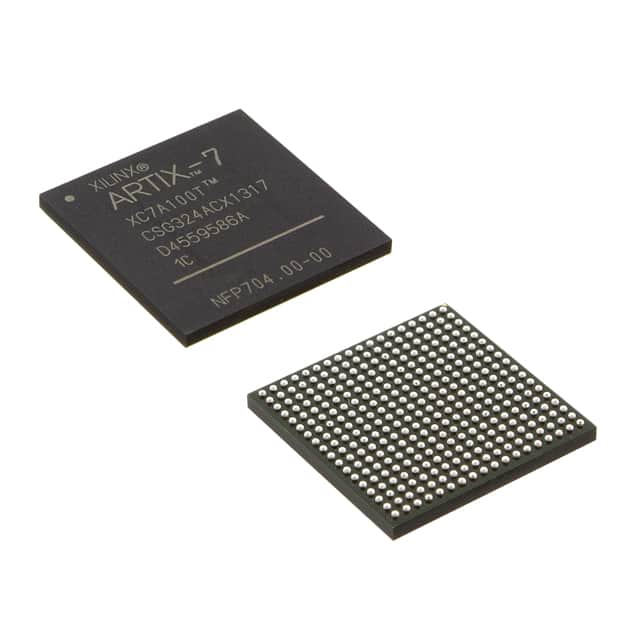
AMD XC7A50T-2CSG324I
- Part No.:
- XC7A50T-2CSG324I
- Manufacturer:
- AMD
- Category:
- FPGAs (Field Programmable Gate Array)
- Package:
- 324-LFBGA, CSPBGA
- Datasheet:
-
 XC7A50T-2CSG324I.pdf
- Description:
- IC FPGA 210 I/O 324CSBGA
- Quantity:
- Payment:

- Shipping:

Inventory:120
Please send an inquiry. Send us your inquiry, and we will respond immediately.
Product details
Overview
XC7A50T-2CSG324I from AMD is a Kintex-7 family FPGA with 49,600 logic cells, 2.55 Gbps transceiver capability, and -2 speed grade, designed for high-performance embedded vision and industrial Ethernet applications.
For engineers reviewing the XC7A50T-2CSG324I datasheet, pinout, applications, or equivalent options, key selection factors include I/O count (210 user I/Os), package thermal performance (CSG324), transceiver compliance (PCIe Gen2, SATA, CPRI), and configuration interface support (SPIx4, SelectMAP).
Technical Context
The XC7A50T-2CSG324I integrates 49,600 Logic Cells, 240 DSP slices, and 2.5 MB of block RAM. It supports 24 transceivers operating up to 2.55 Gbps with built-in 8B/10B encoding and PRBS generation.
Configuration is performed via Master SPI or SelectMAP interfaces with AES-256 bitstream encryption. The device uses 28 nm HKMG process technology and operates over industrial temperature range (–40°C to +100°C junction).
Key Specifications
| Parameter | Value and Actual Design Meaning |
|---|---|
| Logic Cells | 49,600 - determines maximum combinational/sequential logic capacity for HDL implementation |
| User I/O Pins | 210 - supports high-density parallel bus interfaces and multi-protocol I/O banking |
| Transceiver Speed | 2.55 Gbps - enables PCIe Gen2 x1, SATA II, and CPRI v6.0 physical layer operation |
| Block RAM | 2.5 MB - provides on-chip memory for FIFOs, frame buffers, and lookup tables without external DRAM |
| DSP Slices | 240 - delivers 18×25-bit multiply-accumulate throughput for real-time filtering and FFT processing |
| Speed Grade | -2 - guarantees timing closure at highest operating frequency for critical paths in industrial designs |
Pinout & Package
The XC7A50T-2CSG324I is housed in a 324-pin CSG (Chip Scale Grid Array) package with 1.0 mm pitch, optimized for thermal dissipation and board-level reliability in industrial environments.
| Pin/Terminal | Circuit Role | Design Meaning |
|---|---|---|
| VCCINT | Core power supply | 1.0V ±3% supply for FPGA fabric and CLBs; requires low-noise regulation |
| VCCAUX | Auxiliary power supply | 1.8V supply for configuration logic, transceivers, and clock management tiles |
| M0–M2 | Mode configuration pins | Determine boot mode (SPI, BPI, or SelectMAP) at power-up |
| CCLK | Configuration clock | Drives internal configuration shift register during master SPI programming |
| INIT_B | Configuration status | Active-low open-drain signal indicating configuration completion or error |
Key Features
| Feature | Design Value |
|---|---|
| 24 integrated transceivers | Enables multi-protocol serial connectivity (PCIe Gen2, SATA, CPRI) without external PHYs |
| AES-256 bitstream encryption | Protects intellectual property against reverse engineering and unauthorized cloning |
| Multi-voltage I/O banks | Supports concurrent LVCMOS, SSTL, HSTL, and differential signaling standards on same device |
| Integrated clock management (MMCM/PLL) | Provides jitter cleaning, frequency synthesis, and phase alignment across multiple clock domains |
| Industrial temperature rating | Guarantees reliable operation from –40°C to +100°C junction temperature |
Applications
| Machine Vision System | Industrial Ethernet Gateway |
|---|---|
Use Scenario: Real-time image preprocessing and feature extraction in factory-floor inspection systems. IC Role / Device Role / Timing Role: FPGA fabric implements pixel pipeline, histogram equalization, and edge detection; transceivers interface with GigE Vision cameras. Use Value: XC7A50T-2CSG324I delivers deterministic latency and parallel processing for sub-20ms frame analysis cycles. | Use Scenario: Protocol translation between PROFINET RT and EtherNet/IP in PLC backplanes. IC Role / Device Role / Timing Role: XC7A50T-2CSG324I hosts dual MACs, time-synchronized packet buffering, and fieldbus-specific state machines. Use Value: XC7A50T-2CSG324I supports <1 µs cycle jitter required for motion control synchronization. |
| Medical Imaging Interface | Test & Measurement Equipment |
Use Scenario: High-speed data aggregation from ultrasound beamformers and ADC arrays. IC Role / Device Role / Timing Role: XC7A50T-2CSG324I manages JESD204B subclass 1 links and performs real-time digital beamforming. Use Value: XC7A50T-2CSG324I achieves 2.55 Gbps per lane with deterministic lane alignment for coherent sampling. | Use Scenario: Modular signal generation and analysis in PXIe-based ATE platforms. IC Role / Device Role / Timing Role: XC7A50T-2CSG324I implements arbitrary waveform synthesis, pattern matching, and timestamped trigger routing. Use Value: XC7A50T-2CSG324I provides 210 user I/Os and 240 DSP slices for simultaneous multi-channel RF stimulus/response handling. |
Equivalent & Alternatives
The following parts are listed as comparable options for similar FPGA-based system integration applications.
| Alternative Part | Technical Difference | Application Difference | Selection Advice |
|---|---|---|---|
| XC7A75T-2CSG324I | 74,900 logic cells, same package and speed grade | Higher gate count supports larger protocol stacks and dual-camera fusion | Select when additional LUTs and DSP slices are needed without changing PCB layout |
| XC7A35T-2CSG324I | 33,280 logic cells, identical I/O count and transceiver spec | Lower cost point for single-protocol edge devices with reduced algorithm complexity | Choose when design fits within 33K LUTs and budget constraints dominate |
Compared with XC7A75T-2CSG324I and XC7A35T-2CSG324I, the XC7A50T-2CSG324I offers balanced logic density, transceiver count, and thermal profile-making it optimal for mid-tier industrial vision and communication gateway designs where cost, performance, and footprint must be tightly aligned.
Availability
XC7A50T-2CSG324I is available at Aetrix Electronics and suitable for industrial automation, embedded vision, and test equipment requiring stable component supply across extended product lifecycles.
Supply support for XC7A50T-2CSG324I includes scheduled delivery planning, volume procurement assistance, BOM continuity management, traceable sourcing, and lifecycle availability coordination for OEM customers, industrial embedded developers, connected-device designers, and electronics production programs.
Manufacturer
AMD is a global semiconductor leader delivering adaptive computing solutions for data center, embedded, and client markets.
The Kintex-7 FPGA family targets high-performance, cost-sensitive applications demanding transceiver integration, DSP capability, and industrial reliability-especially in vision, communications, and instrumentation.
FAQ
What is the maximum transceiver data rate supported by XC7A50T-2CSG324I?
The XC7A50T-2CSG324I supports transceiver line rates up to 2.55 Gbps per lane. This enables compliance with PCIe Gen2, SATA II, and CPRI v6.0 standards. The transceivers include built-in 8B/10B encoding, PRBS generators, and clock-data recovery circuits. All 24 transceivers in the XC7A50T-2CSG324I operate within this specification under industrial temperature conditions.
Does XC7A50T-2CSG324I support AES-256 bitstream encryption?
Yes, XC7A50T-2CSG324I includes hardware-accelerated AES-256 bitstream encryption for secure configuration. This feature protects FPGA design IP from unauthorized readback or cloning. Encryption keys are stored in on-chip eFUSE and require proper key programming during bitstream generation. The XC7A50T-2CSG324I implements this security mechanism without external components or firmware overhead.
What I/O standards are supported by XC7A50T-2CSG324I?
XC7A50T-2CSG324I supports multiple I/O standards across its 12 configurable I/O banks, including LVCMOS (1.2V–3.3V), SSTL (I/II), HSTL (I/II), and differential standards such as LVDS, TMDS, and RSDS. Each bank operates independently at its assigned voltage. The XC7A50T-2CSG324I allows mixed-voltage operation on a single device, enabling direct interfacing with diverse peripherals without level-shifting circuitry.
What is the operating temperature range for XC7A50T-2CSG324I?
The XC7A50T-2CSG324I is rated for industrial temperature operation with a junction temperature range of –40°C to +100°C. This rating is validated per AMD's qualification testing and applies to the full speed grade (-2) performance specification. Thermal design must maintain junction temperature within this range using appropriate PCB copper area, heatsinking, and airflow. The XC7A50T-2CSG324I maintains timing closure and functional integrity across this entire range.
How many block RAM resources does XC7A50T-2CSG324I provide?
XC7A50T-2CSG324I contains 2.5 MB of total block RAM, implemented as 36 Kb BRAM primitives. These resources are distributed across the FPGA fabric and support true dual-port operation, byte-write enable, and parity generation. Block RAM in the XC7A50T-2CSG324I is used for on-chip buffering, FIFOs, coefficient storage, and lookup tables-eliminating need for external memory in many real-time signal processing applications.
XC7A50T-2CSG324I Specifications
- Product attributes
- Attribute value
- Manufacturer:
- AMD
- Series:
- Artix-7
- Package/Case:
- 324-LFBGA, CSPBGA
- Packaging:
- Tray
- Product Status:
- Active
- Programmable:
- Not Verified
- Number of LABs/CLBs:
- 4075
- Number of Logic Elements/Cells:
- 52160
- Total RAM Bits:
- 2764800
- Number of I/O:
- 210
- Number of Gates:
- -
- Voltage - Supply:
- 0.95V ~ 1.05V
- Mounting Type:
- Surface Mount
- Operating Temperature:
- -40°C ~ 100°C (TJ)
- Grade:
- -
- Qualification:
- -
- Supplier Device Package:
- 324-CSPBGA (15x15)
XC7A50T-2CSG324I FAQ
1.How can I place an order for XC7A50T-2CSG324I through Aetrix?
Please submit a Request for Quotation (RFQ) for XC7A50T-2CSG324I on Aetrix. Our sales agent will provide a competitive quotation and guide you through the order confirmation once you accept the terms.
2.Are the price and stock information for XC7A50T-2CSG324I reliable?
The price and inventory of XC7A50T-2CSG324I are updated periodically and may fluctuate due to market conditions. Stock and pricing data are typically refreshed every 24 hours. Quotation validity for XC7A50T-2CSG324I is usually 5 days.
3.What payment methods are accepted for XC7A50T-2CSG324I?
We accept Wire Transfer, PayPal, Credit Card, Western Union, MoneyGram, and Escrow for XC7A50T-2CSG324I transactions.
Note: Certain payment methods may incur a processing fee.
4.How is shipping managed for XC7A50T-2CSG324I?
XC7A50T-2CSG324I orders can be shipped via leading logistics carriers, including DHL, UPS, FedEx, TNT, or Registered Mail.
Once your XC7A50T-2CSG324I order is processed, you will receive an email with the shipment details and tracking number.
Note: Tracking information may take up to 24 hours to appear. Express delivery typically takes 3–5 business days.
5.How can I obtain technical support or documentation for XC7A50T-2CSG324I?
For technical support, including XC7A50T-2CSG324I datasheets, pinout diagrams, or application guidance, please contact our engineering support team. They can provide detailed documentation and assistance for your XC7A50T-2CSG324I requirements.
6.How does Aetrix verify that XC7A50T-2CSG324I is sourced from the original manufacturer or authorized distributors?
All XC7A50T-2CSG324I products on Aetrix are procured from qualified distributors and authorized channels. Our dedicated quality assurance team conducts strict verification, including traceability checks and, if necessary, third-party testing. This ensures that XC7A50T-2CSG324I meets industry standards.
7.What is the process for return or replacement of XC7A50T-2CSG324I?
All XC7A50T-2CSG324I units undergo pre-shipment inspection (PSI). If there is an issue with XC7A50T-2CSG324I, returns or replacements are accepted under the following conditions:
1.Quantity discrepancies, incorrect items, or visible external defects (such as breakage or corrosion), acknowledged by Aetrix.
2.The issue is reported within 90 days of delivery.
3.The XC7A50T-2CSG324I part is unused and in its original packaging.
Return procedure for XC7A50T-2CSG324I:
1.Submit a request within 90 days.
2.Obtain a Return Material Authorization (RMA) from Aetrix.
XC7A50T-2CSG324I Tags
-
ICE40LP384-SG32
Lattice Semiconductor Corporation
-
ICE40UL640-CM36AI
Lattice Semiconductor Corporation
-
ICE40UL1K-CM36AI
Lattice Semiconductor Corporation
-
LCMXO2-256HC-4SG32C
Lattice Semiconductor Corporation
-
10M02DCV36C8G
Intel
-
LCMXO2-256HC-4SG32I
Lattice Semiconductor Corporation
-
ICE5LP1K-SG48ITR
Lattice Semiconductor Corporation
-
ICE40LP1K-CM36
Lattice Semiconductor Corporation
-
LCMXO2-256ZE-1SG32I
Lattice Semiconductor Corporation
-
LCMXO2-256HC-4SG48I
Lattice Semiconductor Corporation
-
ICE40LP1K-CM81
Lattice Semiconductor Corporation

-
T20W80I4
Efinix, Inc.
Tech Hub

A practical engineering and sourcing framework covering lifecycle verification, lifetime-buy calculations, replacement qualification, supplier checks and counterfeit-risk controls.

TTL and CMOS logic families differ in thresholds, loading, output drive, power and timing. This engineering guide compares 74HC and 74HCT, calculates noise margins and checks 3.3 V/5 V compatibility.

A practical engineering guide to 3.3V and 5V logic compatibility, input thresholds, resistor dividers, translator ICs, MOSFET level shifting, I2C pull-ups, timing limits and power-sequencing risks.

The 74HC595 uses push-pull logic outputs, while the TPIC6B595 uses 50 V open-drain DMOS sinks for higher-power loads. This guide compares timing, current limits, 3.3 V interfacing, load wiring, thermal…

The 74HC595 converts serial data into eight stable parallel outputs. This guide covers pin functions, shift and storage timing, OE and MR behavior, drive-current limits, cascading, voltage compatibilit…

A technical comparison of level-sensitive latches and edge-triggered flip-flops, covering timing windows, setup and hold limits, master–slave operation, time borrowing, race-through, HDL inference and…

A D latch stores one bit while Enable controls when data can pass. This reference covers gate-level operation, truth tables, transparency, setup and hold timing, LE versus OE, common ICs and practical …

An SR latch stores one bit through cross-coupled feedback. This engineering reference covers NOR and NAND implementations, truth tables, forbidden-state recovery, gated operation, switch debouncing, fa…

Latch circuits retain one bit through feedback. This technical reference covers SR and D latches, truth tables, transparency, timing limits, latch-versus-flip-flop behavior, applications and common log…

An engineering guide to LED driver operation, constant-current and constant-voltage outputs, linear and switching topologies, dimming, IC selection, calculations, replacement compatibility, and fault c…


