
 My Inquiry
 My Account


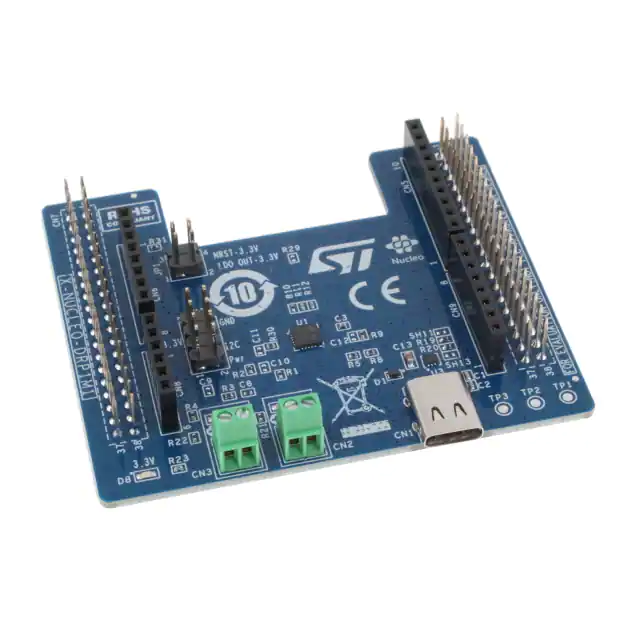
STMicroelectronics X-NUCLEO-DRP1M1
- Part No.:
- X-NUCLEO-DRP1M1
- Manufacturer:
- STMicroelectronics
- Category:
- Expansion Boards, Daughter Cards
- Package:
- Datasheet:
-
 X-NUCLEO-DRP1M1.pdf
- Description:
- X-NUCLEO-DRP1M1
- Quantity:
- Payment:

- Shipping:

Inventory:2,976
Please send an inquiry. Send us your inquiry, and we will respond immediately.
Product details
Overview
X-NUCLEO-DRP1M1 from STMicroelectronics is a USB Type-C™ Power Delivery dual-role power (DRP) and dual-role data (DRD) expansion board based on the TCPP03-M20 transceiver, designed for stacking on STM32 Nucleo-64 boards with UCPD peripherals. It supports 100 W SPR profiles, PPS compliance, USB-IF certification (ID 6408), and integrates ST715PU33R LDO for dead-battery operation.
For engineers reviewing the X-NUCLEO-DRP1M1 datasheet, X-NUCLEO-DRP1M1 pinout, X-NUCLEO-DRP1M1 application, or X-NUCLEO-DRP1M1 equivalent, this board enables rapid validation of DRP/DRD behavior, VBUS/CC line protection (8/20 µs surge, ±8 kV ESD), I²C-configurable power role switching, and sink/source/data handshaking in real USB-C PD ecosystems.
Technical Context
The board implements full USB Type-C™ 2.1 and Power Delivery 3.1 SPR functionality using the TCPP03-M20 companion chip, which handles CC logic, VBUS sensing (0–22 V range), current monitoring (Isense), and fault signaling via FLGn. It interfaces with host STM32 MCUs through I²C (SCL/SDA), GPIO (ENABLE, SOURCE, SINK, FLGN), and ADC channels (ADC_VBUSc, ADC_Isense, ADC_Prov, ADC_Cons).
Three configurable power modes (active, low-power, shutdown) optimize system current draw, while integrated protections include short-to-VBUS on CC pins, overvoltage/overcurrent on VBUS and VCONN, and common-mode filtering on D+/D− lines per USB 2.0 signal integrity requirements.
Key Specifications
| Parameter | Value and Actual Design Meaning |
|---|---|
| Power Delivery Profile | USB PD 3.1 Standard Power Range (SPR) up to 100 W; supports Programmable Power Supply (PPS) |
| USB-IF Certification | Test ID 6408; certified for DRP operation including dead-battery sink and source negotiation |
| VBUS Protection | 8/20 µs surge rating; overvoltage clamp up to 22 V; discharge path for safe hot-plug |
| ESD Rating | IEC 61000-4-2 Level 4: ±8 kV contact discharge on CC1, CC2, D+, D− |
| LDO Output | ST715PU33R provides regulated 3.3 V @ 85 mA to power connected Nucleo board during dead-battery condition |
| Data Interface | USB 2.0 Dual Role Data compliant; common-mode filter on D+/D−; I²C control (SCL/SDA/I2C_ADD) |
Availability
X-NUCLEO-DRP1M1 is available at Aetrix Electronics and suitable for USB-C PD evaluation, embedded DRP firmware development, and industrial USB-C interface qualification requiring stable component supply and USB-IF certified reference behavior.
Supply support for X-NUCLEO-DRP1M1 includes scheduled delivery planning, volume procurement assistance, BOM continuity management, traceable sourcing, and lifecycle availability coordination for OEM customers, industrial embedded developers, connected-device designers, and electronics production programs.
Manufacturer
STMicroelectronics is a global semiconductor leader headquartered in Geneva, Switzerland, designing and manufacturing microcontrollers, analog ICs, power devices, and sensors for industrial, automotive, and consumer applications.
The X-NUCLEO series targets rapid prototyping of STM32-based systems, with the DRP1M1 specifically engineered to demonstrate USB Type-C™ dual-role power and data capabilities using ST's UCPD peripheral and TCPP03-M20 transceiver ecosystem.
FAQ
What microcontrollers are supported by the X-NUCLEO-DRP1M1?
The board is designed for STM32 Nucleo-64 development boards embedding a UCPD peripheral, including NUCLEO-G071RB and NUCLEO-G474RE. The X-CUBE-TCPP firmware library provides portable examples that can be adapted to other UCPD-capable STM32 MCUs such as those in the G0B1 and L5 series, subject to pin mapping and clock configuration alignment.
Does the X-NUCLEO-DRP1M1 require external power to operate as a sink?
No - the integrated ST715PU33R LDO supplies 3.3 V to the host Nucleo board even when VBUS is absent, enabling true dead-battery sink operation. This allows the MCU to initialize, detect connection, and negotiate power roles before receiving VBUS, fulfilling USB-C specification requirements for sink readiness.
How is USB-C configuration channel (CC) signaling implemented?
The TCPP03-M20 transceiver handles all CC logic: detecting plug orientation, determining source/sink role, measuring VBUS voltage (via VSENSE), monitoring current (via ISENSE), and asserting FLGn on fault events. CC1 and CC2 pins are protected against short-to-VBUS and ESD, and biasing is managed internally via CBIAS and external resistors per USB-C spec.
Can the X-NUCLEO-DRP1M1 be used without STM32Cube firmware?
While the board is optimized for use with ST's X-CUBE-TCPP software package, its hardware interface (I²C, GPIOs, ADC inputs) is fully documented in DB4515. Engineers may develop custom firmware using register-level access to TCPP03-M20 and direct control of SOURCE/SINK/ENABLE signals, provided they implement USB PD protocol stack and state machine logic independently.
X-NUCLEO-DRP1M1 Specifications
- Product attributes
- Attribute value
- Manufacturer:
- STMicroelectronics
- Series:
- -
- Packaging:
- Bulk
- Product Status:
- Active
- Platform:
- Nucleo
- Type:
- Power Management
- Function:
- Power Supply
- Utilized IC / Part:
- TCPP03-M20
- Contents:
- Board(s)
X-NUCLEO-DRP1M1 FAQ
1.How can I place an order for X-NUCLEO-DRP1M1 through Aetrix?
Please submit a Request for Quotation (RFQ) for X-NUCLEO-DRP1M1 on Aetrix. Our sales agent will provide a competitive quotation and guide you through the order confirmation once you accept the terms.
2.Are the price and stock information for X-NUCLEO-DRP1M1 reliable?
The price and inventory of X-NUCLEO-DRP1M1 are updated periodically and may fluctuate due to market conditions. Stock and pricing data are typically refreshed every 24 hours. Quotation validity for X-NUCLEO-DRP1M1 is usually 5 days.
3.What payment methods are accepted for X-NUCLEO-DRP1M1?
We accept Wire Transfer, PayPal, Credit Card, Western Union, MoneyGram, and Escrow for X-NUCLEO-DRP1M1 transactions.
Note: Certain payment methods may incur a processing fee.
4.How is shipping managed for X-NUCLEO-DRP1M1?
X-NUCLEO-DRP1M1 orders can be shipped via leading logistics carriers, including DHL, UPS, FedEx, TNT, or Registered Mail.
Once your X-NUCLEO-DRP1M1 order is processed, you will receive an email with the shipment details and tracking number.
Note: Tracking information may take up to 24 hours to appear. Express delivery typically takes 3–5 business days.
5.How can I obtain technical support or documentation for X-NUCLEO-DRP1M1?
For technical support, including X-NUCLEO-DRP1M1 datasheets, pinout diagrams, or application guidance, please contact our engineering support team. They can provide detailed documentation and assistance for your X-NUCLEO-DRP1M1 requirements.
6.How does Aetrix verify that X-NUCLEO-DRP1M1 is sourced from the original manufacturer or authorized distributors?
All X-NUCLEO-DRP1M1 products on Aetrix are procured from qualified distributors and authorized channels. Our dedicated quality assurance team conducts strict verification, including traceability checks and, if necessary, third-party testing. This ensures that X-NUCLEO-DRP1M1 meets industry standards.
7.What is the process for return or replacement of X-NUCLEO-DRP1M1?
All X-NUCLEO-DRP1M1 units undergo pre-shipment inspection (PSI). If there is an issue with X-NUCLEO-DRP1M1, returns or replacements are accepted under the following conditions:
1.Quantity discrepancies, incorrect items, or visible external defects (such as breakage or corrosion), acknowledged by Aetrix.
2.The issue is reported within 90 days of delivery.
3.The X-NUCLEO-DRP1M1 part is unused and in its original packaging.
Return procedure for X-NUCLEO-DRP1M1:
1.Submit a request within 90 days.
2.Obtain a Return Material Authorization (RMA) from Aetrix.
X-NUCLEO-DRP1M1 Tags
-
2809
Adafruit Industries LLC
-
BOB-19626
SparkFun Electronics
-
DFR0299
DFRobot
-
5346
Adafruit Industries LLC
-
4538
Adafruit Industries LLC

-
4471
Adafruit Industries LLC
-
1980
Adafruit Industries LLC
-
4470
Adafruit Industries LLC
-
U035-B
M5Stack Technology Co., Ltd.
-
SEN0137
DFRobot
-
3191
Adafruit Industries LLC
-
4756
Adafruit Industries LLC
Tech Hub

A practical engineering and sourcing framework covering lifecycle verification, lifetime-buy calculations, replacement qualification, supplier checks and counterfeit-risk controls.

TTL and CMOS logic families differ in thresholds, loading, output drive, power and timing. This engineering guide compares 74HC and 74HCT, calculates noise margins and checks 3.3 V/5 V compatibility.

A practical engineering guide to 3.3V and 5V logic compatibility, input thresholds, resistor dividers, translator ICs, MOSFET level shifting, I2C pull-ups, timing limits and power-sequencing risks.

The 74HC595 uses push-pull logic outputs, while the TPIC6B595 uses 50 V open-drain DMOS sinks for higher-power loads. This guide compares timing, current limits, 3.3 V interfacing, load wiring, thermal…

The 74HC595 converts serial data into eight stable parallel outputs. This guide covers pin functions, shift and storage timing, OE and MR behavior, drive-current limits, cascading, voltage compatibilit…

A technical comparison of level-sensitive latches and edge-triggered flip-flops, covering timing windows, setup and hold limits, master–slave operation, time borrowing, race-through, HDL inference and…

A D latch stores one bit while Enable controls when data can pass. This reference covers gate-level operation, truth tables, transparency, setup and hold timing, LE versus OE, common ICs and practical …

An SR latch stores one bit through cross-coupled feedback. This engineering reference covers NOR and NAND implementations, truth tables, forbidden-state recovery, gated operation, switch debouncing, fa…

Latch circuits retain one bit through feedback. This technical reference covers SR and D latches, truth tables, transparency, timing limits, latch-versus-flip-flop behavior, applications and common log…

An engineering guide to LED driver operation, constant-current and constant-voltage outputs, linear and switching topologies, dimming, IC selection, calculations, replacement compatibility, and fault c…


