
 My Inquiry
 My Account


Diodes Incorporated ZM33064CSTOB
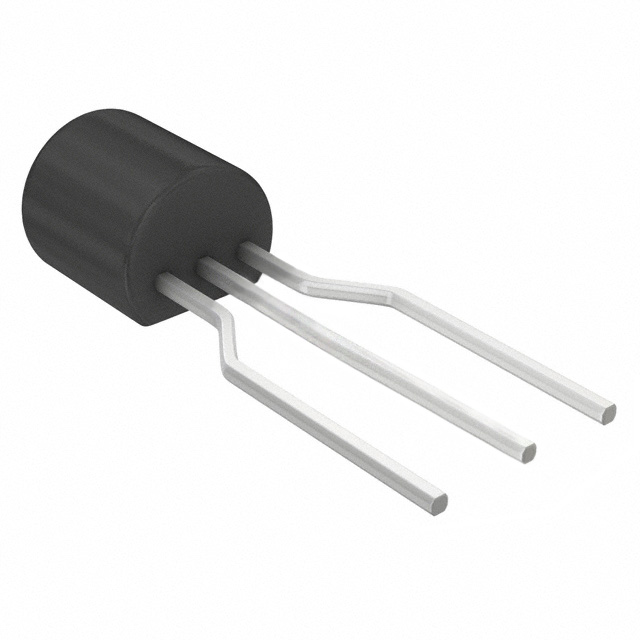
- Part No.:
- ZM33064CSTOB
- Manufacturer:
- Diodes Incorporated
- Category:
- Supervisors
- Package:
- TO-226-3, TO-92-3 (TO-226AA) Formed Leads
- Datasheet:
-
 ZM33064CSTOB.pdf
- Description:
- IC SUPERVISOR 1 CHANNEL TO92-3
- Quantity:
- Payment:

- Shipping:

Inventory:2,698
Please send an inquiry. Send us your inquiry, and we will respond immediately.
Product details
Overview
ZM33064CSTOB from Zetex Semiconductors is a three-terminal under-voltage monitor IC for microprocessor power-on reset and brownout detection in 5 V systems, featuring a fixed 4.6 V threshold, 20 mV hysteresis, open-collector output capable of sinking ≥10 mA, and guaranteed operation from 1.0 V to 6.5 V supply.
For engineers reviewing the ZM33064CSTOB datasheet, ZM33064CSTOB pinout, ZM33064CSTOB application, or ZM33064CSTOB equivalent, key selection criteria include threshold accuracy across temperature (±0.1 V), low quiescent current (200 µA max at 5 V), TO-92 package compatibility, clamp diode integration for reset delay capacitor discharge, and open-collector interface simplicity with single pull-up resistor.
Technical Context
The ZM33064CSTOB integrates a precision bandgap voltage reference and comparator with built-in hysteresis to eliminate oscillation near the 4.6 V trip point. Its internal clamp diode enables direct connection to an external RC timing network for programmable reset delay without discrete components.
Operation begins at 1.0 V supply, holding output low until VCC exceeds the upper threshold (4.61 V typ); output remains high until VCC drops below the lower threshold (4.59 V typ), then pulls low again-ensuring reliable power-on and brownout reset generation in embedded 5 V logic rails.
Key Specifications
| Parameter | Value and Actual Design Meaning |
|---|---|
| Threshold Voltage | 4.61 V (rising), 4.59 V (falling) - ensures clean 5 V system reset with 20 mV hysteresis |
| Output Sink Current | 10 mA min - drives standard TTL/CMOS reset inputs directly with single pull-up |
| Supply Range | 1.0 V to 6.5 V - supports startup from weak supplies and tolerates overvoltage transients |
| Quiescent Current | 200 µA max at 5 V - enables battery-backed monitoring without significant drain |
| Hysteresis | 20 mV - prevents chatter during slow-rising or noisy supply transitions |
| Clamp Diode VF | 1.2 V max at 10 mA - discharges external RC delay capacitor automatically on power-down |
| Propagation Delay | 1.5 µs - provides fast response to supply dips without compromising noise immunity |
Pinout & Package
Package: TO-92 (suffix C), through-hole mounting, 3-pin plastic case with standard lead spacing and thermal rating of 780 mW.
| Pin/Terminal | Circuit Role | Design Meaning |
|---|---|---|
| VIN | Supply Input | Monitored 5 V rail; device operates from 1.0–6.5 V and asserts reset when below 4.59 V |
| GND | Ground Reference | Return path for internal reference and output sink current; must be low-impedance |
| OUT | Open-Collector Output | Sinks ≥10 mA when active; requires external pull-up to define reset logic level (e.g., 10 kΩ to 5 V) |
Key Features
| Feature | Design Value |
|---|---|
| Fixed 4.6 V Threshold | Matched to standard 5 V logic supply tolerance; eliminates need for external resistor divider calibration |
| Integrated Clamp Diode | Automatically discharges RC delay capacitor on power-off, enabling precise, repeatable reset timing |
| Guaranteed 1 V Startup | Ensures reset assertion during cold start or battery recovery before full regulation is achieved |
| Low Standby Current | 200 µA max at 5 V - extends battery life in portable instrumentation and automotive modules |
Applications
| Microprocessor Power-On Reset | Automotive Body Control Module |
|---|---|
Use Scenario: Ensuring deterministic CPU initialization after power application in industrial PLCs. IC Role / Device Role / Timing Role: Under-voltage monitor generating active-low reset pulse upon stable 5 V rail establishment. Use Value: Prevents code execution before VCC reaches valid logic levels, eliminating boot failures. | Use Scenario: Monitoring 5 V supply in vehicle door module with battery backup during ignition cycling. IC Role / Device Role / Timing Role: Brownout detector asserting reset when alternator voltage sags below 4.59 V. Use Value: Avoids MCU lockup during engine cranking by triggering controlled restart within 1.5 µs. |
| Battery-Powered Data Logger | Computer Peripheral Controller |
Use Scenario: Maintaining data integrity in handheld meter during alkaline battery depletion. IC Role / Device Role / Timing Role: Low-voltage supervisor disabling write operations before supply falls below safe operating margin. Use Value: Uses 200 µA quiescent current and 1.0 V startup to extend usable battery life by >15%. | Use Scenario: Reset coordination between USB hub controller and attached peripherals during hot-plug events. IC Role / Device Role / Timing Role: Synchronized reset generator ensuring all ICs initialize simultaneously after VBUS stabilization. Use Value: Leverages 20 mV hysteresis to reject noise-induced false resets on shared 5 V bus traces. |
Equivalent & Alternatives
The following parts are listed as comparable options for similar under-voltage monitor applications.
| Alternative Part | Technical Difference | Application Difference | Selection Advice |
|---|---|---|---|
| MAX809TRD2T | 4.63 V threshold, 140 µA IQ, SOT23-3 package, no integrated clamp diode | Requires external diode for RC delay discharge; better suited for space-constrained PCBs | Choose when board area is critical and reset timing is fixed via external components |
| TLV7031DBVR | Adjustable threshold (via resistor divider), 360 nA IQ, rail-to-rail output, no hysteresis | Needs external hysteresis network; ultra-low power but higher design complexity | Prefer for battery-critical designs where threshold flexibility outweighs added BOM count |
Compared with MAX809TRD2T and TLV7031DBVR, the ZM33064CSTOB delivers fixed 4.6 V accuracy with integrated clamp diode and proven 1.0 V startup-reducing component count and simplifying reset timing in cost-sensitive TO-92-based 5 V systems.
Availability
ZM33064CSTOB is available at Aetrix Electronics and suitable for microprocessor systems, automotive body electronics, and battery-powered instrumentation requiring stable component supply and long-term obsolescence management.
Supply support for ZM33064CSTOB includes scheduled delivery planning, volume procurement assistance, BOM continuity management, traceable sourcing, and lifecycle availability coordination for OEM customers, industrial embedded developers, connected-device designers, and electronics production programs.
Manufacturer
Zetex Semiconductors (now part of Diodes Incorporated) specialized in high-performance analog and power management ICs, with emphasis on reliability and ease-of-use in industrial and automotive environments.
The ZM33064 series was designed specifically for robust, low-component-count power-supply monitoring in 5 V microprocessor systems-prioritizing threshold stability, hysteresis integrity, and seamless integration with legacy TO-92 footprints.
FAQ
What is the minimum supply voltage required for ZM33064CSTOB to assert a valid reset?
The ZM33064CSTOB begins functional operation at 1.0 V and holds its open-collector output low until the supply rises above 4.61 V (typ). Below 1.0 V, behavior is undefined per absolute maximum ratings; however, the device remains undamaged down to −1 V input.
Can ZM33064CSTOB drive a microcontroller's active-high reset input directly?
No-it features an open-collector output that sinks current when active. To interface with an active-high reset input, connect a pull-up resistor (e.g., 10 kΩ) from the OUT pin to the target supply rail (e.g., 5 V or 3.3 V), so output low = reset asserted.
How does the internal clamp diode affect reset delay timing?
The internal clamp diode (VF ≤ 1.2 V at 10 mA) discharges the external RC delay capacitor when VCC falls below 1.0 V, ensuring consistent reset pulse width on subsequent power cycles without manual discharge circuitry.
Is ZM33064CSTOB qualified for automotive temperature range?
Yes-the device is specified for operation from −40 °C to +85 °C, with threshold drift of ±0.05 V over that range, and is widely deployed in automotive body control modules and infotainment power supervisors.
ZM33064CSTOB Specifications
- Product attributes
- Attribute value
- Manufacturer:
- Diodes Incorporated
- Series:
- -
- Package/Case:
- TO-226-3, TO-92-3 (TO-226AA) Formed Leads
- Packaging:
- Tape & Reel (TR)
- Product Status:
- Obsolete
- Programmable:
- Not Verified
- Type:
- Simple Reset/Power-On Reset
- Number of Voltages Monitored:
- 1
- Voltage - Threshold:
- 4.6V
- Output:
- Open Drain or Open Collector
- Reset:
- Active Low
- Reset Timeout:
- 1.5µs Typical Propagation Delay
- Operating Temperature:
- -40°C ~ 85°C (TA)
- Grade:
- -
- Qualification:
- -
- Mounting Type:
- Through Hole
- Supplier Device Package:
- TO-92
ZM33064CSTOB FAQ
1.How can I place an order for ZM33064CSTOB through Aetrix?
Please submit a Request for Quotation (RFQ) for ZM33064CSTOB on Aetrix. Our sales agent will provide a competitive quotation and guide you through the order confirmation once you accept the terms.
2.Are the price and stock information for ZM33064CSTOB reliable?
The price and inventory of ZM33064CSTOB are updated periodically and may fluctuate due to market conditions. Stock and pricing data are typically refreshed every 24 hours. Quotation validity for ZM33064CSTOB is usually 5 days.
3.What payment methods are accepted for ZM33064CSTOB?
We accept Wire Transfer, PayPal, Credit Card, Western Union, MoneyGram, and Escrow for ZM33064CSTOB transactions.
Note: Certain payment methods may incur a processing fee.
4.How is shipping managed for ZM33064CSTOB?
ZM33064CSTOB orders can be shipped via leading logistics carriers, including DHL, UPS, FedEx, TNT, or Registered Mail.
Once your ZM33064CSTOB order is processed, you will receive an email with the shipment details and tracking number.
Note: Tracking information may take up to 24 hours to appear. Express delivery typically takes 3–5 business days.
5.How can I obtain technical support or documentation for ZM33064CSTOB?
For technical support, including ZM33064CSTOB datasheets, pinout diagrams, or application guidance, please contact our engineering support team. They can provide detailed documentation and assistance for your ZM33064CSTOB requirements.
6.How does Aetrix verify that ZM33064CSTOB is sourced from the original manufacturer or authorized distributors?
All ZM33064CSTOB products on Aetrix are procured from qualified distributors and authorized channels. Our dedicated quality assurance team conducts strict verification, including traceability checks and, if necessary, third-party testing. This ensures that ZM33064CSTOB meets industry standards.
7.What is the process for return or replacement of ZM33064CSTOB?
All ZM33064CSTOB units undergo pre-shipment inspection (PSI). If there is an issue with ZM33064CSTOB, returns or replacements are accepted under the following conditions:
1.Quantity discrepancies, incorrect items, or visible external defects (such as breakage or corrosion), acknowledged by Aetrix.
2.The issue is reported within 90 days of delivery.
3.The ZM33064CSTOB part is unused and in its original packaging.
Return procedure for ZM33064CSTOB:
1.Submit a request within 90 days.
2.Obtain a Return Material Authorization (RMA) from Aetrix.
ZM33064CSTOB Tags
-
MIC826SYMT-TR
Microchip Technology
-
APX803S-31SA-7
Diodes Incorporated
-
APX803L20-29SA-7
Diodes Incorporated
-
TPS3828-33DBVR
Texas Instruments

-
V6340RSP3B+
EM Microelectronic
-
EM6325CXSP5B-2.9+
EM Microelectronic
-
MCP120T-300I/TT
Microchip Technology
-
MCP130T-315I/TT
Microchip Technology
-
MCP120T-475I/TT
Microchip Technology
-
MCP111T-300E/TT
Microchip Technology
-
MCP120T-315I/TT
Microchip Technology
-
MCP809T-315I/TT
Microchip Technology
Tech Hub

An engineering guide to LED driver operation, constant-current and constant-voltage outputs, linear and switching topologies, dimming, IC selection, calculations, replacement compatibility, and fault c…

Operational amplifier guide covering op amp basics, feedback, ideal vs real op amps, common configurations, buffer circuits, offset, bias current, gain-bandwidth, slew rate, rail-to-rail limits and sel…

Jumper cables guide covering safe connection order, red and black clamp placement, final ground connection, cable gauge, length, clamp quality, copper vs CCA cables, jump starter comparison and battery…

LDO regulator guide covering low dropout voltage, power dissipation, thermal design, PSRR, output noise, capacitor stability, adjustable LDO circuits, LDO vs buck converter and datasheet selection chec…

Conditional Access Module guide covering CAM meaning, CI/CI+ interface, smart card authorization, DVB security workflow, TV and set-top box compatibility, internal electronics, ESD protection, connecto…

Guide to electronic component obsolescence covering EOL risk, PCN/PDN notices, last-time buy planning, replacement options, form-fit-function validation, counterfeit risk and BOM lifecycle management.

18650 battery guide covering lithium-ion cell basics, 3.6V/3.7V voltage, 4.2V charging, mAh and Wh capacity, protected cells, chargers, BMS, series-parallel packs, holders, welding and sourcing checks.…

Hall effect sensor guide covering working principle, linear and digital sensors, Arduino circuits, current sensing, speed detection, automotive applications, A3144 examples, signal filtering and datash…

Product Change Notification guide for electronic components, covering PCN meaning, PCN vs PDN/EOL, common change types, risk levels, form-fit-function review, engineering validation, BOM control, LTB/L…

A practical guide to blend door actuators, covering HVAC function, symptoms, location, AC and heater issues, reset and calibration, replacement cost, electrical diagnosis, compatibility checks, and rep…


