
 My Inquiry
 My Account


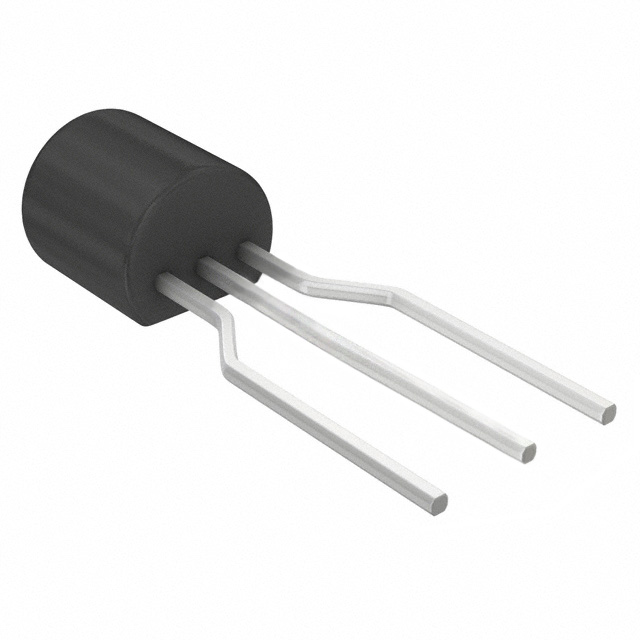
Diodes Incorporated ZSR330CSTOB
- Part No.:
- ZSR330CSTOB
- Manufacturer:
- Diodes Incorporated
- Package:
- TO-226-3, TO-92-3 (TO-226AA) Formed Leads
- Datasheet:
-
 ZSR330CSTOB.pdf
- Description:
- IC REG LINEAR 3.3V 200MA TO92-3
- Quantity:
- Payment:

- Shipping:

Inventory:3,814
Please send an inquiry. Send us your inquiry, and we will respond immediately.
Product details
Overview
ZSR330CSTOB from Zetex Semiconductors is a fixed 3.3 V positive linear voltage regulator in TO-92 package, delivering up to 200 mA output current with ±2.5% initial output voltage tolerance (3.218–3.382 V), 350–600 µA quiescent current, and stable operation from –55°C to +125°C. It serves as a local point-of-load regulator in space-constrained industrial control and embedded sensor modules where distributed supply noise or trace impedance limits centralized regulation.
For engineers reviewing the ZSR330CSTOB datasheet, ZSR330CSTOB pinout, ZSR330CSTOB application, or ZSR330CSTOB equivalent, this device is selected for low-noise (50 µVrms), high ripple rejection (50–64 dB at 120 Hz), and dropout-voltage-insensitive stability in battery-powered instrumentation and microcontroller power domains requiring minimal external components.
Technical Context
The ZSR330CSTOB integrates internal current limiting and thermal shutdown circuitry, enabling robust operation under short-circuit or overtemperature fault conditions without external protection. Its three-terminal architecture eliminates need for external compensation capacitors across input or output.
Designed for fixed-output local regulation, it maintains regulation with input voltages from 5.3 V to 20 V and load currents from 1 mA to 200 mA. Line regulation is specified at 7.5–30 mV and load regulation at 5–25 mV over full operating range, confirming tight output stability under dynamic line and load transients.
Key Specifications
| Parameter | Value and Actual Design Meaning |
|---|---|
| Output Voltage | 3.3 V nominal, 3.218–3.382 V (±2.5%) at 1–200 mA load and –55°C to +125°C |
| Quiescent Current | 350–600 µA - enables ultra-low standby power in always-on sensor nodes |
| Input Voltage Range | 5.3 V to 20 V - supports wide-input industrial supplies while maintaining regulation |
| Ripple Rejection | 50–64 dB at 120 Hz - suppresses AC ripple from switching pre-regulators or noisy DC sources |
| Output Noise | 50 µVrms (10 Hz–10 Hz) - suitable for analog front-ends and precision ADC reference rails |
| Operating Temperature | –55°C to +125°C - qualified for extended-range automotive and industrial environments |
| Thermal Shutdown Threshold | Internally set - protects against sustained overload or PCB-level thermal runaway |
Pinout & Package
Package: TO-92 (3-lead plastic through-hole). Pin 1 = Input (IN), Pin 2 = Ground (GND), Pin 3 = Output (OUT). Pin 2 is internally connected to the metal tab for thermal conduction; no external heatsink required below 200 mA at ambient ≤85°C.
| Pin/Terminal | Circuit Role | Design Meaning |
|---|---|---|
| Pin 1 (IN) | Unregulated input supply connection | Accepts 5.3–20 V DC; must be decoupled with ≥1 µF capacitor to limit transient overshoot during thermal shutdown |
| Pin 2 (GND) | Common reference and thermal path | Electrically tied to metal tab; provides primary heat dissipation path to PCB copper pour |
| Pin 3 (OUT) | Regulated 3.3 V output | Stable under 1–200 mA loads; no external capacitor required for stability per datasheet |
Key Features
| Feature | Design Value |
|---|---|
| No external components required | Guaranteed stability with zero external capacitors - reduces BOM count and board area in compact designs |
| Internal short-circuit current limit | Peak output current limited to ~400 mA at 25°C - prevents catastrophic failure during output faults |
| Tight initial voltage tolerance | ±2.5% output accuracy at 25°C - eliminates need for post-assembly trimming in cost-sensitive applications |
| Low temperature coefficient | 0.1 mV/°C average VO drift - ensures <±3 mV total variation over –55°C to +125°C |
| High PSRR at low frequency | ≥50 dB ripple rejection at 120 Hz - critical for rejecting rectified AC line noise in offline-powered systems |
Applications
| Industrial Sensor Node Power | Microcontroller Core Supply |
|---|---|
Use Scenario: Local 3.3 V rail for MEMS pressure sensor and signal conditioning ASIC in factory-floor environmental monitor. IC Role / Device Role / Timing Role: Fixed-output linear regulator providing clean, low-noise bias for analog front-end and ADC reference. Use Value: 50 µVrms output noise and 64 dB ripple rejection preserve 12-bit effective resolution without additional filtering. |
Use Scenario: Dedicated 3.3 V supply for ARM Cortex-M0+ MCU in programmable logic controller I/O module. IC Role / Device Role / Timing Role: Point-of-load regulator ensuring stable core voltage during rapid GPIO toggle and interrupt bursts. Use Value: Load regulation of ≤25 mV over 1–200 mA guarantees clock domain stability and eliminates reset glitches. |
| Portable Data Logger | Legacy RS-232 Interface Regulator |
Use Scenario: Battery-powered environmental logger using Li-ion cell (3.0–4.2 V) with step-up converter feeding ZSR330CSTOB. IC Role / Device Role / Timing Role: Post-regulator cleaning output of boost converter for ultra-low-power sleep mode operation. Use Value: 350 µA quiescent current extends battery life to >1 year in 1-minute wake/sleep cycle. |
Use Scenario: Isolated 3.3 V supply for MAX3232 transceiver in industrial HMI panel with 5 V system rail. IC Role / Device Role / Timing Role: Local regulator decoupling RS-232 driver from noisy main 5 V bus. Use Value: Line regulation ≤30 mV prevents data corruption during shared-rail voltage sag from motor drive activation. |
Equivalent & Alternatives
The following parts are listed as comparable options for similar fixed-output linear regulator applications.
| Alternative Part | Technical Difference | Application Difference | Selection Advice |
|---|---|---|---|
| LM317LZ/LM317L | Adjustable output (1.25–37 V); requires two external resistors; higher quiescent current (50–100 µA typical) | Requires design-time resistor selection; less accurate at 3.3 V due to reference tolerance and resistor drift | Select only if future voltage flexibility is needed; adds BOM complexity and calibration risk for fixed 3.3 V use |
| TLV73333PDBVR | 3.3 V fixed, SOT-23 package; lower quiescent current (45 µA); max 300 mA output; requires 1 µF output capacitor | SMT-only; incompatible with through-hole legacy designs; higher PSRR (65 dB) but narrower input range (1.4–5.5 V) | Prefer for new SMT designs with tight space constraints and low-IQ priority; not drop-in for TO-92 footprint |
Compared with LM317LZ and TLV73333PDBVR, ZSR330CSTOB offers proven through-hole reliability, no external components, and wide-input capability (5.3–20 V), making it optimal for retrofitting into existing TO-92-based industrial hardware where layout change is prohibited.
Availability
ZSR330CSTOB is available at Aetrix Electronics and suitable for industrial sensor nodes, microcontroller power domains, portable data loggers, and legacy RS-232 interface circuits requiring stable component supply with long-lifecycle support.
Supply support for ZSR330CSTOB includes scheduled delivery planning, volume procurement assistance, BOM continuity management, traceable sourcing, and lifecycle availability coordination for OEM customers, industrial embedded developers, connected-device designers, and electronics production programs.
Manufacturer
Zetex Semiconductors plc was a UK-based ISO 9001/TS16949-certified analog and power semiconductor manufacturer, acquired by Diodes Incorporated in 2008.
The ZSR Series was developed for high-reliability local voltage regulation in harsh-environment industrial and automotive applications, emphasizing fault tolerance, wide temperature operation, and minimal external component count.
FAQ
Is ZSR330CSTOB still in production?
No - ZSR330CSTOB is an obsolete part per Zetex Issue 9 datasheet (October 2007), marked "Obsolete" in ordering tables. Aetrix Electronics maintains legacy inventory and offers engineering support for replacement selection, including pin-compatible alternatives and redesign guidance for active equivalents.
What is the maximum power dissipation for ZSR330CSTOB in TO-92?
Maximum power dissipation is 0.5 W at 25°C ambient, derating linearly to zero at 125°C. At 200 mA load and 5.3 V input, dropout is ~2 V, yielding ~0.4 W dissipation - within safe limits on standard FR-4 with 1 in² copper pour. Exceeding 0.5 W requires thermal analysis per JEDEC JESD51-2.
Does ZSR330CSTOB require an input bypass capacitor?
Yes - a minimum 1 µF ceramic capacitor is recommended across IN and GND per datasheet Note on page 2. This prevents input voltage overshoot during thermal shutdown events, especially when supplied from inductive sources, and ensures the 20 V absolute maximum rating is not exceeded.
Can ZSR330CSTOB be used with input voltage below 5.3 V?
No - the minimum input voltage to maintain 3.3 V regulation is 5.3 V (specified as "Vin required to maintain regulation"). Below this, output voltage drops linearly with input; operation at 4.5 V input yields ~2.7 V output and violates regulation spec. Use only within 5.3–20 V input range.
ZSR330CSTOB Specifications
- Product attributes
- Attribute value
- Manufacturer:
- Diodes Incorporated
- Series:
- -
- Package/Case:
- TO-226-3, TO-92-3 (TO-226AA) Formed Leads
- Packaging:
- Tape & Reel (TR)
- Product Status:
- Obsolete
- Output Configuration:
- Positive
- Output Type:
- Fixed
- Number of Regulators:
- 1
- Voltage - Input (Max):
- 20V
- Voltage - Output (Min/Fixed):
- 3.3V
- Voltage - Output (Max):
- -
- Voltage Dropout (Max):
- -
- Current - Output:
- 200mA
- Current - Quiescent (Iq):
- 600 µA
- Current - Supply (Max):
- -
- PSRR:
- 64dB (120Hz)
- Control Features:
- -
- Protection Features:
- Over Temperature, Short Circuit
- Operating Temperature:
- -55°C ~ 125°C
- Grade:
- -
- Qualification:
- -
- Mounting Type:
- Through Hole
- Supplier Device Package:
- TO-92
ZSR330CSTOB FAQ
1.How can I place an order for ZSR330CSTOB through Aetrix?
Please submit a Request for Quotation (RFQ) for ZSR330CSTOB on Aetrix. Our sales agent will provide a competitive quotation and guide you through the order confirmation once you accept the terms.
2.Are the price and stock information for ZSR330CSTOB reliable?
The price and inventory of ZSR330CSTOB are updated periodically and may fluctuate due to market conditions. Stock and pricing data are typically refreshed every 24 hours. Quotation validity for ZSR330CSTOB is usually 5 days.
3.What payment methods are accepted for ZSR330CSTOB?
We accept Wire Transfer, PayPal, Credit Card, Western Union, MoneyGram, and Escrow for ZSR330CSTOB transactions.
Note: Certain payment methods may incur a processing fee.
4.How is shipping managed for ZSR330CSTOB?
ZSR330CSTOB orders can be shipped via leading logistics carriers, including DHL, UPS, FedEx, TNT, or Registered Mail.
Once your ZSR330CSTOB order is processed, you will receive an email with the shipment details and tracking number.
Note: Tracking information may take up to 24 hours to appear. Express delivery typically takes 3–5 business days.
5.How can I obtain technical support or documentation for ZSR330CSTOB?
For technical support, including ZSR330CSTOB datasheets, pinout diagrams, or application guidance, please contact our engineering support team. They can provide detailed documentation and assistance for your ZSR330CSTOB requirements.
6.How does Aetrix verify that ZSR330CSTOB is sourced from the original manufacturer or authorized distributors?
All ZSR330CSTOB products on Aetrix are procured from qualified distributors and authorized channels. Our dedicated quality assurance team conducts strict verification, including traceability checks and, if necessary, third-party testing. This ensures that ZSR330CSTOB meets industry standards.
7.What is the process for return or replacement of ZSR330CSTOB?
All ZSR330CSTOB units undergo pre-shipment inspection (PSI). If there is an issue with ZSR330CSTOB, returns or replacements are accepted under the following conditions:
1.Quantity discrepancies, incorrect items, or visible external defects (such as breakage or corrosion), acknowledged by Aetrix.
2.The issue is reported within 90 days of delivery.
3.The ZSR330CSTOB part is unused and in its original packaging.
Return procedure for ZSR330CSTOB:
1.Submit a request within 90 days.
2.Obtain a Return Material Authorization (RMA) from Aetrix.
ZSR330CSTOB Tags
-
MIC5504-1.8YM5-TR
Microchip Technology
-
MIC5504-3.3YM5-TR
Microchip Technology
-
MIC5365-3.0YC5-TR
Microchip Technology
-
MIC5365-1.8YC5-TR
Microchip Technology
-
MIC5365-2.5YC5-TR
Microchip Technology
-
MIC5365-3.3YC5-TR
Microchip Technology
-
MIC5365-3.3YD5-TR
Microchip Technology
-
MIC5317-3.3YM5-TR
Microchip Technology
-
TLV1117LV33DCYR
Texas Instruments
-
MIC5317-3.3YMT-TZ
Microchip Technology
-
MIC5528-3.3YMT-TR
Microchip Technology
-
TLV75801PDRVR
Texas Instruments
Tech Hub
Schmitt triggers use separate rising and falling thresholds to stabilize slow or noisy signals. This guide covers hysteresis, 74HC14 and 74HCT14 selection, comparator calculations, RC oscillators and p…
Counterfeit components can hide behind convincing markings and passing basic function tests. This engineering reference covers source traceability, external inspection, X-ray, XRF, electrical testing, …

A practical engineering and sourcing framework covering lifecycle verification, lifetime-buy calculations, replacement qualification, supplier checks and counterfeit-risk controls.

TTL and CMOS logic families differ in thresholds, loading, output drive, power and timing. This engineering guide compares 74HC and 74HCT, calculates noise margins and checks 3.3 V/5 V compatibility.

A practical engineering guide to 3.3V and 5V logic compatibility, input thresholds, resistor dividers, translator ICs, MOSFET level shifting, I2C pull-ups, timing limits and power-sequencing risks.

The 74HC595 uses push-pull logic outputs, while the TPIC6B595 uses 50 V open-drain DMOS sinks for higher-power loads. This guide compares timing, current limits, 3.3 V interfacing, load wiring, thermal…

The 74HC595 converts serial data into eight stable parallel outputs. This guide covers pin functions, shift and storage timing, OE and MR behavior, drive-current limits, cascading, voltage compatibilit…

A technical comparison of level-sensitive latches and edge-triggered flip-flops, covering timing windows, setup and hold limits, master–slave operation, time borrowing, race-through, HDL inference and…

A D latch stores one bit while Enable controls when data can pass. This reference covers gate-level operation, truth tables, transparency, setup and hold timing, LE versus OE, common ICs and practical …

An SR latch stores one bit through cross-coupled feedback. This engineering reference covers NOR and NAND implementations, truth tables, forbidden-state recovery, gated operation, switch debouncing, fa…


