
 My Inquiry
 My Account


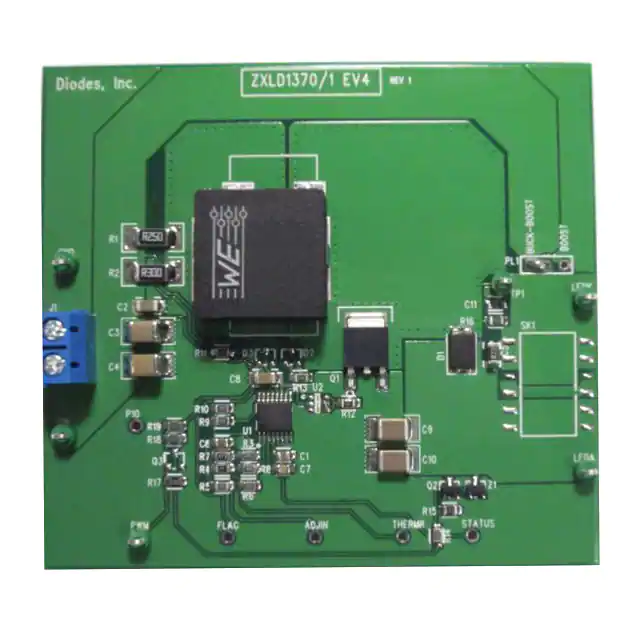
Diodes Incorporated ZXLD1370/1EV4
- Part No.:
- ZXLD1370/1EV4
- Manufacturer:
- Diodes Incorporated
- Category:
- LED Driver Evaluation Boards
- Package:
- Datasheet:
-
 ZXLD1370/1EV4.pdf
- Description:
- EVAL BOARD FOR ZXLD1370 ZXLD1371
- Quantity:
- Payment:

- Shipping:

Inventory:2,804
Please send an inquiry. Send us your inquiry, and we will respond immediately.
Product details
Overview
ZXLD1370/1EV4 from Diodes Incorporated is a 60V automotive-grade LED driver controller IC that regulates current through external MOSFETs in buck, boost, and buck-boost topologies. It delivers 0.5% typical output current accuracy, supports 6–60V input, enables up to 1MHz switching, and integrates thermal current control via TADJ for LED overtemperature protection in automotive lighting systems.
For engineers reviewing the ZXLD1370/1EV4 datasheet, ZXLD1370/1EV4 pinout, ZXLD1370/1EV4 application, or ZXLD1370/1EV4 equivalent, key selection criteria include multi-topology flexibility, AEC-Q100 qualification, 1000:1 PWM dimming at 500Hz, dual-fault reporting (FLAG + STATUS), and thermally adaptive current regulation using an external thermistor network.
Technical Context
The ZXLD1370/1EV4 implements a modified hysteretic control architecture with patent-pending feedback that maintains ±0.25% VSENSE accuracy across all three topologies. Its dual-current-monitoring path-fast monitor for transient response and accurate monitor for steady-state regulation-enables stable LED current under wide VIN (6–60V) and load variations.
Thermal management is implemented via the TADJ pin, which accepts a thermistor-resistor divider to linearly reduce LED current above a preset junction temperature threshold (e.g., 70°C to 85°C). Fault detection includes undervoltage lockout (5.6V UVLO), overtemperature shutdown (150°C), stall detection (tON/tOFF >100µs), and overcurrent sensing (350mV VSENSE threshold).
Key Specifications
| Parameter | Value and Actual Design Meaning |
|---|---|
| Topology Support | Buck, boost, and buck-boost - enables single IC design reuse across varying LED string voltage requirements relative to input rail. |
| Output Current Accuracy | ±0.25% VSENSE threshold tolerance - ensures consistent luminance across production units without per-unit calibration. |
| Input Voltage Range | 6V to 60V - supports 12V/24V/48V automotive and industrial supply rails, including cold-crank and load-dump transients. |
| PWM Dimming Range | 1000:1 at 500Hz - achieves deep dimming in headlight DRL and adaptive driving beam applications without visible flicker. |
| Switching Frequency | Up to 1MHz - allows use of compact 33µH inductors and reduces EMI filter size in space-constrained modules. |
| Thermal Control | TADJ pin with 625mV upper threshold - enables programmable LED current derating to extend lifetime in high-ambient-temperature headlamp housings. |
| Fault Reporting | Dual outputs: open-drain FLAG (binary fault flag) and analog STATUS (4.5V nominal, voltage-coded warnings) - simplifies diagnostic interface with microcontroller ADC and GPIO. |
Pinout & Package
Package: TSSOP-16EP (exposed paddle), RoHS-compliant, halogen-free, lead-free. Thermal resistance θJA = 50°C/W on high-conductivity test board.
| Pin/Terminal | Circuit Role | Design Meaning |
|---|---|---|
| ADJ | DC current setpoint input | Accepts 0.125–2.5V to scale LED current from 10% to 200%; internal clamp limits node to <3V for overvoltage robustness. |
| REF | 1.25V precision reference output | Provides stable bias for external resistor dividers; sources 1mA max - used to set ADJ baseline and TADJ network. |
| TADJ | Thermal compensation input | Connects to thermistor/resistor divider; voltage drop below 625mV initiates linear LED current reduction to prevent thermal runaway. |
| SHP | Loop compensation node | Requires 100pF ±20% capacitor to ground - sets dominant pole for hysteretic loop stability across topologies. |
| STATUS | Analog fault status output | Voltage-coded: 4.5V (normal), 3.6V (undervoltage), 1.8V (overtemperature), 0.9V (overcurrent) - enables single-wire diagnostics. |
| GATE | External NMOS gate driver | Drives high-side switch with ±300mA peak current; clamped to 15V when VAUX >12V - ensures safe MOSFET turn-on. |
| GI | Topology configuration input | Set to ADJ for buck; resistive divider from ADJ to SGND for boost/buck-boost - defines switch-to-LED current ratio (0.20–0.50). |
| ISM | High-side current sense input | Monitors voltage drop across external sense resistor (nominal 225mV); supports bidirectional sensing for boost/buck-boost. |
Key Features
| Feature | Design Value |
|---|---|
| Multi-topology operation | Single IC supports buck (VIN > VLED), boost (VIN < VLED), and buck-boost (VIN ≈ VLED) - eliminates BOM proliferation across lighting variants. |
| 0.5% typical current accuracy | Reduces binning requirements and enables closed-loop luminance control without external DAC or current-sense amplifier. |
| AEC-Q100 Grade 1 qualification | Rated for −40°C to +125°C TJ operation - validated for under-hood automotive LED headlamps and daytime running lights. |
| Integrated thermal derating | TADJ pin enables automatic, linear LED current reduction above user-defined temperature - extends LED lifetime without firmware intervention. |
| Dual-fault reporting | FLAG (digital alert) + STATUS (analog-coded warning) - allows both immediate system shutdown and root-cause diagnostics via MCU ADC. |
Applications
| Automotive Headlamp Systems | Commercial Vehicle Lighting |
|---|---|
Use Scenario: Adaptive front-lighting system (AFS) with matrix LED arrays requiring precise current control per segment and thermal derating during extended operation. IC Role / Device Role / Timing Role: Multi-topology LED current controller managing high-side NMOS switches in buck-boost configuration to drive 8–12 series LEDs from 12V battery with load-dump resilience. Use Value: 0.5% current accuracy ensures uniform photometric output across segments; TADJ-based thermal foldback prevents LED chromatic shift at 105°C ambient. | Use Scenario: Heavy-duty truck tail lamps and stop/turn signals operating from 24V systems with wide temperature swings (−40°C to +85°C). IC Role / Device Role / Timing Role: Boost-mode LED driver controlling 16-series LED strings from 24V rail, leveraging GI pin configuration and 60V rating for reliability during alternator transients. Use Value: 1000:1 PWM dimming enables compliance with SAE J575 photometric standards; AEC-Q100 qualification ensures field durability in vibration-prone environments. |
| Industrial Machine Vision Lighting | Architectural LED Retrofit Modules |
Use Scenario: High-intensity strobed illumination for factory floor inspection cameras, requiring rapid on/off cycling and stable intensity across 0–60V input range. IC Role / Device Role / Timing Role: Buck-mode controller driving 4–6 high-power LEDs with 500Hz PWM dimming and fast transient response enabled by hysteretic architecture. Use Value: Up to 1MHz switching allows compact 10µH inductors; STATUS pin voltage coding enables real-time health monitoring during 24/7 operation. | Use Scenario: Retrofit LED tubes replacing fluorescent fixtures in commercial buildings, powered from rectified 120/277VAC with PFC pre-regulator output (~380V DC bus). IC Role / Device Role / Timing Role: Buck-boost controller operating from 36–60V intermediate rail, driving 10–15 series LEDs while maintaining constant current despite line voltage sag. Use Value: 6V minimum start-up and 60V absolute max rating tolerate brownouts and surges; green molding compound meets LEED sustainability requirements. |
Equivalent & Alternatives
The following parts are listed as comparable options for similar LED driver controller applications.
| Alternative Part | Technical Difference | Application Difference | Selection Advice |
|---|---|---|---|
| AL8862Q-13 | Fixed-frequency current-mode controller; no TADJ thermal control; 40V max input; requires external op-amp for dimming. | Lacks integrated thermal foldback and multi-topology flexibility - suitable only for fixed-buck, non-automotive applications. | Select only if cost sensitivity outweighs thermal management needs and topology flexibility is unnecessary. |
| LM3409QMY/NOPB | Hysteretic controller with 42V max input; no STATUS analog fault coding; single digital fault flag only; no AEC-Q100 grade. | Not qualified for automotive use; limited to industrial lighting where ambient temperature stays below 105°C. | Choose only for non-automotive buck-only designs requiring lower BOM cost and simpler layout. |
Compared with AL8862Q-13 and LM3409QMY/NOPB, the ZXLD1370/1EV4 uniquely combines AEC-Q100 qualification, 60V rating, three-topology support, analog STATUS fault coding, and integrated TADJ thermal control - making it the sole option for automotive-grade adaptive lighting with full diagnostic capability and thermal resilience.
Availability
ZXLD1370/1EV4 is available at Aetrix Electronics and suitable for automotive headlamp systems, commercial vehicle lighting, industrial machine vision illumination, and architectural LED retrofit modules requiring stable component supply, long-term lifecycle support, and AEC-Q100 compliance.
Supply support for ZXLD1370/1EV4 includes scheduled delivery planning, volume procurement assistance, BOM continuity management, traceable sourcing, and lifecycle availability coordination for OEM customers, industrial embedded developers, connected-device designers, and electronics production programs.
Manufacturer
Diodes Incorporated is a global manufacturer of discrete semiconductors and analog ICs, specializing in power management, signal integrity, and lighting solutions for automotive, industrial, and consumer markets.
The ZXLD1370 belongs to Diodes' automotive LED driver controller product line, designed specifically for high-reliability, thermally adaptive, multi-topology LED current regulation in demanding vehicular lighting applications.
FAQ
What is the function of the GI pin on the ZXLD1370/1EV4?
The GI (Gain Input) pin configures the device's topology mode: direct connection to ADJ selects buck operation; a resistive divider from ADJ to SGND sets boost or buck-boost modes by defining the switch-to-LED current ratio (0.20–0.50). It features an internal 3V clamp to prevent damage from overvoltage, and its voltage level directly determines current gain scaling in non-buck configurations.
How does the STATUS pin encode fault conditions?
The STATUS pin outputs a voltage-coded signal: 4.5V (normal), 3.6V (undervoltage or out-of-regulation), 1.8V (overtemperature), or 0.9V (overcurrent). These levels are mutually exclusive and prioritized - e.g., overcurrent overrides undervoltage - enabling single-pin diagnostic readout via MCU ADC without additional logic. No external pull-up is required as it's internally biased.
Can the ZXLD1370/1EV4 operate without an external thermistor on TADJ?
Yes - connecting TADJ directly to REF disables thermal current control, fixing LED current at the ADJ-set value regardless of temperature. This configuration is valid for non-automotive applications or where thermal derating is managed externally. The internal TADJ circuit draws only 1µA, so floating the pin is not recommended due to noise susceptibility.
What is the minimum input voltage required for reliable startup and sustained operation?
The ZXLD1370/1EV4 starts up reliably above 6.5V (with noise margin) and sustains operation down to 6.3V in reduced-performance mode. Below 8V, output current accuracy and efficiency degrade - especially in boost/buck-boost modes - requiring a bootstrap network on VAUX or selection of low-VTH MOSFETs in buck mode to maintain regulation.
ZXLD1370/1EV4 Specifications
- Product attributes
- Attribute value
- Manufacturer:
- Diodes Incorporated
- Series:
- -
- Packaging:
- Bulk
- Product Status:
- Active
- Current - Output / Channel:
- 1.5A
- Outputs and Type:
- 1 Non-Isolated Output
- Voltage - Output:
- 27V
- Features:
- -
- Voltage - Input:
- 10V ~ 30V
- Contents:
- Board(s)
- Utilized IC / Part:
- ZXLD1370, ZXLD1371
ZXLD1370/1EV4 FAQ
1.How can I place an order for ZXLD1370/1EV4 through Aetrix?
Please submit a Request for Quotation (RFQ) for ZXLD1370/1EV4 on Aetrix. Our sales agent will provide a competitive quotation and guide you through the order confirmation once you accept the terms.
2.Are the price and stock information for ZXLD1370/1EV4 reliable?
The price and inventory of ZXLD1370/1EV4 are updated periodically and may fluctuate due to market conditions. Stock and pricing data are typically refreshed every 24 hours. Quotation validity for ZXLD1370/1EV4 is usually 5 days.
3.What payment methods are accepted for ZXLD1370/1EV4?
We accept Wire Transfer, PayPal, Credit Card, Western Union, MoneyGram, and Escrow for ZXLD1370/1EV4 transactions.
Note: Certain payment methods may incur a processing fee.
4.How is shipping managed for ZXLD1370/1EV4?
ZXLD1370/1EV4 orders can be shipped via leading logistics carriers, including DHL, UPS, FedEx, TNT, or Registered Mail.
Once your ZXLD1370/1EV4 order is processed, you will receive an email with the shipment details and tracking number.
Note: Tracking information may take up to 24 hours to appear. Express delivery typically takes 3–5 business days.
5.How can I obtain technical support or documentation for ZXLD1370/1EV4?
For technical support, including ZXLD1370/1EV4 datasheets, pinout diagrams, or application guidance, please contact our engineering support team. They can provide detailed documentation and assistance for your ZXLD1370/1EV4 requirements.
6.How does Aetrix verify that ZXLD1370/1EV4 is sourced from the original manufacturer or authorized distributors?
All ZXLD1370/1EV4 products on Aetrix are procured from qualified distributors and authorized channels. Our dedicated quality assurance team conducts strict verification, including traceability checks and, if necessary, third-party testing. This ensures that ZXLD1370/1EV4 meets industry standards.
7.What is the process for return or replacement of ZXLD1370/1EV4?
All ZXLD1370/1EV4 units undergo pre-shipment inspection (PSI). If there is an issue with ZXLD1370/1EV4, returns or replacements are accepted under the following conditions:
1.Quantity discrepancies, incorrect items, or visible external defects (such as breakage or corrosion), acknowledged by Aetrix.
2.The issue is reported within 90 days of delivery.
3.The ZXLD1370/1EV4 part is unused and in its original packaging.
Return procedure for ZXLD1370/1EV4:
1.Submit a request within 90 days.
2.Obtain a Return Material Authorization (RMA) from Aetrix.
ZXLD1370/1EV4 Tags
-
COM-13716
SparkFun Electronics
-
B-G474E-DPOW1
STMicroelectronics

-
EVB81116-A2
Melexis Technologies NV
-
EVB81116-A3
Melexis Technologies NV
-
LP5036EVM
Texas Instruments
-
LP5813-12WCSPEVM
Texas Instruments
-
LP8863EVM
Texas Instruments
-
1455
Adafruit Industries LLC
-
1427
Adafruit Industries LLC
-
WIG-13279
SparkFun Electronics
-
5650
Adafruit Industries LLC
-
1429
Adafruit Industries LLC
Tech Hub

An engineering guide to LED driver operation, constant-current and constant-voltage outputs, linear and switching topologies, dimming, IC selection, calculations, replacement compatibility, and fault c…

Operational amplifier guide covering op amp basics, feedback, ideal vs real op amps, common configurations, buffer circuits, offset, bias current, gain-bandwidth, slew rate, rail-to-rail limits and sel…

Jumper cables guide covering safe connection order, red and black clamp placement, final ground connection, cable gauge, length, clamp quality, copper vs CCA cables, jump starter comparison and battery…

LDO regulator guide covering low dropout voltage, power dissipation, thermal design, PSRR, output noise, capacitor stability, adjustable LDO circuits, LDO vs buck converter and datasheet selection chec…

Conditional Access Module guide covering CAM meaning, CI/CI+ interface, smart card authorization, DVB security workflow, TV and set-top box compatibility, internal electronics, ESD protection, connecto…

Guide to electronic component obsolescence covering EOL risk, PCN/PDN notices, last-time buy planning, replacement options, form-fit-function validation, counterfeit risk and BOM lifecycle management.

18650 battery guide covering lithium-ion cell basics, 3.6V/3.7V voltage, 4.2V charging, mAh and Wh capacity, protected cells, chargers, BMS, series-parallel packs, holders, welding and sourcing checks.…

Hall effect sensor guide covering working principle, linear and digital sensors, Arduino circuits, current sensing, speed detection, automotive applications, A3144 examples, signal filtering and datash…

Product Change Notification guide for electronic components, covering PCN meaning, PCN vs PDN/EOL, common change types, risk levels, form-fit-function review, engineering validation, BOM control, LTB/L…

A practical guide to blend door actuators, covering HVAC function, symptoms, location, AC and heater issues, reset and calibration, replacement cost, electrical diagnosis, compatibility checks, and rep…


