
 My Inquiry
 My Account


Skyworks Solutions Inc. 510FCA-AAAG
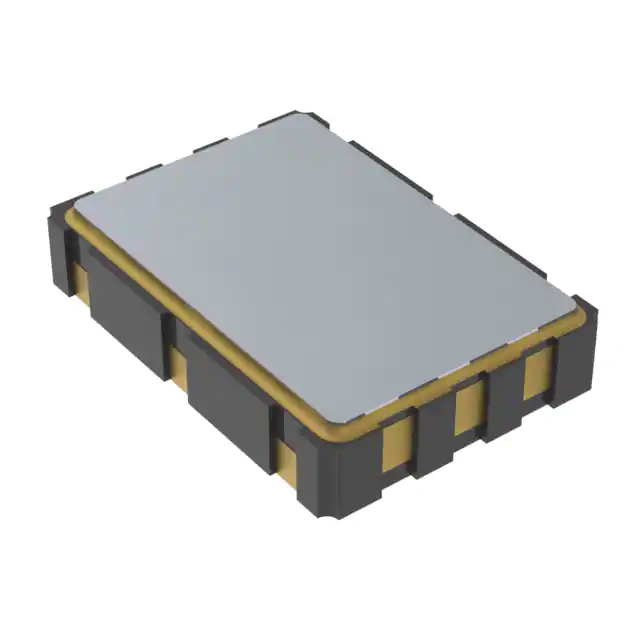
- Part No.:
- 510FCA-AAAG
- Manufacturer:
- Skyworks Solutions Inc.
- Category:
- Programmable Oscillators
- Package:
- 6-SMD, No Lead
- Datasheet:
-
 510FCA-AAAG.pdf
- Description:
- XTAL OSC PROG XO LVDS 2.5V 20PPM
- Quantity:
- Payment:

- Shipping:

Inventory:7,242
Please send an inquiry. Send us your inquiry, and we will respond immediately.
Product details
Overview
510FCA-AAAG from Skyworks Solutions is a factory-programmed, 3.3 V CMOS-output crystal oscillator (XO) delivering 100 MHz output with ±30 ppm total stability over –40°C to +85°C, using DSPLL synthesis for low-jitter clock generation in FPGA/ASIC and Gigabit Ethernet systems.
For engineers reviewing the 510FCA-AAAG datasheet, 510FCA-AAAG pinout, 510FCA-AAAG application, or 510FCA-AAAG equivalent, this page provides verified package mapping (5 × 7 mm, 4-pin), confirmed CMOS drive capability (±8 mA at 3.3 V), startup time (≤10 ms), and OE-active-high configuration - all critical for timing-critical board bring-up and supply chain continuity planning.
Technical Context
The 510FCA-AAAG implements Skyworks' DSPLL architecture with a fixed internal crystal and digital frequency synthesis, enabling precise 100 MHz output without custom crystal selection. It integrates an on-chip LDO regulator for supply noise rejection and supports runt suppression on power-up and OE assertion.
This device operates exclusively in CMOS mode with single-ended output, uses pin 1 for OE (active high, internal pull-up), and is configured for 3.3 V supply (2.97–3.63 V), 48–52% duty cycle, and 0.45–1.2 ns rise/fall time into 15 pF load - parameters validated per Table 3 of the Si510/511 Rev. 1.4 datasheet.
Key Specifications
| Parameter | Value and Actual Design Meaning |
|---|---|
| Output Frequency | 100 MHz - stable, jitter-optimized reference for PCIe Gen2/3 and 1 GbE PHY clocking |
| Output Format | CMOS - single-ended, rail-to-rail logic compatible with standard FPGA clock inputs |
| Total Stability | ±30 ppm - includes initial accuracy, temp, voltage, load, shock/vibration, and 10-year aging |
| Supply Voltage | 3.3 V ±10% - supports industrial-grade power rails with integrated LDO filtering |
| Startup Time | ≤10 ms - ensures deterministic system boot within microcontroller or FPGA reset windows |
| Duty Cycle | 48–52% - meets setup/hold margin requirements for synchronous logic interfaces |
| Rise/Fall Time | 0.45–1.2 ns (20–80% VDD, CL = 15 pF) - minimizes edge-induced EMI in dense PCB layouts |
Pinout & Package
510FCA-AAAG is supplied in a RoHS-compliant, lead-free 5 × 7 mm surface-mount ceramic package (CLCC) with 4 pins and gold-over-nickel contact pads. Thermal resistance junction-to-ambient is 110°C/W (still air).
| Pin/Terminal | Circuit Role | Design Meaning |
|---|---|---|
| 1 | OE (Output Enable) | Active-high enable with internal pull-up; asserts output after ≤20 µs when enabled |
| 2 | GND | Electrical and case ground - requires low-inductance connection to minimize ground bounce |
| 3 | CLK | CMOS clock output - drives up to 15 pF load with 0.45–1.2 ns edge rates |
| 4 | VDD | 3.3 V power input - filtered internally by on-chip LDO for supply noise immunity |
Key Features
| Feature | Design Value |
|---|---|
| DSPLL Synthesis | Enables factory-programmed 100 MHz without custom crystal - eliminates long lead times and NRE charges |
| On-Chip LDO Regulator | Provides >30 dB supply noise rejection - simplifies power integrity design in noisy digital environments |
| Runt Suppression | Prevents false clock edges during power-up and OE transitions - critical for glitch-free system initialization |
| Production-Tested Crystal ESR/DLD | Guarantees long-term reliability and frequency stability - no field failures due to resonator degradation |
| 10-Year Aging Inclusion | Total ±30 ppm stability covers aging drift - eliminates need for post-deployment recalibration |
Applications
| FPGA/ASIC Clock Generation | Gigabit Ethernet PHY |
|---|---|
Use Scenario: Provides primary reference clock to Xilinx Artix-7 or Intel Cyclone V FPGA I/O banks requiring low-jitter, 100 MHz single-ended input. IC Role / Device Role / Timing Role: System-level timing source replacing legacy quartz XOs with higher reliability and faster customization. Use Value: Eliminates crystal matching effort and reduces BOM count via DSPLL programmability while maintaining <1.3 ps RMS period jitter. | Use Scenario: Supplies 100 MHz reference to Marvell Alaska 88E1512 or Broadcom BCM54616S Gigabit Ethernet transceivers. IC Role / Device Role / Timing Role: Master clock generator meeting IEEE 802.3 Clause 22/45 timing compliance for GMII/RGMII interfaces. Use Value: Delivers guaranteed ±30 ppm stability across –40°C to +85°C - exceeds Ethernet spec requirement of ±50 ppm. |
| Industrial PLC Backplane | Medical Imaging Data Acquisition |
Use Scenario: Synchronizes multi-slot EtherCAT master controller (Beckhoff CX5140) with distributed I/O modules. IC Role / Device Role / Timing Role: Deterministic timing anchor ensuring sub-microsecond cycle consistency across real-time fieldbus networks. Use Value: 10 ms startup time enables full system readiness within PLC boot sequence; 110°C/W θJA supports convection-cooled enclosures. | Use Scenario: Clocks ADC sampling in ultrasound beamformer boards where phase coherence across 128 channels is critical. IC Role / Device Role / Timing Role: Low-phase-noise reference (–116 dBc/Hz @ 10 kHz offset) minimizing harmonic distortion in RF front-end digitization. Use Value: 0.35 ps RMS phase jitter (1.875–20 MHz) preserves SNR in 14-bit, 100 MSPS acquisition paths. |
Equivalent & Alternatives
The following parts are listed as comparable options for similar crystal oscillator applications.
| Alternative Part | Technical Difference | Application Difference | Selection Advice |
|---|---|---|---|
| Si510FCA-AAG | Same 5 × 7 mm, 4-pin CMOS package; identical 100 MHz, ±30 ppm, 3.3 V specs; differs only in tape-and-reel packaging (R vs blank) | No functional difference - suitable for same PCB layout and schematic | Select 510FCA-AAAG for tray delivery; Si510FCA-AAG if automated pick-and-place requires tape-and-reel |
| ABM8G-100.000MHZ-18-D2Y-T | Fixed-frequency quartz XO (no DSPLL); ±50 ppm stability; 3.3 V CMOS; 3.2 × 2.5 mm package; no OE control | Lacks output enable, wider stability tolerance, smaller footprint - not drop-in for OE-driven power management | Choose only if board space is constrained and OE functionality is unused; verify 50 ppm meets system timing budget |
Compared with Si510FCA-AAG, 510FCA-AAAG offers identical electrical performance but different packaging format; versus ABM8G-100.000MHZ-18-D2Y-T, it delivers tighter stability, OE control, and DSPLL-based robustness against supply noise - critical for high-reliability embedded systems.
Availability
510FCA-AAAG is available at Aetrix Electronics and suitable for FPGA/ASIC clock generation, Gigabit Ethernet PHY timing, and industrial PLC backplane synchronization requiring stable component supply with short lead times.
Supply support for 510FCA-AAAG includes scheduled delivery planning, volume procurement assistance, BOM continuity management, traceable sourcing, and lifecycle availability coordination for OEM customers, industrial embedded developers, connected-device designers, and electronics production programs.
Manufacturer
Skyworks Solutions is a global semiconductor company specializing in analog and mixed-signal connectivity solutions, with leadership in RF, timing, and power management ICs.
The Si510/511 family was designed to replace traditional quartz oscillators with programmable, high-reliability DSPLL-based XOs for datacenter, telecom, and industrial timing applications demanding low jitter and fast customization.
FAQ
What is the output enable polarity and internal termination for 510FCA-AAAG?
The 510FCA-AAAG features active-high OE on pin 1 with an internal pull-up resistor (45 kΩ typical). When OE is high, CLK outputs 100 MHz CMOS; when low, output enters high-impedance state. No external pull-up is required - this configuration is factory-programmed and verified in Table 11 of the Si510/511 datasheet Rev. 1.4.
Does 510FCA-AAAG support dual CMOS or differential outputs?
No, 510FCA-AAAG is configured exclusively for single-ended CMOS output. Dual CMOS or LVDS/LVPECL variants use different part number suffixes (e.g., "M" or "N" for dual CMOS, "B" for LVDS) and 6-pin packages. The "C" in position 3 of 510FCA-AAAG explicitly denotes CMOS-only, 4-pin configuration per Skyworks' ordering guide.
What is the maximum capacitive load 510FCA-AAAG can drive reliably?
The 510FCA-AAAG is specified to drive up to 15 pF load while maintaining 0.45–1.2 ns rise/fall time and 48–52% duty cycle. Driving >15 pF may degrade edge rate and increase jitter; for heavier loads, add a dedicated fanout buffer. This limit is confirmed in Table 3 (CMOS Output Rise/Fall Time) of the Si510/511 datasheet.
Is 510FCA-AAAG compliant with Pb-free and RoHS requirements?
Yes, 510FCA-AAAG is Pb-free and RoHS compliant per EU Directive 2011/65/EU. Its 5 × 7 mm CLCC package uses gold-over-nickel contact pads and meets JEDEC J-STD-020E reflow standards, including peak temperature of 260°C for ≤40 seconds. Compliance is documented in Table 8 and Section 4 of the Si510/511 datasheet Rev. 1.4.
How does the DSPLL architecture in 510FCA-AAAG improve reliability over traditional XOs?
The DSPLL architecture in 510FCA-AAAG replaces the mechanically sensitive, frequency-specific crystal with a single fixed-crystal resonator and digital synthesis. This eliminates crystal ESR drift and DLD-related aging effects - both production-tested per unit - resulting in guaranteed 10-year stability within ±30 ppm. Traditional XOs lack this built-in test coverage and long-term predictability.
510FCA-AAAG Specifications
- Product attributes
- Attribute value
- Manufacturer:
- Skyworks Solutions Inc.
- Package/Case:
- 6-SMD, No Lead
- Series:
- Si510
- Packaging:
- Strip
- Product Status:
- Active
- Base Resonator:
- Crystal
- Type:
- XO (Standard)
- Programmable Type:
- Programmed by Digi-Key (Enter your frequency in Web Order Notes)
- Available Frequency Range:
- 100 kHz ~ 124.999 MHz
- Function:
- Enable/Disable
- Output:
- LVDS
- Voltage - Supply:
- 2.5V
- Frequency Stability:
- ±20ppm
- Frequency Stability (Total):
- ±30ppm
- Operating Temperature:
- -40°C ~ 85°C
- Spread Spectrum Bandwidth:
- -
- Current - Supply (Max):
- 23mA
- Ratings:
- -
- Mounting Type:
- Surface Mount
- Supplier Device Package:
- -
- Size / Dimension:
- 0.276" L x 0.197" W (7.00mm x 5.00mm)
- Height - Seated (Max):
- 0.071" (1.80mm)
510FCA-AAAG FAQ
1.How can I place an order for 510FCA-AAAG through Aetrix?
Please submit a Request for Quotation (RFQ) for 510FCA-AAAG on Aetrix. Our sales agent will provide a competitive quotation and guide you through the order confirmation once you accept the terms.
2.Are the price and stock information for 510FCA-AAAG reliable?
The price and inventory of 510FCA-AAAG are updated periodically and may fluctuate due to market conditions. Stock and pricing data are typically refreshed every 24 hours. Quotation validity for 510FCA-AAAG is usually 5 days.
3.What payment methods are accepted for 510FCA-AAAG?
We accept Wire Transfer, PayPal, Credit Card, Western Union, MoneyGram, and Escrow for 510FCA-AAAG transactions.
Note: Certain payment methods may incur a processing fee.
4.How is shipping managed for 510FCA-AAAG?
510FCA-AAAG orders can be shipped via leading logistics carriers, including DHL, UPS, FedEx, TNT, or Registered Mail.
Once your 510FCA-AAAG order is processed, you will receive an email with the shipment details and tracking number.
Note: Tracking information may take up to 24 hours to appear. Express delivery typically takes 3–5 business days.
5.How can I obtain technical support or documentation for 510FCA-AAAG?
For technical support, including 510FCA-AAAG datasheets, pinout diagrams, or application guidance, please contact our engineering support team. They can provide detailed documentation and assistance for your 510FCA-AAAG requirements.
6.How does Aetrix verify that 510FCA-AAAG is sourced from the original manufacturer or authorized distributors?
All 510FCA-AAAG products on Aetrix are procured from qualified distributors and authorized channels. Our dedicated quality assurance team conducts strict verification, including traceability checks and, if necessary, third-party testing. This ensures that 510FCA-AAAG meets industry standards.
7.What is the process for return or replacement of 510FCA-AAAG?
All 510FCA-AAAG units undergo pre-shipment inspection (PSI). If there is an issue with 510FCA-AAAG, returns or replacements are accepted under the following conditions:
1.Quantity discrepancies, incorrect items, or visible external defects (such as breakage or corrosion), acknowledged by Aetrix.
2.The issue is reported within 90 days of delivery.
3.The 510FCA-AAAG part is unused and in its original packaging.
Return procedure for 510FCA-AAAG:
1.Submit a request within 90 days.
2.Obtain a Return Material Authorization (RMA) from Aetrix.
510FCA-AAAG Tags
-
LMK61E2-SIAT
Texas Instruments
-
DSC8001CL5
Microchip Technology
-
LMK61E2BBA-SIAT
Texas Instruments
-
LMK61E2BAA-SIAT
Texas Instruments
-
DSC8001BL2
Microchip Technology
-7.00-mm-x-5.00-mm.jpg)
-
DSC1101NL3-PROGT
Microchip Technology
-
DSC8001AL2
Microchip Technology
-
DSC8101CI5
Microchip Technology
-
DSC8121AM2
Microchip Technology
-
DSC8123CI5
Microchip Technology
-
DSC6003HA3B-PROGT
Microchip Technology
-
DSC6101HA3B-PROGT
Microchip Technology
Tech Hub

Counterfeit components can hide behind convincing markings and passing basic function tests. This engineering reference covers source traceability, external inspection, X-ray, XRF, electrical testing, …

A practical engineering and sourcing framework covering lifecycle verification, lifetime-buy calculations, replacement qualification, supplier checks and counterfeit-risk controls.

TTL and CMOS logic families differ in thresholds, loading, output drive, power and timing. This engineering guide compares 74HC and 74HCT, calculates noise margins and checks 3.3 V/5 V compatibility.

A practical engineering guide to 3.3V and 5V logic compatibility, input thresholds, resistor dividers, translator ICs, MOSFET level shifting, I2C pull-ups, timing limits and power-sequencing risks.

The 74HC595 uses push-pull logic outputs, while the TPIC6B595 uses 50 V open-drain DMOS sinks for higher-power loads. This guide compares timing, current limits, 3.3 V interfacing, load wiring, thermal…

The 74HC595 converts serial data into eight stable parallel outputs. This guide covers pin functions, shift and storage timing, OE and MR behavior, drive-current limits, cascading, voltage compatibilit…

A technical comparison of level-sensitive latches and edge-triggered flip-flops, covering timing windows, setup and hold limits, master–slave operation, time borrowing, race-through, HDL inference and…

A D latch stores one bit while Enable controls when data can pass. This reference covers gate-level operation, truth tables, transparency, setup and hold timing, LE versus OE, common ICs and practical …

An SR latch stores one bit through cross-coupled feedback. This engineering reference covers NOR and NAND implementations, truth tables, forbidden-state recovery, gated operation, switch debouncing, fa…

Latch circuits retain one bit through feedback. This technical reference covers SR and D latches, truth tables, transparency, timing limits, latch-versus-flip-flop behavior, applications and common log…


