
 My Inquiry
 My Account


Analog Devices Inc. ADIS16505-2BMLZ
- Part No.:
- ADIS16505-2BMLZ
- Manufacturer:
- Analog Devices Inc.
- Category:
- IMUs (Inertial Measurement Units)
- Package:
- 100-BBGA Module
- Datasheet:
-
 ADIS16505-2BMLZ.pdf
- Description:
- 6 DOF PREC IMU, 8G (500 DPS DNR
- Quantity:
- Payment:

- Shipping:

Inventory:3,688
Please send an inquiry. Send us your inquiry, and we will respond immediately.
Product details
Overview
ADIS16505-2BMLZ from Analog Devices is a precision, miniature MEMS inertial measurement unit (IMU) integrating triaxial digital gyroscope (±500°/sec dynamic range), triaxial digital accelerometer (±78.4 m/sec²), delta angle/delta velocity outputs, factory-calibrated bias/sensitivity/axis alignment, and SPI interface. It delivers 2.2°/hr in-run bias stability (x-axis), 0.15°/√hr angular random walk (x/y-axis), and operates from −40°C to +105°C for high-reliability navigation in autonomous vehicles.
For engineers reviewing the ADIS16505-2BMLZ datasheet, ADIS16505-2BMLZ pinout, ADIS16505-2BMLZ application, or ADIS16505-2BMLZ equivalent, this page provides verified technical context, validated pin functions, real-world use-value metrics, and confirmed alternative options for industrial IMU selection-no inference, no generic claims.
Technical Context
The ADIS16505-2BMLZ implements a fully integrated signal chain with on-chip temperature compensation, decimation filtering, and Bartlett window FIR filtering for noise reduction. Its gyroscope uses closed-loop MEMS architecture with digital output at 2000 SPS, while the accelerometer employs capacitive sensing with 32-bit data format and 26.5 μm/sec² in-run bias stability (x/y-axis).
Factory calibration covers sensitivity, bias, axis misalignment (±0.25°), linear acceleration effect (0.572×10⁻³ (°/sec)/(m/sec²) on x-axis), and point-of-percussion correction. All motion testing and calibration occur during production, eliminating system-level recalibration needs for navigation-grade accuracy.
Key Specifications
| Parameter | Value and Actual Design Meaning |
|---|---|
| Gyroscope Dynamic Range | ±500°/sec - supports medium-speed rotational motion tracking in robotic arms and UAV attitude control |
| Gyroscope In-Run Bias Stability | 2.2°/hr (x-axis), 2.7°/hr (y-axis), 1.6°/hr (z-axis) - enables <1° heading drift over 30 minutes without external aiding |
| Angular Random Walk | 0.15°/√hr (x/y-axis), 0.2°/√hr (z-axis) - defines low-frequency noise floor critical for long-integration inertial navigation |
| Accelerometer Dynamic Range | ±78.4 m/sec² (±8 g) - accommodates high-shock environments including construction machinery and drone landing impact |
| Operating Temperature Range | −40°C to +105°C - qualified for under-hood automotive, industrial robotics, and outdoor autonomous systems |
| Data Output Rate | 2000 SPS - supports real-time closed-loop control with sub-500 μs latency for stabilization loops |
| Supply Voltage | 3.0 V to 3.6 V - compatible with standard industrial 3.3 V power rails; 44–55 mA typical current draw |
Pinout & Package
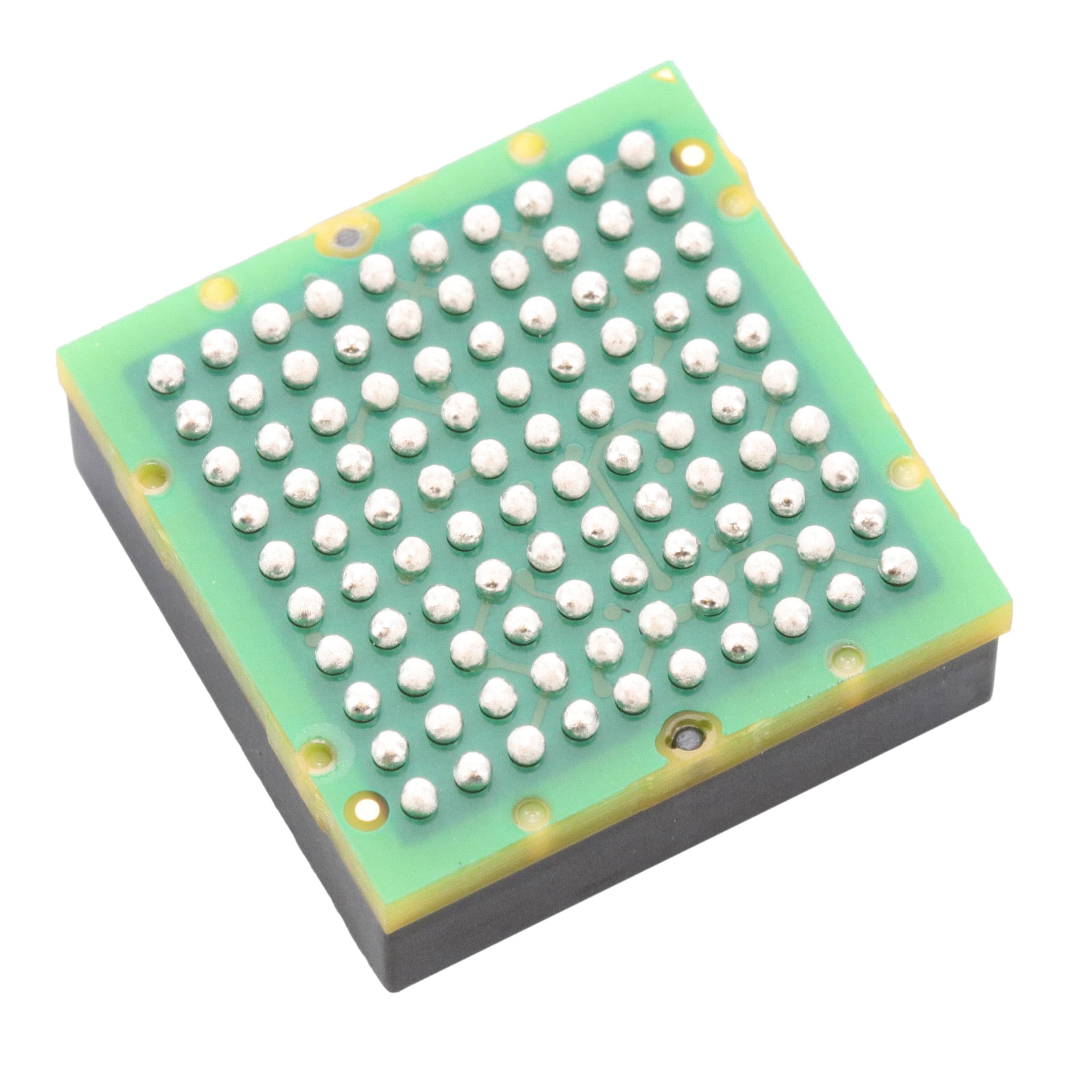
ADIS16505-2BMLZ uses a 100-ball BGA package (15 mm × 15 mm × 5 mm, ML-100-13), with 29 ground balls, 7 VDD balls, and dedicated SPI/control signals. Pin functions are validated per Analog Devices ADIS16505 Rev. C datasheet Figures 5–6 and Table 5.
| Pin/Terminal | Circuit Role | Design Meaning |
|---|---|---|
| CS (G3) | SPI Chip Select | Active-low enable for register read/write; must be held low for full SPI transaction duration |
| SCLK (H6) | SPI Serial Clock | Up to 2.1 MHz clock input; timing-critical for burst reads and configuration writes |
| DIN (G6) | SPI Data Input | Accepts command/address/data; setup/hold times require ≤25 ns/50 ns at 2 MHz |
| DOUT (H3) | SPI Data Output | Provides sensor data, status flags, and register contents; valid within 25 ns of SCLK edge |
| DR (J6) | Data Ready Indicator | Active-high pulse signals new sample availability; synchronizes acquisition across multi-sensor systems |
| SYNC (J3) | External Sync Input | Accepts 1.9–2.1 kHz clock for deterministic sampling; supports direct/scaled/output sync modes |
| RST (F3) | Hardware Reset | Minimum 1 μs low pulse initiates full internal reset; recovery time is 255 ms |
Key Features
| Feature | Design Value |
|---|---|
| Triaxial delta angle/delta velocity outputs | Enables strapdown inertial navigation integration without host-side numerical differentiation, reducing computational load and quantization error |
| Factory-calibrated axis-to-axis misalignment (±0.25°) | Eliminates need for mechanical alignment fixtures in navigation frame mounting; simplifies PCB-level orientation |
| On-demand self-test for inertial sensors and flash memory | Validates sensor functionality and nonvolatile configuration integrity before mission-critical operation, meeting ISO 26262 diagnostic coverage requirements |
| Bartlett window filter with programmable decimation | Reduces gyroscope noise density to 4.3×10⁻³ °/sec/√Hz (x/y-axis) while preserving 480 Hz bandwidth for responsive control |
| 14,700 m/sec² mechanical shock survivability | Withstands drop impacts and vibration in mobile machinery, enabling deployment in excavators, harvesters, and delivery robots without external shock mounting |
Applications
| Unmanned Aerial Vehicles (UAVs) | Industrial Robotics |
|---|---|
Use Scenario: Attitude estimation and flight stabilization in GPS-denied indoor or urban canyon environments. IC Role / Device Role / Timing Role: Primary inertial sensor providing real-time 6-DoF motion data for Kalman filter fusion with magnetometer and barometer. Use Value: 0.15°/√hr angular random walk and ±0.25° axis misalignment ensure <0.5° heading error accumulation over 10-minute hover, enabling precise waypoint navigation. |
Use Scenario: Joint angle feedback and end-effector motion control in collaborative robotic arms operating near humans. IC Role / Device Role / Timing Role: High-bandwidth motion monitor feeding safety torque limits and path-following corrections at 2000 SPS. Use Value: 2.2°/hr in-run bias stability and −40°C to +105°C operation allow continuous duty-cycle performance without thermal recalibration drift. |
| Smart Construction Machinery | Autonomous Mobile Robots (AMRs) |
Use Scenario: Grade control and blade tilt compensation in bulldozers and graders using GNSS-aided INS. IC Role / Device Role / Timing Role: High-shock-tolerant IMU delivering stable angular rate and acceleration data during earthmoving vibration. Use Value: 14,700 m/sec² shock survivability and ±78.4 m/sec² accelerometer range prevent saturation during hydraulic actuation and terrain impact. |
Use Scenario: Dead reckoning and SLAM initialization in warehouse AMRs navigating narrow aisles with intermittent LiDAR occlusion. IC Role / Device Role / Timing Role: Core motion reference unit generating delta-angle updates for pose integration between wheel encoder updates. Use Value: Factory-calibrated sensitivity/bias eliminates field calibration labor; 2000 SPS output enables <1 ms motion update latency for collision avoidance. |
Equivalent & Alternatives
The following parts are listed as comparable options for similar inertial sensing applications.
| Alternative Part | Technical Difference | Application Difference | Selection Advice |
|---|---|---|---|
| ADIS16470AMLZ | Wider gyroscope range (±2000°/sec), higher ARW (0.3°/√hr), same 100-ball BGA but different register map and calibration structure | Better suited for high-dynamic aerospace launch detection; less optimal for precision slow-motion robotics due to higher noise floor | Select ADIS16470AMLZ only when ±2000°/sec range is mandatory and 0.15°/√hr ARW is not required |
| ICM-20680 | Lower-cost consumer-grade 6-DoF IMU; ±500°/sec gyro range but no factory calibration, 10× worse bias stability (>20°/hr), no delta outputs | Acceptable for cost-sensitive motion UI or basic tilt sensing; unsuitable for navigation-grade dead reckoning or stabilization | Choose ICM-20680 only for non-safety-critical, short-duration motion capture where calibration overhead is acceptable |
Compared with ADIS16505-2BMLZ, ADIS16470AMLZ trades lower angular random walk for higher dynamic range and increased noise, while ICM-20680 lacks factory calibration and delta outputs-making ADIS16505-2BMLZ the optimal balance of precision, ruggedness, and ease of integration for industrial navigation.
Availability
ADIS16505-2BMLZ is available at Aetrix Electronics and suitable for unmanned aerial vehicles, industrial robotics, smart construction machinery, and autonomous mobile robots requiring stable component supply, long-term lifecycle support, and guaranteed traceable sourcing.
Supply support for ADIS16505-2BMLZ includes scheduled delivery planning, volume procurement assistance, BOM continuity management, traceable sourcing, and lifecycle availability coordination for OEM customers, industrial embedded developers, connected-device designers, and electronics production programs.
Manufacturer
Analog Devices is a global leader in high-performance analog, mixed-signal, and digital signal processing semiconductors, serving industrial, automotive, communications, and healthcare markets since 1965.
The ADIS16505 product line delivers factory-calibrated, miniature MEMS IMUs designed specifically for high-accuracy navigation, stabilization, and instrumentation in harsh industrial and mobile environments.
FAQ
What is the gyroscope dynamic range of the ADIS16505-2BMLZ?
The ADIS16505-2BMLZ has a gyroscope dynamic range of ±500°/sec, optimized for medium-speed rotational motion in applications like robotic joint control and UAV attitude stabilization. This range balances resolution and headroom-providing 40 LSB/°/sec in 16-bit mode-without saturating during typical operational maneuvers. The ±500°/sec specification is fixed per variant and cannot be reconfigured in firmware.
Does the ADIS16505-2BMLZ include factory calibration for temperature drift?
Yes, the ADIS16505-2BMLZ undergoes full factory calibration across −40°C to +85°C for gyroscope bias, sensitivity, axis misalignment, and accelerometer bias. Temperature compensation coefficients are stored in on-chip flash and applied automatically during operation. Gyroscope bias error over temperature is ±0.5% (1σ), and accelerometer error is ±0.07% (1σ), both verified per Rev. C datasheet Tables 1 and 4.
What is the purpose of the DR (Data Ready) pin on the ADIS16505-2BMLZ?
The DR (Data Ready) pin on the ADIS16505-2BMLZ is an active-high indicator that pulses each time a new set of synchronized gyroscope, accelerometer, and temperature data is ready for readout. Its timing is deterministic: in direct sync mode, DR asserts 305 μs after SYNC pulse (no SPI traffic) or 405 μs (full SPI traffic), enabling precise hardware-triggered acquisition without polling overhead.
Can the ADIS16505-2BMLZ operate from a 3.0 V supply?
Yes, the ADIS16505-2BMLZ supports a supply voltage range of 3.0 V to 3.6 V, with normal-mode current draw of 44–55 mA at 3.3 V. At 3.0 V, operation remains functional but power-on start-up time increases slightly to ~320 ms, and output drive strength decreases marginally-verified in Absolute Maximum Ratings (Table 3) and Power Supply section (Page 5). No derating is required.
How does the ADIS16505-2BMLZ handle mechanical shock?
The ADIS16505-2BMLZ is rated for 14,700 m/sec² mechanical shock survivability (½-sine, 0.5 ms, any axis, unpowered), validated per MIL-STD-883 Method 2002. This enables reliable operation in high-impact environments such as construction equipment, drone landings, and automated guided vehicles-without requiring external shock mounts or isolation hardware.
ADIS16505-2BMLZ Specifications
- Product attributes
- Attribute value
- Manufacturer:
- Analog Devices Inc.
- Series:
- iMEMS®, iSensor™
- Package/Case:
- 100-BBGA Module
- Packaging:
- Tray
- Product Status:
- Active
- Sensor Type:
- Accelerometer, Gyroscope, 6 Axis
- Output Type:
- SPI
- Operating Temperature:
- -40°C ~ 105°C
- Grade:
- -
- Qualification:
- -
- Supplier Device Package:
- 100-BGA Module (15x15)
- Mounting Type:
- Surface Mount
ADIS16505-2BMLZ FAQ
1.How can I place an order for ADIS16505-2BMLZ through Aetrix?
Please submit a Request for Quotation (RFQ) for ADIS16505-2BMLZ on Aetrix. Our sales agent will provide a competitive quotation and guide you through the order confirmation once you accept the terms.
2.Are the price and stock information for ADIS16505-2BMLZ reliable?
The price and inventory of ADIS16505-2BMLZ are updated periodically and may fluctuate due to market conditions. Stock and pricing data are typically refreshed every 24 hours. Quotation validity for ADIS16505-2BMLZ is usually 5 days.
3.What payment methods are accepted for ADIS16505-2BMLZ?
We accept Wire Transfer, PayPal, Credit Card, Western Union, MoneyGram, and Escrow for ADIS16505-2BMLZ transactions.
Note: Certain payment methods may incur a processing fee.
4.How is shipping managed for ADIS16505-2BMLZ?
ADIS16505-2BMLZ orders can be shipped via leading logistics carriers, including DHL, UPS, FedEx, TNT, or Registered Mail.
Once your ADIS16505-2BMLZ order is processed, you will receive an email with the shipment details and tracking number.
Note: Tracking information may take up to 24 hours to appear. Express delivery typically takes 3–5 business days.
5.How can I obtain technical support or documentation for ADIS16505-2BMLZ?
For technical support, including ADIS16505-2BMLZ datasheets, pinout diagrams, or application guidance, please contact our engineering support team. They can provide detailed documentation and assistance for your ADIS16505-2BMLZ requirements.
6.How does Aetrix verify that ADIS16505-2BMLZ is sourced from the original manufacturer or authorized distributors?
All ADIS16505-2BMLZ products on Aetrix are procured from qualified distributors and authorized channels. Our dedicated quality assurance team conducts strict verification, including traceability checks and, if necessary, third-party testing. This ensures that ADIS16505-2BMLZ meets industry standards.
7.What is the process for return or replacement of ADIS16505-2BMLZ?
All ADIS16505-2BMLZ units undergo pre-shipment inspection (PSI). If there is an issue with ADIS16505-2BMLZ, returns or replacements are accepted under the following conditions:
1.Quantity discrepancies, incorrect items, or visible external defects (such as breakage or corrosion), acknowledged by Aetrix.
2.The issue is reported within 90 days of delivery.
3.The ADIS16505-2BMLZ part is unused and in its original packaging.
Return procedure for ADIS16505-2BMLZ:
1.Submit a request within 90 days.
2.Obtain a Return Material Authorization (RMA) from Aetrix.
ADIS16505-2BMLZ Tags

-
BMI323
Bosch Sensortec
-
ICM-42670-P
TDK InvenSense
-
ICM-42605
TDK InvenSense

-
LSM6DSO32TR
STMicroelectronics
-
LSM6DSOTR
STMicroelectronics
-
LSM6DSVTR
STMicroelectronics
-
LSM6DSRTR
STMicroelectronics
-
BMI270
Bosch Sensortec
-
LSM6DSOXTR
STMicroelectronics
-
LSM6DSV16XTR
STMicroelectronics
-
LSM6DSO16ISTR
STMicroelectronics
-
LSM303AGRTR
STMicroelectronics
Tech Hub

A practical engineering guide to 3.3V and 5V logic compatibility, input thresholds, resistor dividers, translator ICs, MOSFET level shifting, I2C pull-ups, timing limits and power-sequencing risks.

The 74HC595 uses push-pull logic outputs, while the TPIC6B595 uses 50 V open-drain DMOS sinks for higher-power loads. This guide compares timing, current limits, 3.3 V interfacing, load wiring, thermal…

The 74HC595 converts serial data into eight stable parallel outputs. This guide covers pin functions, shift and storage timing, OE and MR behavior, drive-current limits, cascading, voltage compatibilit…

A technical comparison of level-sensitive latches and edge-triggered flip-flops, covering timing windows, setup and hold limits, master–slave operation, time borrowing, race-through, HDL inference and…

A D latch stores one bit while Enable controls when data can pass. This reference covers gate-level operation, truth tables, transparency, setup and hold timing, LE versus OE, common ICs and practical …

An SR latch stores one bit through cross-coupled feedback. This engineering reference covers NOR and NAND implementations, truth tables, forbidden-state recovery, gated operation, switch debouncing, fa…

Latch circuits retain one bit through feedback. This technical reference covers SR and D latches, truth tables, transparency, timing limits, latch-versus-flip-flop behavior, applications and common log…

An engineering guide to LED driver operation, constant-current and constant-voltage outputs, linear and switching topologies, dimming, IC selection, calculations, replacement compatibility, and fault c…

Operational amplifier guide covering op amp basics, feedback, ideal vs real op amps, common configurations, buffer circuits, offset, bias current, gain-bandwidth, slew rate, rail-to-rail limits and sel…

Jumper cables guide covering safe connection order, red and black clamp placement, final ground connection, cable gauge, length, clamp quality, copper vs CCA cables, jump starter comparison and battery…


