
 My Inquiry
 My Account


Diodes Incorporated AP43776ZDZ20-13

- Part No.:
- AP43776ZDZ20-13
- Manufacturer:
- Diodes Incorporated
- Category:
- Power Management - Specialized
- Package:
- 20-WFQFN Exposed Pad
- Datasheet:
-
 AP43776ZDZ20-13.pdf
- Description:
- ACDC DECODER W-QFN4040-20 T&R 3K
- Quantity:
- Payment:

- Shipping:

Inventory:2,975
Please send an inquiry. Send us your inquiry, and we will respond immediately.
Product details
Overview
AP43776ZDZ20-13 from Diodes Incorporated is a dual-channel, MCU-based USB Type-C PD3.1/PPS/QC5 protocol decoder in W-QFN4040-20 package. It delivers certified USB-IF PD3.1 (TID 6206) and QC5 (QC20211008263) compliance, supports full PPS range (3.3–21 V @ 20 mV/step, up to 6 A @ 50 mA/step), and enables two independent PD3.1 charging ports without external output-enable MOSFETs. It is deployed in multi-port automotive USB PD chargers.
For engineers reviewing the AP43776ZDZ20-13 datasheet, AP43776ZDZ20-13 pinout, AP43776ZDZ20-13 application, or AP43776ZDZ20-13 equivalent, key selection criteria include dual-channel PPS voltage/current resolution, embedded 16-channel 8-bit SAR ADC for thermal/voltage monitoring, I2C master capability for buck-boost controller coordination, and e-Marker cable detection with 15 Ω VCONN switch.
Technical Context
The AP43776 integrates two independent hardware BMC transceivers and D+/D− PHYs per channel to handle concurrent USB PD3.1 handshake and QC5/FCP negotiation with sub-millisecond response. Its 8-bit 8051 MCU executes firmware stored in 12 KB OTP ROM and user-configurable MTP blocks, enabling runtime power-sharing logic between ports.
It operates as an I2C master communicating with two external buck-boost controllers, conveying negotiated voltage/current targets and protection triggers (OVP on DP/DN, OTP, OCP on VCONN). GPIO pins support UART interconnection between two AP43776 devices for four-port smart power sharing, while internal ADC digitizes temperature via GPIO3/GPIO4 current-source NTC interfaces.
Key Specifications
| Parameter | Value and Actual Design Meaning |
|---|---|
| Protocol Support | USB PD3.1 Rev 3.1 v1.1 (TID 6206), QC5 (QC20211008263), BC1.2 DCP, FCP |
| PPS Output Range | 3.3–21 V at 20 mV/step; up to 6 A at 50 mA/step - enables precise battery charging across wide chemistries |
| VCONN Switch RDS(on) | 15 Ω - drives e-Marker cables up to 30 mA with integrated overcurrent protection |
| ADC Resolution | 16-channel, 8-bit SAR @ 83 kHz - measures VBUS, CC line voltages, and NTC thermistors for thermal derating |
| Power Modes | Normal mode: ≤3 mA; Sleep mode: ~0.5 mA - extends standby efficiency in always-on car charger designs |
| I2C Role | Master only - directly commands two I2C-based buck-boost converters without intermediate logic |
| Package | W-QFN4040-20 (4 mm × 4 mm, 0.5 mm pitch) - supports high-density multi-port PCB layouts |
Pinout & Package
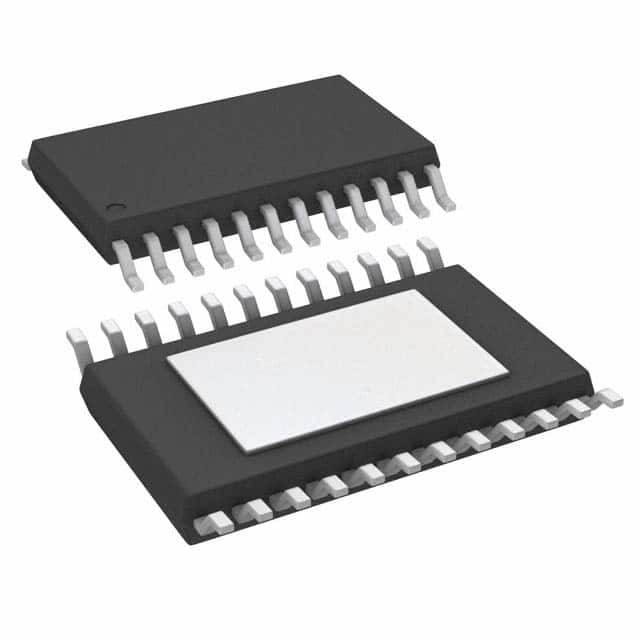
AP43776ZDZ20-13 uses a wettable flank W-QFN4040-20 package with 20-pin top-side layout and exposed thermal pad connected to PCB ground.
| Pin/Terminal | Circuit Role | Design Meaning |
|---|---|---|
| CC1_A / CC2_A / CC1_B / CC2_B | USB Type-C CC line transceiver outputs | Drive BMC signaling and VCONN power for channel A/B; support plug orientation detection and role negotiation |
| DP_A / DN_A / DP_B / DN_B | D+/D− differential pair interfaces | Enable QC5/FCP handshake; include 20 kΩ/900 kΩ pull-downs and short-detection circuitry (5–40 Ω) |
| SCL / SDA | I2C bus interface | Master-mode communication with buck-boost controllers; 760–920 μA sink capability ensures robust noise immunity |
| GPIO1–GPIO8 | Configurable digital I/O | Support UART inter-chip comms (GPIO1/GPIO2), NTC sensing (GPIO3/GPIO4), LED indication (GPIO5/GPIO6), and V/I reporting (GPIO7/GPIO8) |
| VCC | Main supply input | 3–5.5 V operation; powers internal LDOs and bias circuits - no external decoupling required |
Key Features
| Feature | Design Value |
|---|---|
| Dual independent PD3.1 PPS decoders | Eliminates need for separate PD controllers per port - reduces BOM count and PCB area in dual-C car chargers |
| Embedded 12 KB OTP + MTP ROM | Stores certified PD/QC firmware and allows field-updatable configuration tables for custom power-sharing rules |
| Cable-loss compensation | Adjusts output voltage dynamically based on real-time VBUS drop measurement - maintains target voltage at device connector |
| Integrated VCONN switch + OCP | 15 Ω RDS(on) with 32–56 mA trip threshold - enables safe e-Marker cable support without external FET or sense resistor |
| Smart power sharing (2 or 4 ports) | UART-linked dual-device topology allocates fixed-source power across four ports using runtime load balancing |
Applications
| Multi-port Automotive USB PD Charger | 120W Dual-C PD3.1 PPS Power Bank |
|---|---|
Use Scenario: In-vehicle dual USB-C charging system powered from 12 V battery with two independent 60 W PD3.1 outputs. IC Role / Device Role / Timing Role: Protocol decoder and power manager - negotiates voltage/current per port, controls buck-boost converters via I2C, and enforces thermal derating. Use Value: Enables compact, certified 120 W dual-C solution without discrete MOSFETs for output enable - reduces component count by ≥6 vs. discrete controller + gate driver approach. | Use Scenario: Portable 120 W power bank supporting simultaneous fast charging of laptop and smartphone via two USB-C ports. IC Role / Device Role / Timing Role: Dual-channel PD3.1 coordinator - manages shared battery capacity, prevents over-discharge during high-power delivery, and reports real-time V/I via GPIO. Use Value: Delivers precise PPS regulation (20 mV/step) across full 3.3–21 V range - matches lithium-ion and GaN charger requirements without external DAC or feedback loop tuning. |
| Four-Port Smart Charging Hub | Industrial Docking Station |
Use Scenario: Desktop docking station with four USB-C ports drawing from single 19 V/10 A AC adapter. IC Role / Device Role / Timing Role: Two AP43776 devices interconnected via UART - negotiate total power budget and allocate per-port limits in real time. Use Value: Achieves dynamic load balancing across four ports - avoids tripping AC adapter OCP while maximizing utilization of available 190 W input power. | Use Scenario: Ruggedized industrial docking station for medical tablets requiring certified PD3.1 charging and fault logging. IC Role / Device Role / Timing Role: Safety-critical PD controller - monitors CC/DP/DN shorts (up to 24 V), implements OTP at 150 °C junction, and logs faults via GPIO-interrupt-driven I2C writes. Use Value: Meets IEC 62368-1 creepage/clearance requirements via integrated OVP (4.1–4.6 V on DP/DN) and short-protection - eliminates need for external TVS arrays. |
Equivalent & Alternatives
The following parts are listed as comparable options for similar dual-channel USB PD3.1 protocol decoder applications.
| Alternative Part | Technical Difference | Application Difference | Selection Advice |
|---|---|---|---|
| STUSB4760QTR | Single-channel PD3.0 controller; requires external MCU for dual-port coordination and lacks PPS resolution below 100 mV/step | No native support for QC5 or cable-loss compensation; needs external ADC for thermal monitoring | Select when cost-sensitive single-port design suffices and QC5 certification is not required |
| IP2726 | Dual-channel PD3.0+PPS with 25 mV/step resolution; no QC5 certification; uses external 32.768 kHz crystal for timing | Lacks integrated VCONN switch - requires external 15 Ω FET and OCP circuit; no UART inter-device linking | Choose for non-automotive consumer docks where QC5 compliance and e-Marker support are optional |
Compared with STUSB4760QTR and IP2726, AP43776ZDZ20-13 uniquely combines USB-IF PD3.1 + QC5 certification, 20 mV/step PPS granularity, integrated VCONN switch, and UART-enabled four-port scaling - making it the only option qualified for certified 120 W dual-C automotive chargers.
Availability
AP43776ZDZ20-13 is available at Aetrix Electronics and suitable for multi-port automotive USB PD chargers, portable 120 W power banks, and industrial docking stations requiring stable component supply and long-term lifecycle support.
Supply support for AP43776ZDZ20-13 includes scheduled delivery planning, volume procurement assistance, BOM continuity management, traceable sourcing, and lifecycle availability coordination for OEM customers, industrial embedded developers, connected-device designers, and electronics production programs.
Manufacturer
Diodes Incorporated is a global manufacturer of discrete semiconductors and ICs, specializing in power management, signal integrity, and connectivity solutions for automotive, industrial, and consumer markets.
The AP43776 belongs to Diodes' USB Power Delivery Controller product line, engineered specifically for high-efficiency, space-constrained multi-port PD3.1/PPS charging systems where certification, thermal resilience, and firmware flexibility are critical.
FAQ
Does AP43776ZDZ20-13 require external crystal or oscillator?
No. The AP43776 integrates a 12 MHz ±10% internal clock generator, eliminating need for external crystal or oscillator. This reduces BOM count and PCB footprint while maintaining timing accuracy sufficient for USB PD BMC signaling and I2C communication up to 400 kHz.
How does AP43776 handle overtemperature protection?
AP43776 implements overtemperature protection (OTP) using its built-in 16-channel 8-bit SAR ADC to monitor NTC thermistors connected to GPIO3/GPIO4. When junction temperature exceeds 150 °C, firmware triggers thermal derating - reducing output current or disabling ports - without requiring external thermal sensors or comparator circuits.
Can AP43776ZDZ20-13 support USB-C cables without e-Marker chips?
Yes. AP43776 detects presence of e-Marker cables via VCONN current draw but operates fully with legacy USB-C cables. For non-e-Marker cables, it defaults to 3 A maximum current per port and disables cable-loss compensation - maintaining full PD3.1/PPS functionality within USB-IF specification limits.
What is the function of the exposed thermal pad on W-QFN4040-20?
The exposed thermal pad on AP43776ZDZ20-13 must be soldered to a solid PCB ground plane to achieve specified thermal resistance (θJA = 122 °C/W). It conducts heat from the die to the board, enabling reliable operation at 85 °C ambient with full 6 A per channel current - critical for enclosed automotive charger enclosures.
AP43776ZDZ20-13 Specifications
- Product attributes
- Attribute value
- Manufacturer:
- Diodes Incorporated
- Series:
- -
- Package/Case:
- 20-WFQFN Exposed Pad
- Packaging:
- Tape & Reel (TR)
- Product Status:
- Active
- Applications:
- Quick Charge Decoder
- Current - Supply:
- 3mA
- Voltage - Supply:
- 3V ~ 5.5V
- Operating Temperature:
- -40°C ~ 85°C
- Grade:
- -
- Qualification:
- -
- Mounting Type:
- Surface Mount
- Supplier Device Package:
- W-QFN4040-20 (Type A1)
AP43776ZDZ20-13 FAQ
1.How can I place an order for AP43776ZDZ20-13 through Aetrix?
Please submit a Request for Quotation (RFQ) for AP43776ZDZ20-13 on Aetrix. Our sales agent will provide a competitive quotation and guide you through the order confirmation once you accept the terms.
2.Are the price and stock information for AP43776ZDZ20-13 reliable?
The price and inventory of AP43776ZDZ20-13 are updated periodically and may fluctuate due to market conditions. Stock and pricing data are typically refreshed every 24 hours. Quotation validity for AP43776ZDZ20-13 is usually 5 days.
3.What payment methods are accepted for AP43776ZDZ20-13?
We accept Wire Transfer, PayPal, Credit Card, Western Union, MoneyGram, and Escrow for AP43776ZDZ20-13 transactions.
Note: Certain payment methods may incur a processing fee.
4.How is shipping managed for AP43776ZDZ20-13?
AP43776ZDZ20-13 orders can be shipped via leading logistics carriers, including DHL, UPS, FedEx, TNT, or Registered Mail.
Once your AP43776ZDZ20-13 order is processed, you will receive an email with the shipment details and tracking number.
Note: Tracking information may take up to 24 hours to appear. Express delivery typically takes 3–5 business days.
5.How can I obtain technical support or documentation for AP43776ZDZ20-13?
For technical support, including AP43776ZDZ20-13 datasheets, pinout diagrams, or application guidance, please contact our engineering support team. They can provide detailed documentation and assistance for your AP43776ZDZ20-13 requirements.
6.How does Aetrix verify that AP43776ZDZ20-13 is sourced from the original manufacturer or authorized distributors?
All AP43776ZDZ20-13 products on Aetrix are procured from qualified distributors and authorized channels. Our dedicated quality assurance team conducts strict verification, including traceability checks and, if necessary, third-party testing. This ensures that AP43776ZDZ20-13 meets industry standards.
7.What is the process for return or replacement of AP43776ZDZ20-13?
All AP43776ZDZ20-13 units undergo pre-shipment inspection (PSI). If there is an issue with AP43776ZDZ20-13, returns or replacements are accepted under the following conditions:
1.Quantity discrepancies, incorrect items, or visible external defects (such as breakage or corrosion), acknowledged by Aetrix.
2.The issue is reported within 90 days of delivery.
3.The AP43776ZDZ20-13 part is unused and in its original packaging.
Return procedure for AP43776ZDZ20-13:
1.Submit a request within 90 days.
2.Obtain a Return Material Authorization (RMA) from Aetrix.
AP43776ZDZ20-13 Tags
-
TPS2511DGNR
Texas Instruments
-
UTC2000/MG
Microchip Technology
-
TUSB320HAIRWBR
Texas Instruments
-
TPS61252DSGR
Texas Instruments
-
PI5USB30216CXUAEX
Diodes Incorporated
-
SN6501DBVR
Texas Instruments
-
CYPD3177-24LQXQT
Infineon Technologies
-
SN6501QDBVRQ1
Texas Instruments
-
STUSB1600AQTR
STMicroelectronics

-
SN6505BDBVR
Texas Instruments
-
SN6501DBVT
Texas Instruments
-
TPS65150PWPR
Texas Instruments
Tech Hub

An engineering guide to LED driver operation, constant-current and constant-voltage outputs, linear and switching topologies, dimming, IC selection, calculations, replacement compatibility, and fault c…

Operational amplifier guide covering op amp basics, feedback, ideal vs real op amps, common configurations, buffer circuits, offset, bias current, gain-bandwidth, slew rate, rail-to-rail limits and sel…

Jumper cables guide covering safe connection order, red and black clamp placement, final ground connection, cable gauge, length, clamp quality, copper vs CCA cables, jump starter comparison and battery…

LDO regulator guide covering low dropout voltage, power dissipation, thermal design, PSRR, output noise, capacitor stability, adjustable LDO circuits, LDO vs buck converter and datasheet selection chec…

Conditional Access Module guide covering CAM meaning, CI/CI+ interface, smart card authorization, DVB security workflow, TV and set-top box compatibility, internal electronics, ESD protection, connecto…

Guide to electronic component obsolescence covering EOL risk, PCN/PDN notices, last-time buy planning, replacement options, form-fit-function validation, counterfeit risk and BOM lifecycle management.

18650 battery guide covering lithium-ion cell basics, 3.6V/3.7V voltage, 4.2V charging, mAh and Wh capacity, protected cells, chargers, BMS, series-parallel packs, holders, welding and sourcing checks.…

Hall effect sensor guide covering working principle, linear and digital sensors, Arduino circuits, current sensing, speed detection, automotive applications, A3144 examples, signal filtering and datash…

Product Change Notification guide for electronic components, covering PCN meaning, PCN vs PDN/EOL, common change types, risk levels, form-fit-function review, engineering validation, BOM control, LTB/L…

A practical guide to blend door actuators, covering HVAC function, symptoms, location, AC and heater issues, reset and calibration, replacement cost, electrical diagnosis, compatibility checks, and rep…


