
 My Inquiry
 My Account


Diodes Incorporated PI5USB30216CXUAEX
- Part No.:
- PI5USB30216CXUAEX
- Manufacturer:
- Diodes Incorporated
- Category:
- Power Management - Specialized
- Package:
- 12-XFQFN
- Datasheet:
-
 PI5USB30216CXUAEX.pdf
- Description:
- IC PLUG IN DET TYPE C 12X2QFN
- Quantity:
- Payment:

- Shipping:

Inventory:27,501
Please send an inquiry. Send us your inquiry, and we will respond immediately.
Product details
Overview
PI5USB30216CXUAEX from Diodes Incorporated is a USB Type-C™ plug-in detector IC supporting host/device/dual-role port configuration via CC1/CC2 channel sensing, with integrated 5.1 kΩ pull-down resistors (SNK), 80 µA pull-up current source (SRC), I²C and pin-control interfaces, and VBUS detection capability for connector attachment monitoring in portable electronics.
For engineers reviewing the PI5USB30216CXUAEX datasheet, PI5USB30216CXUAEX pinout, PI5USB30216CXUAEX application, or PI5USB30216CXUAEX equivalent, key selection considerations include CC pin voltage threshold accuracy (±0.05 V), dual-mode control flexibility (ADDR-configurable I²C vs. GPIO), industrial temperature operation (−40°C to +85°C), and support for USB Type-C 1.1-compliant orientation auto-detection and 3A charging profile negotiation.
Technical Context
The PI5USB30216CXUAEX implements a dual-path detection architecture: analog CC1/CC2 comparators with programmable thresholds (0.20 V default, 0.66 V medium, 1.23 V high) feed status logic that drives open-drain outputs (ID, OUT1–OUT3) and updates I²C registers (0x03 interrupt, 0x04 CC status). Its internal state machine supports four connection states-unattached, Attached.SNK, Attached.SRC, AudioAccessory-and resets on ENB toggling or VDD drop below 1.0 V.
It integrates tri-level input decoding (PORT, ADDR), 910 kΩ VBUSDET scaling network interface, dead-battery startup (CC1/CC2 pulled low at VDD = 0 V), and I²C slave addressing with two fixed addresses (0x7D/0x75) determined by ADDR pin level. Power management includes active-low ENB with 5 MΩ internal pull-up and <5 µA disable-state current draw.
Key Specifications
| Parameter | Value and Actual Design Meaning |
|---|---|
| USB Compliance | USB Type-C Specification 1.1 compliant; backward compatible with v1.0; supports Try.SNK/Try.SRC negotiation |
| CC Detection Accuracy | VTH1_SNK = 0.20 V ±0.05 V (default mode); enables reliable SNK identification under varying cable impedance |
| Current Mode Support | Default (80 µA), 1.5A (180 µA), 3A (330 µA) SRC modes; detected via OUT1/OUT2 logic levels in pin-control mode |
| Supply Range | 2.7 V to 5.5 V VDD; operates across single-cell Li-ion (3.0–4.2 V) and USB bus (5 V) rails without LDO |
| VBUS Detection | Threshold = 3.01 V (typ.) with 910 kΩ external resistor; allows safe VBUS monitoring up to 28 V system input |
| Operating Temp | −40°C to +85°C; qualified for industrial-grade embedded systems including docking stations and tablets |
| I²C Interface | Fast-mode (400 kHz); no offset byte; sequential register access required; ADDR pin selects slave address (0x75 or 0x7D) |
Pinout & Package
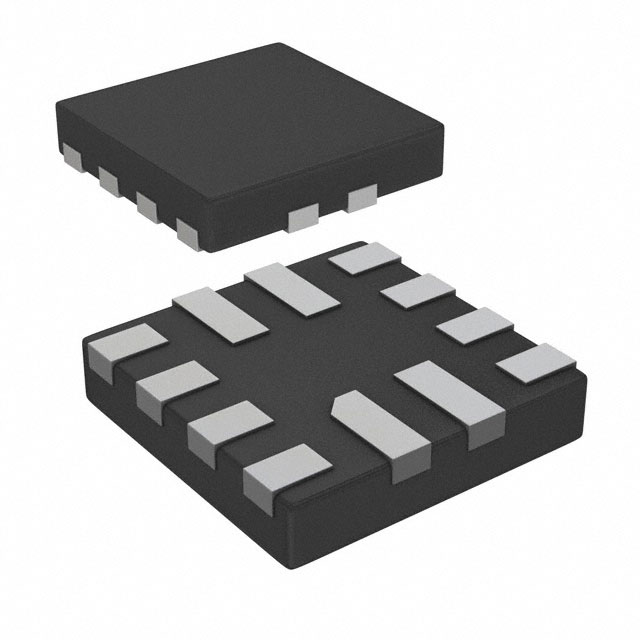
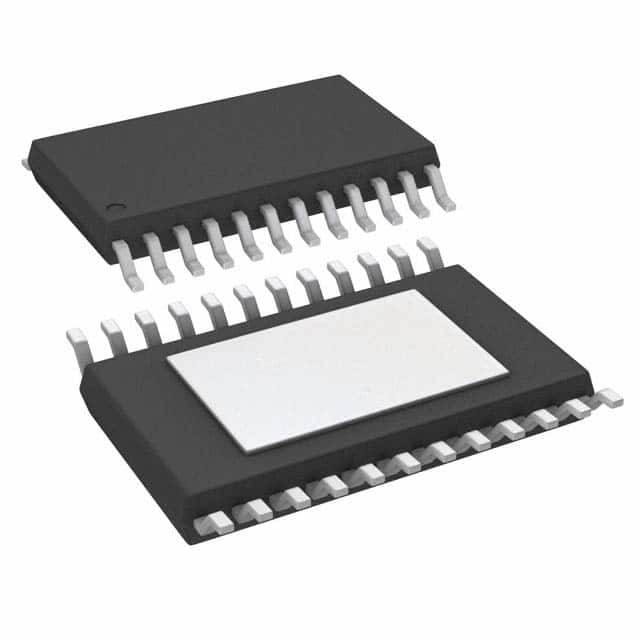
PI5USB30216CXUAEX is housed in a 12-contact STQFN package measuring 1.6 mm × 1.6 mm with 0.4 mm pitch and wettable flank terminals for automated optical inspection.
| Pin/Terminal | Circuit Role | Design Meaning |
|---|---|---|
| 1, 2 | CC1, CC2 | Bi-directional configuration channel I/O; internally clamped to VDD+0.5 V; used for orientation detection, role negotiation, and accessory identification |
| 3 | PORT | Tri-level input controlling port mode: GND = SNK, float = DRP (Try.SNK), VDD = SRC; sets initial role before I²C override |
| 4 | VBUSDET | Analog input scaled by external 910 kΩ resistor; triggers VBUS presence detection at ~3.0 V threshold for device-attachment inference |
| 5 | ADDR | Tri-level input selecting control mode: float = pin control, VDD/GND = I²C enabled with slave address bit-6 = 1/0 |
| 6 | INTB / OUT3 | Open-drain interrupt output (I²C mode) or audio adapter accessory indicator (pin mode); active-low, 1.6 mA sink capability |
| 7, 8 | SDA / OUT1, SCL / OUT2 | I²C data/clock bidirectional pins; double-function as current-mode detect outputs (OUT1/OUT2) in pin-control device mode |
| 9 | ID | Open-drain host-attachment indicator; pulled low only when acting as SRC and detecting SNK; hi-Z otherwise |
| 10 | GND | System ground reference; shared return path for all analog and digital functions |
| 11 | ENB | Active-low enable with 5 MΩ internal pull-up; forces CC1/CC2 low and disables outputs (except CC/SDA/SCL/INTB) in disabled state |
| 12 | VDD | Primary power supply input; powers internal regulators, comparators, and logic; supports dead-battery startup down to 0 V |
Key Features
| Feature | Design Value |
|---|---|
| Auto-orientation detection | Real-time CC1/CC2 voltage comparison enables automatic USB-C plug insertion direction recognition without MCU polling |
| Dual-control interface | Selectable between hardware pin control (PORT/ADDR) and software-configurable I²C (0x02 control register) for flexible system integration |
| 3A charging profile support | Configurable SRC current modes (80/180/330 µA) and SNK detection thresholds ensure compliance with USB PD 3.0 default/medium/high power contracts |
| Audio accessory detection | OUT3 pin asserts low upon audio adapter attachment (per USB-C spec Appendix A); eliminates need for separate accessory ID circuitry |
| Dead-battery compatibility | CC1/CC2 forced low at VDD = 0 V allows host ports to recognize unpowered devices and initiate VBUS charging automatically |
Applications
| Mobile Phone Charging Port | Notebook Docking Interface |
|---|---|
|
Use Scenario: Detects USB-C cable insertion direction and negotiates host/device role during fast-charging handshakes. IC Role / Device Role / Timing Role: Plug-in detector and role negotiator; monitors CC1/CC2 to determine SNK/SRC state and reports via ID/INTB within 10 ms of attach. Use Value: Enables native 3A charging without external level shifters or discrete comparators; reduces BOM count by integrating Rd and Ip sources. |
Use Scenario: Manages multi-role connectivity between laptop and peripheral hub with simultaneous video, data, and power delivery. IC Role / Device Role / Timing Role: Dual-role port manager; uses PORT pin to initialize as DRP and switches to SRC/SNK based on CC line biasing; supports Try.SNK for reliable peripheral enumeration. Use Value: Eliminates firmware dependency for basic orientation detection; provides deterministic timing for VBUS assertion and ID assertion within 20 ms of stable CC detection. |
| Tablet Peripheral Adapter | USB-C Audio Dongle |
|
Use Scenario: Enables tablet-to-keyboard/mouse/hub connectivity with automatic role switching and VBUS-powered peripheral support. IC Role / Device Role / Timing Role: Host-mode initiator; detects device attachment via ID pin low pulse and configures charging profile using OUT1/OUT2 logic levels. Use Value: Supports 1.5A charging while maintaining USB 2.0 data path integrity; avoids false triggers from ESD transients due to internal 2000 V HBM protection. |
Use Scenario: Identifies USB-C analog audio adapters (e.g., 3.5 mm jack dongles) and signals host OS to route audio through legacy codec path. IC Role / Device Role / Timing Role: Accessory classifier; asserts OUT3 low only when CC1/CC2 match USB-C Audio Adapter spec (Ra = 1.1 kΩ); ignores debug accessories. Use Value: Provides hardware-level audio accessory detection independent of USB enumeration; reduces OS driver complexity and boot-time latency. |
Equivalent & Alternatives
The following parts are listed as comparable options for similar USB Type-C plug-in detection applications.
| Alternative Part | Technical Difference | Application Difference | Selection Advice |
|---|---|---|---|
| TUSB320LAIRTER | Single-supply 3.3 V only; no VDD=2.7–5.5 V range; lacks integrated 3A current mode detection logic | Requires external current-sense resistors and comparator for 3A mode; limited to host-only or device-only configurations | Choose for cost-sensitive, fixed-role designs where I²C control and wide VDD range are not required |
| USB3503A-AEZG | Integrated USB 2.0 switch + Type-C detection; larger QFN-24 package; higher IDD (120 µA active) | Supports simultaneous USB data switching and CC detection; adds signal integrity overhead for pure detection use cases | Choose when combining detection with USB 2.0 path switching; avoid if minimal footprint and ultra-low standby current (<35 µA) are critical |
Compared with TUSB320LAIRTER and USB3503A-AEZG, the PI5USB30216CXUAEX delivers broader supply flexibility, native 3A charging profile support without external components, and smallest footprint (1.6 mm × 1.6 mm), making it optimal for space-constrained mobile and docking applications requiring dual-mode control.
Availability
PI5USB30216CXUAEX is available at Aetrix Electronics and suitable for notebooks, mobile phones, tablets, and docking stations requiring stable component supply, industrial temperature operation, and USB Type-C 1.1 compliance.
Supply support for PI5USB30216CXUAEX includes scheduled delivery planning, volume procurement assistance, BOM continuity management, traceable sourcing, and lifecycle availability coordination for OEM customers, industrial embedded developers, connected-device designers, and electronics production programs.
Manufacturer
Diodes Incorporated is a global manufacturer of discrete semiconductors and analog ICs, specializing in high-reliability, energy-efficient solutions for consumer, industrial, and computing markets.
The PI5USB30216CXUAEX belongs to Diodes' USB Type-C interface product line, designed specifically to simplify USB-C connector implementation in portable electronics by integrating CC detection, role negotiation, and accessory classification into a single ultra-compact package.
FAQ
What is the function of the ADDR pin on PI5USB30216CXUAEX?
The ADDR pin is a tri-level input that selects the control interface mode: floating enables pin control (PORT/ENB/OUTx), VDD sets I²C address bit-6 = 1 (0x7D), and GND sets bit-6 = 0 (0x75). It does not affect analog functionality-CC detection and VBUS monitoring remain active regardless of ADDR state.
How does PI5USB30216CXUAEX handle dead-battery conditions?
When VDD = 0 V, internal circuitry pulls CC1 and CC2 low via integrated 5.1 kΩ resistors, signaling to an attached host port that the device is in SNK mode and requesting VBUS power. This enables charging initiation even with zero battery voltage, per USB Type-C dead-battery specification.
Can PI5USB30216CXUAEX detect audio adapters without I²C communication?
Yes-audio adapter detection is implemented in hardware and reported directly on the OUT3 pin: low indicates detection, hi-Z indicates absence. This occurs in both pin-control and I²C modes and requires no register reads, enabling immediate OS-level audio routing decisions.
What is the maximum VBUS voltage the PI5USB30216CXUAEX can safely monitor?
The VBUSDET pin accepts up to 28 V system VBUS, protected by an internal clamp diode limiting voltage to ~5.5 V. A 910 kΩ ±5% resistor must be placed between system VBUS and VBUSDET to scale input and ensure accurate 3.01 V detection threshold across temperature and process variation.
PI5USB30216CXUAEX Specifications
- Product attributes
- Attribute value
- Manufacturer:
- Diodes Incorporated
- Series:
- -
- Package/Case:
- 12-XFQFN
- Packaging:
- Tape & Reel (TR)
- Product Status:
- Active
- Applications:
- USB, Type-C Configuration
- Current - Supply:
- -
- Voltage - Supply:
- 2.7V ~ 5.5V
- Operating Temperature:
- -40°C ~ 85°C
- Grade:
- -
- Qualification:
- -
- Mounting Type:
- Surface Mount
- Supplier Device Package:
- 12-STQFN (1.6x1.6)
PI5USB30216CXUAEX FAQ
1.How can I place an order for PI5USB30216CXUAEX through Aetrix?
Please submit a Request for Quotation (RFQ) for PI5USB30216CXUAEX on Aetrix. Our sales agent will provide a competitive quotation and guide you through the order confirmation once you accept the terms.
2.Are the price and stock information for PI5USB30216CXUAEX reliable?
The price and inventory of PI5USB30216CXUAEX are updated periodically and may fluctuate due to market conditions. Stock and pricing data are typically refreshed every 24 hours. Quotation validity for PI5USB30216CXUAEX is usually 5 days.
3.What payment methods are accepted for PI5USB30216CXUAEX?
We accept Wire Transfer, PayPal, Credit Card, Western Union, MoneyGram, and Escrow for PI5USB30216CXUAEX transactions.
Note: Certain payment methods may incur a processing fee.
4.How is shipping managed for PI5USB30216CXUAEX?
PI5USB30216CXUAEX orders can be shipped via leading logistics carriers, including DHL, UPS, FedEx, TNT, or Registered Mail.
Once your PI5USB30216CXUAEX order is processed, you will receive an email with the shipment details and tracking number.
Note: Tracking information may take up to 24 hours to appear. Express delivery typically takes 3–5 business days.
5.How can I obtain technical support or documentation for PI5USB30216CXUAEX?
For technical support, including PI5USB30216CXUAEX datasheets, pinout diagrams, or application guidance, please contact our engineering support team. They can provide detailed documentation and assistance for your PI5USB30216CXUAEX requirements.
6.How does Aetrix verify that PI5USB30216CXUAEX is sourced from the original manufacturer or authorized distributors?
All PI5USB30216CXUAEX products on Aetrix are procured from qualified distributors and authorized channels. Our dedicated quality assurance team conducts strict verification, including traceability checks and, if necessary, third-party testing. This ensures that PI5USB30216CXUAEX meets industry standards.
7.What is the process for return or replacement of PI5USB30216CXUAEX?
All PI5USB30216CXUAEX units undergo pre-shipment inspection (PSI). If there is an issue with PI5USB30216CXUAEX, returns or replacements are accepted under the following conditions:
1.Quantity discrepancies, incorrect items, or visible external defects (such as breakage or corrosion), acknowledged by Aetrix.
2.The issue is reported within 90 days of delivery.
3.The PI5USB30216CXUAEX part is unused and in its original packaging.
Return procedure for PI5USB30216CXUAEX:
1.Submit a request within 90 days.
2.Obtain a Return Material Authorization (RMA) from Aetrix.
PI5USB30216CXUAEX Tags
-
TPS2511DGNR
Texas Instruments
-
UTC2000/MG
Microchip Technology
-
TUSB320HAIRWBR
Texas Instruments
-
TPS61252DSGR
Texas Instruments
-
PI5USB30216CXUAEX
Diodes Incorporated
-
SN6501DBVR
Texas Instruments
-
CYPD3177-24LQXQT
Infineon Technologies
-
SN6501QDBVRQ1
Texas Instruments
-
STUSB1600AQTR
STMicroelectronics

-
SN6505BDBVR
Texas Instruments
-
SN6501DBVT
Texas Instruments
-
TPS65150PWPR
Texas Instruments
Tech Hub

Operational amplifier guide covering op amp basics, feedback, ideal vs real op amps, common configurations, buffer circuits, offset, bias current, gain-bandwidth, slew rate, rail-to-rail limits and sel…

Jumper cables guide covering safe connection order, red and black clamp placement, final ground connection, cable gauge, length, clamp quality, copper vs CCA cables, jump starter comparison and battery…

LDO regulator guide covering low dropout voltage, power dissipation, thermal design, PSRR, output noise, capacitor stability, adjustable LDO circuits, LDO vs buck converter and datasheet selection chec…

Conditional Access Module guide covering CAM meaning, CI/CI+ interface, smart card authorization, DVB security workflow, TV and set-top box compatibility, internal electronics, ESD protection, connecto…

Guide to electronic component obsolescence covering EOL risk, PCN/PDN notices, last-time buy planning, replacement options, form-fit-function validation, counterfeit risk and BOM lifecycle management.

18650 battery guide covering lithium-ion cell basics, 3.6V/3.7V voltage, 4.2V charging, mAh and Wh capacity, protected cells, chargers, BMS, series-parallel packs, holders, welding and sourcing checks.…

Hall effect sensor guide covering working principle, linear and digital sensors, Arduino circuits, current sensing, speed detection, automotive applications, A3144 examples, signal filtering and datash…

Product Change Notification guide for electronic components, covering PCN meaning, PCN vs PDN/EOL, common change types, risk levels, form-fit-function review, engineering validation, BOM control, LTB/L…

A practical guide to blend door actuators, covering HVAC function, symptoms, location, AC and heater issues, reset and calibration, replacement cost, electrical diagnosis, compatibility checks, and rep…

Engineering guide to Raspberry Pi alternatives, covering chip-level differences, Orange Pi, ROCK, Jetson, Banana Pi, NanoPi, Compute Module, Pico, GPIO, camera, HAT compatibility, and replacement risks…


