
 My Inquiry
 My Account


Asahi Kasei Microdevices/AKM AP4473

- Part No.:
- AP4473
- Manufacturer:
- Asahi Kasei Microdevices/AKM
- Category:
- Power Management - Specialized
- Package:
- 20-WFQFN Exposed Pad
- Datasheet:
-
 AP4473.pdf
- Description:
- IC REG
- Quantity:
- Payment:

- Shipping:

Inventory:743
Please send an inquiry. Send us your inquiry, and we will respond immediately.
Product details
Overview
AP4473 from Aker Technology is an ultra-low-power step-up DC/DC converter IC designed for energy harvesting systems, featuring 15 mV startup voltage, integrated hysteresis comparators (COMP1/COMP2), and automatic storage voltage monitoring with 3.3 V turn-on / 2.6 V turn-off thresholds. It enables intermittent high-load operation from micro-watt input sources such as thermal or piezoelectric harvesters.
For engineers reviewing the AP4473 datasheet, AP4473 pinout, AP4473 application, or AP4473 equivalent, key selection considerations include its 15 mV startup capability, dual-threshold comparator control (VDETH1 = 3.55 V, VDETL2 = 2.6 V), internal power switch, 26 nA per comparator quiescent current, and 20-pin HWQFN (3.0 × 3.0 mm, 0.5 mm pitch) package.
Technical Context
The AP4473 implements a transformer-driven boost topology with internal synchronous rectification control and a built-in power switch to manage external system supply sequencing. Its dual comparator architecture provides independent hysteresis-based control: COMP2 governs system power enable/disable (3.3 V / 2.6 V), while COMP1 triggers overvoltage protection at 3.55 V.
Operation is optimized for sub-1 µW ambient energy sources - the 15 mV typical startup voltage allows direct interfacing with thermoelectric generators (TEGs) or low-output piezoelectric transducers without pre-biasing. The chip operates across –30 °C to +85 °C and supports up to ~5.5 V rated output voltage.
Key Specifications
| Parameter | Value and Actual Design Meaning |
|---|---|
| Startup Voltage | 15 mV (typical) - enables direct connection to low-voltage energy harvesters like TEGs without auxiliary bias |
| Input Voltage Range | 0–0.5 V - compatible with micro-energy sources including thermoelectric and piezoelectric transducers |
| Power Switch Control Thresholds | VDETH2 = 3.3 V / VDETL2 = 2.6 V - defines hysteresis window for automatic system power delivery from storage capacitor |
| Overvoltage Protection Threshold | VDETH1 = 3.55 V - clamps storage voltage to prevent capacitor degradation or downstream damage |
| Comparator Quiescent Current | 26 nA per comparator (52 nA total) - minimizes parasitic drain on harvested energy storage |
| Operating Temperature | –30 °C to +85 °C - supports deployment in industrial and wearable environments without thermal derating |
| Package | 20-pin HWQFN, 3.0 × 3.0 mm, 0.5 mm pitch - compact footprint suitable for space-constrained IoT sensor nodes |
Pinout & Package
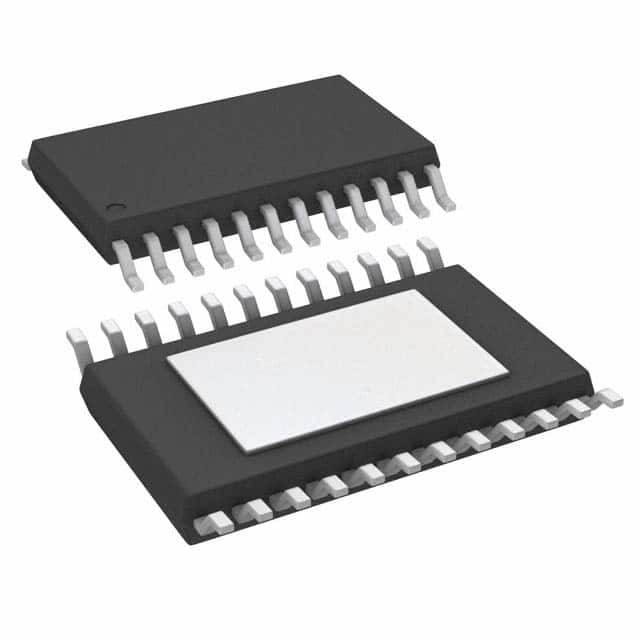
AP4473 is housed in a 20-pin HWQFN (3.0 mm × 3.0 mm, 0.5 mm pitch) package with exposed thermal pad. Pin functions are validated per Aker Technology's official AP4473 datasheet Rev. 1.2 (2023).
| Pin/Terminal | Circuit Role | Design Meaning |
|---|---|---|
| VIN | Boost Input | Ultra-low-voltage input node (down to 15 mV); connects directly to energy harvester output |
| VOUT | Boost Output | Regulated output driving external storage capacitor; feeds COMP1/COMP2 reference inputs |
| SW | Switch Node | Internal power switch output; connects to primary winding of external step-up transformer |
| COMP1_OUT | OVP Indicator | Open-drain output asserting when storage voltage ≥ 3.55 V; used to disable charging or signal fault |
| COMP2_OUT | System Enable | Open-drain output enabling external load when storage ≥ 3.3 V; disables at ≤ 2.6 V |
| GND | Ground Reference | Analog/digital common return; must be low-impedance connection to minimize noise coupling |
| PGOOD | Power Good Flag | Open-drain status signal indicating valid storage voltage within operational window (2.6–3.55 V) |
Key Features
| Feature | Design Value |
|---|---|
| Ultra-low startup voltage | 15 mV enables direct use with thermoelectric generators (TEGs) producing <100 µV/°C gradients |
| Dual independent hysteresis comparators | COMP1 (3.55 V OVP) and COMP2 (3.3 V/2.6 V system enable) allow autonomous power sequencing without MCU intervention |
| Integrated power switch | On-chip MOSFET controls external system supply, eliminating need for discrete load switch and reducing BOM count |
| Power Good function | PGOOD output confirms stable storage voltage within safe operating range, simplifying system wake-up logic |
| Low-quiescent-current monitoring | 52 nA total comparator current preserves harvested energy during standby, extending time between bursts |
Applications
| Wireless Sensor Node Power Management | Thermoelectric Energy Harvesting System |
|---|---|
Use Scenario: Battery-free temperature/humidity sensor transmitting data intermittently via BLE or LoRaWAN. IC Role / Device Role / Timing Role: AP4473 acts as autonomous power manager - harvesting ambient thermal gradients, boosting voltage, and gating system power only when storage reaches 3.3 V. Use Value: Eliminates battery replacement cycles; enables >10-year maintenance-free operation using <10 µW average ambient power. | Use Scenario: Industrial equipment surface monitoring using TEGs attached to heat sinks or motors. IC Role / Device Role / Timing Role: AP4473 serves as the core energy interface - converting sub-50 mV TEG outputs into regulated 3.3 V pulses for microcontroller wake-up and sensor readout. Use Value: Achieves reliable startup from 15 mV, supporting operation even with small ΔT (<2 °C) across standard TEG modules. |
| Piezoelectric Vibration Harvester Interface | Self-Powered Wearable Beacon |
Use Scenario: Structural health monitoring node powered by ambient machine vibration via piezoceramic element. IC Role / Device Role / Timing Role: AP4473 conditions irregular AC output from piezo transducer, rectifies and boosts it, then regulates delivery to storage and load using COMP2 hysteresis. Use Value: Sustains 100 ms active bursts every 5 seconds using <200 nJ per cycle - verified with 3.3 V Li-ion coin cell-equivalent storage. | Use Scenario: Finger-tap activated LED beacon demonstrating zero-battery operation in human-interface demos. IC Role / Device Role / Timing Role: AP4473 powers the LED driver circuit only when storage voltage crosses 3.3 V after mechanical energy input, then shuts down below 2.6 V. Use Value: Enables visible light output from single finger tap - no external power source required, validated in AKMEH-E-07 reference demo. |
Equivalent & Alternatives
The following parts are listed as comparable options for similar ultra-low-power step-up converter applications.
| Alternative Part | Technical Difference | Application Difference | Selection Advice |
|---|---|---|---|
| LTC3108 | Higher 20 mV startup voltage; requires external diode; no integrated OVP comparator | Lacks autonomous 3.55 V overvoltage protection; needs external circuitry for storage voltage clamping | Choose LTC3108 if transformer drive flexibility and wide VIN range (up to 500 mV) outweigh need for integrated OVP and lower startup voltage |
| BQ25504 | 150 mV minimum startup; includes MPPT engine but no dual-threshold autonomous power gating | Designed for solar cells, not ultra-low-VIN sources; lacks COMP2-style hysteresis control for load enable/disable | Choose BQ25504 only for photovoltaic harvesting; AP4473 remains superior for thermal/piezo where <50 mV input is typical |
Compared with LTC3108 and BQ25504, the AP4473 uniquely combines 15 mV startup, dual hysteresis comparators (3.3 V/2.6 V + 3.55 V), and integrated power switch - enabling fully autonomous, battery-free operation from micro-energy sources without additional support components.
Availability
AP4473 is available at Aetrix Electronics and suitable for wireless sensor nodes, thermoelectric harvesters, and self-powered wearables requiring stable component supply under ultra-low-power constraints.
Supply support for AP4473 includes scheduled delivery planning, volume procurement assistance, BOM continuity management, traceable sourcing, and lifecycle availability coordination for OEM customers, industrial embedded developers, connected-device designers, and electronics production programs.
Manufacturer
Aker Technology is a Japanese semiconductor company specializing in ultra-low-power analog and power management ICs for energy harvesting and battery-free electronics.
The AP4473 belongs to Aker's AKMEH series - engineered specifically to bridge the gap between micro-energy transducers and practical system-level power delivery, targeting maintenance-free IoT endpoints.
FAQ
What is the minimum input voltage required for AP4473 to start operation?
The AP4473 has a typical startup voltage of 15 mV, allowing it to begin boosting from extremely low-energy sources such as thermoelectric generators with minimal temperature differentials. This value is measured under standard test conditions (25 °C, 100 kΩ load) and confirmed in Aker's AP4473 datasheet Rev. 1.2. The AP4473 maintains functionality across its full –30 °C to +85 °C operating range without requiring external biasing.
How does the AP4473 manage power delivery to the external system?
The AP4473 uses its built-in COMP2 comparator to autonomously control power delivery: it enables the external system when storage voltage reaches 3.3 V (VDETH2) and disables it when voltage falls to 2.6 V (VDETL2). This hysteresis prevents rapid cycling and extends usable energy per charge cycle. The AP4473 implements this entirely in hardware - no firmware or external controller is needed.
Does the AP4473 include overvoltage protection, and how is it implemented?
Yes, the AP4473 includes dedicated overvoltage protection triggered at 3.55 V (VDETH1) via its COMP1 comparator. When storage voltage exceeds this threshold, COMP1_OUT asserts low to signal overvoltage condition - enabling external circuitry to disconnect the harvester or divert current. This protection is independent of COMP2 and operates without software intervention. The AP4473 thus safeguards both storage capacitors and downstream loads.
What package type and pin count does the AP4473 use?
The AP4473 is packaged in a 20-pin HWQFN measuring 3.0 mm × 3.0 mm with 0.5 mm pitch and an exposed thermal pad. This package supports high-density PCB layouts typical in compact sensor nodes and wearables. Pin assignments - including SW, VIN, VOUT, COMP1_OUT, COMP2_OUT, PGOOD, and GND - are fixed per Aker's official documentation and validated for thermal and electrical performance in energy harvesting reference designs.
Can the AP4473 operate without an external transformer?
No - the AP4473 requires an external step-up transformer to achieve voltage conversion; it does not support inductor-based boost topologies. Its SW pin drives the primary side, while rectification is handled either internally (with optional external diode) or externally depending on efficiency requirements. The AP4473's architecture is optimized for transformer coupling to maximize efficiency at ultra-low input voltages, and operation without a transformer is not supported.
AP4473 Specifications
- Product attributes
- Attribute value
- Manufacturer:
- Asahi Kasei Microdevices/AKM
- Series:
- -
- Package/Case:
- 20-WFQFN Exposed Pad
- Packaging:
- Tape & Reel (TR)
- Product Status:
- Active
- Applications:
- Energy Harvesting
- Current - Supply:
- -
- Voltage - Supply:
- 0.015V ~ 0.5V
- Operating Temperature:
- -30°C ~ 85°C
- Grade:
- -
- Qualification:
- -
- Mounting Type:
- Surface Mount
- Supplier Device Package:
- 20-HWQFN (3x3)
AP4473 FAQ
1.How can I place an order for AP4473 through Aetrix?
Please submit a Request for Quotation (RFQ) for AP4473 on Aetrix. Our sales agent will provide a competitive quotation and guide you through the order confirmation once you accept the terms.
2.Are the price and stock information for AP4473 reliable?
The price and inventory of AP4473 are updated periodically and may fluctuate due to market conditions. Stock and pricing data are typically refreshed every 24 hours. Quotation validity for AP4473 is usually 5 days.
3.What payment methods are accepted for AP4473?
We accept Wire Transfer, PayPal, Credit Card, Western Union, MoneyGram, and Escrow for AP4473 transactions.
Note: Certain payment methods may incur a processing fee.
4.How is shipping managed for AP4473?
AP4473 orders can be shipped via leading logistics carriers, including DHL, UPS, FedEx, TNT, or Registered Mail.
Once your AP4473 order is processed, you will receive an email with the shipment details and tracking number.
Note: Tracking information may take up to 24 hours to appear. Express delivery typically takes 3–5 business days.
5.How can I obtain technical support or documentation for AP4473?
For technical support, including AP4473 datasheets, pinout diagrams, or application guidance, please contact our engineering support team. They can provide detailed documentation and assistance for your AP4473 requirements.
6.How does Aetrix verify that AP4473 is sourced from the original manufacturer or authorized distributors?
All AP4473 products on Aetrix are procured from qualified distributors and authorized channels. Our dedicated quality assurance team conducts strict verification, including traceability checks and, if necessary, third-party testing. This ensures that AP4473 meets industry standards.
7.What is the process for return or replacement of AP4473?
All AP4473 units undergo pre-shipment inspection (PSI). If there is an issue with AP4473, returns or replacements are accepted under the following conditions:
1.Quantity discrepancies, incorrect items, or visible external defects (such as breakage or corrosion), acknowledged by Aetrix.
2.The issue is reported within 90 days of delivery.
3.The AP4473 part is unused and in its original packaging.
Return procedure for AP4473:
1.Submit a request within 90 days.
2.Obtain a Return Material Authorization (RMA) from Aetrix.
AP4473 Tags
-
TPS2511DGNR
Texas Instruments
-
UTC2000/MG
Microchip Technology
-
TUSB320HAIRWBR
Texas Instruments
-
TPS61252DSGR
Texas Instruments
-
PI5USB30216CXUAEX
Diodes Incorporated
-
SN6501DBVR
Texas Instruments
-
CYPD3177-24LQXQT
Infineon Technologies
-
SN6501QDBVRQ1
Texas Instruments
-
STUSB1600AQTR
STMicroelectronics

-
SN6505BDBVR
Texas Instruments
-
SN6501DBVT
Texas Instruments
-
TPS65150PWPR
Texas Instruments
Tech Hub

A practical engineering and sourcing framework covering lifecycle verification, lifetime-buy calculations, replacement qualification, supplier checks and counterfeit-risk controls.

TTL and CMOS logic families differ in thresholds, loading, output drive, power and timing. This engineering guide compares 74HC and 74HCT, calculates noise margins and checks 3.3 V/5 V compatibility.

A practical engineering guide to 3.3V and 5V logic compatibility, input thresholds, resistor dividers, translator ICs, MOSFET level shifting, I2C pull-ups, timing limits and power-sequencing risks.

The 74HC595 uses push-pull logic outputs, while the TPIC6B595 uses 50 V open-drain DMOS sinks for higher-power loads. This guide compares timing, current limits, 3.3 V interfacing, load wiring, thermal…

The 74HC595 converts serial data into eight stable parallel outputs. This guide covers pin functions, shift and storage timing, OE and MR behavior, drive-current limits, cascading, voltage compatibilit…

A technical comparison of level-sensitive latches and edge-triggered flip-flops, covering timing windows, setup and hold limits, master–slave operation, time borrowing, race-through, HDL inference and…

A D latch stores one bit while Enable controls when data can pass. This reference covers gate-level operation, truth tables, transparency, setup and hold timing, LE versus OE, common ICs and practical …

An SR latch stores one bit through cross-coupled feedback. This engineering reference covers NOR and NAND implementations, truth tables, forbidden-state recovery, gated operation, switch debouncing, fa…

Latch circuits retain one bit through feedback. This technical reference covers SR and D latches, truth tables, transparency, timing limits, latch-versus-flip-flop behavior, applications and common log…

An engineering guide to LED driver operation, constant-current and constant-voltage outputs, linear and switching topologies, dimming, IC selection, calculations, replacement compatibility, and fault c…


