
 My Inquiry
 My Account


Monolithic Power Systems Inc. AX5689GRK-Z

- Part No.:
- AX5689GRK-Z
- Manufacturer:
- Monolithic Power Systems Inc.
- Category:
- Audio Amplifiers
- Package:
- 64-VFQFN Exposed Pad
- Datasheet:
-
 AX5689GRK-Z.pdf
- Description:
- 4-CHANNEL, DIGITAL-INPUT CLASS-D
- Quantity:
- Payment:

- Shipping:

Inventory:1,618
Please send an inquiry. Send us your inquiry, and we will respond immediately.
Product details
Overview
AX5689GRK-Z from Monolithic Power Systems is a 4-channel BTL digital Class-D amplifier controller IC with 8 low-latency ADCs (115 dB DR), 8 programmable digital loop-filter slices, and 8 CMOS-level PWM outputs configurable as 4 BTL channels. It enables feedback-based digital control loops across loudspeaker nodes for error suppression in the audio band (20 Hz–20 kHz), targeting high-fidelity active loudspeakers and TV soundbars.
For engineers reviewing the AX5689GRK-Z datasheet, AX5689GRK-Z pinout, AX5689GRK-Z application, or AX5689GRK-Z equivalent, key selection considerations include its 32–768 kHz I²S/TDM serial interface, 1.2 V analog/digital core supplies, 3.3 V I/O and PWM domains, SPI/I²C dual-control interface, and support for MIMO loop configurations with pop-free soft mute and dynamic ramp control.
Technical Context
The AX5689GRK-Z implements an 8-slice digital control architecture where each slice integrates feed-in filtering, butterfly mixing, programmable loop filtering, and PWM generation - enabling independent or interlinked channel control. Its 8 low-latency ADCs (typical latency: 1 MCLK cycle) operate at up to 60 kHz full-scale bandwidth and support differential input with 111 dB A-weighted SNR and –120 dB crosstalk.
Signal routing is fully configurable via output crossbar and slice-to-ADC interconnects, allowing custom topologies including analog input monitoring, power stage diagnostics, current/temperature sensing, and multi-output filter compensation. Loop gain remains high across 20 Hz–20 kHz, suppressing supply, power stage, and output filter errors digitally.
Key Specifications
| Parameter | Value and Actual Design Meaning |
|---|---|
| ADC Count & DR | 8 × differential low-latency ADCs; 111 dB A-weighted dynamic range supports high-resolution feedback sampling behind output filters. |
| PWM Outputs | 8 CMOS-level PWM outputs; configurable as 4 BTL channels with <1 MCLK-cycle latency from ADC input to PWM update. |
| Audio Interface | I²S/TDM with 16 downstream + 8 upstream channels; 32–768 kHz sample rate and 16–32-bit format support for flexible streaming architectures. |
| Control Interfaces | SPI (up to 10 MHz) and fast-mode I²C (400 kHz); dual-address I²C enables multi-chip systems without bus contention. |
| Supply Domains | Separate 1.2 V analog/digital cores (VDDA1/VDDA2/VDDD), 3.3 V I/O (VDD(IO)), and dual 3.3 V PWM rails (VDD(PWM1)/VDD(PWM2)) for noise isolation. |
| Dynamic Range | 113 dB A-weighted SNR at –1 dBFS output; enables >110 dB system-level THD+N performance with proper clock jitter management. |
| Loop Architecture | Programmable digital loop filters per channel; feedback possible across loudspeaker terminals post-output filter for real-time error correction. |
Pinout & Package
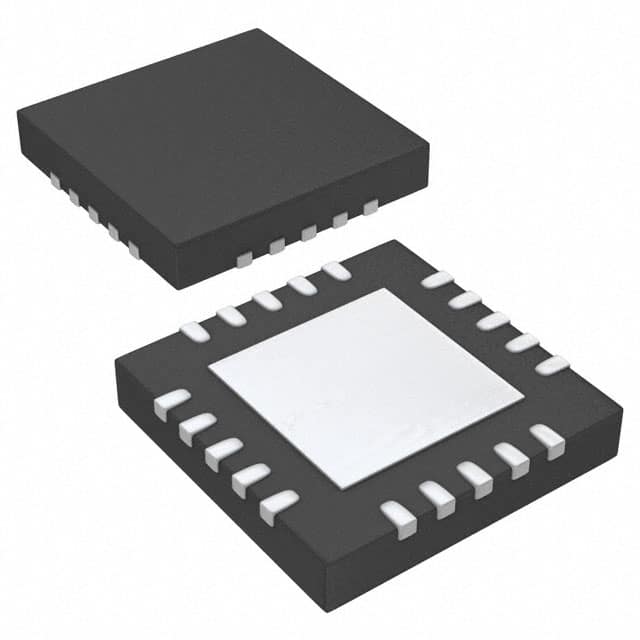
The AX5689GRK-Z is housed in a 64-pin QFN package (9 mm × 9 mm, 0.5 mm pitch) with exposed thermal pad (EPAD) for enhanced thermal dissipation. Pin assignment follows strict domain segregation: analog inputs (IN1P–IN8N, INRP/INRN), 8 PWM outputs (OUT1–OUT8), dual-domain power supplies, JTAG debug, and dual-control interfaces (SPI/I²C).
| Pin/Terminal | Circuit Role | Design Meaning |
|---|---|---|
| IN1P–IN8N | Differential analog inputs for 8 low-latency ADCs | Enable closed-loop feedback directly across speaker terminals; support ±0.52 V common-mode and 4.81 mA full-scale differential input. |
| OUT1–OUT8 | CMOS-level PWM outputs | Configurable as 4 BTL pairs; driven from 3.3 V PWM supplies (VDD(PWM1)/VDD(PWM2)) with 13.9 mA sink capability. |
| VDDA1/VDDA2, VSSA1/VSSA2 | Analog core power/ground | 1.2 V ±0.1 V supplies for ADCs and reference circuitry; require tight decoupling to maintain 111 dB SNR performance. |
| CSN_AD0, SCK_SCL, MOSI_AD1, MISO_SDA | SPI/I²C control interface pins | Shared pins support both protocols: CSN/AD0 selects SPI chip select or I²C address bit; SCK/SCL and MOSI/AD1/MISO/SDA are functionally multiplexed. |
| FCLKI/BCLKI/SDI, FCLKO/BCLKO/SDO | Serial audio input/output clocks & data | Independent frame/bit clock domains allow asynchronous TDM streaming; BCLKI supports up to 49.152 MHz for high-channel-count audio. |
| PSTART/PSTART_N, PFAULT_N, PWARN_N | Power stage control and status | Active-high/low start signals coordinate external gate drivers; fault/warning pins interface directly with protection logic of discrete or integrated power stages. |
Key Features
| Feature | Design Value |
|---|---|
| Pop-free mode transitions | Programmable volume ramp generator enables smooth mute/unmute and channel enable/disable without audible artifacts. |
| MIMO loop configuration | Configurable interconnections between 8 ADCs and 8 loop-filter slices support multi-input/multi-output control for complex speaker arrays. |
| Post-filter feedback | Direct ADC sampling across loudspeaker terminals allows digital correction of output filter nonlinearity and power stage distortion. |
| Multi-vendor power stage compatibility | Standardized control signals (PSTART, PFAULT_N) and diagnostic readback enable interoperability with discrete MOSFET H-bridges or integrated drivers. |
| Low-jitter clock tolerance | Accepts master clock (MCLK) with ≤100 ps RMS period jitter; baseband jitter <1.6 ns RMS required to sustain >110 dB dynamic range. |
Applications
| TV Soundbar Amplifier | Active Studio Monitor |
|---|---|
|
Use Scenario: 4-channel BTL Class-D amplification for compact multi-driver soundbar with beamforming DSP. IC Role / Device Role / Timing Role: Digital amplifier controller managing PWM generation, speaker-level feedback ADCs, and I²S-linked DSP co-processor. Use Value: Enables real-time correction of cabinet resonance and driver mismatch using 8-channel loop filters, achieving flat 20 Hz–20 kHz response without analog EQ. |
Use Scenario: High-fidelity 2-way active loudspeaker with separate LF/HF amplification and thermal/current monitoring. IC Role / Device Role / Timing Role: Central audio controller providing synchronized PWM outputs, auxiliary ADC inputs for sensor telemetry, and SPI-configurable loop parameters. Use Value: Dual 3.3 V PWM domains isolate LF/HF stage switching noise; 111 dB ADC SNR preserves resolution for precision crossover and limiting algorithms. |
| Streaming Audio Reference Platform | High-Resolution DAC Subsystem |
|
Use Scenario: Linux-based network audio endpoint supporting MQA, DSD, and PCM up to 768 kHz via TDM backplane. IC Role / Device Role / Timing Role: Serial audio interface bridge converting TDM streams to 8-channel PWM with ultra-low latency path from network buffer to speaker. Use Value: 32–768 kHz sample rate support and 16–32-bit format flexibility eliminate need for external sample-rate conversion; 1-cycle ADC-to-PWM latency minimizes buffer requirements. |
Use Scenario: Standalone high-end DAC module with analog line outputs derived from filtered PWM reconstruction. IC Role / Device Role / Timing Role: Digital audio converter core generating precise PWM waveforms, with 8 ADCs repurposed for analog input monitoring and reference voltage calibration. Use Value: 115 dB ADC dynamic range enables accurate DC offset and THD+N measurement of analog output stages; programmable loop filters adapt to different reconstruction filter topologies. |
Equivalent & Alternatives
The following parts are listed as comparable options for similar digital audio amplifier controller applications.
| Alternative Part | Technical Difference | Application Difference | Selection Advice |
|---|---|---|---|
| AX5689CGRK-Z | Direct successor; identical pinout and register map, but with updated internal PLL and improved ESD robustness (HBM ±3 kV vs. ±2 kV). | Drop-in replacement for new designs; supports same 32–768 kHz audio formats and 8-channel loop architecture. | Select AX5689CGRK-Z for production builds requiring extended lifecycle support and enhanced reliability in humid environments. |
| TAS5825MRGZR | TI 4-channel Class-D controller with integrated 12-bit ADCs (95 dB DR), no post-filter feedback capability, and fixed 48/96/192 kHz sample rates. | Limited to lower-resolution feedback and narrower audio bandwidth; lacks MIMO configurability and programmable loop filters. | Consider only for cost-sensitive, lower-performance applications where 111 dB ADC DR and speaker-terminal feedback are not required. |
Compared with AX5689GRK-Z, AX5689CGRK-Z offers identical functionality with improved robustness and long-term availability, while TAS5825MRGZR trades loop fidelity and configurability for integration density and lower BOM count in mid-tier audio systems.
Availability
AX5689GRK-Z is available at Aetrix Electronics and suitable for TV soundbars, active loudspeakers, and high-resolution DAC subsystems requiring stable component supply during legacy design maintenance and EOL transition planning.
Supply support for AX5689GRK-Z includes scheduled delivery planning, volume procurement assistance, BOM continuity management, traceable sourcing, and lifecycle availability coordination for OEM customers, industrial embedded developers, connected-device designers, and electronics production programs.
Manufacturer
Monolithic Power Systems (MPS) is a fabless semiconductor company specializing in high-performance power management and audio ICs, with design centers in the US, China, and Taiwan.
The AX5689 product line targets high-fidelity digital audio systems requiring ultra-low-latency feedback, multi-channel programmable control, and seamless integration with third-party power stages - emphasizing signal integrity over integration density.
FAQ
What does "END OF LIFE, REFER TO AX5689C" mean for AX5689GRK-Z?
AX5689GRK-Z has reached end-of-life status per MPS documentation, with last-time-buy dates published on the Monolithic Power Systems website. The AX5689CGRK-Z is its direct functional replacement, sharing identical pinout, register mapping, and software compatibility while incorporating minor silicon-level enhancements for reliability and ESD immunity.
Can AX5689GRK-Z drive Class-D power stages directly without external gate drivers?
No. AX5689GRK-Z provides CMOS-level PWM outputs (not high-current gate drivers) and requires external half-bridge or full-bridge gate drivers (e.g., MPS MPQ6535, TI UCC27531) to interface with discrete MOSFETs or integrated power stages. Its PSTART/PSTART_N and PFAULT_N signals coordinate timing and safety with those drivers.
How is feedback implemented across the loudspeaker nodes?
Feedback is implemented by connecting the loudspeaker's + and – terminals directly to two ADC inputs (e.g., IN1P/IN1N), enabling measurement of actual acoustic output after the LC output filter. The digital loop filter then computes correction terms applied to the PWM modulator - suppressing distortion and impedance-induced anomalies within 20 Hz–20 kHz.
What master clock (MCLK) jitter specifications must be met to achieve 111 dB SNR?
To sustain ≥111 dB A-weighted SNR, the MCLK must exhibit ≤100 ps RMS period jitter and <1.6 ns RMS baseband jitter (100 Hz–200 kHz). Exceeding these thresholds degrades ADC effective resolution and introduces correlated noise that cannot be removed by digital filtering.
Is the JTAG interface functional for production programming or only for development?
JTAG (TCK/TMS/TDI/TDO) supports boundary-scan testing, in-circuit debugging, and firmware loading during development. While functional in production, it is not intended for field firmware updates; SPI/I²C are the primary interfaces for runtime configuration and calibration in deployed systems.
Does AX5689GRK-Z support analog audio inputs in addition to digital?
Yes. Its 8 low-latency ADCs accept analog inputs (e.g., line-level or microphone signals) and can be routed into the digital signal processing chain alongside I²S/TDM streams. This enables hybrid architectures such as analog AUX input mixing, analog sensor monitoring, or analog reference calibration - all processed within the same loop-filter framework.
What thermal derating applies above 25°C ambient?
With θJA = 23°C/W, junction temperature rises ~23°C per watt of dissipated power. At 85°C ambient, maximum allowable power dissipation drops to ~2.6 W before exceeding the 125°C max junction limit. Layout with 6+ thermal vias under the EPAD and 2 oz copper is recommended to maintain θJC = 1.6°C/W performance.
AX5689GRK-Z Specifications
- Product attributes
- Attribute value
- Manufacturer:
- Monolithic Power Systems Inc.
- Series:
- -
- Package/Case:
- 64-VFQFN Exposed Pad
- Packaging:
- Tape & Reel (TR)
- Product Status:
- Active
- Type:
- Class D
- Output Type:
- 4-Channel (Quad)
- Max Output Power x Channels @ Load:
- -
- Voltage - Supply:
- 1.1V ~ 1.3V
- Features:
- -
- Mounting Type:
- Surface Mount
- Operating Temperature:
- -40°C ~ 85°C (TA)
- Grade:
- -
- Qualification:
- -
- Supplier Device Package:
- 64-QFN (9x9)
AX5689GRK-Z FAQ
1.How can I place an order for AX5689GRK-Z through Aetrix?
Please submit a Request for Quotation (RFQ) for AX5689GRK-Z on Aetrix. Our sales agent will provide a competitive quotation and guide you through the order confirmation once you accept the terms.
2.Are the price and stock information for AX5689GRK-Z reliable?
The price and inventory of AX5689GRK-Z are updated periodically and may fluctuate due to market conditions. Stock and pricing data are typically refreshed every 24 hours. Quotation validity for AX5689GRK-Z is usually 5 days.
3.What payment methods are accepted for AX5689GRK-Z?
We accept Wire Transfer, PayPal, Credit Card, Western Union, MoneyGram, and Escrow for AX5689GRK-Z transactions.
Note: Certain payment methods may incur a processing fee.
4.How is shipping managed for AX5689GRK-Z?
AX5689GRK-Z orders can be shipped via leading logistics carriers, including DHL, UPS, FedEx, TNT, or Registered Mail.
Once your AX5689GRK-Z order is processed, you will receive an email with the shipment details and tracking number.
Note: Tracking information may take up to 24 hours to appear. Express delivery typically takes 3–5 business days.
5.How can I obtain technical support or documentation for AX5689GRK-Z?
For technical support, including AX5689GRK-Z datasheets, pinout diagrams, or application guidance, please contact our engineering support team. They can provide detailed documentation and assistance for your AX5689GRK-Z requirements.
6.How does Aetrix verify that AX5689GRK-Z is sourced from the original manufacturer or authorized distributors?
All AX5689GRK-Z products on Aetrix are procured from qualified distributors and authorized channels. Our dedicated quality assurance team conducts strict verification, including traceability checks and, if necessary, third-party testing. This ensures that AX5689GRK-Z meets industry standards.
7.What is the process for return or replacement of AX5689GRK-Z?
All AX5689GRK-Z units undergo pre-shipment inspection (PSI). If there is an issue with AX5689GRK-Z, returns or replacements are accepted under the following conditions:
1.Quantity discrepancies, incorrect items, or visible external defects (such as breakage or corrosion), acknowledged by Aetrix.
2.The issue is reported within 90 days of delivery.
3.The AX5689GRK-Z part is unused and in its original packaging.
Return procedure for AX5689GRK-Z:
1.Submit a request within 90 days.
2.Obtain a Return Material Authorization (RMA) from Aetrix.
AX5689GRK-Z Tags
-Exposed-Pad.jpg)
-
TS34119CS RLG
Taiwan Semiconductor Corporation

-
LM386MX-1/NOPB
Texas Instruments
-
TPA711DGNR
Texas Instruments
-
LM386N-4/NOPB
Texas Instruments
-
TS4990IST
STMicroelectronics
-
PAM8302AASCR
Diodes Incorporated
-
TPA6130A2RTJR
Texas Instruments
-
TPA6111A2DGNR
Texas Instruments
-
LM4861MX/NOPB
Texas Instruments
-
LM386M-1/NOPB
Texas Instruments
-
NCS2211DR2G
onsemi
-
IS31AP2005-DLS2-TR
Lumissil Microsystems
Tech Hub

Operational amplifier guide covering op amp basics, feedback, ideal vs real op amps, common configurations, buffer circuits, offset, bias current, gain-bandwidth, slew rate, rail-to-rail limits and sel…

Jumper cables guide covering safe connection order, red and black clamp placement, final ground connection, cable gauge, length, clamp quality, copper vs CCA cables, jump starter comparison and battery…

LDO regulator guide covering low dropout voltage, power dissipation, thermal design, PSRR, output noise, capacitor stability, adjustable LDO circuits, LDO vs buck converter and datasheet selection chec…

Conditional Access Module guide covering CAM meaning, CI/CI+ interface, smart card authorization, DVB security workflow, TV and set-top box compatibility, internal electronics, ESD protection, connecto…

Guide to electronic component obsolescence covering EOL risk, PCN/PDN notices, last-time buy planning, replacement options, form-fit-function validation, counterfeit risk and BOM lifecycle management.

18650 battery guide covering lithium-ion cell basics, 3.6V/3.7V voltage, 4.2V charging, mAh and Wh capacity, protected cells, chargers, BMS, series-parallel packs, holders, welding and sourcing checks.…

Hall effect sensor guide covering working principle, linear and digital sensors, Arduino circuits, current sensing, speed detection, automotive applications, A3144 examples, signal filtering and datash…

Product Change Notification guide for electronic components, covering PCN meaning, PCN vs PDN/EOL, common change types, risk levels, form-fit-function review, engineering validation, BOM control, LTB/L…

A practical guide to blend door actuators, covering HVAC function, symptoms, location, AC and heater issues, reset and calibration, replacement cost, electrical diagnosis, compatibility checks, and rep…

Engineering guide to Raspberry Pi alternatives, covering chip-level differences, Orange Pi, ROCK, Jetson, Banana Pi, NanoPi, Compute Module, Pico, GPIO, camera, HAT compatibility, and replacement risks…


