
 My Inquiry
 My Account


Texas Instruments LM386M-1/NOPB
- Part No.:
- LM386M-1/NOPB
- Manufacturer:
- Texas Instruments
- Category:
- Audio Amplifiers
- Package:
- 8-SOIC (0.154", 3.90mm Width)
- Datasheet:
-
 LM386M-1/NOPB.pdf
- Description:
- IC AMP CLASS AB MONO 325MW 8SOIC
- Quantity:
- Payment:

- Shipping:

Inventory:3,549
Please send an inquiry. Send us your inquiry, and we will respond immediately.
Product details
Overview
LM386M-1/NOPB from Texas Instruments is a low-voltage mono audio power amplifier IC designed for battery-powered consumer electronics. It delivers 250–325 mW into 8 Ω at 6 V, features internally set 20× voltage gain (26 dB), operates from 4–12 V supply, and draws only 4 mA quiescent current - enabling use in portable AM-FM radios and intercoms.
For engineers reviewing the LM386M-1/NOPB datasheet, LM386M-1/NOPB pinout, LM386M-1/NOPB application, or LM386M-1/NOPB equivalent, key selection considerations include its SOIC-8 package, ground-referenced inputs, self-centering output bias, 0.2% THD at 125 mW, and configurable gain (20–200×) via pins 1 and 8.
Technical Context
The LM386M-1/NOPB integrates an internal 1.35 kΩ gain-setting resistor to fix nominal voltage gain at 20, with external RC networks between pins 1 and 8 enabling precise gain adjustment up to 200. Its input stage uses PNP transistors with 50 kΩ input resistance and 250 nA bias current, while the output stage provides rail-to-rail swing capability with automatic DC biasing to VS/2.
It employs a Class-AB output stage optimized for low distortion (0.2% THD at 1 kHz, 125 mW, 8 Ω) and wide bandwidth (300 kHz typical). Power supply rejection is 50 dB at 1 kHz, and thermal design relies on SOIC-8's 115.7°C/W junction-to-ambient resistance under standard PCB mounting.
Key Specifications
| Parameter | Value and Actual Design Meaning |
|---|---|
| Supply Voltage Range | 4 V to 12 V - supports single-cell Li-ion, dual-AA, or triple-alkaline battery operation without regulation |
| Quiescent Current | 4 mA at 6 V - enables >100-hour runtime on two AA cells in standby audio monitoring |
| Output Power | 250–325 mW into 8 Ω at 6 V, 10% THD - sufficient for small speakers in portable radios and intercoms |
| THD | 0.2% at 1 kHz, 125 mW, 8 Ω - meets fidelity requirements for voice and mid-fidelity music playback |
| Gain Range | 20× to 200× (26–46 dB) - selectable via external capacitor (200×) or resistor-capacitor (intermediate values) on pins 1–8 |
| Input Resistance | 50 kΩ - compatible with line-level and electret microphone preamp outputs without loading |
| Bandwidth | 300 kHz - ensures flat response across full audio band (20 Hz–20 kHz) with margin for stability |
Pinout & Package
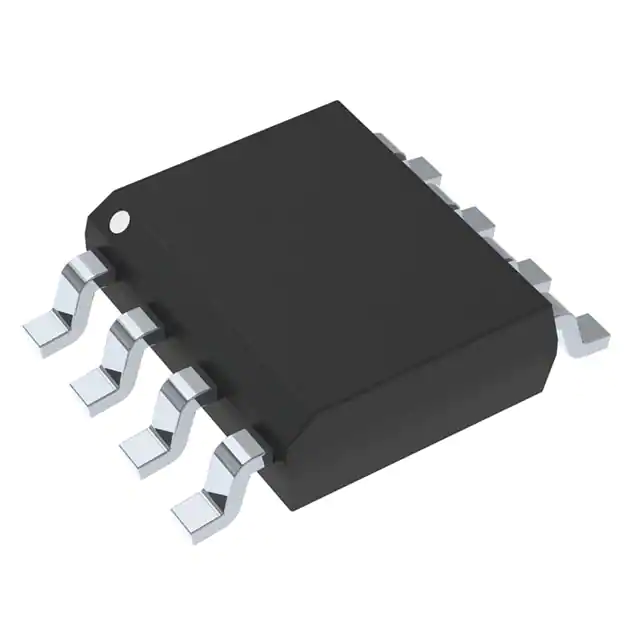
LM386M-1/NOPB is housed in an 8-pin SOIC (D) package measuring 4.90 mm × 3.90 mm, with standard 1.27 mm pitch and gull-wing leads suitable for automated SMT assembly.
| Pin/Terminal | Circuit Role | Design Meaning |
|---|---|---|
| GAIN (Pin 1) | Gain control node | Connects to internal 1.35 kΩ resistor; ties to Pin 8 to bypass for 200× gain or adds series R/C for intermediate gains |
| –INPUT (Pin 2) | Inverting input | Accepts differential or single-ended signals; requires biasing to GND via 50 kΩ if unused |
| +INPUT (Pin 3) | Noninverting input | Main signal input path; ground-referenced design simplifies coupling capacitor selection |
| GND (Pin 4) | Ground reference | Primary return path for input, bias, and power; must connect to low-impedance analog ground plane |
| VOUT (Pin 5) | Amplified output | Drives 4–32 Ω loads directly; requires 250 µF output coupling capacitor for speaker DC blocking |
| VS (Pin 6) | Positive supply | Accepts 4–12 V; requires local 0.05 µF ceramic + bulk electrolytic decoupling per layout guidelines |
| BYPASS (Pin 7) | Internal bias node | Connects to 10 µF capacitor to GND to stabilize internal bias circuitry and reduce ripple sensitivity |
| GAIN (Pin 8) | Gain control node | Completes gain-setting network with Pin 1; open-circuit default yields 20× gain |
Key Features
| Feature | Design Value |
|---|---|
| Internally set 20× gain | Reduces BOM count by eliminating external feedback resistors in baseline designs |
| Configurable gain up to 200× | Enables one PCB layout to support multiple output power tiers via simple R/C changes on pins 1–8 |
| Self-centering output quiescent voltage | Automatically biases VOUT to VS/2, eliminating need for output DC-blocking capacitor in AC-coupled speaker paths |
| Low 4 mA quiescent current | Extends battery life in always-on intercoms and portable audio recorders without compromising startup time |
| Ground-referenced inputs | Simplifies signal interfacing with microcontrollers, codecs, and electret mic preamps using single-supply rails |
Applications
| AM-FM Radio Amplifier | Portable Tape Player Amplifier |
|---|---|
Use Scenario: Final-stage audio amplification in compact tabletop or handheld AM/FM receivers with 3–6 V battery supply. IC Role / Device Role / Timing Role: Mono power amplifier driving 8 Ω miniature speaker; accepts demodulated audio from detector stage. Use Value: Delivers 250+ mW clean output with 0.2% THD at 1 kHz, enabling loud, intelligible audio from low-profile enclosures. | Use Scenario: Output stage in cassette tape playback systems powered by two or three alkaline cells. IC Role / Device Role / Timing Role: Low-noise, low-distortion audio driver accepting line-level signal from tape head preamp. Use Value: 4 mA quiescent current extends playtime; 20× fixed gain matches typical preamp output levels without trimming. |
| Intercom System | TV Sound System |
Use Scenario: Full-duplex or half-duplex voice amplification in wired/wireless door intercoms operating from 5–9 V supplies. IC Role / Device Role / Timing Role: Speaker driver in master unit; may also serve as microphone preamp gain stage when configured differentially. Use Value: Self-centering output eliminates coupling capacitor in speaker path, reducing component count and board space. | Use Scenario: Auxiliary audio boost for legacy CRT or LCD TVs with weak built-in speaker drivers. IC Role / Device Role / Timing Role: Standalone mono amplifier augmenting TV audio output, connected via RCA or 3.5 mm jack. Use Value: Wide 4–12 V supply range accommodates varied TV power rail options; 300 kHz bandwidth preserves treble clarity. |
Equivalent & Alternatives
The following parts are listed as comparable options for similar audio amplifier applications.
| Alternative Part | Technical Difference | Application Difference | Selection Advice |
|---|---|---|---|
| LM386N-1/NOPB | PDIP-8 package; higher 1.25 W package dissipation; 53.4°C/W θJA; same electrical specs | Through-hole assembly; better thermal performance on perfboard or low-density PCBs | Select for prototyping, educational kits, or legacy through-hole production where SOIC reflow is unavailable |
| LM386MMX-1/NOPB | VSSOP-8 package; smaller 3.0 mm × 3.0 mm footprint; 169.3°C/W θJA; identical gain, THD, and supply specs | Ultra-compact portable devices requiring minimal board area, e.g., wearable audio accessories | Select when board space is constrained and thermal management via copper pour or airflow is feasible |
Compared with LM386N-1/NOPB, LM386M-1/NOPB offers surface-mount compatibility and reduced footprint but requires careful thermal layout; compared with LM386MMX-1/NOPB, it trades some miniaturization for improved thermal resistance and broader soldering process tolerance.
Availability
LM386M-1/NOPB is available at Aetrix Electronics and suitable for portable audio systems, battery-powered communication devices, and consumer electronics requiring stable component supply with long lifecycle support.
Supply support for LM386M-1/NOPB includes scheduled delivery planning, volume procurement assistance, BOM continuity management, traceable sourcing, and lifecycle availability coordination for OEM customers, industrial embedded developers, connected-device designers, and electronics production programs.
Manufacturer
Texas Instruments is a global semiconductor company headquartered in Dallas, Texas, delivering analog and embedded processing solutions for industrial, automotive, and personal electronics markets.
The LM386M-1/NOPB belongs to TI's legacy linear amplifier product line, engineered specifically for cost-sensitive, low-power audio applications where simplicity, reliability, and battery efficiency are prioritized over high-end fidelity metrics.
FAQ
What is the maximum output power of the LM386M-1/NOPB?
The LM386M-1/NOPB delivers 250–325 mW into an 8 Ω load at 6 V supply with 10% total harmonic distortion, per TI's SNAS545D datasheet. This output level is confirmed under recommended operating conditions and reflects typical performance across the commercial temperature range (0°C to 70°C).
How do I configure the LM386M-1/NOPB for 200× voltage gain?
To achieve 200× gain with the LM386M-1/NOPB, connect a 10 µF capacitor directly between Pin 1 (GAIN) and Pin 8 (GAIN), bypassing the internal 1.35 kΩ resistor. Ensure Pin 7 (BYPASS) has a 10 µF capacitor to ground, and maintain proper decoupling on Pin 6 (VS) to prevent oscillation at high gain.
Does the LM386M-1/NOPB require an output coupling capacitor?
Yes, the LM386M-1/NOPB requires a DC-blocking output coupling capacitor - typically 250 µF - between Pin 5 (VOUT) and the speaker. Although the output self-centers at VS/2, this capacitor prevents damaging DC current flow through the speaker coil and ensures safe long-term operation.
What is the purpose of Pin 7 (BYPASS) on the LM386M-1/NOPB?
Pin 7 (BYPASS) on the LM386M-1/NOPB connects to an internal bias node that stabilizes quiescent operating points. A 10 µF capacitor from Pin 7 to ground suppresses supply ripple and improves PSRR (50 dB at 1 kHz), preventing audible hum and ensuring consistent gain and distortion performance across varying supply conditions.
Can the LM386M-1/NOPB drive a 4 Ω speaker?
Yes, the LM386M-1/NOPB is rated to drive loads from 4 Ω to 32 Ω. At 4 Ω, output power increases but thermal stress rises significantly; TI specifies maximum device dissipation of 0.73 W for the SOIC package. Adequate PCB copper area and airflow are required to sustain continuous operation into 4 Ω at full gain and supply voltage.
LM386M-1/NOPB Specifications
- Product attributes
- Attribute value
- Manufacturer:
- Texas Instruments
- Series:
- -
- Package/Case:
- 8-SOIC (0.154", 3.90mm Width)
- Packaging:
- Tube
- Product Status:
- Active
- Type:
- Class AB
- Output Type:
- 1-Channel (Mono)
- Max Output Power x Channels @ Load:
- 325mW x 1 @ 8Ohm
- Voltage - Supply:
- 4V ~ 12V
- Features:
- -
- Mounting Type:
- Surface Mount
- Operating Temperature:
- 0°C ~ 70°C (TA)
- Grade:
- -
- Qualification:
- -
- Supplier Device Package:
- 8-SOIC
LM386M-1/NOPB FAQ
1.How can I place an order for LM386M-1/NOPB through Aetrix?
Please submit a Request for Quotation (RFQ) for LM386M-1/NOPB on Aetrix. Our sales agent will provide a competitive quotation and guide you through the order confirmation once you accept the terms.
2.Are the price and stock information for LM386M-1/NOPB reliable?
The price and inventory of LM386M-1/NOPB are updated periodically and may fluctuate due to market conditions. Stock and pricing data are typically refreshed every 24 hours. Quotation validity for LM386M-1/NOPB is usually 5 days.
3.What payment methods are accepted for LM386M-1/NOPB?
We accept Wire Transfer, PayPal, Credit Card, Western Union, MoneyGram, and Escrow for LM386M-1/NOPB transactions.
Note: Certain payment methods may incur a processing fee.
4.How is shipping managed for LM386M-1/NOPB?
LM386M-1/NOPB orders can be shipped via leading logistics carriers, including DHL, UPS, FedEx, TNT, or Registered Mail.
Once your LM386M-1/NOPB order is processed, you will receive an email with the shipment details and tracking number.
Note: Tracking information may take up to 24 hours to appear. Express delivery typically takes 3–5 business days.
5.How can I obtain technical support or documentation for LM386M-1/NOPB?
For technical support, including LM386M-1/NOPB datasheets, pinout diagrams, or application guidance, please contact our engineering support team. They can provide detailed documentation and assistance for your LM386M-1/NOPB requirements.
6.How does Aetrix verify that LM386M-1/NOPB is sourced from the original manufacturer or authorized distributors?
All LM386M-1/NOPB products on Aetrix are procured from qualified distributors and authorized channels. Our dedicated quality assurance team conducts strict verification, including traceability checks and, if necessary, third-party testing. This ensures that LM386M-1/NOPB meets industry standards.
7.What is the process for return or replacement of LM386M-1/NOPB?
All LM386M-1/NOPB units undergo pre-shipment inspection (PSI). If there is an issue with LM386M-1/NOPB, returns or replacements are accepted under the following conditions:
1.Quantity discrepancies, incorrect items, or visible external defects (such as breakage or corrosion), acknowledged by Aetrix.
2.The issue is reported within 90 days of delivery.
3.The LM386M-1/NOPB part is unused and in its original packaging.
Return procedure for LM386M-1/NOPB:
1.Submit a request within 90 days.
2.Obtain a Return Material Authorization (RMA) from Aetrix.
LM386M-1/NOPB Tags
-Exposed-Pad.jpg)
-
TS34119CS RLG
Taiwan Semiconductor Corporation

-
LM386MX-1/NOPB
Texas Instruments
-
TPA711DGNR
Texas Instruments
-
LM386N-4/NOPB
Texas Instruments
-
TS4990IST
STMicroelectronics
-
PAM8302AASCR
Diodes Incorporated
-
TPA6130A2RTJR
Texas Instruments
-
TPA6111A2DGNR
Texas Instruments
-
LM4861MX/NOPB
Texas Instruments
-
LM386M-1/NOPB
Texas Instruments
-
NCS2211DR2G
onsemi
-
IS31AP2005-DLS2-TR
Lumissil Microsystems
Tech Hub

A practical engineering and sourcing framework covering lifecycle verification, lifetime-buy calculations, replacement qualification, supplier checks and counterfeit-risk controls.

TTL and CMOS logic families differ in thresholds, loading, output drive, power and timing. This engineering guide compares 74HC and 74HCT, calculates noise margins and checks 3.3 V/5 V compatibility.

A practical engineering guide to 3.3V and 5V logic compatibility, input thresholds, resistor dividers, translator ICs, MOSFET level shifting, I2C pull-ups, timing limits and power-sequencing risks.

The 74HC595 uses push-pull logic outputs, while the TPIC6B595 uses 50 V open-drain DMOS sinks for higher-power loads. This guide compares timing, current limits, 3.3 V interfacing, load wiring, thermal…

The 74HC595 converts serial data into eight stable parallel outputs. This guide covers pin functions, shift and storage timing, OE and MR behavior, drive-current limits, cascading, voltage compatibilit…

A technical comparison of level-sensitive latches and edge-triggered flip-flops, covering timing windows, setup and hold limits, master–slave operation, time borrowing, race-through, HDL inference and…

A D latch stores one bit while Enable controls when data can pass. This reference covers gate-level operation, truth tables, transparency, setup and hold timing, LE versus OE, common ICs and practical …

An SR latch stores one bit through cross-coupled feedback. This engineering reference covers NOR and NAND implementations, truth tables, forbidden-state recovery, gated operation, switch debouncing, fa…

Latch circuits retain one bit through feedback. This technical reference covers SR and D latches, truth tables, transparency, timing limits, latch-versus-flip-flop behavior, applications and common log…

An engineering guide to LED driver operation, constant-current and constant-voltage outputs, linear and switching topologies, dimming, IC selection, calculations, replacement compatibility, and fault c…


