
 My Inquiry
 My Account


onsemi BAV99
- Part No.:
- BAV99
- Manufacturer:
- onsemi
- Category:
- Diode Arrays
- Package:
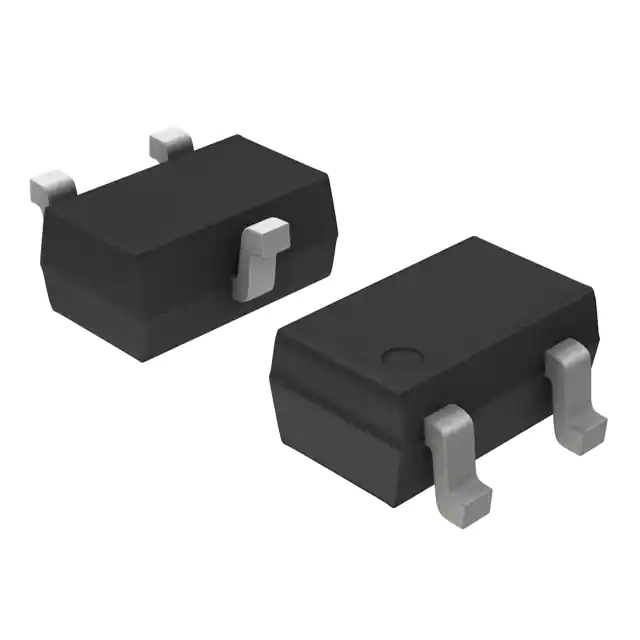
- TO-236-3, SC-59, SOT-23-3
- Description:
- DIODE ARRAY GP 70V 200MA SOT23-3
- Quantity:
- Payment:

- Shipping:

Inventory:3,045
Please send an inquiry. Send us your inquiry, and we will respond immediately.
Product details
Overview
BAV99 from onsemi is a dual series-connected silicon switching diode family supplied in a three-lead SOT-23 package. Represented by production ordering codes such as BAV99LT1G and BAV99LT3G, it combines a 100 V reverse-voltage rating, 215 mA forward-current capability, 6 ns maximum reverse-recovery time, and 1.5 pF maximum capacitance for fast signal switching, clamping, pulse shaping, level shifting, low-current rectification, and directional current control.
For engineers reviewing the BAV99 datasheet, BAV99 pinout, BAV99 application, or BAV99 equivalent, the onsemi version should be evaluated by its 100 V voltage rating, 215 mA current limit, 6 ns recovery time, 1.5 pF capacitance, SOT-23 Style 11 pin mapping, thermal mounting condition, and standard-versus-automotive ordering code. These values should not be replaced with specifications from another manufacturer merely because the same BAV99 family name is used.
Technical Context
BAV99 contains two diode junctions connected in series, with the internal junction accessible through pin 3. Forward current through the complete pair flows from pin 1 through the first diode to pin 3 and then through the second diode to pin 2. Designers can therefore use either individual element or both junctions together for midpoint clamps, bias networks, signal steering, threshold generation, and compact dual-diode switching functions.
The onsemi BAV99 differs electrically from some cross-manufacturer BAV99 products. Its 100 V reverse rating and 1.5 pF capacitance provide useful voltage margin and low signal loading, while its 215 mA current rating and 6 ns recovery time define the actual conduction and switching limits. Forward voltage reaches 0.855 V maximum at 10 mA and 1.25 V maximum at 150 mA, making operating current and junction temperature important when calculating clamp level or conduction loss.
Key Specifications
| Parameter | Value and Actual Design Meaning |
|---|---|
| Device Type | Dual silicon switching diode for fast, low-power signal-control and rectification functions. |
| Internal Configuration | Two diode elements connected in series with the intermediate cathode-anode junction accessible at pin 3. |
| Reverse Voltage | 100 V maximum per diode, providing the primary DC reverse-bias limit for the onsemi BAV99 family. |
| Repetitive Peak Reverse Voltage | 100 V VRRM, allowing repetitive reverse operation within the specified electrical and thermal conditions. |
| Forward Current | 215 mA maximum per diode; practical current capability depends on ambient temperature, PCB construction, copper area, and duty cycle. |
| Repetitive Peak Forward Current | 450 mA maximum for repetitive pulsed operation within the permitted thermal envelope. |
| Peak Forward Surge Current | 500 mA surge rating, with non-repetitive IFSM limits of 2 A at 1 µs, 1 A at 1 ms, and 0.5 A at 1 s. |
| Forward Voltage | Maximum 0.715 V at 1 mA, 0.855 V at 10 mA, 1.0 V at 50 mA, and 1.25 V at 150 mA. |
| Reverse Leakage Current | 1 µA maximum at 100 V and 25°C; leakage rises with junction temperature and can affect high-impedance circuits. |
| Diode Capacitance | 1.5 pF maximum at 0 V and 1 MHz, reducing loading on fast or high-impedance signal nodes. |
| Reverse-Recovery Time | 6 ns maximum with IF = IR = 10 mA, recovery current measured at 1 mA, and RL = 100 Ω. |
| Forward-Recovery Voltage | 1.75 V maximum at IF = 10 mA with a 20 ns current rise time, relevant to fast leading-edge transients. |
| Power Dissipation | 225 mW on the specified FR-5 board or 300 mW on the specified alumina substrate, showing that mounting construction changes thermal capability. |
| Thermal Resistance | 556°C/W junction-to-ambient on the specified FR-5 board and 417°C/W on the specified alumina substrate. |
| Temperature Range | -65°C to +150°C junction and storage range for operation and handling within the applicable electrical limits. |
| Package | SOT-23 / TO-236, Case 318, Style 11, with a nominal body size of approximately 2.90 mm × 1.30 mm × 1.00 mm. |
| Standard Ordering Codes | BAV99LT1G uses 3,000-piece tape-and-reel packing, while BAV99LT3G uses 10,000-piece tape-and-reel packing. |
| Automotive Options | SBAV99LT1G and SBAV99LT3G add AEC-Q101 qualification, PPAP capability, and controlled automotive manufacturing requirements. |
| Environmental Compliance | Pb-free, halogen-free, BFR-free, and RoHS-compliant construction for current surface-mount production. |
Pinout & Package
BAV99 uses onsemi SOT-23 Case 318, Style 11. Pin 1 is the anode at one end of the series chain, pin 2 is the cathode at the opposite end, and pin 3 is the shared cathode-anode junction between the two elements. This is a dual-series configuration rather than a common-cathode or common-anode array.
| Pin / Terminal | Circuit Role | Design Meaning |
|---|---|---|
| Pin 1 - Anode | Anode of the first diode element. | Provides the beginning of the complete series conduction path and can also be used with pin 3 when only the first diode is required. |
| Pin 2 - Cathode | Cathode of the second diode element. | Provides the end of the complete series path and can be used with pin 3 when only the second diode is required. |
| Pin 3 - Cathode / Anode | Internal series midpoint. | Connects the cathode of the first diode to the anode of the second diode, enabling access to both individual junctions and midpoint clamping functions. |
| SOT-23 Case 318 | Three-lead surface-mount package. | Supports compact automated assembly while requiring correct Style 11 orientation, land pattern, reflow control, and board-level thermal management. |
Key Features
- Two fast silicon switching diodes connected in series inside one SOT-23 package.
- Accessible center junction allows use of either individual diode or the complete series pair.
- 100 V reverse and repetitive peak reverse-voltage ratings.
- 215 mA forward-current capability per diode under specified conditions.
- 6 ns maximum reverse-recovery time for rapid small-signal switching.
- 1.5 pF maximum capacitance for reduced loading of high-impedance and fast signal paths.
- Defined forward-voltage limits from 1 mA to 150 mA for clamp and loss calculations.
- BAV99LT1G and BAV99LT3G tape-and-reel options for different production volumes.
- SBAV99 automotive-qualified variants available for AEC-Q101 and PPAP-controlled programs.
- Pb-free, halogen-free, BFR-free, and RoHS-compliant construction.
Applications
| Signal Clamping and Limiting | Logic-Level Shifting and Pulse Shaping |
|---|---|
Use Scenario: Analog inputs, comparator nodes, communication interfaces, and control lines requiring low-energy voltage limiting. Device Role: BAV99 provides one or two forward-biased junctions that conduct when the signal crosses a defined threshold while blocking reverse voltage up to 100 V. Use Value: The accessible midpoint supports compact upper/lower clamping arrangements, while 1.5 pF capacitance limits loading on the protected signal. | Use Scenario: Digital interfaces, transistor bias networks, clock circuits, and mixed-voltage control paths requiring a diode threshold or directional connection. Device Role: One BAV99 junction can steer current or introduce a single forward-voltage offset, while the complete series path can create a two-junction voltage shift. Use Value: Integrating both junctions in one SOT-23 package reduces component count and trace length compared with two separately packaged switching diodes. |
| Low-Current Rectification and Detection | Bias and Protection Networks |
Use Scenario: Peak detectors, envelope detectors, polarity detectors, low-current charge pumps, and small-signal rectifier stages. Device Role: BAV99 conducts during the required signal polarity and returns to reverse blocking with a maximum recovery time of 6 ns. Use Value: Low capacitance and defined forward-voltage behavior support predictable detection and rectification in signal paths where a power rectifier would add excessive charge and package size. | Use Scenario: Transistor drive circuits, relay-control signal paths, feedback networks, and low-energy reverse-polarity management. Device Role: BAV99 establishes directional current paths, protects control nodes from limited reverse excursions, or generates stable diode-drop offsets. Use Value: The 100 V blocking capability provides useful margin in industrial control circuits, although current limiting and thermal derating remain necessary because BAV99 is a small-signal diode. |
Equivalent & Alternatives
When evaluating a BAV99 equivalent, engineers should compare the complete manufacturer specification rather than relying on the shared family name. Internal topology, SOT-23 pin mapping, reverse-voltage rating, forward current, forward voltage, leakage, capacitance, recovery time, qualification, package marking, and reel quantity can differ between suppliers.
| Alternative Part | Technical Difference | Application Difference | Selection Advice |
|---|---|---|---|
| onsemi SBAV99LT1G | Maintains the onsemi BAV99 dual-series SOT-23 function and electrical ratings while adding AEC-Q101 qualification, PPAP capability, and controlled automotive site and change requirements. | Designed for automotive and other programs that require formal qualification and stricter production-change control. | Select SBAV99LT1G when BAV99LT1G electrical compatibility is required together with automotive documentation and qualification support. |
| Nexperia BAV99,215 | Provides the same dual-series SOT-23 topology, 100 V reverse rating, 215 mA current rating, and 1.5 pF capacitance, but specifies a faster 4 ns recovery time and uses Nexperia manufacturing, marking, and packing controls. | Suitable as a cross-manufacturer comparison for general-purpose and high-speed switching when the PCB pin mapping and production requirements match. | Compare forward voltage, leakage limits, thermal ratings, land pattern, qualification status, marking, and reel format before approving substitution. |
| Diodes Incorporated BAV99Q-7-F | Uses a dual-series SOT-23 topology but is rated for 75 V, 300 mA, 4 ns recovery, and 2 pF capacitance and adds AEC-Q101 qualification. | Offers higher stated current capability and faster recovery but lower reverse-voltage capability than the onsemi BAV99. | Use only when the circuit can accept the 75 V reverse limit and the exact pinout, forward-voltage behavior, thermal conditions, and automotive requirements have been matched. |
SBAV99LT1G is the closest onsemi automotive alternative, while Nexperia BAV99,215 provides a closely matched 100 V cross-manufacturer option. Diodes Incorporated BAV99Q-7-F shares the package and topology but has materially different voltage, current, recovery, and capacitance limits.
Quality
BAV99 should be sourced as original onsemi material through traceable and controlled supply channels. Quality procedures may include SOT-23 package inspection, A7 device-code and date-code review, reel-label verification, lead-finish and solderability inspection, X-ray or electrical topology testing, forward-voltage measurement, reverse-leakage screening, breakdown-voltage testing, and switching-response evaluation appropriate to the end-product reliability requirement.
Incoming inspection should confirm onsemi Style 11 pin mapping, with pin 3 serving as the internal cathode-anode junction. This check prevents accidental installation of visually similar SOT-23 devices containing common-anode, common-cathode, transistor, single-diode, or protection-diode structures.
Availability
BAV99 is available at Aetrix Electronics for signal clamping, logic-level shifting, pulse shaping, low-current rectification, detector circuits, bias networks, industrial controls, communication equipment, and compact consumer electronics. The exact production requirement should identify BAV99LT1G for 3,000-piece reels or BAV99LT3G for 10,000-piece reels rather than using only the base family name.
Supply support may include scheduled delivery planning, volume procurement assistance, lot and date-code review, traceable sourcing management, BOM continuity support, and automotive-option coordination for OEMs, contract manufacturers, industrial equipment builders, communication-hardware developers, and legacy-product maintenance programs.
Before production release, confirming the complete ordering code, SOT-23 Style 11 footprint, dual-series pinout, reel quantity, 100 V reverse requirement, 215 mA current limit, thermal mounting condition, standard or AEC-Q101 qualification, and approved cross-reference list helps reduce procurement and assembly risk.
Manufacturer
onsemi develops intelligent power and sensing semiconductor solutions together with discrete devices, power-management ICs, signal-conditioning components, interfaces, logic products, and protection devices for automotive, industrial, energy infrastructure, communications, computing, and consumer applications. BAV99 belongs to onsemi's small-signal switching-diode portfolio and integrates two series-connected diode elements in a compact SOT-23 package.
The standard BAV99L ordering options are intended for general electronic applications, while SBAV99L versions add AEC-Q101 qualification, PPAP capability, and manufacturing controls for automotive and other qualification-sensitive programs.
FAQ
What is onsemi BAV99 used for?
onsemi BAV99 is used for fast signal switching, voltage clamping, pulse shaping, logic-level shifting, low-current rectification, detection, bias control, and reverse-current blocking. BAV99 combines two series-connected silicon diode junctions in one SOT-23 package, reducing board space and interconnect length compared with two separately packaged diodes.
What is the correct pinout for onsemi BAV99?
onsemi BAV99 uses SOT-23 Style 11: pin 1 is the anode, pin 2 is the cathode, and pin 3 is the shared cathode-anode junction between the two series-connected elements. Forward current through both BAV99 junctions flows from pin 1 through pin 3 and then to pin 2.
What voltage and current ratings apply to onsemi BAV99?
onsemi BAV99 is rated for 100 V reverse voltage and 100 V repetitive peak reverse voltage per diode. Its forward-current rating is 215 mA, repetitive peak forward current is 450 mA, and non-repetitive peak current reaches 2 A for a 1 µs pulse under the specified conditions.
How fast is onsemi BAV99?
onsemi BAV99 has a maximum reverse-recovery time of 6 ns with 10 mA forward and reverse test currents, a 1 mA recovery-current endpoint, and a 100 Ω load. BAV99 also limits diode capacitance to 1.5 pF, helping reduce loading and edge distortion in fast signal paths.
What is the difference between BAV99LT1G and BAV99LT3G?
BAV99LT1G and BAV99LT3G provide the same onsemi BAV99 electrical function, SOT-23 package, pinout, and environmental construction. The difference is production packing: BAV99LT1G is supplied in 3,000-piece tape-and-reel quantities, while BAV99LT3G is supplied in 10,000-piece tape-and-reel quantities.
What is the automotive-qualified version of onsemi BAV99?
SBAV99LT1G and SBAV99LT3G are the automotive-qualified versions of onsemi BAV99. These parts retain the dual-series electrical function while adding AEC-Q101 qualification, PPAP capability, and controlled manufacturing-site and product-change requirements for automotive and other qualification-sensitive applications.
Can another manufacturer's BAV99 directly replace onsemi BAV99?
Another manufacturer's BAV99 may share the SOT-23 package and dual-series topology but can have different voltage, current, leakage, capacitance, recovery, thermal, and qualification limits. Replacing onsemi BAV99 therefore requires comparison of the complete electrical specification, pin mapping, footprint, marking, packing format, and application safety margin.
BAV99 Specifications
- Product attributes
- Attribute value
- Manufacturer:
- onsemi
- Series:
- -
- Package/Case:
- TO-236-3, SC-59, SOT-23-3
- Packaging:
- Tape & Reel (TR)
- Product Status:
- Obsolete
- Diode Configuration:
- 1 Pair Series Connection
- Technology:
- Standard
- Voltage - DC Reverse (Vr) (Max):
- 70 V
- Current - Average Rectified (Io) (per Diode):
- 200mA
- Voltage - Forward (Vf) (Max) @ If:
- 1.25 V @ 150 mA
- Speed:
- Small Signal =< 200mA (Io), Any Speed
- Reverse Recovery Time (trr):
- 6 ns
- Current - Reverse Leakage @ Vr:
- 2.5 µA @ 70 V
- Operating Temperature - Junction:
- -55°C ~ 150°C
- Grade:
- -
- Qualification:
- -
- Mounting Type:
- Surface Mount
- Supplier Device Package:
- SOT-23-3
BAV99 FAQ
1.How can I place an order for BAV99 through Aetrix?
Please submit a Request for Quotation (RFQ) for BAV99 on Aetrix. Our sales agent will provide a competitive quotation and guide you through the order confirmation once you accept the terms.
2.Are the price and stock information for BAV99 reliable?
The price and inventory of BAV99 are updated periodically and may fluctuate due to market conditions. Stock and pricing data are typically refreshed every 24 hours. Quotation validity for BAV99 is usually 5 days.
3.What payment methods are accepted for BAV99?
We accept Wire Transfer, PayPal, Credit Card, Western Union, MoneyGram, and Escrow for BAV99 transactions.
Note: Certain payment methods may incur a processing fee.
4.How is shipping managed for BAV99?
BAV99 orders can be shipped via leading logistics carriers, including DHL, UPS, FedEx, TNT, or Registered Mail.
Once your BAV99 order is processed, you will receive an email with the shipment details and tracking number.
Note: Tracking information may take up to 24 hours to appear. Express delivery typically takes 3–5 business days.
5.How can I obtain technical support or documentation for BAV99?
For technical support, including BAV99 datasheets, pinout diagrams, or application guidance, please contact our engineering support team. They can provide detailed documentation and assistance for your BAV99 requirements.
6.How does Aetrix verify that BAV99 is sourced from the original manufacturer or authorized distributors?
All BAV99 products on Aetrix are procured from qualified distributors and authorized channels. Our dedicated quality assurance team conducts strict verification, including traceability checks and, if necessary, third-party testing. This ensures that BAV99 meets industry standards.
7.What is the process for return or replacement of BAV99?
All BAV99 units undergo pre-shipment inspection (PSI). If there is an issue with BAV99, returns or replacements are accepted under the following conditions:
1.Quantity discrepancies, incorrect items, or visible external defects (such as breakage or corrosion), acknowledged by Aetrix.
2.The issue is reported within 90 days of delivery.
3.The BAV99 part is unused and in its original packaging.
Return procedure for BAV99:
1.Submit a request within 90 days.
2.Obtain a Return Material Authorization (RMA) from Aetrix.
BAV99 Tags
-
BAV99-7-F
Diodes Incorporated
-
BAT54C-7-F
Diodes Incorporated
-
BAV99,215
Nexperia USA Inc.
-
BAT54SLT1G
onsemi
-
BAV70LT1G
onsemi
-
BAT54CLT1G
onsemi
-
BAT54S-7-F
Diodes Incorporated
-
BAV99LT1G
onsemi
-
BAT54S,215
Nexperia USA Inc.
-
BAS40-04LT1G
onsemi
-
MMBD1503-TP
Micro Commercial Co
-
BAV99WT1G
onsemi
Tech Hub
An SR latch stores one bit through cross-coupled feedback. This engineering reference covers NOR and NAND implementations, truth tables, forbidden-state recovery, gated operation, switch debouncing, fa…

Latch circuits retain one bit through feedback. This technical reference covers SR and D latches, truth tables, transparency, timing limits, latch-versus-flip-flop behavior, applications and common log…

An engineering guide to LED driver operation, constant-current and constant-voltage outputs, linear and switching topologies, dimming, IC selection, calculations, replacement compatibility, and fault c…

Operational amplifier guide covering op amp basics, feedback, ideal vs real op amps, common configurations, buffer circuits, offset, bias current, gain-bandwidth, slew rate, rail-to-rail limits and sel…

Jumper cables guide covering safe connection order, red and black clamp placement, final ground connection, cable gauge, length, clamp quality, copper vs CCA cables, jump starter comparison and battery…

LDO regulator guide covering low dropout voltage, power dissipation, thermal design, PSRR, output noise, capacitor stability, adjustable LDO circuits, LDO vs buck converter and datasheet selection chec…

Conditional Access Module guide covering CAM meaning, CI/CI+ interface, smart card authorization, DVB security workflow, TV and set-top box compatibility, internal electronics, ESD protection, connecto…

Guide to electronic component obsolescence covering EOL risk, PCN/PDN notices, last-time buy planning, replacement options, form-fit-function validation, counterfeit risk and BOM lifecycle management.

18650 battery guide covering lithium-ion cell basics, 3.6V/3.7V voltage, 4.2V charging, mAh and Wh capacity, protected cells, chargers, BMS, series-parallel packs, holders, welding and sourcing checks.…

Hall effect sensor guide covering working principle, linear and digital sensors, Arduino circuits, current sensing, speed detection, automotive applications, A3144 examples, signal filtering and datash…


