
 My Inquiry
 My Account


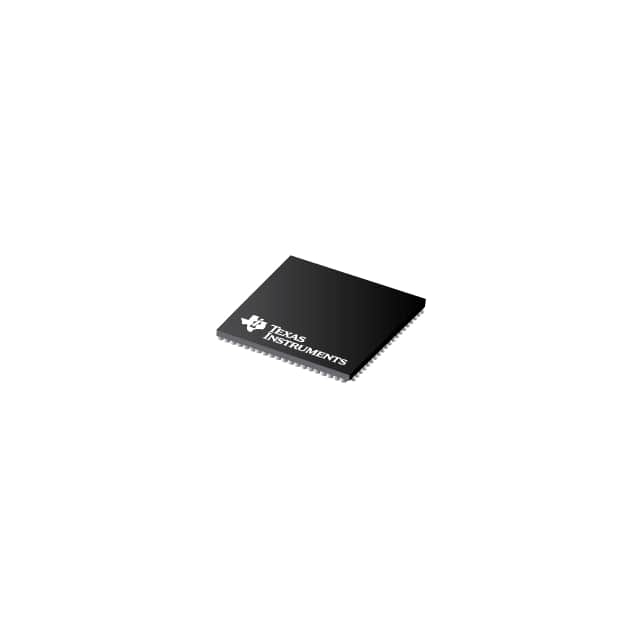
Texas Instruments CP3SP33SMS/NOPB
- Part No.:
- CP3SP33SMS/NOPB
- Manufacturer:
- Texas Instruments
- Category:
- Application Specific Microcontrollers
- Package:
- 224-LFBGA
- Datasheet:
-
 CP3SP33SMS/NOPB.pdf
- Description:
- IC CPU W/BLUTOOTH&CAN 224NFBGA
- Quantity:
- Payment:

- Shipping:

Inventory:2,051
Please send an inquiry. Send us your inquiry, and we will respond immediately.
Product details
Overview
CP3SP33SMS/NOPB from Texas Instruments is a dual-core connectivity processor integrating a 96-MHz CR16CPlus RISC CPU with 4KB instruction cache and a Teak 16-bit fixed-point DSP, featuring dual CAN 2.0B interfaces, USB 2.0 On-The-Go, Bluetooth LLC hardware, and integrated telematics codec. It delivers real-time voice/audio processing and wired/wireless communication for automotive infotainment gateways and industrial telematics terminals.
For engineers reviewing the CP3SP33SMS/NOPB datasheet, CP3SP33SMS/NOPB pinout, CP3SP33SMS/NOPB application, or CP3SP33SMS/NOPB equivalent, key selection criteria include its FBGA-224 package, 32-bit external bus width, 64 GPIOs, dual CAN message buffer architecture, and Bluetooth 1.2-compliant hardware link controller with 7KB dedicated data RAM.
Technical Context
The CP3SP33SMS/NOPB implements AMBA AHB/APB bus architecture with independent CPU and DSP buses operating up to 96 MHz. Its External Bus Interface Unit (EBIU) supports three programmable memory regions with 8-level write buffering and configurable 8/16/32-bit bus widths.
Hardware peripherals are tightly coupled: dual CAN controllers use memory-mapped 15-message buffers with dual acceptance masks and 16-bit time stamp counters; the Bluetooth LLC includes dedicated 7KB data RAM and 1KB sequencer RAM; and the telematics codec provides dual 10-bit ADC channels and stereo DAC with differential line drivers and sidetone injection.
Key Specifications
| Parameter | Value and Actual Design Meaning |
|---|---|
| CPU Core | CR16CPlus RISC, 0–96 MHz operation, 4KB 4-way set-associative instruction cache |
| DSP Core | Teak 16-bit fixed-point, dual-MAC, 24KB program RAM + 24KB data RAM + 4KB shared RAM |
| External Memory Support | Up to 96 MB addressable space via 32-bit EBIU with 8-level write buffer |
| CAN Interfaces | Dual CAN 2.0B compliant, 15 memory-mapped message buffers per controller, 16-bit timestamp counter |
| USB Interface | USB 2.0 Full-Speed OTG node/host with integrated transceiver, 7 endpoint pipes (EP0 + 6 unidirectional) |
| Bluetooth Hardware | Lower Link Controller (LLC) compliant with Bluetooth 1.2, 7KB data RAM + 1KB sequencer RAM |
| Audio Peripherals | Dual 10-bit ADC (8–24 kHz sample rate), stereo DAC with differential outputs, I2S and AAI interfaces |
| Package & Temp Range | FBGA-224 (13×13 mm, 0.8 mm pitch), –40°C to +85°C industrial temperature range |
Pinout & Package
CP3SP33SMS/NOPB is housed in a 224-ball Fine-Pitch Ball Grid Array (FBGA-224) package with 0.8 mm ball pitch and 13 mm × 13 mm body size. Pin assignments follow TI's standardized ball map for CP3SP33 family devices, supporting high-density routing for automotive and industrial PCB layouts.
| Pin/Terminal | Circuit Role | Design Meaning |
|---|---|---|
| VDD_CORE | CPU/DSP core supply | 1.8 V nominal, powers CR16CPlus and Teak cores; requires low-noise regulation |
| VDD_IO | I/O supply | 3.0–3.3 V, powers GPIOs, UARTs, SPI, CAN transceivers, and external bus interface |
| XTAL_IN / XTAL_OUT | Main oscillator input/output | Accepts 12 MHz crystal; drives internal PLL for 96 MHz system clock generation |
| RTC_XIN / RTC_XOUT | Real-time clock oscillator | 32.768 kHz crystal connection for power-save mode timing and RTC functionality |
| CAN0_TX / CAN0_RX | CAN0 differential signal pair | Direct connection to external CAN transceiver; supports up to 1 Mbps bit rate |
| CAN1_TX / CAN1_RX | CAN1 differential signal pair | Independent second CAN channel; enables dual-bus vehicle network architectures |
| USB_DP / USB_DM | USB 2.0 differential data pair | Full-speed (12 Mbps) signaling; integrated pull-up resistor on DP controlled by VBUS sense |
| AD0–AD31 | Address/data multiplexed bus | 32-bit external memory interface; supports 8/16/32-bit wide accesses with programmable timing |
Key Features
| Feature | Design Value |
|---|---|
| Dual CAN 2.0B with hardware filtering | 15 message buffers per controller, dual mask registers, and priority decoder enable deterministic real-time messaging without CPU overhead |
| Integrated Bluetooth LLC hardware | Dedicated 7KB data RAM and 1KB sequencer RAM offload baseband processing from CPU/DSP, reducing latency and power |
| Telematics audio subsystem | Dual mono ADC + stereo DAC with differential outputs, sidetone injection, and click/pop suppression for hands-free voice systems |
| AMBA AHB/APB bus isolation | Independent CPU and DSP AHB buses with shared APB peripherals prevent resource contention during concurrent signal and control processing |
| Multi-Input Wake-Up (MIWU) | Allows CAN, UART, or GPIO events to wake device from Power Save/Idle/Halt modes, enabling ultra-low-power telematics monitoring |
| USB 2.0 OTG with integrated transceiver | Eliminates external PHY components; VBUS-sensed pull-up enables automatic host/peripheral role negotiation |
Applications
| Automotive Gateway Module | Industrial Telematics Terminal |
|---|---|
Use Scenario: Aggregating CAN bus data from engine, chassis, and body ECUs while bridging to cellular/Wi-Fi modules via USB or UART. IC Role / Device Role / Timing Role: Central connectivity hub executing protocol translation, real-time CAN message scheduling, and secure firmware updates over USB OTG. Use Value: Dual CAN controllers with 16-bit timestamp counters enable synchronized multi-bus diagnostics; 96 MHz CPU ensures deterministic response under 100% bus load. |
Use Scenario: Remote asset monitoring unit collecting sensor data via ADC and transmitting over cellular networks using Bluetooth HCI or USB CDC. IC Role / Device Role / Timing Role: Real-time data concentrator with Bluetooth 1.2 baseband offload, dual UARTs for modem control, and MIWU-triggered wake-on-event operation. Use Value: Integrated Bluetooth LLC reduces host CPU loading by >40% versus software stack implementations; 32K CPU RAM supports embedded RTOS and protocol stacks. |
| VoIP-Enabled Fleet Communication | Smart Building HVAC Controller |
Use Scenario: In-vehicle hands-free calling system with microphone input, echo cancellation, and speaker output via integrated codec and CVSD/PCM converters. IC Role / Device Role / Timing Role: Audio signal processor running Teak DSP algorithms while CR16CPlus handles Bluetooth packet assembly and USB audio class streaming. Use Value: Dual CVSD/PCM conversion modules support two simultaneous bidirectional voice paths; differential DAC outputs deliver >95 dB SNR for clear audio playback. |
Use Scenario: Networked HVAC controller interfacing with BACnet MS/TP over CAN and communicating with cloud gateway via USB or Bluetooth HCI. IC Role / Device Role / Timing Role: Fieldbus bridge processor managing time-critical CAN messaging while hosting web server and OTA update logic in CPU RAM. Use Value: 64 GPIOs support direct sensor/actuator interfacing; FBGA-224 package meets IPC Class 3 reliability requirements for long-life building infrastructure deployments. |
Equivalent & Alternatives
The following parts are listed as comparable options for similar connectivity processor applications.
| Alternative Part | Technical Difference | Application Difference | Selection Advice |
|---|---|---|---|
| TMS320F28379D | Single C2000 DSP core (200 MHz), no integrated Bluetooth LLC or CAN message buffers; relies on software CAN stack | Targeted at motor control with floating-point math; lacks hardware Bluetooth and dual-CAN message RAM architecture | Choose when real-time motor control dominates over wireless connectivity; requires external Bluetooth module and CAN transceivers |
| S32K144 | ARM Cortex-M4F (112 MHz), single CAN FD controller, no integrated Bluetooth hardware or audio codec | Designed for ASIL-B automotive safety; lacks dedicated DSP, Bluetooth LLC, and telematics audio subsystem | Prefer for functional safety-critical ECU designs where Bluetooth is implemented via external module and audio is not required |
Compared with TMS320F28379D and S32K144, CP3SP33SMS/NOPB uniquely integrates Bluetooth 1.2 LLC hardware, dual CAN 2.0B controllers with 15-message buffers each, and a full telematics audio subsystem - eliminating need for external PHYs, transceivers, and audio codecs in voice-enabled telematics applications.
Availability
CP3SP33SMS/NOPB is available at Aetrix Electronics and suitable for automotive gateway modules, industrial telematics terminals, VoIP fleet communication units, smart building HVAC controllers, and embedded Bluetooth audio systems requiring stable component supply across extended product lifecycles.
Supply support for CP3SP33SMS/NOPB includes scheduled delivery planning, volume procurement assistance, BOM continuity management, traceable sourcing, and lifecycle availability coordination for OEM customers, industrial embedded developers, connected-device designers, and electronics production programs.
Manufacturer
Texas Instruments is a global semiconductor company headquartered in Dallas, Texas, delivering analog and embedded processing solutions for industrial, automotive, and communications markets.
The CP3SP33SMS/NOPB belongs to TI's legacy connectivity processor family designed specifically for embedded Bluetooth 1.2 applications requiring integrated dual CAN, USB OTG, and telematics-grade audio processing in a single chip.
FAQ
What is the maximum external memory capacity supported by CP3SP33SMS/NOPB?
CP3SP33SMS/NOPB supports up to 96 MB of external memory via its 32-bit External Bus Interface Unit (EBIU). This capacity applies specifically to the CP3SP33SMS/NOPB variant in FBGA-224 packaging, as confirmed in the CP3SP33 Selection Guide table. The FBGA-144 variant (CP3SP33SMR) supports only 8 MB, making the 96 MB capability a distinguishing feature of CP3SP33SMS/NOPB for memory-intensive telematics applications.
Does CP3SP33SMS/NOPB include hardware support for Bluetooth 2.0 or later specifications?
No, CP3SP33SMS/NOPB implements Bluetooth Lower Link Controller (LLC) hardware compliant exclusively with Bluetooth Specification Version 1.2, as documented in Section 3.6 of the datasheet. It does not support Enhanced Data Rate (EDR), Bluetooth 2.0+, or later versions. The hardware lacks EDR modulation circuitry and associated packet handling logic required for higher throughput profiles.
How many independent CAN message buffers does CP3SP33SMS/NOPB provide per controller?
CP3SP33SMS/NOPB provides 15 memory-mapped message buffers per CAN controller, as specified in Section 3.8 and Section 22.1 of the datasheet. These buffers are individually configurable as transmit or receive endpoints and support hardware-based acceptance filtering with two distinct mask registers - one for buffers 0–13 and another for buffer 14 - enabling flexible multi-path CAN messaging.
What audio sampling rates are supported by the integrated telematics codec in CP3SP33SMS/NOPB?
The integrated telematics codec in CP3SP33SMS/NOPB supports ADC sampling rates from 8 kHz to 24 kHz, requiring a 125× oversampling clock. The stereo DAC operates at selectable sample rates derived from either a 125× or 128× oversampling clock, enabling compatibility with standard telephony (8 kHz) and wideband voice (16 kHz) applications. These rates are fixed by hardware design and cannot be extended beyond the documented ranges.
Is CP3SP33SMS/NOPB pin-compatible with other variants in the CP3SP33 family?
No, CP3SP33SMS/NOPB is not pin-compatible with CP3SP33SMR. The CP3SP33SMS/NOPB uses FBGA-224 packaging (224 balls), while CP3SP33SMR uses FBGA-144 (144 balls), resulting in fundamentally different ball maps, power delivery schemes, and I/O count (64 vs. 36 general-purpose I/Os). PCB layout and power sequencing must be redesigned when substituting between these variants.
CP3SP33SMS/NOPB Specifications
- Product attributes
- Attribute value
- Manufacturer:
- Texas Instruments
- Series:
- -
- Package/Case:
- 224-LFBGA
- Packaging:
- Tray
- Product Status:
- Active
- Programmable:
- Not Verified
- Applications:
- Connectivity Processor
- Core Processor:
- CR16C
- Program Memory Type:
- External Program Memory
- Controller Series:
- CP3000
- RAM Size:
- 44K x 8
- Interface:
- ACCESS.bus, Audio, Bluetooth, CAN, EBI/EMI, I2S, Microwire/SPI, UART/USART, USB OTG
- Number of I/O:
- 64
- Voltage - Supply:
- 3V ~ 3.3V
- Operating Temperature:
- -40°C ~ 85°C
- Grade:
- -
- Qualification:
- -
- Mounting Type:
- Surface Mount
- Supplier Device Package:
- 224-NFBGA (13x13)
CP3SP33SMS/NOPB FAQ
1.How can I place an order for CP3SP33SMS/NOPB through Aetrix?
Please submit a Request for Quotation (RFQ) for CP3SP33SMS/NOPB on Aetrix. Our sales agent will provide a competitive quotation and guide you through the order confirmation once you accept the terms.
2.Are the price and stock information for CP3SP33SMS/NOPB reliable?
The price and inventory of CP3SP33SMS/NOPB are updated periodically and may fluctuate due to market conditions. Stock and pricing data are typically refreshed every 24 hours. Quotation validity for CP3SP33SMS/NOPB is usually 5 days.
3.What payment methods are accepted for CP3SP33SMS/NOPB?
We accept Wire Transfer, PayPal, Credit Card, Western Union, MoneyGram, and Escrow for CP3SP33SMS/NOPB transactions.
Note: Certain payment methods may incur a processing fee.
4.How is shipping managed for CP3SP33SMS/NOPB?
CP3SP33SMS/NOPB orders can be shipped via leading logistics carriers, including DHL, UPS, FedEx, TNT, or Registered Mail.
Once your CP3SP33SMS/NOPB order is processed, you will receive an email with the shipment details and tracking number.
Note: Tracking information may take up to 24 hours to appear. Express delivery typically takes 3–5 business days.
5.How can I obtain technical support or documentation for CP3SP33SMS/NOPB?
For technical support, including CP3SP33SMS/NOPB datasheets, pinout diagrams, or application guidance, please contact our engineering support team. They can provide detailed documentation and assistance for your CP3SP33SMS/NOPB requirements.
6.How does Aetrix verify that CP3SP33SMS/NOPB is sourced from the original manufacturer or authorized distributors?
All CP3SP33SMS/NOPB products on Aetrix are procured from qualified distributors and authorized channels. Our dedicated quality assurance team conducts strict verification, including traceability checks and, if necessary, third-party testing. This ensures that CP3SP33SMS/NOPB meets industry standards.
7.What is the process for return or replacement of CP3SP33SMS/NOPB?
All CP3SP33SMS/NOPB units undergo pre-shipment inspection (PSI). If there is an issue with CP3SP33SMS/NOPB, returns or replacements are accepted under the following conditions:
1.Quantity discrepancies, incorrect items, or visible external defects (such as breakage or corrosion), acknowledged by Aetrix.
2.The issue is reported within 90 days of delivery.
3.The CP3SP33SMS/NOPB part is unused and in its original packaging.
Return procedure for CP3SP33SMS/NOPB:
1.Submit a request within 90 days.
2.Obtain a Return Material Authorization (RMA) from Aetrix.
CP3SP33SMS/NOPB Tags
-
CYPD3175-24LQXQ
Infineon Technologies

-
SLB9672VU20FW1523XTMA1
Infineon Technologies
-
SLB9670VQ20FW785XTMA1
Infineon Technologies
-
SLB9672XU20FW1523XTMA1
Infineon Technologies
-
SLB9673XU20FW2613XTMA1
Infineon Technologies
-
CYPD3125-40LQXIT
Infineon Technologies
-
AT97SC3204-U2A1A-20
Microchip Technology
-
AT97SC3204-U2A1A-10
Microchip Technology
-
SLM9670AQ20FW1311XTMA1
Infineon Technologies
-
SLB9672XU20FW1613XTMA1
Infineon Technologies
-
SLB9672AU20FW1613XTMA1
Infineon Technologies
-
SLB9673AU20FW2613XTMA1
Infineon Technologies
Tech Hub

A practical engineering guide to 3.3V and 5V logic compatibility, input thresholds, resistor dividers, translator ICs, MOSFET level shifting, I2C pull-ups, timing limits and power-sequencing risks.

The 74HC595 uses push-pull logic outputs, while the TPIC6B595 uses 50 V open-drain DMOS sinks for higher-power loads. This guide compares timing, current limits, 3.3 V interfacing, load wiring, thermal…

The 74HC595 converts serial data into eight stable parallel outputs. This guide covers pin functions, shift and storage timing, OE and MR behavior, drive-current limits, cascading, voltage compatibilit…

A technical comparison of level-sensitive latches and edge-triggered flip-flops, covering timing windows, setup and hold limits, master–slave operation, time borrowing, race-through, HDL inference and…

A D latch stores one bit while Enable controls when data can pass. This reference covers gate-level operation, truth tables, transparency, setup and hold timing, LE versus OE, common ICs and practical …

An SR latch stores one bit through cross-coupled feedback. This engineering reference covers NOR and NAND implementations, truth tables, forbidden-state recovery, gated operation, switch debouncing, fa…

Latch circuits retain one bit through feedback. This technical reference covers SR and D latches, truth tables, transparency, timing limits, latch-versus-flip-flop behavior, applications and common log…

An engineering guide to LED driver operation, constant-current and constant-voltage outputs, linear and switching topologies, dimming, IC selection, calculations, replacement compatibility, and fault c…

Operational amplifier guide covering op amp basics, feedback, ideal vs real op amps, common configurations, buffer circuits, offset, bias current, gain-bandwidth, slew rate, rail-to-rail limits and sel…

Jumper cables guide covering safe connection order, red and black clamp placement, final ground connection, cable gauge, length, clamp quality, copper vs CCA cables, jump starter comparison and battery…


