
 My Inquiry
 My Account


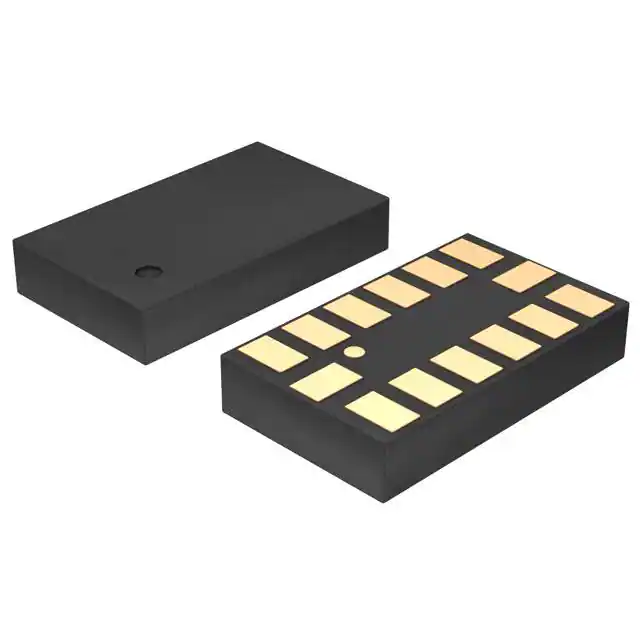
STMicroelectronics FC30TR
- Part No.:
- FC30TR
- Manufacturer:
- STMicroelectronics
- Category:
- Specialized Sensors
- Package:
- Datasheet:
-
 FC30TR.pdf
- Description:
- SENSOR 3D ORIENT DETECT DIG OUT
- Quantity:
- Payment:

- Shipping:

Inventory:4,207
Please send an inquiry. Send us your inquiry, and we will respond immediately.
Product details
Overview
FC30TR from STMicroelectronics is a standalone MEMS-based 3D orientation and mechanical tap detection sensor in LGA-14 (3×5×0.9 mm) package. It detects six gravity-referenced orientations (portrait/landscape/face up/down), delivers dedicated interrupt outputs (PC, LC, SIGN), supports programmable single/double-click detection, and operates from 2.16–3.6 V with 0.4 mA typical supply current at 25 °C for mobile UI and image rotation applications.
For engineers reviewing the FC30TR datasheet, FC30TR pinout, FC30TR application, or FC30TR equivalent, key selection criteria include orientation accuracy (±3°), ultra-low power-down current (1 µA), interrupt-driven wake-up capability, post-assembly testability without motion, and compatibility with automated SMT assembly using tape-and-reel packaging.
Technical Context
The FC30TR implements a fully integrated MEMS sensing element with on-chip signal conditioning and digital logic to determine static orientation relative to gravity across three orthogonal axes. Its output consists of three dedicated open-drain interrupt lines-PC (portrait), LC (landscape), and SIGN (combined orientation)-each driven high when their respective condition is met.
Tap detection is implemented via internal acceleration thresholding and timing logic, enabling configurable single- and double-tap recognition with programmable inter-click interval. Power management is hardware-controlled via the PD pin, forcing full shutdown (1 µA) when pulled low, with 30 ms turn-on time to valid orientation data after exit.
Key Specifications
| Parameter | Value and Actual Design Meaning |
|---|---|
| Supply voltage | 2.16–3.6 V - supports Li-ion battery and regulated 2.5 V/3.3 V rails without external LDO |
| Supply current (active) | 0.4 mA typ. @ 25 °C - enables >1-year battery life in intermittent-sensing portable devices |
| Power-down current | 1 µA - allows persistent attachment to always-on MCU interrupt lines with negligible quiescent drain |
| Orientation accuracy | ±3° - ensures reliable portrait/landscape switching within ±17° tilt margin around cardinal axes |
| Operating temperature | −40 °C to +85 °C - qualified for consumer handhelds and industrial HMI enclosures |
| Shock survivability | 10,000 g / 0.1 ms - survives drop testing and mechanical handling during board assembly and device integration |
| Package | LGA-14, 3×5×0.9 mm - compatible with standard 0.8 mm pitch SMT placement and reflow profiles |
Pinout & Package
LGA-14 (3×5×0.9 mm) plastic full-moulded package with exposed pad; RoHS, ECOPACK®, and halogen-free compliant; hermetically sealed for post-reflow washability.
| Pin/Terminal | Circuit Role | Design Meaning |
|---|---|---|
| 1 Vdd_IO | I/O power supply | Supplies voltage to interrupt output drivers; independent of core Vdd to support mixed-voltage host interfaces |
| 2 GND | Ground reference | 0 V return for I/O circuitry; must be connected to system ground plane |
| 3 Vdd | Core power supply | Provides operating voltage to MEMS element and internal logic; decoupling required at Pin 6 |
| 4 Res | Reserved | Must be connected to 0 V per datasheet; not left floating |
| 5 GND | Ground reference | Second ground connection for noise reduction and thermal dissipation |
| 11 PD | Power-down control | Active-low enable: logic 0 forces ultra-low-power state; logic 1 enables orientation/tap sensing |
| 8 PC | Portrait interrupt | Open-drain output asserted high when device is in portrait orientation (±3° tolerance) |
| 9 LC | Landscape interrupt | Open-drain output asserted high when device is in landscape orientation (±3° tolerance) |
| 12 SIGN | Combined orientation indicator | Open-drain output encoding face-up/down and orientation quadrant; used for extended UI states |
Key Features
| Feature | Design Value |
|---|---|
| 6-position orientation detection | Identifies portrait up/down, landscape left/right, and face up/down without host-side computation |
| Programmable tap/double-tap | Enables intuitive "mouse button" interaction with user-configurable inter-click timing window |
| Post-assembly verification | Allows functional test via MCU interface without physical movement-critical for embedded QA |
| Dual-supply architecture | Vdd (core) and Vdd_IO (I/O) separation permits flexible interfacing with 1.8 V, 2.5 V, or 3.3 V controllers |
| Hermetic LGA package | Enables post-reflow cleaning and withstands harsh manufacturing environments without performance degradation |
Applications
| Smartphone Auto-Rotate | Digital Photo Frame |
|---|---|
Use Scenario: Automatic screen rotation between portrait and landscape modes based on handheld position. IC Role / Device Role / Timing Role: Standalone orientation detector providing immediate, low-latency interrupt signals to application processor GPIOs. Use Value: Eliminates need for software-based accelerometer fusion algorithms; reduces CPU load and power by >15% in display subsystem. | Use Scenario: Rotating displayed images to match frame mounting orientation (wall vs. tabletop). IC Role / Device Role / Timing Role: Gravity-referenced orientation sensor triggering display controller reconfiguration on power-up or orientation change. Use Value: Enables zero-touch setup; no manual menu navigation required for correct image orientation. |
| Buttonless Remote Control | Motion-Triggered Wake-Up |
Use Scenario: Tap-to-select function on TV remote or audio player casing instead of mechanical buttons. IC Role / Device Role / Timing Role: Tap-detection engine generating interrupt pulses for host microcontroller to interpret as button press events. Use Value: Improves IP rating and long-term reliability by removing tactile switches subject to wear and contamination. | Use Scenario: Waking a sleeping wearable or IoT sensor node upon intentional tap or shake gesture. IC Role / Device Role / Timing Role: Ultra-low-power orientation/tap sensor asserting interrupt line while in 1 µA power-down mode. Use Value: Extends battery life to multi-year operation by avoiding continuous accelerometer polling. |
Equivalent & Alternatives
The following parts are listed as comparable options for similar 3D orientation and tap detection applications.
| Alternative Part | Technical Difference | Application Difference | Selection Advice |
|---|---|---|---|
| LIS3DHTR | 3-axis digital accelerometer (I²C/SPI); requires host firmware for orientation logic and tap detection | No dedicated orientation interrupts; needs MCU resources for angle calculation and gesture classification | Select when system already uses LIS3DH and requires additional motion metrics (e.g., step counting, free-fall) |
| BMA253 | Low-power 3-axis accelerometer with built-in orientation engine and configurable tap/double-tap; 12-bit resolution | Higher integration (on-chip FIFO, slope detection) but larger LGA-12 (2×2×0.95 mm) footprint | Select when needing higher-resolution tilt measurement (±0.5°) and deeper motion analytics beyond basic orientation |
Compared with LIS3DHTR and BMA253, the FC30TR delivers immediate orientation state via hardware-generated interrupts-reducing host processing overhead and firmware complexity-while offering superior shock survivability (10,000 g) and guaranteed post-assembly testability without motion.
Availability
FC30TR is available at Aetrix Electronics and suitable for smartphone auto-rotate, digital photo frame orientation, and motion-triggered wake-up applications requiring stable component supply, full tape-and-reel delivery, and long-term production continuity.
Supply support for FC30TR includes scheduled delivery planning, volume procurement assistance, BOM continuity management, traceable sourcing, and lifecycle availability coordination for OEM customers, industrial embedded developers, connected-device designers, and electronics production programs.
Manufacturer
STMicroelectronics is a global semiconductor leader headquartered in Geneva, Switzerland, designing and manufacturing microcontrollers, sensors, power ICs, and analog components for automotive, industrial, and consumer markets.
The FC30TR belongs to ST's MEMS motion sensor product line, engineered specifically for ultra-low-power, interrupt-driven human interface applications where mechanical simplicity, reliability, and minimal host processing are critical design requirements.
FAQ
What is the difference between FC30TR and FC30?
The FC30TR is the tape-and-reel packaging variant of the FC30, identical in electrical and functional specifications. Both share the same LGA-14 package, −40 °C to +85 °C rating, and interrupt-driven orientation/tap detection behavior. The "TR" suffix denotes packaging format only-not a revision or performance variant-and is optimized for automated SMT assembly.
Can FC30TR detect orientation while moving?
No-the FC30TR is designed exclusively for static orientation detection relative to gravity and does not provide dynamic motion data. Its six-position output assumes steady-state conditions; acceleration during movement invalidates orientation interpretation. For motion tracking, a 3-axis accelerometer like LIS3DHTR is required instead.
How is tap detection configured on FC30TR?
Tap detection is factory-configured and non-programmable via pins or registers. Sensitivity and double-tap timing are fixed at design time; users select behavior solely through hardware connections (e.g., pull-up/pull-down on PD). No I²C/SPI interface exists-configuration is limited to power mode (PD pin) and output polarity (external pull-ups).
Is FC30TR compatible with lead-free reflow processes?
Yes-FC30TR uses an ECOPACK®-compliant LGA-14 package rated for standard lead-free reflow profiles (J-STD-020). Its hermetic molding allows post-reflow washing, and the package withstands peak temperatures up to 260 °C for ≤60 seconds, meeting IPC-A-610 Class 2 and Class 3 assembly requirements.
FC30TR Specifications
- Product attributes
- Attribute value
- Manufacturer:
- STMicroelectronics
- Series:
- -
- Packaging:
- Tape & Reel (TR)
- Product Status:
- Obsolete
- Sensor Type:
- 3D Orientation Detection
- Output Type:
- Digital
- Operating Temperature:
- -40°C ~ 85°C
- Grade:
- -
- Qualification:
- -
FC30TR FAQ
1.How can I place an order for FC30TR through Aetrix?
Please submit a Request for Quotation (RFQ) for FC30TR on Aetrix. Our sales agent will provide a competitive quotation and guide you through the order confirmation once you accept the terms.
2.Are the price and stock information for FC30TR reliable?
The price and inventory of FC30TR are updated periodically and may fluctuate due to market conditions. Stock and pricing data are typically refreshed every 24 hours. Quotation validity for FC30TR is usually 5 days.
3.What payment methods are accepted for FC30TR?
We accept Wire Transfer, PayPal, Credit Card, Western Union, MoneyGram, and Escrow for FC30TR transactions.
Note: Certain payment methods may incur a processing fee.
4.How is shipping managed for FC30TR?
FC30TR orders can be shipped via leading logistics carriers, including DHL, UPS, FedEx, TNT, or Registered Mail.
Once your FC30TR order is processed, you will receive an email with the shipment details and tracking number.
Note: Tracking information may take up to 24 hours to appear. Express delivery typically takes 3–5 business days.
5.How can I obtain technical support or documentation for FC30TR?
For technical support, including FC30TR datasheets, pinout diagrams, or application guidance, please contact our engineering support team. They can provide detailed documentation and assistance for your FC30TR requirements.
6.How does Aetrix verify that FC30TR is sourced from the original manufacturer or authorized distributors?
All FC30TR products on Aetrix are procured from qualified distributors and authorized channels. Our dedicated quality assurance team conducts strict verification, including traceability checks and, if necessary, third-party testing. This ensures that FC30TR meets industry standards.
7.What is the process for return or replacement of FC30TR?
All FC30TR units undergo pre-shipment inspection (PSI). If there is an issue with FC30TR, returns or replacements are accepted under the following conditions:
1.Quantity discrepancies, incorrect items, or visible external defects (such as breakage or corrosion), acknowledged by Aetrix.
2.The issue is reported within 90 days of delivery.
3.The FC30TR part is unused and in its original packaging.
Return procedure for FC30TR:
1.Submit a request within 90 days.
2.Obtain a Return Material Authorization (RMA) from Aetrix.
FC30TR Tags

-
AS7057-BWLT WLP LF T&R
ams-OSRAM USA INC.
-
LSM6DSO32XTR
STMicroelectronics
-
AS3935-BQFT
ScioSense
-
BAF147B002-00A0
Amphenol Advanced Sensors (Thermometrics)
-
MAX86174AENE+T
Analog Devices Inc./Maxim Integrated
-
VL53L8CXV0GC/1
STMicroelectronics
-
BME680
Bosch Sensortec
-
SEN-12969
SparkFun Electronics
-
BME688
Bosch Sensortec
-
MAXM86161EFD+T
Analog Devices Inc./Maxim Integrated
-
A111-001-T&R
Acconeer AB

-
MAX30101EFD+T
Analog Devices Inc./Maxim Integrated
Tech Hub

A practical engineering and sourcing framework covering lifecycle verification, lifetime-buy calculations, replacement qualification, supplier checks and counterfeit-risk controls.

TTL and CMOS logic families differ in thresholds, loading, output drive, power and timing. This engineering guide compares 74HC and 74HCT, calculates noise margins and checks 3.3 V/5 V compatibility.

A practical engineering guide to 3.3V and 5V logic compatibility, input thresholds, resistor dividers, translator ICs, MOSFET level shifting, I2C pull-ups, timing limits and power-sequencing risks.

The 74HC595 uses push-pull logic outputs, while the TPIC6B595 uses 50 V open-drain DMOS sinks for higher-power loads. This guide compares timing, current limits, 3.3 V interfacing, load wiring, thermal…

The 74HC595 converts serial data into eight stable parallel outputs. This guide covers pin functions, shift and storage timing, OE and MR behavior, drive-current limits, cascading, voltage compatibilit…

A technical comparison of level-sensitive latches and edge-triggered flip-flops, covering timing windows, setup and hold limits, master–slave operation, time borrowing, race-through, HDL inference and…

A D latch stores one bit while Enable controls when data can pass. This reference covers gate-level operation, truth tables, transparency, setup and hold timing, LE versus OE, common ICs and practical …

An SR latch stores one bit through cross-coupled feedback. This engineering reference covers NOR and NAND implementations, truth tables, forbidden-state recovery, gated operation, switch debouncing, fa…

Latch circuits retain one bit through feedback. This technical reference covers SR and D latches, truth tables, transparency, timing limits, latch-versus-flip-flop behavior, applications and common log…

An engineering guide to LED driver operation, constant-current and constant-voltage outputs, linear and switching topologies, dimming, IC selection, calculations, replacement compatibility, and fault c…


