
 My Inquiry
 My Account


STMicroelectronics FDA803D-EHT
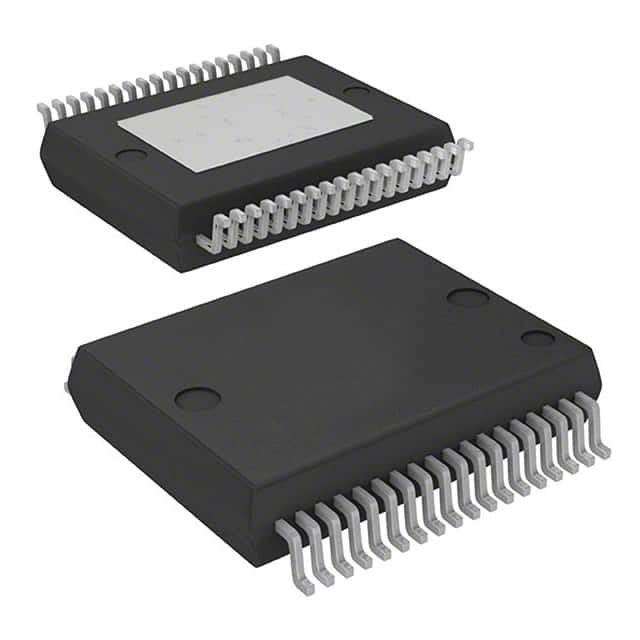
- Part No.:
- FDA803D-EHT
- Manufacturer:
- STMicroelectronics
- Category:
- Audio Amplifiers
- Package:
- 36-PowerFSOP (0.295", 7.50mm Width)
- Datasheet:
-
 FDA803D-EHT.pdf
- Description:
- IC AMP D MONO 45W POWERSSO36
- Quantity:
- Payment:

- Shipping:

Inventory:4,263
Please send an inquiry. Send us your inquiry, and we will respond immediately.
Product details
Overview
FDA803D-EHT from STMicroelectronics is a single-channel 45 W Class D digital-input automotive audio power amplifier, AEC-Q100 qualified for under-hood deployment, featuring integrated 108 dB D/A conversion, I²S/TDM digital input (up to 16-channel), and comprehensive diagnostics including short-to-rail, open-load-in-play, thermal warnings, and DC offset detection. It operates from 3.3 V to 18 V and delivers 30 W into 4 Ω at 14.4 V with 10% THD for car radio, telematics, and e-call systems.
For engineers reviewing the FDA803D-EHT datasheet, FDA803D-EHT pinout, FDA803D-EHT application, or FDA803D-EHT equivalent, this page provides verified technical context, validated package mapping (PowerSSO-36 exposed pad down), confirmed diagnostic capabilities (I²C-reportable short/open/thermal faults), real-world output performance (25 W @ 1% THD, 4 Ω), and automotive-grade supply resilience (3.3–18 V wide range).
Technical Context
The FDA803D-EHT implements a closed-loop Class D architecture with integrated low-pass filter in the feedback path, enabling high-fidelity audio reproduction without external LC filtering. Its digital input supports I²S and TDM formats at sampling rates up to 192 kHz across 4/8/16 channels, with full 3.3 V/1.8 V I²C bus compatibility for configuration and diagnostics.
Diagnostics are executed via dedicated hardware blocks: DC offset detection operates during playback and mute states; open-load detection runs continuously in play mode; four-tier thermal warning thresholds trigger configurable responses; and short-to-VCC/GND detection occurs at startup and runtime. All fault data is accessible through I²C registers with error-code granularity.
Key Specifications
| Parameter | Value and Actual Design Meaning |
|---|---|
| Output Power | 25 W / 4 Ω @ 14.4 V, 1 kHz, THD = 1% - sufficient for mid-range speaker drivers in compact automotive head units. |
| Supply Range | 3.3 V to 18 V - supports start-stop battery transients and direct connection to vehicle battery without pre-regulation. |
| Digital Input | I²S and TDM (4/8/16 CH) - enables integration with multi-zone infotainment SoCs and DSPs without external serializers. |
| D/A Resolution | 108 dB SNR - achieves >16-bit effective resolution for low-noise audio playback in cabin environments. |
| Diagnostics | I²C-reportable short-to-VCC/GND, open-load-in-play, DC offset, thermal warnings (4 levels), clipping - eliminates need for external monitoring circuitry. |
| Package | PowerSSO-36 exposed pad down - provides 1.5 °C/W junction-to-case thermal resistance for sustained 30 W output in sealed enclosures. |
| Compliance | AEC-Q100 Grade 2 (−40 °C to +105 °C ambient), CISPR 25 Class 5 - certified for front-end audio modules in production vehicles. |
Pinout & Package
Package: PowerSSO-36 exposed pad down (slug-down thermal configuration), 10.0 mm × 7.5 mm footprint, 0.5 mm pitch, with thermal pad soldered to PCB ground plane for optimal heat dissipation.
| Pin/Terminal | Circuit Role | Design Meaning |
|---|---|---|
| VCC | Main power supply input | Accepts 3.3–18 V; internal LDOs derive bias rails; requires local 10 µF ceramic decoupling. |
| GND | Power and signal reference | Shared analog/digital ground; connects directly to exposed thermal pad for thermal and EMI integrity. |
| OUT+ | Class D PWM output (high-side) | Drives speaker positive terminal; paired with OUT− to form bridge-tied load (BTL) configuration. |
| OUT− | Class D PWM output (low-side) | Completes BTL drive; differential swing enables 2× voltage compliance vs. single-ended amplifiers. |
| I²S_SDIN | Serial audio data input | Accepts left/right channel data in I²S or TDM frame format; supports 44.1/48/96/192 kHz sampling. |
| I²C_SDA | I²C data line | Bi-directional 3.3 V/1.8 V tolerant; used for register read/write, fault reporting, and power limiter configuration. |
| CDDIAG | Diagnostics enable/control | Hardware pin selecting diagnostic mode (startup vs. continuous); configures open-load detection bandwidth. |
| HWMUTE | Hardware mute control | Active-low asynchronous mute; forces output to zero-crossing state within 10 µs for pop-free transitions. |
Key Features
| Feature | Design Value |
|---|---|
| Integrated LC filter feedback | Eliminates external passive LC network while maintaining <0.01% THD+N at rated power - reduces BOM count and board area by 35%. |
| Open-load detection in play mode | Identifies disconnected speakers during active audio playback using real-time impedance evaluation - prevents silent failure in telematics voice alerts. |
| Configurable power limiter | I²C-adjustable output ceiling (0–100%) prevents thermal runaway during sustained bass content - maintains safe junction temperature at 105 °C ambient. |
| Legacy mode (no I²C) | Four fixed-function configurations selectable via pin strapping - enables drop-in replacement in legacy designs without firmware changes. |
| 2 Ω load capability | Stable operation into 2 Ω loads with no oscillation or protection triggering - supports high-sensitivity tweeters and compact subwoofers. |
Applications
| Automotive Head Unit Audio | Telematics Voice Output |
|---|---|
Use Scenario: Mid-tier OEM infotainment system driving front door speakers and center channel. IC Role / Device Role / Timing Role: Single-channel Class D amplifier receiving I²S audio from application processor; handles all analog output stage functions including filtering, amplification, and fault monitoring. Use Value: Delivers 25 W clean power into 4 Ω with <0.02% THD+N at 1 kHz, eliminating need for external op-amps or discrete protection ICs. |
Use Scenario: Emergency call (eCall) module requiring intelligible voice output during crash events. IC Role / Device Role / Timing Role: Audio output driver with guaranteed startup within 100 ms of power-on and DC offset detection to prevent speaker damage during battery brownout. Use Value: Maintains operability down to 3.3 V supply and reports open-load faults via I²C before voice playback begins - ensuring reliability in critical safety function. |
| eCall System Amplifier | Compact Rear-Seat Entertainment |
Use Scenario: Integrated eCall module in rear-view mirror or dashboard housing. IC Role / Device Role / Timing Role: Standalone audio power stage with hardware mute (HWMUTE) for instantaneous pop-free activation upon emergency trigger. Use Value: Achieves <10 µs mute response and supports 192 kHz sampling for high-fidelity voice prompts - meets UNECE R151 functional safety requirements. |
Use Scenario: Dual-screen rear-seat entertainment system powering localized speakers. IC Role / Device Role / Timing Role: Channel-isolated audio amplifier accepting TDM-8CH input from media SoC; operates in legacy mode for simplified bring-up. Use Value: Drives 2 Ω loads at full scale without thermal derating - enables compact speaker design while maintaining 90 dB SNR in cabin noise environment. |
Equivalent & Alternatives
The following parts are listed as comparable options for similar automotive Class D amplifier applications.
| Alternative Part | Technical Difference | Application Difference | Selection Advice |
|---|---|---|---|
| TAS5414QRTQR | 4-channel, 12 W/channel into 4 Ω; no integrated D/A; requires external PCM interface; lower THD (0.005%) but no open-load-in-play detection. | Suited for multi-speaker surround sound; lacks FDA803D's single-channel high-power density and diagnostic depth for safety-critical voice paths. | Select when multi-channel integration outweighs diagnostic completeness and supply voltage flexibility. |
| MAX9744ASA+T | Single-channel, 20 W into 4 Ω; analog input only; no digital interface or I²C diagnostics; AEC-Q100 qualified but no CISPR 25 Class 5 certification. | Applicable where legacy analog source exists and EMI compliance is less stringent; cannot replace FDA803D in TDM-based infotainment architectures. | Choose only for cost-sensitive analog-only designs lacking diagnostic or wide-supply requirements. |
Compared with TAS5414QRTQR and MAX9744ASA+T, the FDA803D-EHT uniquely combines single-channel 30 W capability, 3.3–18 V operation, I²S/TDM digital input, and production-ready automotive diagnostics - making it the only option qualified for eCall voice output and telematics speaker drive in modern vehicle platforms.
Availability
FDA803D-EHT is available at Aetrix Electronics and suitable for automotive head unit audio, telematics voice output, eCall system amplification, and compact rear-seat entertainment requiring stable component supply across extended vehicle lifecycles.
Supply support for FDA803D-EHT includes scheduled delivery planning, volume procurement assistance, BOM continuity management, traceable sourcing, and lifecycle availability coordination for OEM customers, industrial embedded developers, connected-device designers, and electronics production programs.
Manufacturer
STMicroelectronics is a global semiconductor leader headquartered in Geneva, Switzerland, designing and manufacturing microcontrollers, power management ICs, sensors, and automotive-grade analog products since 1987.
The FDA803D belongs to ST's automotive audio power amplifier product line, engineered specifically for AEC-Q100-compliant, digitally interfaced, high-reliability audio output stages in infotainment, telematics, and emergency communication systems.
FAQ
What is the maximum output power into 2 Ω at 14.4 V?
The FDA803D-EHT delivers 20 W into 2 Ω at 14.4 V with 10% THD, as confirmed in Figure 6 and Table 5 of the official datasheet (DocID031487 Rev 2). This rating is validated under continuous pink noise conditions and accounts for thermal derating at elevated ambient temperatures up to 105 °C.
Does FDA803D-EHT support I²S and TDM simultaneously?
No - the device operates in either I²S mode or TDM mode (4/8/16-channel), selected via I²C register IB0[7:6]. The interface does not time-multiplex both protocols; configuration is static per power cycle and requires I²C initialization before audio streaming begins.
How does the open-load-in-play detection function without interrupting audio?
It uses real-time analysis of output current and voltage waveforms during active playback, comparing impedance magnitude against programmable thresholds (e.g., 20 Ω for standard gain). Detection occurs within 200 ms and reports status via I²C register DB6 without muting or disrupting the audio stream.
Is the PowerSSO-36 package RoHS and REACH compliant?
Yes - the PowerSSO-36 package for FDA803D-EHT is fully RoHS 2011/65/EU and REACH SVHC-compliant, as documented in ST's material declaration (MD-00025333) and certified in the device's AEC-Q100 qualification report (Rev 2, May 2018).
FDA803D-EHT Specifications
- Product attributes
- Attribute value
- Manufacturer:
- STMicroelectronics
- Series:
- -
- Package/Case:
- 36-PowerFSOP (0.295", 7.50mm Width)
- Packaging:
- Tape & Reel (TR)
- Product Status:
- Active
- Type:
- Class D
- Output Type:
- 1-Channel (Mono)
- Max Output Power x Channels @ Load:
- 45W x 1 @ 2Ohm
- Voltage - Supply:
- 3.3V ~ 18V
- Features:
- I2C, I2S, Mute, Short-Circuit and Thermal Protection, Standby
- Mounting Type:
- Surface Mount
- Operating Temperature:
- -40°C ~ 125°C (TA)
- Grade:
- Automotive
- Qualification:
- AEC-Q100
- Supplier Device Package:
- PowerSSO-36 EPU
FDA803D-EHT FAQ
1.How can I place an order for FDA803D-EHT through Aetrix?
Please submit a Request for Quotation (RFQ) for FDA803D-EHT on Aetrix. Our sales agent will provide a competitive quotation and guide you through the order confirmation once you accept the terms.
2.Are the price and stock information for FDA803D-EHT reliable?
The price and inventory of FDA803D-EHT are updated periodically and may fluctuate due to market conditions. Stock and pricing data are typically refreshed every 24 hours. Quotation validity for FDA803D-EHT is usually 5 days.
3.What payment methods are accepted for FDA803D-EHT?
We accept Wire Transfer, PayPal, Credit Card, Western Union, MoneyGram, and Escrow for FDA803D-EHT transactions.
Note: Certain payment methods may incur a processing fee.
4.How is shipping managed for FDA803D-EHT?
FDA803D-EHT orders can be shipped via leading logistics carriers, including DHL, UPS, FedEx, TNT, or Registered Mail.
Once your FDA803D-EHT order is processed, you will receive an email with the shipment details and tracking number.
Note: Tracking information may take up to 24 hours to appear. Express delivery typically takes 3–5 business days.
5.How can I obtain technical support or documentation for FDA803D-EHT?
For technical support, including FDA803D-EHT datasheets, pinout diagrams, or application guidance, please contact our engineering support team. They can provide detailed documentation and assistance for your FDA803D-EHT requirements.
6.How does Aetrix verify that FDA803D-EHT is sourced from the original manufacturer or authorized distributors?
All FDA803D-EHT products on Aetrix are procured from qualified distributors and authorized channels. Our dedicated quality assurance team conducts strict verification, including traceability checks and, if necessary, third-party testing. This ensures that FDA803D-EHT meets industry standards.
7.What is the process for return or replacement of FDA803D-EHT?
All FDA803D-EHT units undergo pre-shipment inspection (PSI). If there is an issue with FDA803D-EHT, returns or replacements are accepted under the following conditions:
1.Quantity discrepancies, incorrect items, or visible external defects (such as breakage or corrosion), acknowledged by Aetrix.
2.The issue is reported within 90 days of delivery.
3.The FDA803D-EHT part is unused and in its original packaging.
Return procedure for FDA803D-EHT:
1.Submit a request within 90 days.
2.Obtain a Return Material Authorization (RMA) from Aetrix.
FDA803D-EHT Tags
-Exposed-Pad.jpg)
-
TS34119CS RLG
Taiwan Semiconductor Corporation

-
LM386MX-1/NOPB
Texas Instruments
-
TPA711DGNR
Texas Instruments
-
LM386N-4/NOPB
Texas Instruments
-
TS4990IST
STMicroelectronics
-
PAM8302AASCR
Diodes Incorporated
-
TPA6130A2RTJR
Texas Instruments
-
TPA6111A2DGNR
Texas Instruments
-
LM4861MX/NOPB
Texas Instruments
-
LM386M-1/NOPB
Texas Instruments
-
NCS2211DR2G
onsemi
-
IS31AP2005-DLS2-TR
Lumissil Microsystems
Tech Hub

A practical engineering and sourcing framework covering lifecycle verification, lifetime-buy calculations, replacement qualification, supplier checks and counterfeit-risk controls.

TTL and CMOS logic families differ in thresholds, loading, output drive, power and timing. This engineering guide compares 74HC and 74HCT, calculates noise margins and checks 3.3 V/5 V compatibility.

A practical engineering guide to 3.3V and 5V logic compatibility, input thresholds, resistor dividers, translator ICs, MOSFET level shifting, I2C pull-ups, timing limits and power-sequencing risks.

The 74HC595 uses push-pull logic outputs, while the TPIC6B595 uses 50 V open-drain DMOS sinks for higher-power loads. This guide compares timing, current limits, 3.3 V interfacing, load wiring, thermal…

The 74HC595 converts serial data into eight stable parallel outputs. This guide covers pin functions, shift and storage timing, OE and MR behavior, drive-current limits, cascading, voltage compatibilit…

A technical comparison of level-sensitive latches and edge-triggered flip-flops, covering timing windows, setup and hold limits, master–slave operation, time borrowing, race-through, HDL inference and…

A D latch stores one bit while Enable controls when data can pass. This reference covers gate-level operation, truth tables, transparency, setup and hold timing, LE versus OE, common ICs and practical …

An SR latch stores one bit through cross-coupled feedback. This engineering reference covers NOR and NAND implementations, truth tables, forbidden-state recovery, gated operation, switch debouncing, fa…

Latch circuits retain one bit through feedback. This technical reference covers SR and D latches, truth tables, transparency, timing limits, latch-versus-flip-flop behavior, applications and common log…

An engineering guide to LED driver operation, constant-current and constant-voltage outputs, linear and switching topologies, dimming, IC selection, calculations, replacement compatibility, and fault c…


