
 My Inquiry
 My Account


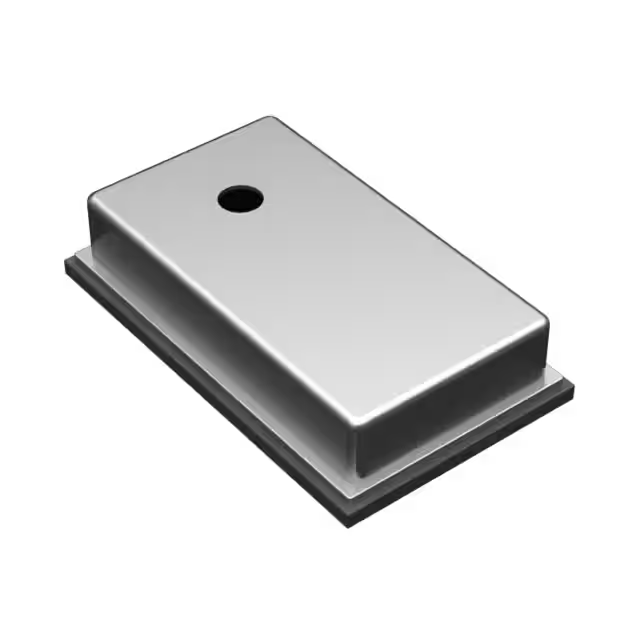
NXP Semiconductors FXPQ3115BV
- Part No.:
- FXPQ3115BV
- Manufacturer:
- NXP Semiconductors
- Category:
- Pressure Sensors, Transducers
- Package:
- -
- Datasheet:
-
 FXPQ3115BV.pdf
- Description:
- PRESS SENSOR 2.5V 20/110KPA TSON
- Quantity:
- Payment:

- Shipping:

Inventory:4,774
Please send an inquiry. Send us your inquiry, and we will respond immediately.
Product details
Overview
FXPQ3115BV from NXP Semiconductors is a compact, piezoresistive absolute pressure sensor with integrated I2C digital interface, biocompatible gel coating (USP Class VI), and on-chip altimetry calculation. It delivers 20-bit pressure (0.25 Pa LSB) and 12-bit temperature (±3 °C accuracy) outputs across 20–110 kPa and −40 °C to +85 °C, enabling direct altitude-in-meters reporting without MCU compensation-ideal for CPAP masks and inhalers.
For engineers reviewing the FXPQ3115BV datasheet, FXPQ3115BV pinout, FXPQ3115BV application, or FXPQ3115BV equivalent, key selection criteria include its 1.5 Pa RMS noise at 128× oversampling, programmable interrupts (INT1/INT2), embedded 32-sample FIFO for up to 12-day logging, 40 μA typical active current per measurement-second, and 8-pin LGA package with biomedically approved encapsulation.
Technical Context
The FXPQ3115BV integrates MEMS pressure sensing with an ASIC containing a high-resolution ADC, digital signal processing engine, and I2C interface. Its internal computation implements US Standard Atmosphere 1976 (NASA) to convert absolute pressure into altitude in meters with 0.0625 m resolution, eliminating external unit conversion.
It supports three operational modes-barometer, altimeter, and thermometer-with user-programmable acquisition timing (1 s to 9 h), autonomous data logging, and dual interrupt outputs configurable for data-ready or threshold-triggered events. The device uses factory-trimmed NVM calibration data and allows volatile offset correction registers for post-mounting accuracy optimization.
Key Specifications
| Parameter | Value and Actual Design Meaning |
|---|---|
| Pressure Range | 20 kPa to 110 kPa absolute - covers sea level to ~10 km altitude, suitable for medical respiratory devices and portable health monitors |
| Altitude Resolution | 0.0625 m - enables precise elevation tracking in wearable activity monitors and spirometry systems |
| Effective Pressure Noise | 1.5 Pa RMS at 128× oversample - ensures stable altitude output under low-dynamic conditions like sleep apnea therapy |
| Supply Current | 40 μA per measurement-second (standard mode) - extends battery life in portable medical electronics |
| I²C Address | 0x60 (7-bit) - standard address simplifies integration with common microcontrollers and avoids bus conflicts |
| Operating Temp | −40 °C to +85 °C - supports deployment in clinical environments and uncontrolled ambient settings |
| Biocompatibility | USP Class VI gel coating - certified for direct patient airway contact in CPAP masks and nebulizers |
Pinout & Package
FXPQ3115BV is housed in an 8-pin LGA package (3.0 × 5.0 × 1.1 mm), optimized for space-constrained medical wearables and handheld diagnostics. The metal lid includes a vent hole aligned over the MEMS diaphragm; light exposure through this port must be avoided to preserve measurement integrity.
| Pin/Terminal | Circuit Role | Design Meaning |
|---|---|---|
| VDD | Main power supply input | 1.95 V to 3.6 V analog supply; requires 10 µF + 100 nF decoupling near pin 1 |
| CAP | External capacitor connection | Connects to internal regulator bypass capacitor (100 nF ceramic) for stable voltage reference |
| GND | Ground reference | Common return path for analog and digital sections; must be low-impedance |
| VDDIO | Digital interface supply | 1.62 V to 3.6 V logic supply; independent of VDD to support mixed-voltage systems |
| INT2 | Programmable interrupt output 2 | Open-drain, active-low; configurable for FIFO full, pressure delta, or data-ready events |
| INT1 | Programmable interrupt output 1 | Open-drain, active-low; independently set for altimeter threshold crossing or temperature alert |
| SDL | I²C serial data line | Bi-directional, supports standard/fast-mode I²C (up to 4 MHz with 20 pF bus load) |
| SCL | I²C serial clock line | Input-only clock; timing compliant with I²C specification including hold/setup requirements |
Key Features
| Feature | Design Value |
|---|---|
| On-chip altimetry calculation | Direct altitude-in-meters output using US Standard Atmosphere 1976 model - removes floating-point math and lookup tables from host MCU |
| Embedded FIFO buffer | 32-sample depth with autonomous logging up to 12 days at 1 s interval - enables offline activity monitoring without continuous host polling |
| Programmable oversampling | 1× to 128× OSR selection - trades current draw (8.5 μA to 265 μA) against noise floor (19 Pa to 1.5 Pa RMS) for optimal system power/performance balance |
| Dual independent interrupts | INT1 and INT2 each support multiple trigger sources (data-ready, FIFO status, pressure/temperature thresholds) - reduces host wake-up frequency and software overhead |
| Volatile offset correction | User-accessible registers to adjust pressure/altitude zero-point post-soldering - compensates for board mount drift (±0.15 kPa) and improves long-term accuracy |
Applications
| Inhaler Dose Tracking | CPAP Mask Altitude Compensation |
|---|---|
Use Scenario: Measuring real-time air pressure during inhaler actuation to verify dose delivery and log usage history. IC Role / Device Role / Timing Role: Absolute pressure sensor providing 20-bit pressure samples at up to 100 Hz with 0.25 Pa resolution, synchronized via I²C to MCU-controlled valve timing. Use Value: Enables regulatory-compliant dose verification and patient adherence reporting without adding external signal conditioning or calibration routines. | Use Scenario: Compensating CPAP pressure setpoints based on local altitude to maintain therapeutic airway pressure at varying elevations. IC Role / Device Role / Timing Role: Altimeter delivering 0.0625 m resolution altitude updates every 1–60 seconds, with interrupt-driven notification to MCU upon significant elevation change. Use Value: Maintains consistent treatment efficacy across geographic locations by dynamically adjusting pressure targets-no manual recalibration required. |
| Oxygen Concentrator Barometric Correction | Wearable Health Activity Monitor |
Use Scenario: Correcting oxygen concentration output in response to ambient barometric pressure changes during transport or seasonal weather shifts. IC Role / Device Role / Timing Role: Barometer mode providing calibrated pressure in Pascals (50–110 kPa range) with ±0.75 kPa absolute accuracy over −10 °C to +70 °C. Use Value: Ensures accurate O₂ delivery across environmental conditions by feeding real-time atmospheric pressure into control algorithm-eliminates need for external weather service APIs. | Use Scenario: Logging elevation gain/loss during hiking or stair climbing to estimate caloric expenditure and activity intensity. IC Role / Device Role / Timing Role: Autonomous altimeter operating in FIFO mode with 1-second acquisition rate, storing 32 samples before host readout. Use Value: Provides continuous altitude profiling for 12+ days on coin-cell power, enabling multi-day fitness analytics without frequent Bluetooth sync or host intervention. |
Equivalent & Alternatives
The following parts are listed as comparable options for similar precision pressure sensing applications.
| Alternative Part | Technical Difference | Application Difference | Selection Advice |
|---|---|---|---|
| MPL3115A2 | Same architecture and register map; identical 8-pin LGA package and I²C address (0x60); lacks USP Class VI biocompatible gel coating | Not certified for direct patient airway contact; limited to non-invasive consumer or industrial use | Select when biocompatibility is unnecessary and cost sensitivity outweighs medical certification requirements |
| BMP388 | Higher pressure accuracy (±0.08 hPa vs ±0.75 kPa), wider range (30–110 kPa), but no built-in altimetry calculation - requires host-side US Standard Atmosphere implementation | Requires additional MCU resources for altitude conversion; no FIFO or autonomous logging capability | Select when maximum pressure precision is critical and host processor has spare cycles for floating-point math and memory management |
Compared with MPL3115A2, FXPQ3115BV adds USP Class VI biocompatibility for regulated medical use; compared with BMP388, it offloads altitude computation and provides FIFO-based data logging-reducing host firmware complexity and power consumption in battery-operated devices.
Availability
FXPQ3115BV is available at Aetrix Electronics and suitable for CPAP machines, inhaler dose verification systems, and portable oxygen concentrators requiring stable component supply, biocompatible materials, and long-term production continuity.
Supply support for FXPQ3115BV includes scheduled delivery planning, volume procurement assistance, BOM continuity management, traceable sourcing, and lifecycle availability coordination for OEM customers, industrial embedded developers, connected-device designers, and electronics production programs.
Manufacturer
NXP Semiconductors is a global semiconductor company headquartered in Eindhoven, Netherlands, specializing in secure connectivity solutions for automotive, industrial, and healthcare markets.
The FXPQ3115BV belongs to NXP's medical-grade sensor portfolio, designed specifically for low-power, high-accuracy pressure and altitude sensing in patient-critical respiratory and wellness applications where biocompatibility and regulatory compliance are mandatory.
FAQ
What is the primary function of the FXPQ3115BV?
The FXPQ3115BV is a precision absolute pressure sensor with integrated altimetry calculation. It measures pressure from 20 kPa to 110 kPa and directly outputs altitude in meters using the US Standard Atmosphere 1976 model. Its biocompatible gel coating and calibrated accuracy make it suitable for medical devices such as CPAP masks and inhalers. The FXPQ3115BV eliminates the need for external compensation or unit conversion in the host MCU.
How does the FXPQ3115BV achieve altitude measurement without external computation?
The FXPQ3115BV performs all altitude calculations internally using its on-chip digital signal processing engine and the US Standard Atmosphere 1976 (NASA) equation. It accepts user-input sea-level pressure (OFF_H) and computes altitude in meters with 0.0625 m resolution. This offloads floating-point arithmetic and lookup tables from the host MCU, reducing firmware complexity and power consumption. The FXPQ3115BV delivers ready-to-use altitude values via its I²C interface.
What are the key electrical interfaces and supply requirements for the FXPQ3115BV?
The FXPQ3115BV uses an I²C digital interface with fixed 7-bit address 0x60 and supports up to 4 MHz operation under low-capacitance conditions. It requires two separate supplies: VDD (1.95 V to 3.6 V) for analog circuitry and VDDIO (1.62 V to 3.6 V) for digital I/O. Typical active current is 40 μA per measurement-second in standard mode. The FXPQ3115BV also features two open-drain interrupt pins (INT1/INT2) configurable for data-ready or threshold-triggered events.
Is the FXPQ3115BV suitable for direct patient contact in medical devices?
Yes-the FXPQ3115BV incorporates a biomedically approved elastomeric gel coating that meets United States Pharmacopeia (USP) Biological Reactivity Testing Class VI requirements. This nontoxic, nonallergenic material uniformly transmits pressure to the MEMS diaphragm while protecting it from moisture and contaminants. The gel enables safe, direct integration into patient airway interfaces such as CPAP masks and inhalers, satisfying ISO 10993 and FDA design controls for Class II medical devices.
What packaging and handling precautions apply to the FXPQ3115BV?
The FXPQ3115BV is supplied in an 8-pin LGA package (3.0 × 5.0 × 1.1 mm) with a vented metal lid exposing the MEMS diaphragm. Direct light exposure through the vent hole must be avoided during operation, as it degrades pressure measurement accuracy. During handling, vacuum nozzles must contact only the metal cover-not the vent-and mechanical tweezers must never puncture the cavity. Ultrasonic cleaning and pressure spraying are prohibited; if PCB cleaning is required, Water Soluble flux with Kapton tape protection is recommended. The FXPQ3115BV is ESD-sensitive (HBM ±2000 V).
FXPQ3115BV Specifications
- Product attributes
- Attribute value
- Manufacturer:
- NXP Semiconductors
- Series:
- -
- Package/Case:
- -
- Packaging:
- Tray
- Product Status:
- Obsolete
- Applications:
- -
- Pressure Type:
- -
- Operating Pressure:
- -
- Output Type:
- -
- Output:
- -
- Accuracy:
- -
- Voltage - Supply:
- -
- Port Size:
- -
- Port Style:
- -
- Features:
- -
- Termination Style:
- -
- Maximum Pressure:
- -
- Operating Temperature:
- -
- Grade:
- -
- Qualification:
- -
- Mounting Type:
- -
- Supplier Device Package:
- -
FXPQ3115BV FAQ
1.How can I place an order for FXPQ3115BV through Aetrix?
Please submit a Request for Quotation (RFQ) for FXPQ3115BV on Aetrix. Our sales agent will provide a competitive quotation and guide you through the order confirmation once you accept the terms.
2.Are the price and stock information for FXPQ3115BV reliable?
The price and inventory of FXPQ3115BV are updated periodically and may fluctuate due to market conditions. Stock and pricing data are typically refreshed every 24 hours. Quotation validity for FXPQ3115BV is usually 5 days.
3.What payment methods are accepted for FXPQ3115BV?
We accept Wire Transfer, PayPal, Credit Card, Western Union, MoneyGram, and Escrow for FXPQ3115BV transactions.
Note: Certain payment methods may incur a processing fee.
4.How is shipping managed for FXPQ3115BV?
FXPQ3115BV orders can be shipped via leading logistics carriers, including DHL, UPS, FedEx, TNT, or Registered Mail.
Once your FXPQ3115BV order is processed, you will receive an email with the shipment details and tracking number.
Note: Tracking information may take up to 24 hours to appear. Express delivery typically takes 3–5 business days.
5.How can I obtain technical support or documentation for FXPQ3115BV?
For technical support, including FXPQ3115BV datasheets, pinout diagrams, or application guidance, please contact our engineering support team. They can provide detailed documentation and assistance for your FXPQ3115BV requirements.
6.How does Aetrix verify that FXPQ3115BV is sourced from the original manufacturer or authorized distributors?
All FXPQ3115BV products on Aetrix are procured from qualified distributors and authorized channels. Our dedicated quality assurance team conducts strict verification, including traceability checks and, if necessary, third-party testing. This ensures that FXPQ3115BV meets industry standards.
7.What is the process for return or replacement of FXPQ3115BV?
All FXPQ3115BV units undergo pre-shipment inspection (PSI). If there is an issue with FXPQ3115BV, returns or replacements are accepted under the following conditions:
1.Quantity discrepancies, incorrect items, or visible external defects (such as breakage or corrosion), acknowledged by Aetrix.
2.The issue is reported within 90 days of delivery.
3.The FXPQ3115BV part is unused and in its original packaging.
Return procedure for FXPQ3115BV:
1.Submit a request within 90 days.
2.Obtain a Return Material Authorization (RMA) from Aetrix.
FXPQ3115BV Tags
-
DPS368XTSA1
Infineon Technologies
-
DPS310XTSA1
Infineon Technologies
-
LPS22HHTR
STMicroelectronics

-
ICP-20100
TDK InvenSense
-
ICP-10110
TDK InvenSense
-
LPS22DFTR
STMicroelectronics
-
LPS22HBTR
STMicroelectronics
-
BMP390
Bosch Sensortec
-
BMP581
Bosch Sensortec
-
BMP384
Bosch Sensortec
-
2511020213301
Würth Elektronik
-
ILPS22QSTR
STMicroelectronics
Tech Hub

A practical engineering guide to 3.3V and 5V logic compatibility, input thresholds, resistor dividers, translator ICs, MOSFET level shifting, I2C pull-ups, timing limits and power-sequencing risks.

The 74HC595 uses push-pull logic outputs, while the TPIC6B595 uses 50 V open-drain DMOS sinks for higher-power loads. This guide compares timing, current limits, 3.3 V interfacing, load wiring, thermal…

The 74HC595 converts serial data into eight stable parallel outputs. This guide covers pin functions, shift and storage timing, OE and MR behavior, drive-current limits, cascading, voltage compatibilit…

A technical comparison of level-sensitive latches and edge-triggered flip-flops, covering timing windows, setup and hold limits, master–slave operation, time borrowing, race-through, HDL inference and…

A D latch stores one bit while Enable controls when data can pass. This reference covers gate-level operation, truth tables, transparency, setup and hold timing, LE versus OE, common ICs and practical …

An SR latch stores one bit through cross-coupled feedback. This engineering reference covers NOR and NAND implementations, truth tables, forbidden-state recovery, gated operation, switch debouncing, fa…

Latch circuits retain one bit through feedback. This technical reference covers SR and D latches, truth tables, transparency, timing limits, latch-versus-flip-flop behavior, applications and common log…

An engineering guide to LED driver operation, constant-current and constant-voltage outputs, linear and switching topologies, dimming, IC selection, calculations, replacement compatibility, and fault c…

Operational amplifier guide covering op amp basics, feedback, ideal vs real op amps, common configurations, buffer circuits, offset, bias current, gain-bandwidth, slew rate, rail-to-rail limits and sel…

Jumper cables guide covering safe connection order, red and black clamp placement, final ground connection, cable gauge, length, clamp quality, copper vs CCA cables, jump starter comparison and battery…


