
 My Inquiry
 My Account


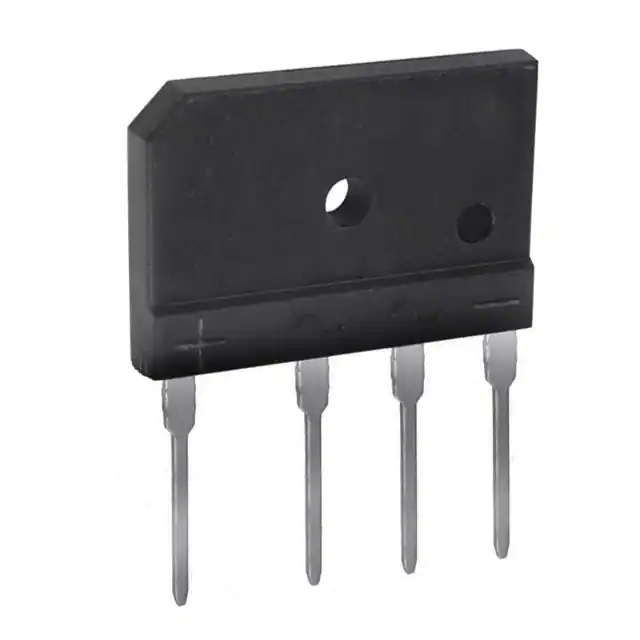
Diodes Incorporated GBJ804
- Part No.:
- GBJ804
- Manufacturer:
- Diodes Incorporated
- Category:
- Bridge Rectifiers
- Package:
- 4-SIP, GBJ
- Datasheet:
-
 GBJ804.pdf
- Description:
- BRIDGE RECT 1PHASE 400V 8A GBJ
- Quantity:
- Payment:

- Shipping:

Inventory:3,878
Please send an inquiry. Send us your inquiry, and we will respond immediately.
Product details
Overview
GBJ804 from Diodes Incorporated is an 8A standard recovery bridge rectifier in GBJ package, rated for 400V repetitive peak reverse voltage (VRRM), 1.0V max forward voltage at 4A, and 5µA max reverse leakage at 25°C. It features glass-passivated die construction, 1500VRMS case dielectric strength, and 170A non-repetitive surge capability - deployed in AC/DC power supplies for industrial motor drives.
For engineers reviewing the GBJ804 datasheet, GBJ804 pinout, GBJ804 application, or GBJ804 equivalent, key selection criteria include VRRM margin for line-voltage transients, thermal resistance (1.6°C/W junction-to-case), surge rating for inrush handling, and through-hole mounting compatibility with #6 screw hardware.
Technical Context
This single-phase full-wave bridge rectifier integrates four silicon diodes in a monolithic molded plastic GBJ package with integrated strain relief and polarity marking. Its standard recovery characteristic (trr not specified, consistent with standard recovery classification) supports line-frequency (50/60Hz) rectification without high-frequency switching losses.
Designed for PCB mounting with through-hole leads, it delivers 8.0A average forward current at TC = +110°C and sustains 170A peak surge (8.3ms half-sine) - enabling robust operation in unregulated offline power supplies where input filtering and transformer sizing dominate thermal design.
Key Specifications
| Parameter | Value and Actual Design Meaning |
|---|---|
| VRRM | 400 V - Withstands 400V repetitive reverse voltage, suitable for 230VAC mains with safety margin |
| IF(AV) | 8.0 A - Continuous average forward output current at TC = +110°C, defining heatsink sizing baseline |
| VF Max | 1.0 V @ 4A - Forward drop limits conduction loss to ≤4W per diode pair at rated DC load |
| IR Max | 5 µA @ 25°C - Low leakage preserves efficiency in high-impedance hold-up circuits |
| IFSM | 170 A (8.3ms) - Handles cold-start inrush surges common in transformer-coupled supplies |
| RθJC | 1.6 °C/W - Enables thermal design using aluminum plate heatsink (100×100×1.6mm) |
| VB | 400 V - Breakdown voltage matches VRRM rating, confirming blocking integrity under overvoltage stress |
Pinout & Package
Package: GBJ - Molded plastic, UL 94V-0 rated, 6.6g weight, through-hole mount compatible with #6 screw and 5.0 in-lbs max torque.
| Pin/Terminal | Circuit Role | Design Meaning |
|---|---|---|
| AC1 | Input AC Terminal 1 | One of two alternating-current input pins; connected internally to anode of D1 and cathode of D2 |
| AC2 | Input AC Terminal 2 | Second AC input pin; connected internally to cathode of D1 and anode of D3 |
| + (Anode) | Positive DC Output | Full-wave rectified positive output node; internal connection point of D1/D3 anodes and D2/D4 cathodes |
| – (Cathode) | Negative DC Output | Full-wave rectified negative output node; internal connection point of D1/D3 cathodes and D2/D4 anodes |
Key Features
| Feature | Design Value |
|---|---|
| Glass passivated die | Enhances long-term reliability and moisture resistance in humid industrial environments |
| 1500VRMS dielectric strength | Ensures isolation between AC inputs and DC outputs meets basic insulation requirements for Class I equipment |
| Lead-free, RoHS-compliant plating | Meets global environmental compliance mandates without compromising solderability (MIL-STD-202, Method 208) |
| UL Recognized (E95060) | Validates safety certification for end-equipment listing in North American markets |
Applications
| Industrial AC/DC Power Supplies | Motor Drive Input Rectification |
|---|---|
Use Scenario: Unregulated 230VAC-to-DC conversion feeding SCR-controlled DC motor field windings. IC Role / Device Role / Timing Role: Full-wave bridge rectifier providing polarity-stable DC bus with minimal conduction loss. Use Value: 8A rating and 170A surge capacity handle motor startup currents without derating; 400V VRRM accommodates 230VAC +10% tolerance plus line spikes. | Use Scenario: Input stage of 3-phase inverter front-end using single-phase auxiliary supply. IC Role / Device Role / Timing Role: Standard-recovery bridge converting single-phase AC to DC for gate driver and control logic rails. Use Value: Low 5µA IR at 25°C minimizes standby power loss; UL recognition simplifies system-level safety certification. |
| LED Driver Primary-Side Rectification | Appliance Power Input Stage |
Use Scenario: Off-line LED driver for commercial lighting with passive PFC and flyback topology. IC Role / Device Role / Timing Role: Mains-input rectifier preceding bulk capacitor and PFC choke. Use Value: 1.0V VF at 4A ensures <4W conduction loss at full load, supporting >85% efficiency targets without active cooling. | Use Scenario: Power input section of washing machine main control board operating from 230VAC mains. IC Role / Device Role / Timing Role: Primary rectifier delivering DC bus to relay drivers, microcontroller LDOs, and display backlight circuitry. Use Value: Through-hole GBJ package provides mechanical robustness against vibration; 1500VRMS isolation meets IEC 60335 creepage/clearance requirements. |
Equivalent & Alternatives
The following parts are listed as comparable options for similar bridge rectifier applications.
| Alternative Part | Technical Difference | Application Difference | Selection Advice |
|---|---|---|---|
| GBU8K (ON Semiconductor) | Same 8A/400V rating, but GBU package (smaller footprint, lower RθJC = 1.5°C/W) | Preferred for space-constrained PCBs; requires revised mounting hole pattern | Select when board area is limited and thermal interface allows direct heatsink contact |
| KBP204 (Shindengen) | Same 8A/400V rating, KBP package (lower profile, 1.8°C/W RθJC) | Better suited for low-height enclosures; slightly higher thermal resistance | Select when vertical clearance is constrained and moderate heatsinking suffices |
Compared with GBJ804, GBU8K offers tighter thermal performance in smaller volume, while KBP204 trades minor thermal penalty for reduced height - both require layout adaptation but deliver identical electrical functionality in 400V/8A bridge roles.
Availability
GBJ804 is available at Aetrix Electronics and suitable for industrial AC/DC power supplies, motor drive input rectification, and appliance power input stages requiring stable component supply and long-term manufacturing continuity.
Supply support for GBJ804 includes scheduled delivery planning, volume procurement assistance, BOM continuity management, traceable sourcing, and lifecycle availability coordination for OEM customers, industrial embedded developers, connected-device designers, and electronics production programs.
Manufacturer
Diodes Incorporated is a global manufacturer of discrete semiconductors and analog ICs, headquartered in Plano, Texas, with design, manufacturing, and sales operations across Asia, Europe, and the Americas.
The GBJ series belongs to Diodes' standard recovery bridge rectifier product line, engineered for cost-effective, high-reliability AC/DC conversion in industrial, appliance, and lighting applications where switching frequency is limited to line frequency.
FAQ
What is the maximum operating temperature for GBJ804?
The GBJ804 has a junction temperature range of –55°C to +150°C and is rated for 8.0A average forward current at case temperature (TC) of +110°C. Operation beyond +110°C requires derating per the thermal resistance (RθJC = 1.6°C/W) and heatsink capability to maintain TJ ≤ +150°C.
Is GBJ804 suitable for high-frequency switching applications?
No - GBJ804 is a standard recovery bridge rectifier with no specified reverse recovery time (trr). It is optimized for 50/60Hz line-frequency rectification. Using it in high-frequency SMPS (>20kHz) would cause excessive switching losses and overheating due to slow carrier recombination.
Does GBJ804 require a heatsink in all applications?
A heatsink is required when dissipating ≥2W continuously. At 8A output and 1.0V VF, conduction loss reaches ~8W - necessitating a heatsink (e.g., 100×100×1.6mm Al plate) to limit TC to +110°C. For intermittent loads below 3A, PCB copper area may suffice per thermal simulation.
How is polarity marked on the GBJ804 package?
Polarity is molded directly onto the plastic body: the "+" symbol identifies the positive DC output terminal, and the "–" symbol marks the negative DC output terminal. AC input terminals are unmarked but located diagonally opposite each other - confirmed by the GBJ outline drawing showing AC1 and AC2 adjacent to the flat side of the package.
GBJ804 Specifications
- Product attributes
- Attribute value
- Manufacturer:
- Diodes Incorporated
- Series:
- -
- Package/Case:
- 4-SIP, GBJ
- Packaging:
- Tube
- Product Status:
- Discontinued at Digi-Key
- Diode Type:
- Single Phase
- Technology:
- Standard
- Voltage - Peak Reverse (Max):
- 400 V
- Current - Average Rectified (Io):
- 8 A
- Voltage - Forward (Vf) (Max) @ If:
- 1 V @ 4 A
- Current - Reverse Leakage @ Vr:
- 5 µA @ 400 V
- Operating Temperature:
- -65°C ~ 150°C (TJ)
- Grade:
- -
- Qualification:
- -
- Mounting Type:
- Through Hole
- Supplier Device Package:
- GBJ
GBJ804 FAQ
1.How can I place an order for GBJ804 through Aetrix?
Please submit a Request for Quotation (RFQ) for GBJ804 on Aetrix. Our sales agent will provide a competitive quotation and guide you through the order confirmation once you accept the terms.
2.Are the price and stock information for GBJ804 reliable?
The price and inventory of GBJ804 are updated periodically and may fluctuate due to market conditions. Stock and pricing data are typically refreshed every 24 hours. Quotation validity for GBJ804 is usually 5 days.
3.What payment methods are accepted for GBJ804?
We accept Wire Transfer, PayPal, Credit Card, Western Union, MoneyGram, and Escrow for GBJ804 transactions.
Note: Certain payment methods may incur a processing fee.
4.How is shipping managed for GBJ804?
GBJ804 orders can be shipped via leading logistics carriers, including DHL, UPS, FedEx, TNT, or Registered Mail.
Once your GBJ804 order is processed, you will receive an email with the shipment details and tracking number.
Note: Tracking information may take up to 24 hours to appear. Express delivery typically takes 3–5 business days.
5.How can I obtain technical support or documentation for GBJ804?
For technical support, including GBJ804 datasheets, pinout diagrams, or application guidance, please contact our engineering support team. They can provide detailed documentation and assistance for your GBJ804 requirements.
6.How does Aetrix verify that GBJ804 is sourced from the original manufacturer or authorized distributors?
All GBJ804 products on Aetrix are procured from qualified distributors and authorized channels. Our dedicated quality assurance team conducts strict verification, including traceability checks and, if necessary, third-party testing. This ensures that GBJ804 meets industry standards.
7.What is the process for return or replacement of GBJ804?
All GBJ804 units undergo pre-shipment inspection (PSI). If there is an issue with GBJ804, returns or replacements are accepted under the following conditions:
1.Quantity discrepancies, incorrect items, or visible external defects (such as breakage or corrosion), acknowledged by Aetrix.
2.The issue is reported within 90 days of delivery.
3.The GBJ804 part is unused and in its original packaging.
Return procedure for GBJ804:
1.Submit a request within 90 days.
2.Obtain a Return Material Authorization (RMA) from Aetrix.
GBJ804 Tags
-
HDS10M-13
Diodes Incorporated
-
CD-MBL106S
Bourns Inc.
-
MB10S-13
Diodes Incorporated
-
CD-MBL206SL
Bourns Inc.
-
MB4S-TP
Micro Commercial Co
-
MB6S-TP
Micro Commercial Co
-
CD-MBL210S
Bourns Inc.
-
BAS3007ARPPE6327HTSA1
Infineon Technologies
-
DF02M
Diodes Incorporated
-
CD-MBL210SL
Bourns Inc.
-
DF04M
Diodes Incorporated
-
DF01M
Diodes Incorporated
Tech Hub

An engineering guide to LED driver operation, constant-current and constant-voltage outputs, linear and switching topologies, dimming, IC selection, calculations, replacement compatibility, and fault c…

Operational amplifier guide covering op amp basics, feedback, ideal vs real op amps, common configurations, buffer circuits, offset, bias current, gain-bandwidth, slew rate, rail-to-rail limits and sel…

Jumper cables guide covering safe connection order, red and black clamp placement, final ground connection, cable gauge, length, clamp quality, copper vs CCA cables, jump starter comparison and battery…

LDO regulator guide covering low dropout voltage, power dissipation, thermal design, PSRR, output noise, capacitor stability, adjustable LDO circuits, LDO vs buck converter and datasheet selection chec…

Conditional Access Module guide covering CAM meaning, CI/CI+ interface, smart card authorization, DVB security workflow, TV and set-top box compatibility, internal electronics, ESD protection, connecto…

Guide to electronic component obsolescence covering EOL risk, PCN/PDN notices, last-time buy planning, replacement options, form-fit-function validation, counterfeit risk and BOM lifecycle management.

18650 battery guide covering lithium-ion cell basics, 3.6V/3.7V voltage, 4.2V charging, mAh and Wh capacity, protected cells, chargers, BMS, series-parallel packs, holders, welding and sourcing checks.…

Hall effect sensor guide covering working principle, linear and digital sensors, Arduino circuits, current sensing, speed detection, automotive applications, A3144 examples, signal filtering and datash…

Product Change Notification guide for electronic components, covering PCN meaning, PCN vs PDN/EOL, common change types, risk levels, form-fit-function review, engineering validation, BOM control, LTB/L…

A practical guide to blend door actuators, covering HVAC function, symptoms, location, AC and heater issues, reset and calibration, replacement cost, electrical diagnosis, compatibility checks, and rep…


