
 My Inquiry
 My Account


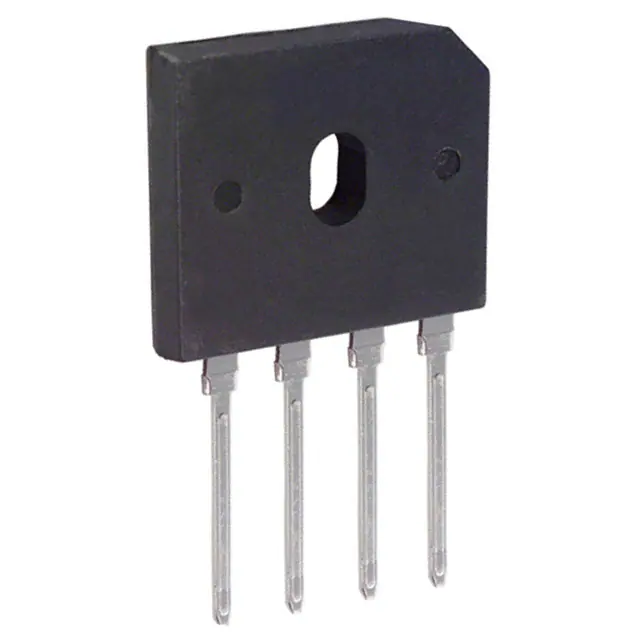
Diodes Incorporated GBU801
- Part No.:
- GBU801
- Manufacturer:
- Diodes Incorporated
- Category:
- Bridge Rectifiers
- Package:
- 4-SIP, GBU
- Datasheet:
-
 GBU801.pdf
- Description:
- BRIDGE RECT 1PHASE 100V 8A GBU
- Quantity:
- Payment:

- Shipping:

Inventory:82
Please send an inquiry. Send us your inquiry, and we will respond immediately.
Product details
Overview
GBU801 from Diodes Incorporated is a standard recovery 8A bridge rectifier in GBU package, rated for 100V repetitive peak reverse voltage (VRRM), 1.0V max forward voltage at 4A, and 5µA max reverse leakage at 25°C. It features glass-passivated die construction, 1500VRMS case dielectric strength, and 200A non-repetitive surge capability - used in AC/DC power supplies for industrial control panels.
For engineers reviewing the GBU801 datasheet, GBU801 pinout, GBU801 application, or GBU801 equivalent, key selection criteria include VRRM margin for line-voltage transients, thermal resistance (2.2°C/W junction-to-case), IFSM rating for inrush handling, and UL recognition (E95060) for safety-compliant designs.
Technical Context
This device integrates four silicon diodes in a single-phase full-wave bridge configuration with standard recovery characteristics (trr not specified but typical for standard recovery bridges). Its 8.0A average forward current rating assumes TC = +100°C on a 50mm × 50mm × 1.6mm copper heatsink.
The GBU801 operates across –55°C to +150°C junction temperature range and exhibits 130pF typical junction capacitance at 1MHz/4V reverse bias. Reverse leakage rises to 500µA at +125°C, requiring thermal-aware layout in high-ambient environments.
Key Specifications
| Parameter | Value and Actual Design Meaning |
|---|---|
| VRRM | 100 V - Withstands 100V repetitive reverse voltage; suitable for 70V RMS AC inputs with safety margin. |
| IF(AV) | 8.0 A - Sustains 8A average forward current at TC = +100°C with proper heatsinking. |
| VF Max | 1.0 V @ 4A - Low conduction loss enables efficient rectification in mid-power SMPS and linear supplies. |
| IFSM | 200 A - Handles 8.3ms half-sine surge; supports inrush current in transformer-fed supplies. |
| RθJC | 2.2 °C/W - Enables thermal design with discrete heatsink; requires ≥50mm² copper area for rated current. |
| IR Max | 5 µA @ 25°C - Minimal reverse leakage preserves efficiency in standby and low-load conditions. |
| Dielectric Strength | 1500 VRMS - Meets reinforced insulation requirements for Class II AC/DC converters. |
Pinout & Package
Package: GBU - molded plastic case (UL 94V-0), through-hole mounting with #6 screw hole, 3.7g weight, tin-plated terminals solderable per MIL-STD-202 Method 208.
| Pin/Terminal | Circuit Role | Design Meaning |
|---|---|---|
| AC1 | Input AC Terminal 1 | One of two AC input pins; connects to primary winding or AC line phase. |
| AC2 | Input AC Terminal 2 | Second AC input pin; completes full-wave bridge input path. |
| + (Anode) | Positive DC Output | Full-wave rectified positive output node; connects to bulk capacitor or regulator input. |
| – (Cathode) | Negative DC Output | Full-wave rectified negative output node; serves as system ground reference point. |
Key Features
| Feature | Design Value |
|---|---|
| Glass-passivated die | Enhances long-term reliability under humidity and thermal cycling vs. epoxy-passivated alternatives. |
| 1500VRMS isolation | Meets IEC/UL 62368-1 reinforced insulation for double-insulated AC/DC adapters. |
| 200A surge rating | Survives cold-start inrush without degradation in 120VAC/240VAC systems with capacitive input filters. |
| UL Recognized (E95060) | Reduces certification effort for end equipment requiring safety agency approval. |
| Lead-free & RoHS compliant | Supports global environmental compliance without requalification for legacy PCB assembly lines. |
Applications
| Industrial Motor Drives | LED Streetlight Power Supplies |
|---|---|
Use Scenario: Rectifying 100–277VAC input in constant-current LED drivers for outdoor lighting. IC Role / Device Role / Timing Role: Full-wave bridge rectifier converting AC line to unregulated DC bus prior to buck converter stage. Use Value: 100V VRRM provides margin over 120VAC peak (170V); 200A IFSM handles lamp cold-start surges. | Use Scenario: Input-stage rectification in IP67-rated outdoor LED luminaires with wide-input AC range. IC Role / Device Role / Timing Role: Primary AC/DC conversion element in isolated flyback or LLC resonant converters. Use Value: UL E95060 recognition accelerates safety certification; 1500VRMS isolation meets creepage/clearance requirements. |
| Programmable Logic Controller (PLC) Power Modules | AC-DC Wall Adapters (Class II) |
Use Scenario: Converting 24VAC control power to DC for PLC I/O modules and microcontroller logic rails. IC Role / Device Role / Timing Role: Bridge rectifier feeding linear regulator or buck converter for clean 5V/3.3V logic supply. Use Value: Low 5µA IR at 25°C minimizes standby power loss; GBU package enables robust mechanical mounting. | Use Scenario: Input rectification in compact 12–24W universal-input wall adapters for consumer electronics. IC Role / Device Role / Timing Role: Standard-recovery bridge providing cost-effective, thermally stable AC/DC front-end. Use Value: 2.2°C/W RθJC allows direct heatsink attachment; RoHS/lead-free compliance meets global shipping requirements. |
Equivalent & Alternatives
The following parts are listed as comparable options for similar bridge rectifier applications.
| Alternative Part | Technical Difference | Application Difference | Selection Advice |
|---|---|---|---|
| GBU8K (ON Semiconductor) | Same 100V VRRM, 8A IF(AV), but 1.1V VF max and 10µA IR at 25°C. | Slightly higher conduction loss and leakage; identical thermal resistance and package. | Select when ON Semi sourcing is preferred; verify VF impact on efficiency in high-duty-cycle operation. |
| KBU8B (Comchip) | 100V VRRM, 8A rating, but 2.5°C/W RθJC and no UL recognition. | Limited thermal performance and missing safety certification for regulated end products. | Use only in cost-sensitive, non-certified internal power supplies where thermal headroom exists. |
Compared with GBU801, GBU8K trades marginally higher VF and IR for alternate supply chain access, while KBU8B sacrifices thermal efficiency and regulatory compliance for lower unit cost - making GBU801 optimal for certified, thermally constrained industrial designs.
Availability
GBU801 is available at Aetrix Electronics and suitable for industrial motor drives, LED streetlight power supplies, programmable logic controller (PLC) power modules, and AC-DC wall adapters requiring stable component supply and long-lifecycle support.
Supply support for GBU801 includes scheduled delivery planning, volume procurement assistance, BOM continuity management, traceable sourcing, and lifecycle availability coordination for OEM customers, industrial embedded developers, connected-device designers, and electronics production programs.
Manufacturer
Diodes Incorporated is a global manufacturer of discrete semiconductors and analog ICs, headquartered in Plano, Texas, with design, manufacturing, and sales operations across Asia, Europe, and North America.
The GBU series belongs to Diodes' standard bridge rectifier product line, engineered for cost-effective, high-reliability AC/DC conversion in industrial, lighting, and consumer power applications with emphasis on safety certification and thermal robustness.
FAQ
What is the maximum operating junction temperature for GBU801?
The GBU801 has a specified junction temperature range of –55°C to +150°C. Its 8.0A average forward current rating is defined at TC = +100°C, meaning the case must be maintained at or below that temperature - typically achieved using a 50mm × 50mm × 1.6mm copper heatsink per datasheet note 4.
Does GBU801 support automotive-grade qualification?
No - the GBU801 is not AEC-Q101 qualified. Diodes states that automotive-grade versions require specific change control, PPAP capability, and IATF 16949 manufacturing; those parts are distinct SKUs and must be requested separately through Diodes' automotive team.
Can GBU801 be used in capacitive-input filter designs?
Yes, but with 20% derating of IF(AV): the datasheet explicitly states that for capacitive loads, average forward current must be reduced to 6.4A. This accounts for higher peak currents and increased thermal stress caused by the narrow conduction angle.
What does the marking "GBU801" indicate on the device body?
The marking "GBU801" identifies the part number directly: "GBU" denotes the GBU package bridge rectifier family, and "801" specifies the 100V VRRM variant. Date code follows as YWW (e.g., "523" = 2025, week 23), per Diodes' standard marking convention in DS21227.
GBU801 Specifications
- Product attributes
- Attribute value
- Manufacturer:
- Diodes Incorporated
- Series:
- -
- Package/Case:
- 4-SIP, GBU
- Packaging:
- Tube
- Product Status:
- Active
- Diode Type:
- Single Phase
- Technology:
- Standard
- Voltage - Peak Reverse (Max):
- 100 V
- Current - Average Rectified (Io):
- 8 A
- Voltage - Forward (Vf) (Max) @ If:
- 1 V @ 4 A
- Current - Reverse Leakage @ Vr:
- 5 µA @ 100 V
- Operating Temperature:
- -55°C ~ 150°C (TJ)
- Grade:
- -
- Qualification:
- -
- Mounting Type:
- Through Hole
- Supplier Device Package:
- GBU
GBU801 FAQ
1.How can I place an order for GBU801 through Aetrix?
Please submit a Request for Quotation (RFQ) for GBU801 on Aetrix. Our sales agent will provide a competitive quotation and guide you through the order confirmation once you accept the terms.
2.Are the price and stock information for GBU801 reliable?
The price and inventory of GBU801 are updated periodically and may fluctuate due to market conditions. Stock and pricing data are typically refreshed every 24 hours. Quotation validity for GBU801 is usually 5 days.
3.What payment methods are accepted for GBU801?
We accept Wire Transfer, PayPal, Credit Card, Western Union, MoneyGram, and Escrow for GBU801 transactions.
Note: Certain payment methods may incur a processing fee.
4.How is shipping managed for GBU801?
GBU801 orders can be shipped via leading logistics carriers, including DHL, UPS, FedEx, TNT, or Registered Mail.
Once your GBU801 order is processed, you will receive an email with the shipment details and tracking number.
Note: Tracking information may take up to 24 hours to appear. Express delivery typically takes 3–5 business days.
5.How can I obtain technical support or documentation for GBU801?
For technical support, including GBU801 datasheets, pinout diagrams, or application guidance, please contact our engineering support team. They can provide detailed documentation and assistance for your GBU801 requirements.
6.How does Aetrix verify that GBU801 is sourced from the original manufacturer or authorized distributors?
All GBU801 products on Aetrix are procured from qualified distributors and authorized channels. Our dedicated quality assurance team conducts strict verification, including traceability checks and, if necessary, third-party testing. This ensures that GBU801 meets industry standards.
7.What is the process for return or replacement of GBU801?
All GBU801 units undergo pre-shipment inspection (PSI). If there is an issue with GBU801, returns or replacements are accepted under the following conditions:
1.Quantity discrepancies, incorrect items, or visible external defects (such as breakage or corrosion), acknowledged by Aetrix.
2.The issue is reported within 90 days of delivery.
3.The GBU801 part is unused and in its original packaging.
Return procedure for GBU801:
1.Submit a request within 90 days.
2.Obtain a Return Material Authorization (RMA) from Aetrix.
GBU801 Tags
-
HDS10M-13
Diodes Incorporated
-
CD-MBL106S
Bourns Inc.
-
MB10S-13
Diodes Incorporated
-
CD-MBL206SL
Bourns Inc.
-
MB4S-TP
Micro Commercial Co
-
MB6S-TP
Micro Commercial Co
-
CD-MBL210S
Bourns Inc.
-
BAS3007ARPPE6327HTSA1
Infineon Technologies
-
DF02M
Diodes Incorporated
-
CD-MBL210SL
Bourns Inc.
-
DF04M
Diodes Incorporated
-
DF01M
Diodes Incorporated
Tech Hub

An engineering guide to LED driver operation, constant-current and constant-voltage outputs, linear and switching topologies, dimming, IC selection, calculations, replacement compatibility, and fault c…

Operational amplifier guide covering op amp basics, feedback, ideal vs real op amps, common configurations, buffer circuits, offset, bias current, gain-bandwidth, slew rate, rail-to-rail limits and sel…

Jumper cables guide covering safe connection order, red and black clamp placement, final ground connection, cable gauge, length, clamp quality, copper vs CCA cables, jump starter comparison and battery…

LDO regulator guide covering low dropout voltage, power dissipation, thermal design, PSRR, output noise, capacitor stability, adjustable LDO circuits, LDO vs buck converter and datasheet selection chec…

Conditional Access Module guide covering CAM meaning, CI/CI+ interface, smart card authorization, DVB security workflow, TV and set-top box compatibility, internal electronics, ESD protection, connecto…

Guide to electronic component obsolescence covering EOL risk, PCN/PDN notices, last-time buy planning, replacement options, form-fit-function validation, counterfeit risk and BOM lifecycle management.

18650 battery guide covering lithium-ion cell basics, 3.6V/3.7V voltage, 4.2V charging, mAh and Wh capacity, protected cells, chargers, BMS, series-parallel packs, holders, welding and sourcing checks.…

Hall effect sensor guide covering working principle, linear and digital sensors, Arduino circuits, current sensing, speed detection, automotive applications, A3144 examples, signal filtering and datash…

Product Change Notification guide for electronic components, covering PCN meaning, PCN vs PDN/EOL, common change types, risk levels, form-fit-function review, engineering validation, BOM control, LTB/L…

A practical guide to blend door actuators, covering HVAC function, symptoms, location, AC and heater issues, reset and calibration, replacement cost, electrical diagnosis, compatibility checks, and rep…


