
 My Inquiry
 My Account


Infineon Technologies KP464EXTMA1
- Part No.:
- KP464EXTMA1
- Manufacturer:
- Infineon Technologies
- Category:
- Pressure Sensors, Transducers
- Package:
- 8-SMD, Flat Leads, Exposed Pad
- Datasheet:
-
 KP464EXTMA1.pdf
- Description:
- XENSIV - KP464E HIGHLY SENSITIVE
- Quantity:
- Payment:

- Shipping:

Inventory:3,266
Please send an inquiry. Send us your inquiry, and we will respond immediately.
Product details
Overview
KP464EXTMA1 from Infineon Technologies is a digital absolute pressure sensor based on capacitive sensing, delivering ±1.0 kPa accuracy across 40–115 kPa range, operating from −40°C to +125°C, with SPI interface supporting 10-/12-/14-bit pressure and temperature outputs, and qualified per AEC-Q103-002 for automotive use.
For engineers reviewing the KP464EXTMA1 datasheet, KP464EXTMA1 pinout, KP464EXTMA1 application, or KP464EXTMA1 equivalent, this device is selected for high-reliability barometric air pressure (BAP), manifold airflow (MAF), battery monitoring (BMS), and seat comfort systems where low-power operation, integrated diagnostics, and automotive-grade validation are mandatory.
Technical Context
The KP464EXTMA1 integrates monolithic capacitive pressure sensing cells with on-die signal conditioning, voltage regulation, and a dedicated temperature sensor. Its digital output path includes configurable resolution (10/12/14-bit) and supports both normal and diagnosis modes via SPI command set.
It implements a hardware-based power-down mode reducing quiescent current to ≤10 µA, and embeds self-test diagnostics-including sensor cell integrity, signal path verification, EEPROM checksum, and pressure-out-of-range detection-all triggered and reported via SPI commands without external circuitry.
Key Specifications
| Parameter | Value and Actual Design Meaning |
|---|---|
| Pressure Range | 40–115 kPa absolute - covers full barometric range for altitude sensing and engine intake applications. |
| Accuracy | ±1.0 kPa - enables <10 m altitude resolution in altimeter and BAP designs. |
| Operating Temp | −40°C to +125°C - meets under-hood and cabin-mounted automotive requirements. |
| Supply Voltage | 3.0–5.25 V - compatible with standard 3.3 V and 5 V microcontroller I/O domains. |
| Power-Down Current | ≤10 µA - extends battery life in always-on BMS or weather station nodes. |
| SPI Resolution | 10-/12-/14-bit selectable - allows trade-off between update rate (up to 1 kHz) and precision. |
| Diagnostic Coverage | On-chip sensor cell test, signal path check, EEPROM validation - reduces need for external BIST logic. |
Pinout & Package
Package: PG-DFN-8-1, 4.5 mm × 5.1 mm, 0.75 mm height, exposed thermal pad, RoHS-compliant green molding compound.
| Pin/Terminal | Circuit Role | Design Meaning |
|---|---|---|
| NCS | Not-Chip-Select (active-low) | Enables SPI communication when pulled low; high-impedance otherwise; supports daisy-chain configuration. |
| CLK | Serial Clock Input | Accepts external clock up to 10 MHz; synchronous timing reference for all SPI transfers. |
| SDI | Serial Data Input | Receives SPI commands (e.g., read pressure, trigger diagnosis, enter power-down). |
| SDO | Serial Data Output | Tri-state output delivering pressure/temperature data or diagnostic status; driven only when NCS = low. |
| VDD | Supply Voltage | 3.0–5.25 V input; powers internal regulator, sensor, and digital core; requires local 100 nF decoupling. |
| VPROG | Programming Voltage | Required only during EEPROM programming (e.g., calibration data write); not used in normal operation. |
| NC | No Connect | Unbonded pin; must be left floating or tied to GND per layout guidelines; no electrical function. |
| GND | Ground Reference | Primary return path for analog and digital circuits; connects to exposed thermal pad for thermal and EMI performance. |
Key Features
| Feature | Design Value |
|---|---|
| Capacitive Sensing Architecture | Monolithic silicon micromachined diaphragm with integrated signal conditioning-enables stable long-term drift performance (<0.1 kPa/year) without external compensation. |
| Configurable SPI Resolution | 10-/12-/14-bit pressure and temperature outputs-allows system-level optimization of data bandwidth, latency, and ADC-equivalent precision. |
| Integrated Diagnostics | Hardware-triggered self-test covering sensor cell integrity, analog signal chain, EEPROM validity, and out-of-range detection-replaces external watchdog or redundancy checks. |
| Ultra-Low-Power Mode | 10 µA quiescent current in power-down state with <5 ms wake-up time-supports duty-cycled sensing in energy-constrained automotive subsystems. |
| AEC-Q103-002 Qualification | Validated for automotive pressure sensing including temperature cycling, mechanical shock, and humidity exposure-certifies suitability for safety-critical BAP and MAF roles. |
Applications
| Automotive Barometric Air Pressure (BAP) | Automotive Manifold Air Flow (MAF) |
|---|---|
|
Use Scenario: Mounted in vehicle cabin or ECU housing to monitor ambient atmospheric pressure for engine control and altitude compensation. IC Role / Device Role / Timing Role: Absolute pressure transducer providing real-time barometric reference to ECU for fuel-air ratio correction and turbo boost control. Use Value: ±1.0 kPa accuracy enables <10 m altitude resolution, improving emissions compliance and cold-start performance across global elevation ranges. |
Use Scenario: Integrated into air intake duct upstream of throttle body to measure dynamic pressure differential for mass airflow calculation. IC Role / Device Role / Timing Role: High-stability absolute pressure sensor feeding synchronized pressure/temperature samples to MAF algorithm at ≥100 Hz update rate. Use Value: On-chip temperature compensation and 5 ms signal path settling ensure accurate airflow estimation despite rapid engine load transients. |
| Automotive Battery Monitoring System (BMS) | Industrial Weather Station |
|
Use Scenario: Embedded in 12 V/48 V battery enclosures to detect enclosure pressure changes indicating thermal runaway or seal failure. IC Role / Device Role / Timing Role: Low-power pressure anomaly detector operating in periodic wake-up mode, reporting delta-pressure trends over time. Use Value: 10 µA power-down current enables multi-year battery life in sealed BMS telemetry nodes without compromising early fault detection. |
Use Scenario: Deployed in outdoor environmental monitoring units to track barometric pressure trends for short-term weather forecasting. IC Role / Device Role / Timing Role: Precision absolute pressure transducer with calibrated output referenced to NIST-traceable standards. Use Value: AEC-Q103 qualification ensures long-term stability and repeatability in uncontrolled outdoor environments (-40°C to +125°C). |
Equivalent & Alternatives
The following parts are listed as comparable options for similar absolute pressure sensing applications.
| Alternative Part | Technical Difference | Application Difference | Selection Advice |
|---|---|---|---|
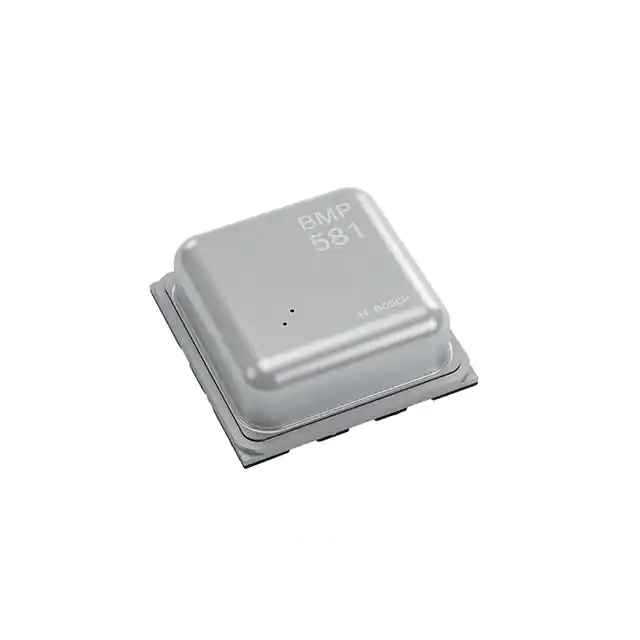
| BMP581 (Bosch) | ±0.06 kPa typical accuracy; I²C/SPI; 2.0 × 2.0 mm LGA-8; no AEC-Q103 qualification. | Targeted at consumer drones and wearables-not validated for automotive under-hood thermal cycling or vibration. | Select if higher resolution and smaller footprint are prioritized over automotive qualification and extended temperature range. |
| MPXV7025DP (NXP) | Analog ratiometric output (0.2–4.7 V); requires external ADC; ±2.5 kPa accuracy; −40°C to +125°C; no integrated diagnostics. | Used in legacy MAF and HVAC systems where analog interface and cost sensitivity outweigh digital integration benefits. | Select only when existing analog signal chain architecture prohibits SPI integration or when diagnostic coverage is handled externally. |
Compared with BMP581 and MPXV7025DP, the KP464EXTMA1 uniquely combines AEC-Q103 qualification, ±1.0 kPa accuracy, embedded diagnostics, and ultra-low-power SPI operation-making it the only drop-in solution for next-generation automotive BAP, MAF, and BMS modules requiring functional safety alignment.
Availability
KP464EXTMA1 is available at Aetrix Electronics and suitable for automotive barometric air pressure (BAP), manifold air flow (MAF), and battery monitoring system (BMS) applications requiring stable component supply, long-lifecycle support, and AEC-Q103-compliant traceability.
Supply support for KP464EXTMA1 includes scheduled delivery planning, volume procurement assistance, BOM continuity management, traceable sourcing, and lifecycle availability coordination for OEM customers, industrial embedded developers, connected-device designers, and electronics production programs.
Manufacturer
Infineon Technologies is a German semiconductor manufacturer specializing in power management, sensor, and automotive ICs, with leadership in silicon-based pressure, radar, and MEMS solutions.
The KP464E belongs to Infineon's XENSIV™ digital pressure sensor family, engineered specifically for high-accuracy, automotive-qualified absolute pressure measurement in harsh environments with minimal external components.
FAQ
What is the maximum SPI clock frequency supported by KP464EXTMA1?
The KP464EXTMA1 supports SPI clock frequencies up to 10 MHz, enabling pressure and temperature data reads at rates exceeding 1 kHz in 10-bit mode. Timing compliance is verified per Section 4.1.5 of the datasheet, with setup/hold times defined for VDD = 3.3 V and 5.0 V. No external level-shifting is required for standard MCU SPI peripherals.
Does KP464EXTMA1 require external calibration during system integration?
No. The KP464EXTMA1 ships with factory-programmed calibration coefficients stored in on-chip EEPROM, covering pressure offset, sensitivity, temperature coefficient, and nonlinearity correction. These values are automatically applied in firmware during each measurement cycle-no user calibration or lookup tables are needed.
How does the integrated diagnosis feature operate without disrupting normal measurements?
Diagnosis is executed asynchronously via dedicated SPI commands (e.g., 0x80 for full diagnosis). During execution, the sensor halts new pressure sampling but maintains SPI responsiveness. Diagnostic results-including PASS/FAIL flags for sensor cell, signal path, and EEPROM-are returned in a standardized 16-bit status word, requiring no additional GPIO or interrupt lines.
Can KP464EXTMA1 be used in daisy-chain SPI configurations?
Yes. The KP464EXTMA1 supports daisy-chain operation using its tri-state SDO output and shared CLK/NCS/SDI lines. Up to four devices can be cascaded with individual addressing via unique chip-select timing sequences, as detailed in Section 4.2.4.10 of the datasheet-enabling compact multi-sensor PCB layouts in space-constrained modules.
KP464EXTMA1 Specifications
- Product attributes
- Attribute value
- Manufacturer:
- Infineon Technologies
- Series:
- XENSIV™
- Package/Case:
- 8-SMD, Flat Leads, Exposed Pad
- Packaging:
- Tape & Reel (TR)
- Product Status:
- Active
- Applications:
- Board Mount
- Pressure Type:
- Absolute
- Operating Pressure:
- 5.8PSI ~ 16.68PSI (40kPa ~ 115kPa)
- Output Type:
- SPI
- Output:
- 14 b
- Accuracy:
- ±0.145PSI (±1kPa)
- Voltage - Supply:
- 3V ~ 5.25V
- Port Size:
- -
- Port Style:
- No Port
- Features:
- -
- Termination Style:
- -
- Maximum Pressure:
- -
- Operating Temperature:
- -40°C ~ 125°C
- Grade:
- -
- Qualification:
- -
- Mounting Type:
- Surface Mount
- Supplier Device Package:
- PG-DFN-8-1
KP464EXTMA1 FAQ
1.How can I place an order for KP464EXTMA1 through Aetrix?
Please submit a Request for Quotation (RFQ) for KP464EXTMA1 on Aetrix. Our sales agent will provide a competitive quotation and guide you through the order confirmation once you accept the terms.
2.Are the price and stock information for KP464EXTMA1 reliable?
The price and inventory of KP464EXTMA1 are updated periodically and may fluctuate due to market conditions. Stock and pricing data are typically refreshed every 24 hours. Quotation validity for KP464EXTMA1 is usually 5 days.
3.What payment methods are accepted for KP464EXTMA1?
We accept Wire Transfer, PayPal, Credit Card, Western Union, MoneyGram, and Escrow for KP464EXTMA1 transactions.
Note: Certain payment methods may incur a processing fee.
4.How is shipping managed for KP464EXTMA1?
KP464EXTMA1 orders can be shipped via leading logistics carriers, including DHL, UPS, FedEx, TNT, or Registered Mail.
Once your KP464EXTMA1 order is processed, you will receive an email with the shipment details and tracking number.
Note: Tracking information may take up to 24 hours to appear. Express delivery typically takes 3–5 business days.
5.How can I obtain technical support or documentation for KP464EXTMA1?
For technical support, including KP464EXTMA1 datasheets, pinout diagrams, or application guidance, please contact our engineering support team. They can provide detailed documentation and assistance for your KP464EXTMA1 requirements.
6.How does Aetrix verify that KP464EXTMA1 is sourced from the original manufacturer or authorized distributors?
All KP464EXTMA1 products on Aetrix are procured from qualified distributors and authorized channels. Our dedicated quality assurance team conducts strict verification, including traceability checks and, if necessary, third-party testing. This ensures that KP464EXTMA1 meets industry standards.
7.What is the process for return or replacement of KP464EXTMA1?
All KP464EXTMA1 units undergo pre-shipment inspection (PSI). If there is an issue with KP464EXTMA1, returns or replacements are accepted under the following conditions:
1.Quantity discrepancies, incorrect items, or visible external defects (such as breakage or corrosion), acknowledged by Aetrix.
2.The issue is reported within 90 days of delivery.
3.The KP464EXTMA1 part is unused and in its original packaging.
Return procedure for KP464EXTMA1:
1.Submit a request within 90 days.
2.Obtain a Return Material Authorization (RMA) from Aetrix.
KP464EXTMA1 Tags
-
DPS368XTSA1
Infineon Technologies
-
DPS310XTSA1
Infineon Technologies
-
LPS22HHTR
STMicroelectronics

-
ICP-20100
TDK InvenSense
-
ICP-10110
TDK InvenSense
-
LPS22DFTR
STMicroelectronics
-
LPS22HBTR
STMicroelectronics
-
BMP390
Bosch Sensortec
-
BMP581
Bosch Sensortec
-
BMP384
Bosch Sensortec
-
2511020213301
Würth Elektronik
-
ILPS22QSTR
STMicroelectronics
Tech Hub

Operational amplifier guide covering op amp basics, feedback, ideal vs real op amps, common configurations, buffer circuits, offset, bias current, gain-bandwidth, slew rate, rail-to-rail limits and sel…

Jumper cables guide covering safe connection order, red and black clamp placement, final ground connection, cable gauge, length, clamp quality, copper vs CCA cables, jump starter comparison and battery…

LDO regulator guide covering low dropout voltage, power dissipation, thermal design, PSRR, output noise, capacitor stability, adjustable LDO circuits, LDO vs buck converter and datasheet selection chec…

Conditional Access Module guide covering CAM meaning, CI/CI+ interface, smart card authorization, DVB security workflow, TV and set-top box compatibility, internal electronics, ESD protection, connecto…

Guide to electronic component obsolescence covering EOL risk, PCN/PDN notices, last-time buy planning, replacement options, form-fit-function validation, counterfeit risk and BOM lifecycle management.

18650 battery guide covering lithium-ion cell basics, 3.6V/3.7V voltage, 4.2V charging, mAh and Wh capacity, protected cells, chargers, BMS, series-parallel packs, holders, welding and sourcing checks.…

Hall effect sensor guide covering working principle, linear and digital sensors, Arduino circuits, current sensing, speed detection, automotive applications, A3144 examples, signal filtering and datash…

Product Change Notification guide for electronic components, covering PCN meaning, PCN vs PDN/EOL, common change types, risk levels, form-fit-function review, engineering validation, BOM control, LTB/L…

A practical guide to blend door actuators, covering HVAC function, symptoms, location, AC and heater issues, reset and calibration, replacement cost, electrical diagnosis, compatibility checks, and rep…

Engineering guide to Raspberry Pi alternatives, covering chip-level differences, Orange Pi, ROCK, Jetson, Banana Pi, NanoPi, Compute Module, Pico, GPIO, camera, HAT compatibility, and replacement risks…


