
 My Inquiry
 My Account


Diodes Incorporated LLSD101B-7
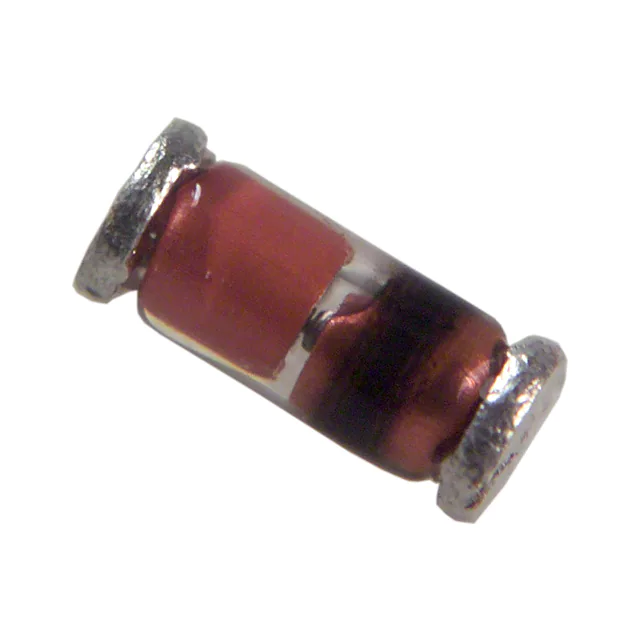
- Part No.:
- LLSD101B-7
- Manufacturer:
- Diodes Incorporated
- Category:
- Single Diodes
- Package:
- DO-213AC, MINI-MELF, SOD-80
- Datasheet:
-
 LLSD101B-7.pdf
- Description:
- SCHOTTKY SOD80 50V 0.015A 125C
- Quantity:
- Payment:

- Shipping:

Inventory:9,081
Please send an inquiry. Send us your inquiry, and we will respond immediately.
Product details
Overview
LLSD101B-7 from Diodes Incorporated is a surface-mount Schottky barrier diode in MiniMELF glass package, rated for 50 V peak repetitive reverse voltage, 15 mA forward continuous current, and 0.40 V forward voltage at 1.0 mA - optimized for low-power signal rectification and ESD-sensitive detector circuits.
For engineers reviewing the LLSD101B-7 datasheet, LLSD101B-7 pinout, LLSD101B-7 application, or LLSD101B-7 equivalent, key selection criteria include its 1.0 ns reverse recovery time, 2.1 pF junction capacitance at 0 V, cathode-band polarity marking, RoHS-compliant Sn97.5Ag2.5 termination, and UL 94V-0 flammability rating.
Technical Context
This Schottky diode employs guard ring construction to enhance transient immunity and suppress leakage-induced signal distortion in high-impedance analog front-ends. Its low VF and fast trr enable efficient signal clamping and RF detector operation up to ~1 GHz.
Designed for minimal parasitic impact, it delivers stable reverse current (≤200 nA at VR = 40 V) and predictable capacitance variation (2.1 pF @ 0 V, decreasing with reverse bias), supporting precision timing and envelope detection in battery-powered instrumentation.
Key Specifications
| Parameter | Value and Actual Design Meaning |
|---|---|
| VRRM | 50 V - maximum non-repetitive reverse voltage before breakdown; sets safe operating limit in clamp/protect circuits |
| VF @ 1.0 mA | 0.40 V - enables low-loss signal steering in micropower sensor interfaces |
| trr | 1.0 ns - supports high-frequency demodulation and fast edge detection without tail current |
| CT @ 0 V | 2.1 pF - minimizes loading on RF nodes and preserves Q-factor in tuned circuits |
| IR @ 40 V | 200 nA - ensures negligible leakage error in high-impedance voltage sampling paths |
| Pd | 400 mW - sufficient for continuous operation at 15 mA in ambient temperatures ≤ +125°C |
Pinout & Package
MiniMELF glass package (3.3–3.7 mm length × 1.3–1.6 mm diameter), hermetically sealed, cathode identified by single black band. No discrete pins; anode and cathode accessed via axial metal end caps.
| Pin/Terminal | Circuit Role | Design Meaning |
|---|---|---|
| Anode (unmarked end) | Forward current entry point | Connected to lower-potential node in rectifier/clamp configuration; requires clean solder wetting per MIL-STD-202 |
| Cathode (banded end) | Forward current exit / reverse blocking terminal | Reference node for voltage clamping; band orientation critical for PCB layout verification |
Key Features
| Feature | Design Value |
|---|---|
| Guard ring construction | Improves ESD robustness and stabilizes leakage under transient stress without adding series resistance |
| Low VF (0.40 V @ 1 mA) | Reduces forward conduction loss in micropower detector and biasing networks |
| 1.0 ns reverse recovery | Enables accurate high-speed pulse rectification without minority-carrier storage delay |
| RoHS-compliant Sn97.5Ag2.5 finish | Ensures reliable solder joint formation with lead-free reflow profiles (J-STD-020C Level 1) |
Applications
| RF Detector Circuit | Low-Power Sensor Biasing |
|---|---|
Use Scenario: Demodulating AM signals in sub-GHz ISM band receivers with passive envelope detection. IC Role / Device Role / Timing Role: Signal rectifier converting RF carrier amplitude to DC envelope voltage. Use Value: 2.1 pF CT and 1.0 ns trr preserve signal fidelity; 0.40 V VF enables detection sensitivity down to –20 dBm. | Use Scenario: Providing temperature-stable bias current to photodiode amplifiers in portable gas sensors. IC Role / Device Role / Timing Role: Low-leakage current source reference diode in transimpedance feedback path. Use Value: 200 nA IR at 40 V prevents offset drift; –55°C to +125°C Tj range supports outdoor deployment. |
| ESD Protection Node | Clamp-Based Voltage Reference |
Use Scenario: Secondary-level transient suppression on analog input lines of medical-grade data acquisition modules. IC Role / Device Role / Timing Role: Fast-acting shunt protector diverting ESD pulses before IC input structures. Use Value: Guard ring design withstands >8 kV HBM; 1.0 ns response limits voltage overshoot to <5% above clamping threshold. | Use Scenario: Generating stable 0.4 V reference for comparator hysteresis in battery-monitoring ICs. IC Role / Device Role / Timing Role: Precision forward-voltage reference element in low-current, low-drift applications. Use Value: VF tolerance (±0.05 V) and <10 ppm/°C TC support ±1% reference accuracy over full industrial temperature range. |
Equivalent & Alternatives
The following parts are listed as comparable options for similar Schottky diode applications.
| Alternative Part | Technical Difference | Application Difference | Selection Advice |
|---|---|---|---|
| SD101BW-7 | Same MiniMELF package; VF = 0.41 V @ 1 mA, VRRM = 50 V, CT = 2.0 pF | Identical electrical specs; newer revision with updated process control and tighter VF distribution | Select SD101BW-7 for new designs requiring long-term supply continuity and enhanced lot-to-lot consistency |
| 1N5711TR | DO-35 glass package; VF = 0.43 V @ 1 mA, VRRM = 70 V, trr = 1.5 ns, CT = 2.5 pF | Higher VRRM and larger package footprint; less suitable for ultra-compact layouts | Choose 1N5711TR only when higher reverse voltage margin or legacy DO-35 compatibility is required |
Compared with LLSD101B-7, SD101BW-7 offers improved manufacturing traceability and identical performance in space-constrained designs, while 1N5711TR trades miniaturization for greater reverse voltage headroom and wider industry familiarity - making it viable only where board real estate permits.
Availability
LLSD101B-7 is available at Aetrix Electronics and suitable for RF detector circuits, low-power sensor biasing, ESD protection nodes, and clamp-based voltage references requiring stable component supply across production lifecycles.
Supply support for LLSD101B-7 includes scheduled delivery planning, volume procurement assistance, BOM continuity management, traceable sourcing, and lifecycle availability coordination for OEM customers, industrial embedded developers, connected-device designers, and electronics production programs.
Manufacturer
Diodes Incorporated is a global manufacturer of discrete semiconductors and analog ICs, specializing in high-reliability, application-optimized components for power management, signal integrity, and protection.
The LLSD101x series belongs to Diodes' MiniMELF Schottky diode product line, engineered specifically for low-capacitance, fast-switching roles in RF, sensing, and portable instrumentation applications.
FAQ
Is LLSD101B-7 suitable for high-frequency RF applications?
Yes. With 1.0 ns reverse recovery time and 2.1 pF junction capacitance at 0 V, LLSD101B-7 supports envelope detection and signal clamping up to 1 GHz. Its MiniMELF geometry minimizes parasitic inductance, and measured VF stability across temperature ensures consistent detector output in wireless sensor nodes.
What is the thermal resistance of LLSD101B-7, and how does it affect power handling?
LLSD101B-7 has a junction-to-ambient thermal resistance (RJA) of 375 °C/W on FR-4 with recommended pad layout. At 15 mA forward current and 0.40 V drop, power dissipation is 6 mW - generating only ~2.25 °C rise above ambient, enabling reliable operation without heatsinking in compact PCBs.
Does LLSD101B-7 meet automotive qualification standards?
No. LLSD101B-7 is not AEC-Q200 qualified. It operates from –55°C to +125°C but lacks automotive-specific testing (e.g., vibration, board flex, extended HTOL). For automotive use, Diodes recommends the AEC-Q200-qualified SD101AW-7 or AP7165 series instead.
Can LLSD101B-7 be used as a replacement for LLSD101A-7 in existing designs?
Yes, with minor derating. LLSD101B-7 has lower VRRM (50 V vs. 60 V) and slightly lower VF (0.40 V vs. 0.41 V at 1 mA). If the original design operates below 50 V reverse stress and tolerates the reduced forward drop, substitution is electrically safe and mechanically identical (same MiniMELF package and marking).
LLSD101B-7 Specifications
- Product attributes
- Attribute value
- Manufacturer:
- Diodes Incorporated
- Series:
- -
- Package/Case:
- DO-213AC, MINI-MELF, SOD-80
- Packaging:
- Tape & Reel (TR)
- Product Status:
- Obsolete
- Technology:
- Schottky
- Voltage - DC Reverse (Vr) (Max):
- 50 V
- Current - Average Rectified (Io):
- 15mA
- Voltage - Forward (Vf) (Max) @ If:
- 950 mV @ 15 A
- Speed:
- Small Signal =< 200mA (Io), Any Speed
- Reverse Recovery Time (trr):
- 1 ns
- Current - Reverse Leakage @ Vr:
- 200 nA @ 40 V
- Capacitance @ Vr, F:
- 2.1pF @ 0V, 1MHz
- Grade:
- -
- Qualification:
- -
- Mounting Type:
- Surface Mount
- Supplier Device Package:
- Mini MELF
- Operating Temperature - Junction:
- -55°C ~ 125°C
LLSD101B-7 FAQ
1.How can I place an order for LLSD101B-7 through Aetrix?
Please submit a Request for Quotation (RFQ) for LLSD101B-7 on Aetrix. Our sales agent will provide a competitive quotation and guide you through the order confirmation once you accept the terms.
2.Are the price and stock information for LLSD101B-7 reliable?
The price and inventory of LLSD101B-7 are updated periodically and may fluctuate due to market conditions. Stock and pricing data are typically refreshed every 24 hours. Quotation validity for LLSD101B-7 is usually 5 days.
3.What payment methods are accepted for LLSD101B-7?
We accept Wire Transfer, PayPal, Credit Card, Western Union, MoneyGram, and Escrow for LLSD101B-7 transactions.
Note: Certain payment methods may incur a processing fee.
4.How is shipping managed for LLSD101B-7?
LLSD101B-7 orders can be shipped via leading logistics carriers, including DHL, UPS, FedEx, TNT, or Registered Mail.
Once your LLSD101B-7 order is processed, you will receive an email with the shipment details and tracking number.
Note: Tracking information may take up to 24 hours to appear. Express delivery typically takes 3–5 business days.
5.How can I obtain technical support or documentation for LLSD101B-7?
For technical support, including LLSD101B-7 datasheets, pinout diagrams, or application guidance, please contact our engineering support team. They can provide detailed documentation and assistance for your LLSD101B-7 requirements.
6.How does Aetrix verify that LLSD101B-7 is sourced from the original manufacturer or authorized distributors?
All LLSD101B-7 products on Aetrix are procured from qualified distributors and authorized channels. Our dedicated quality assurance team conducts strict verification, including traceability checks and, if necessary, third-party testing. This ensures that LLSD101B-7 meets industry standards.
7.What is the process for return or replacement of LLSD101B-7?
All LLSD101B-7 units undergo pre-shipment inspection (PSI). If there is an issue with LLSD101B-7, returns or replacements are accepted under the following conditions:
1.Quantity discrepancies, incorrect items, or visible external defects (such as breakage or corrosion), acknowledged by Aetrix.
2.The issue is reported within 90 days of delivery.
3.The LLSD101B-7 part is unused and in its original packaging.
Return procedure for LLSD101B-7:
1.Submit a request within 90 days.
2.Obtain a Return Material Authorization (RMA) from Aetrix.
LLSD101B-7 Tags
-
1N4448X-TP
Micro Commercial Co
-
1N4148WX-TP
Micro Commercial Co

-
1N4148TR
onsemi
-
MMSD4148T1G
onsemi
-
MMBD914LT3G
onsemi
-
BAS16HT1G
onsemi
-
1N914BWT
onsemi
-
BAS21LT1G
onsemi
-
LL4148
onsemi
-
BAS16LT1G
onsemi
-
MMSD914T1G
onsemi
-
BAV21W-7-F
Diodes Incorporated
Tech Hub

An engineering guide to LED driver operation, constant-current and constant-voltage outputs, linear and switching topologies, dimming, IC selection, calculations, replacement compatibility, and fault c…

Operational amplifier guide covering op amp basics, feedback, ideal vs real op amps, common configurations, buffer circuits, offset, bias current, gain-bandwidth, slew rate, rail-to-rail limits and sel…

Jumper cables guide covering safe connection order, red and black clamp placement, final ground connection, cable gauge, length, clamp quality, copper vs CCA cables, jump starter comparison and battery…

LDO regulator guide covering low dropout voltage, power dissipation, thermal design, PSRR, output noise, capacitor stability, adjustable LDO circuits, LDO vs buck converter and datasheet selection chec…

Conditional Access Module guide covering CAM meaning, CI/CI+ interface, smart card authorization, DVB security workflow, TV and set-top box compatibility, internal electronics, ESD protection, connecto…

Guide to electronic component obsolescence covering EOL risk, PCN/PDN notices, last-time buy planning, replacement options, form-fit-function validation, counterfeit risk and BOM lifecycle management.

18650 battery guide covering lithium-ion cell basics, 3.6V/3.7V voltage, 4.2V charging, mAh and Wh capacity, protected cells, chargers, BMS, series-parallel packs, holders, welding and sourcing checks.…

Hall effect sensor guide covering working principle, linear and digital sensors, Arduino circuits, current sensing, speed detection, automotive applications, A3144 examples, signal filtering and datash…

Product Change Notification guide for electronic components, covering PCN meaning, PCN vs PDN/EOL, common change types, risk levels, form-fit-function review, engineering validation, BOM control, LTB/L…

A practical guide to blend door actuators, covering HVAC function, symptoms, location, AC and heater issues, reset and calibration, replacement cost, electrical diagnosis, compatibility checks, and rep…


