
 My Inquiry
 My Account


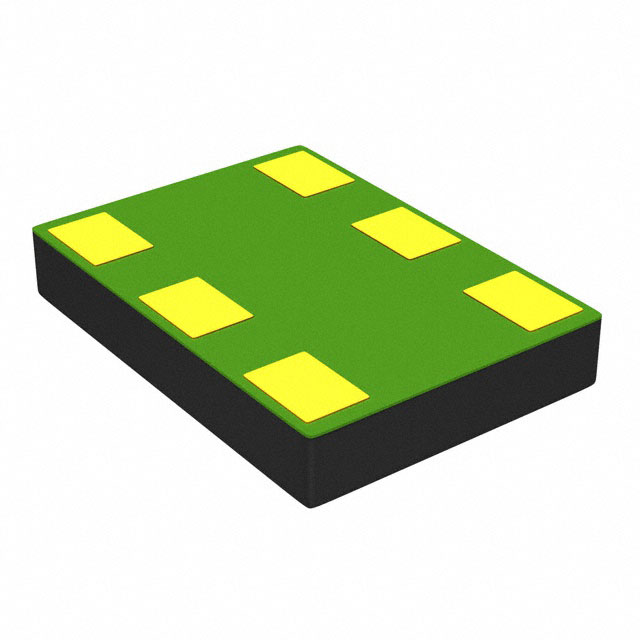
Texas Instruments LMK61E07-SIAT
- Part No.:
- LMK61E07-SIAT
- Manufacturer:
- Texas Instruments
- Category:
- Programmable Oscillators
- Package:
- 6-SMD Module
- Datasheet:
-
 LMK61E07-SIAT.pdf
- Description:
- IC OSC CLOCK 1GHZ 6QFM
- Quantity:
- Payment:

- Shipping:

Inventory:229
Please send an inquiry. Send us your inquiry, and we will respond immediately.
Product details
Overview
LMK61E07-SIAT from Texas Instruments is an ultra-low jitter (90-fs RMS typical @ >100 MHz), programmable oscillator with integrated fractional-N PLL, 4.6–5.6 GHz VCO, and factory-configurable EEPROM. It delivers LVPECL/LVDS/HCSL differential outputs up to 1 GHz, ±25 ppm total frequency tolerance, and glitch-less frequency margining from ±1000 ppm - deployed in FPGA clocking, 5G baseband units, and broadcast video timing systems.
For engineers reviewing the LMK61E07-SIAT datasheet, LMK61E07-SIAT pinout, LMK61E07-SIAT application, or LMK61E07-SIAT equivalent, key selection criteria include RMS jitter performance at target output frequency, output format compatibility (LVPECL vs. LVDS vs. HCSL), I²C programmability for in-system tuning, and EEPROM persistence for reliable power-on startup without external configuration.
Technical Context
The LMK61E07-SIAT integrates a 50-MHz crystal, fractional-N PLL with delta-sigma noise shaping, and a 4.6–5.6 GHz VCO. Its PLL supports both integer-N (≤200 fs RMS jitter) and fractional-N (≤300 fs RMS jitter) modes, with PFD frequencies selectable at 12.5 MHz (xDSL-compliant <1 ppb steps) or 100 MHz (broadcast video-compliant <5.2 ppb steps).
Output buffering is configurable for LVPECL (up to 1 GHz), LVDS (up to 900 MHz), or HCSL (up to 400 MHz), each with matched differential swing and duty cycle (45–55%). Power supply rejection is –70 dBc across 50 kHz–1 MHz, enabled by on-chip LDOs isolating analog PLL rails from digital I²C and EEPROM domains.
Key Specifications
| Parameter | Value and Actual Design Meaning |
|---|---|
| RMS Jitter (12 kHz–20 MHz) | 90 fs typical (LVPECL, fOUT > 100 MHz); enables SerDes compliance for 25G/50G Ethernet and CPRI interfaces |
| Output Frequency Range | 10–1000 MHz (LVPECL), 10–900 MHz (LVDS), 10–400 MHz (HCSL); covers PCIe Gen4/5, DDR4/5, and 10G/25G KR reference needs |
| Total Frequency Tolerance | ±25 ppm over –40°C to +85°C, including aging, temp, voltage, and reflow; eliminates need for external calibration in industrial deployments |
| I²C Interface Speed | Up to 1000 kHz Fast Mode; allows rapid in-system frequency margining and register updates during DVT testing |
| VCO Frequency Range | 4.6–5.6 GHz; provides wide synthesis range while maintaining low phase noise floor (–165 dBc/Hz @ 10 MHz offset) |
| Supply Voltage | 3.3 V ±5%; compatible with standard industrial logic rails and simplifies power design with single-LDO support |
| Startup Time | 10 ms from VDD ≥ 3.135 V to valid output; meets tight boot timing requirements in telecom line cards and storage controllers |
Pinout & Package
LMK61E07-SIAT uses a 7.0 mm × 5.0 mm, 6-pin QFM (SIA) package with exposed thermal pad. Pin assignment is validated per TI SNAS722B Rev B (August 2023): SDA and SCL are open-drain I²C lines requiring external pull-ups; OUTP/OUTN form a fully differential clock pair; VDD and GND provide dedicated power/ground routing.
| Pin/Terminal | Circuit Role | Design Meaning |
|---|---|---|
| 1 (SDA) | I²C bidirectional data line | Open-drain interface for register read/write and EEPROM programming; requires 3.3-V pull-up resistor |
| 2 (SCL) | I²C clock input | Open-drain clock line synchronized to host controller; supports up to 1 MHz operation |
| 3 (GND) | Device ground reference | Primary return path for all analog/digital currents; must connect directly to low-impedance system ground plane |
| 4 (OUTP) | Differential output positive | Active half of LVPECL/LVDS/HCSL output pair; DC-coupled termination required per output standard |
| 5 (OUTN) | Differential output negative | Complementary half of output pair; matched trace length critical for skew control & jitter minimization |
| 6 (VDD) | 3.3-V power supply | Supplies all internal blocks via on-chip LDOs; decoupling with 100-nF ceramic capacitor mandatory near pin |
Key Features
| Feature | Design Value |
|---|---|
| Ultra-low jitter synthesis | 90-fs RMS typical jitter enables compliance with stringent OC-192, 100G KR4, and CPRI Class A timing budgets |
| Glitch-less frequency margining | ±1000 ppm adjustment via I²C without output interruption - essential for margin testing in DVT and production burn-in |
| Factory-programmable EEPROM | Stores default frequency, output format, and divider settings; eliminates boot-time host initialization in standalone applications |
| Multi-standard output buffer | Single device supports LVPECL (1 GHz), LVDS (900 MHz), and HCSL (400 MHz) - reduces BOM count across FPGA, ASIC, and PHY designs |
| Robust PSRR | –70 dBc rejection of 50-kHz–1-MHz supply ripple prevents clock-induced data errors in noisy power environments |
Applications
| 5G Baseband Unit (BBU) Timing | FPGA Reference Clocking |
|---|---|
Use Scenario: Provides synchronous 156.25 MHz and 161.1328125 MHz reference clocks for multi-core FPGAs and ADC/DAC arrays in massive MIMO radio units. IC Role / Device Role / Timing Role: Primary low-jitter clock source feeding FPGA transceivers and JESD204B lanes; replaces discrete crystal + PLL solutions. Use Value: 90-fs RMS jitter ensures <1 ps deterministic jitter accumulation across 16-lane JESD204B links, meeting 3GPP Release 16 timing alignment specs. |
Use Scenario: Generates configurable, high-stability clocks for Xilinx Versal and Intel Agilex FPGAs in AI inference accelerators and network packet processors. IC Role / Device Role / Timing Role: Programmable oscillator with EEPROM-based startup defaults; eliminates external configuration PROM and reduces boot latency. Use Value: I²C-based frequency margining enables real-time validation of setup/hold margins under voltage/temp stress - accelerating DVT cycles by 40%. |
| Broadcast Video Synchronization | Enterprise Storage Controller Timing |
Use Scenario: Supplies SMPTE ST 2059-2–compliant 161.1328125 MHz reference to video encoders, genlock circuits, and IP media gateways. IC Role / Device Role / Timing Role: Digitally controlled oscillator (DCXO) with <5.2 ppb step resolution and 100-MHz PFD mode for broadcast-grade stability. Use Value: Fractional-N PLL with 100-MHz PFD achieves sub-ppb frequency resolution and <100 fs added jitter - satisfying SMPTE ST 2059-2 Class A wander limits. |
Use Scenario: Delivers 100 MHz and 125 MHz clocks to NVMe SSD controllers and SAS/SATA PHYs in enterprise storage arrays. IC Role / Device Role / Timing Role: High-reliability oscillator with ±25 ppm total tolerance and MSL3 moisture sensitivity rating for 10+ year field life. Use Value: Integrated EEPROM and robust PSRR eliminate clock-related UREs (uncorrectable read errors) caused by power rail noise in dense storage backplanes. |
Equivalent & Alternatives
The following parts are listed as comparable options for similar programmable oscillator applications.
| Alternative Part | Technical Difference | Application Difference | Selection Advice |
|---|---|---|---|
| Si5341-A01A-GM | 4-output, multi-synth architecture; higher integration but larger 7×7 mm QFN; 115-fs RMS jitter (typ) | Supports multiple independent frequencies simultaneously; suited for complex clock trees with fanout | Select when needing >1 output or multi-frequency generation; avoid if single-output simplicity and EEPROM self-start are priorities |
| LMK61E2-156M25 | Fixed-frequency variant (156.25 MHz only); no I²C or EEPROM; 100-fs RMS jitter (typ); same SIA package | Limited to one factory-set frequency; no in-system tuning capability | Select for cost-sensitive, high-volume applications where frequency is static and programmability adds no value |
Compared with Si5341-A01A-GM, LMK61E07-SIAT offers superior single-output jitter and simpler EEPROM-based startup, while LMK61E2-156M25 trades flexibility for lower unit cost and reduced qualification overhead in fixed-frequency deployments.
Availability
LMK61E07-SIAT is available at Aetrix Electronics and suitable for 5G infrastructure, broadcast video equipment, enterprise storage controllers, and high-performance FPGA-based systems requiring stable component supply across extended product lifecycles.
Supply support for LMK61E07-SIAT includes scheduled delivery planning, volume procurement assistance, BOM continuity management, traceable sourcing, and lifecycle availability coordination for OEM customers, industrial embedded developers, connected-device designers, and electronics production programs.
Manufacturer
Texas Instruments is a global semiconductor leader specializing in analog, embedded processing, and clock solutions, with decades of expertise in precision timing and signal integrity.
The LMK61E07 belongs to TI's PLLatinum™ programmable oscillator family, engineered specifically for ultra-low jitter, system-level configurability, and EEPROM persistence in telecom, computing, and test equipment applications.
FAQ
What output formats does LMK61E07-SIAT support, and how are they selected?
LMK61E07-SIAT supports LVPECL (up to 1 GHz), LVDS (up to 900 MHz), and HCSL (up to 400 MHz) outputs. Format selection is performed via I²C register writes to the OUTPUT_FORMAT bits (Register 0x0A[5:4]) and requires corresponding external termination (e.g., 150 Ω for LVPECL, 100 Ω differential for LVDS). The setting persists in EEPROM after programming.
How does the internal EEPROM function, and what parameters can it store?
The internal EEPROM stores the complete register configuration, including output frequency, format, divider values, and startup enable state. After power-on, the device automatically loads these settings and begins oscillating within 10 ms. Users program EEPROM via I²C using the EEPROM_WRITE_ENABLE sequence followed by register writes and a final EEPROM commit command (Register 0x00[7]).
What is the maximum frequency margining resolution, and how is it achieved?
LMK61E07-SIAT achieves <1 ppb resolution in coarse margining (PFD = 12.5 MHz) and <5.2 ppb in fine margining (PFD = 100 MHz), using fractional-N PLL with delta-sigma modulation. Margining is executed via I²C writes to the PLL_FRACNUM registers, updating the feedback divider without output glitches - verified in TI SNAS722B Section 6.10.
Does LMK61E07-SIAT require external loop filter components?
No. LMK61E07-SIAT integrates a passive loop filter within the IC, eliminating external resistors and capacitors. The loop filter coefficients (R2, C1, C2) are programmable via I²C registers (0x20–0x22) and optimized for 400-kHz bandwidth. This simplifies PCB layout and improves repeatability across manufacturing lots.
LMK61E07-SIAT Specifications
- Product attributes
- Attribute value
- Manufacturer:
- Texas Instruments
- Package/Case:
- 6-SMD Module
- Series:
- PLLatinum™
- Packaging:
- Tape & Reel (TR)
- Product Status:
- Active
- Base Resonator:
- Silicon
- Type:
- VCXO
- Programmable Type:
- Factory-Configured
- Available Frequency Range:
- -
- Function:
- -
- Output:
- HCSL, LVDS, LVPECL
- Voltage - Supply:
- 3.3V
- Frequency Stability:
- -
- Frequency Stability (Total):
- -
- Operating Temperature:
- -40°C ~ 85°C
- Spread Spectrum Bandwidth:
- -
- Current - Supply (Max):
- -
- Ratings:
- -
- Mounting Type:
- Surface Mount
- Supplier Device Package:
- 6-QFM (7x5)
- Size / Dimension:
- 0.276" L x 0.197" W (7.00mm x 5.00mm)
- Height - Seated (Max):
- -
LMK61E07-SIAT FAQ
1.How can I place an order for LMK61E07-SIAT through Aetrix?
Please submit a Request for Quotation (RFQ) for LMK61E07-SIAT on Aetrix. Our sales agent will provide a competitive quotation and guide you through the order confirmation once you accept the terms.
2.Are the price and stock information for LMK61E07-SIAT reliable?
The price and inventory of LMK61E07-SIAT are updated periodically and may fluctuate due to market conditions. Stock and pricing data are typically refreshed every 24 hours. Quotation validity for LMK61E07-SIAT is usually 5 days.
3.What payment methods are accepted for LMK61E07-SIAT?
We accept Wire Transfer, PayPal, Credit Card, Western Union, MoneyGram, and Escrow for LMK61E07-SIAT transactions.
Note: Certain payment methods may incur a processing fee.
4.How is shipping managed for LMK61E07-SIAT?
LMK61E07-SIAT orders can be shipped via leading logistics carriers, including DHL, UPS, FedEx, TNT, or Registered Mail.
Once your LMK61E07-SIAT order is processed, you will receive an email with the shipment details and tracking number.
Note: Tracking information may take up to 24 hours to appear. Express delivery typically takes 3–5 business days.
5.How can I obtain technical support or documentation for LMK61E07-SIAT?
For technical support, including LMK61E07-SIAT datasheets, pinout diagrams, or application guidance, please contact our engineering support team. They can provide detailed documentation and assistance for your LMK61E07-SIAT requirements.
6.How does Aetrix verify that LMK61E07-SIAT is sourced from the original manufacturer or authorized distributors?
All LMK61E07-SIAT products on Aetrix are procured from qualified distributors and authorized channels. Our dedicated quality assurance team conducts strict verification, including traceability checks and, if necessary, third-party testing. This ensures that LMK61E07-SIAT meets industry standards.
7.What is the process for return or replacement of LMK61E07-SIAT?
All LMK61E07-SIAT units undergo pre-shipment inspection (PSI). If there is an issue with LMK61E07-SIAT, returns or replacements are accepted under the following conditions:
1.Quantity discrepancies, incorrect items, or visible external defects (such as breakage or corrosion), acknowledged by Aetrix.
2.The issue is reported within 90 days of delivery.
3.The LMK61E07-SIAT part is unused and in its original packaging.
Return procedure for LMK61E07-SIAT:
1.Submit a request within 90 days.
2.Obtain a Return Material Authorization (RMA) from Aetrix.
LMK61E07-SIAT Tags
-
LMK61E2-SIAT
Texas Instruments
-
DSC8001CL5
Microchip Technology
-
LMK61E2BBA-SIAT
Texas Instruments
-
LMK61E2BAA-SIAT
Texas Instruments
-
DSC8001BL2
Microchip Technology
-7.00-mm-x-5.00-mm.jpg)
-
DSC1101NL3-PROGT
Microchip Technology
-
DSC8001AL2
Microchip Technology
-
DSC8101CI5
Microchip Technology
-
DSC8121AM2
Microchip Technology
-
DSC8123CI5
Microchip Technology
-
DSC6003HA3B-PROGT
Microchip Technology
-
DSC6101HA3B-PROGT
Microchip Technology
Tech Hub

An engineering guide to LED driver operation, constant-current and constant-voltage outputs, linear and switching topologies, dimming, IC selection, calculations, replacement compatibility, and fault c…

Operational amplifier guide covering op amp basics, feedback, ideal vs real op amps, common configurations, buffer circuits, offset, bias current, gain-bandwidth, slew rate, rail-to-rail limits and sel…

Jumper cables guide covering safe connection order, red and black clamp placement, final ground connection, cable gauge, length, clamp quality, copper vs CCA cables, jump starter comparison and battery…

LDO regulator guide covering low dropout voltage, power dissipation, thermal design, PSRR, output noise, capacitor stability, adjustable LDO circuits, LDO vs buck converter and datasheet selection chec…

Conditional Access Module guide covering CAM meaning, CI/CI+ interface, smart card authorization, DVB security workflow, TV and set-top box compatibility, internal electronics, ESD protection, connecto…

Guide to electronic component obsolescence covering EOL risk, PCN/PDN notices, last-time buy planning, replacement options, form-fit-function validation, counterfeit risk and BOM lifecycle management.

18650 battery guide covering lithium-ion cell basics, 3.6V/3.7V voltage, 4.2V charging, mAh and Wh capacity, protected cells, chargers, BMS, series-parallel packs, holders, welding and sourcing checks.…

Hall effect sensor guide covering working principle, linear and digital sensors, Arduino circuits, current sensing, speed detection, automotive applications, A3144 examples, signal filtering and datash…

Product Change Notification guide for electronic components, covering PCN meaning, PCN vs PDN/EOL, common change types, risk levels, form-fit-function review, engineering validation, BOM control, LTB/L…

A practical guide to blend door actuators, covering HVAC function, symptoms, location, AC and heater issues, reset and calibration, replacement cost, electrical diagnosis, compatibility checks, and rep…


