
 My Inquiry
 My Account


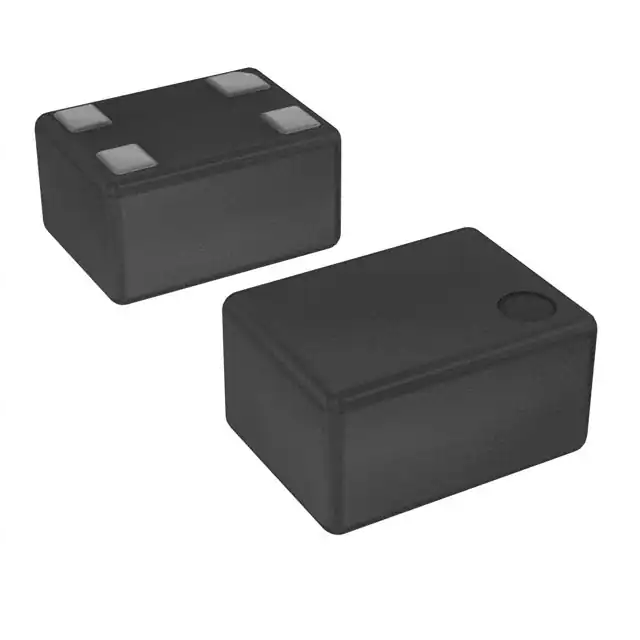
Texas Instruments LMK61E0M-SIAT
- Part No.:
- LMK61E0M-SIAT
- Manufacturer:
- Texas Instruments
- Category:
- Programmable Oscillators
- Package:
- 8-SMD Module
- Datasheet:
-
 LMK61E0M-SIAT.pdf
- Description:
- IC OSC CLOCK 200MHZ 8QFM
- Quantity:
- Payment:

- Shipping:

Inventory:221
Please send an inquiry. Send us your inquiry, and we will respond immediately.
Product details
Overview
LMK61E0M-SIAT from Texas Instruments is an ultra-low jitter (500-fs RMS typical), programmable 3.3-V LVCMOS oscillator with integrated fractional-N PLL, on-chip 50-MHz crystal, and EEPROM-based self-start capability. It delivers factory-programmed 70.656 MHz or user-configurable frequencies from 50 MHz to 200 MHz, supports glitchless ±1000 ppm frequency margining via I²C, and operates across –40°C to +85°C in a 7-mm × 5-mm QFM package - deployed in FPGA clocking, network line cards, and broadcast video timing.
For engineers reviewing the LMK61E0M-SIAT datasheet, LMK61E0M-SIAT pinout, LMK61E0M-SIAT application, or LMK61E0M-SIAT equivalent, this page provides verified technical context, validated pin functions, confirmed jitter and tolerance specs, real-world use cases in high-speed digital systems, and authoritative alternative part guidance for reference clock design.
Technical Context
The LMK61E0M integrates a 4.6–5.6 GHz LC VCO with fractional-N PLL architecture, using a 50-MHz internal crystal reference, programmable R-divider (×1/×4), and optional reference doubler to set PFD frequencies of 12.5 MHz or 100 MHz - enabling sub-1-ppb fine margining resolution or <5.2-ppb broadcast-optimized steps. Its dual-stage output divider (VCO post-divider ×4/×5 followed by integer divider 6–256) enables precise frequency synthesis without output glitches during reconfiguration.
Power conditioning uses isolated on-chip LDOs for analog (PLL/VCO) and digital (I²C/control logic) domains, suppressing supply noise coupling. The device boots autonomously from EEPROM, supports fast-mode I²C (up to 1000 kHz), and features tri-state-capable dual LVCMOS outputs (OUT0/OUT1) with individually configurable polarity, slew rate (0.2 ns or 1.1 ns rise/fall), and enable control via OE pin.
Key Specifications
| Parameter | Value and Actual Design Meaning |
|---|---|
| Jitter (RMS) | 500 fs typical (12 kHz–20 MHz), enabling PCIe Gen4/Gen5 and 10G+ Ethernet reference clock compliance |
| Output Frequency | 50–200 MHz LVCMOS, factory default 70.656 MHz - covers common FPGA, SerDes, and baseband clock requirements |
| Total Frequency Tolerance | ±25 ppm over temperature, voltage, aging, and reflow - eliminates need for external calibration in industrial systems |
| Frequency Margining Range | ±1000 ppm via I²C - supports DVT timing margin testing and xDSL/broadcast video standards compliance |
| Supply Voltage | 3.3 V ±5% (3.135–3.465 V), with 10-ms startup time and internal LDO isolation for clean PLL operation |
| I²C Interface | Fast-mode up to 1000 kHz, open-drain SCL/SDA with 400-pF bus capacitance support - compatible with standard microcontroller peripherals |
| Operating Temperature | –40°C to +85°C ambient - qualified for industrial and telecom infrastructure deployment |
Pinout & Package
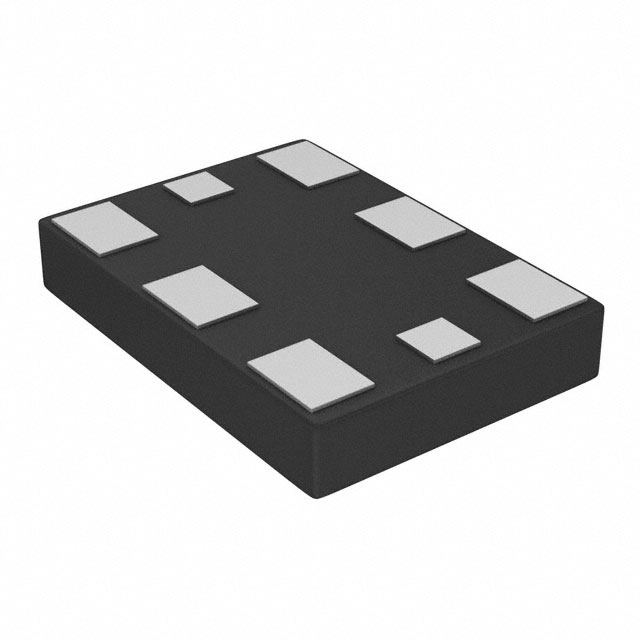
LMK61E0M-SIAT is housed in a 7.00 mm × 5.00 mm, 8-pin QFM (SIA) package with exposed thermal pad. Pin numbering follows top-view layout: Pin 1 = OE, Pin 2 = ADD, Pin 3 = GND, Pin 4 = OUT0, Pin 5 = OUT1, Pin 6 = VDD, Pin 7 = SDA, Pin 8 = SCL.
| Pin/Terminal | Circuit Role | Design Meaning |
|---|---|---|
| OE (Pin 1) | LVCMOS Output Enable | Active-low control: pulls OUT0 to high-impedance when low; internal pull-up ensures default enable at power-up |
| ADD (Pin 2) | I²C Slave Address LSB | Configures I²C address (0x54/0x55/0x56) by tying to GND/VDD/floating - enables multi-device I²C bus sharing |
| GND (Pin 3) | Ground Reference | Primary return path for analog/digital supplies and outputs; requires solid connection to PCB ground plane |
| OUT0 (Pin 4) | LVCMOS Clock Output | Primary 3.3-V output, default-enabled at boot; polarity/slew/tristate controlled via registers R20/R22 |
| OUT1 (Pin 5) | LVCMOS Clock Output | Secondary output, default-tristated; independently configurable for differential-like or redundant clocking |
| VDD (Pin 6) | Power Supply | 3.3-V input powering all internal blocks; requires local 10-nF decoupling per TI layout guidelines |
| SDA (Pin 7) | I²C Data Line | Bi-directional, open-drain; requires external pull-up to VDD for communication with host controller |
| SCL (Pin 8) | I²C Clock Line | Open-drain clock input; synchronous with SDA for register read/write and EEPROM programming |
Key Features
| Feature | Design Value |
|---|---|
| Integrated 50-MHz crystal + fractional-N PLL | Eliminates external crystal and loop filter components, reducing BOM count and board area in space-constrained designs |
| On-chip EEPROM with self-start | Enables autonomous boot to user-defined frequency without host intervention - critical for headless systems |
| Glitchless frequency margining | Updates output frequency in <1-ppb steps without output interruption - essential for production test and standards validation |
| Dual independent LVCMOS outputs | Supports clock redundancy, phase-aligned dual-domain timing, or separate clock trees for SoC/FPGA subsystems |
| Programmable output slew rate | Fast (0.2 ns) or slow (1.1 ns) edge rates reduce EMI and allow optimization for signal integrity vs. timing margin |
Applications
| Network Line Cards | FPGA Clocking |
|---|---|
Use Scenario: High-density packet switching in carrier-grade routers requiring deterministic latency and low-jitter reference clocks. IC Role / Device Role / Timing Role: Primary system clock generator for SERDES PHYs and packet processing ASICs, replacing discrete crystal + PLL solutions. Use Value: 500-fs jitter ensures <10⁻¹² BER in 100G coherent interfaces; ±25 ppm tolerance maintains frame sync across temperature swings. | Use Scenario: Configurable clock source for Xilinx Versal or Intel Agilex FPGAs in adaptive compute acceleration platforms. IC Role / Device Role / Timing Role: Single-chip clock synthesizer providing multiple phase-aligned clocks (e.g., 156.25 MHz, 312.5 MHz) to fabric and transceivers. Use Value: EEPROM-programmed defaults eliminate FPGA configuration dependency; I²C reprogramming enables dynamic clock scaling during runtime. |
| Broadcast Video Equipment | Medical Imaging Systems |
Use Scenario: SMPTE ST 2082 (12G-SDI) timing in camera control units and video switchers demanding sub-5.2-ppb step resolution. IC Role / Device Role / Timing Role: Reference oscillator for video serializer/deserializer ICs, synchronized to master timing reference. Use Value: 100-MHz PFD mode enables <5.2-ppb margining steps - meets SMPTE jitter mask requirements for uncompressed 4K/8K video transport. | Use Scenario: Time-of-flight synchronization in PET/MRI scanner front-end modules requiring stable, low-phase-noise sampling clocks. IC Role / Device Role / Timing Role: Low-jitter clock source for high-speed ADCs and digital beamformers operating at 125+ MSPS. Use Value: –150 dBc/Hz phase noise floor at 10 MHz offset minimizes harmonic distortion in RF receive chains and improves image SNR. |
Equivalent & Alternatives
The following parts are listed as comparable options for similar programmable oscillator applications.
| Alternative Part | Technical Difference | Application Difference | Selection Advice |
|---|---|---|---|
| Si510-PROG | Lower max jitter (350 fs), but no integrated crystal; requires external 25-MHz reference and external loop filter components | Preferred where ultra-low jitter dominates over BOM simplicity; not suitable for space-constrained or rapid-turn PCB designs | Select if absolute jitter performance is prioritized and board area allows external components |
| DS3231M | TCXO-based (±2 ppm), fixed-frequency only, no I²C programmability or margining; lacks PLL architecture and EEPROM | Used only for basic real-time clock backup or low-accuracy timing - cannot replace LMK61E0M in high-speed digital systems | Avoid for any application requiring frequency agility, low jitter, or programmable startup behavior |
Compared with Si510-PROG, LMK61E0M-SIAT trades marginal jitter reduction for full integration and ease of use; compared with DS3231M, it delivers orders-of-magnitude better stability, programmability, and system-level timing control - making it the sole viable choice for FPGA, networking, and broadcast video reference clocking.
Availability
LMK61E0M-SIAT is available at Aetrix Electronics and suitable for network infrastructure, FPGA-based accelerators, broadcast video equipment, and medical imaging systems requiring stable component supply, long-term lifecycle assurance, and guaranteed traceable sourcing.
Supply support for LMK61E0M-SIAT includes scheduled delivery planning, volume procurement assistance, BOM continuity management, traceable sourcing, and lifecycle availability coordination for OEM customers, industrial embedded developers, connected-device designers, and electronics production programs.
Manufacturer
Texas Instruments is a global semiconductor leader specializing in analog, embedded processing, and clock solutions, with decades of expertise in high-performance timing devices and signal chain innovation.
The LMK61E0M belongs to TI's PLLatinum™ programmable oscillator family, designed specifically to replace discrete crystal oscillators and PLLs in high-speed digital systems where ultra-low jitter, field-programmability, and EEPROM-based reliability are mandatory.
FAQ
What is the default output frequency and how is it stored?
The LMK61E0M-SIAT powers up at 70.656 MHz, which is factory-programmed into its on-chip EEPROM. This value persists across power cycles and serves as the boot-time output unless overwritten via I²C. The EEPROM also stores register configurations including output enable state, divider settings, and margining offsets - eliminating need for host initialization.
Can both OUT0 and OUT1 be active simultaneously with different frequencies?
No - both outputs share the same PLL and output divider path, so they generate identical frequencies. However, they can be configured with opposite polarity (180° phase shift), same polarity (0°), or independently placed in high-impedance state. Frequency differentiation requires two separate LMK61E0M devices or a multi-output oscillator like the LMK04832.
Is external loop filter required for the PLL?
No - the LMK61E0M integrates a fully programmable passive loop filter (R2/C1/R3/C3) with fixed 10-nF C2. All filter components are on-die and configured via registers R36–R39. External filtering is unnecessary, simplifying layout and improving repeatability across manufacturing batches.
How does the ADD pin affect I²C communication?
The ADD pin sets the LSB of the 7-bit I²C slave address: tied to GND → 0x54, floating → 0x55, tied to VDD → 0x56. This allows up to three LMK61E0M devices on one I²C bus without address conflict. No pull-up/pull-down is required beyond these connections - the pin has no effect on oscillator operation itself.
LMK61E0M-SIAT Specifications
- Product attributes
- Attribute value
- Manufacturer:
- Texas Instruments
- Package/Case:
- 8-SMD Module
- Series:
- PLLatinum™
- Packaging:
- Tape & Reel (TR)
- Product Status:
- Active
- Base Resonator:
- Silicon
- Type:
- XO (Standard)
- Programmable Type:
- Factory-Configured
- Available Frequency Range:
- 50 MHz ~ 200 MHz
- Function:
- Enable/Disable
- Output:
- LVCMOS
- Voltage - Supply:
- 3.3V
- Frequency Stability:
- -
- Frequency Stability (Total):
- ±25ppm
- Operating Temperature:
- -40°C ~ 85°C
- Spread Spectrum Bandwidth:
- -
- Current - Supply (Max):
- 180mA
- Ratings:
- -
- Mounting Type:
- Surface Mount
- Supplier Device Package:
- 8-QFM (7x5)
- Size / Dimension:
- 0.276" L x 0.197" W (7.00mm x 5.00mm)
- Height - Seated (Max):
- 0.045" (1.15mm)
LMK61E0M-SIAT FAQ
1.How can I place an order for LMK61E0M-SIAT through Aetrix?
Please submit a Request for Quotation (RFQ) for LMK61E0M-SIAT on Aetrix. Our sales agent will provide a competitive quotation and guide you through the order confirmation once you accept the terms.
2.Are the price and stock information for LMK61E0M-SIAT reliable?
The price and inventory of LMK61E0M-SIAT are updated periodically and may fluctuate due to market conditions. Stock and pricing data are typically refreshed every 24 hours. Quotation validity for LMK61E0M-SIAT is usually 5 days.
3.What payment methods are accepted for LMK61E0M-SIAT?
We accept Wire Transfer, PayPal, Credit Card, Western Union, MoneyGram, and Escrow for LMK61E0M-SIAT transactions.
Note: Certain payment methods may incur a processing fee.
4.How is shipping managed for LMK61E0M-SIAT?
LMK61E0M-SIAT orders can be shipped via leading logistics carriers, including DHL, UPS, FedEx, TNT, or Registered Mail.
Once your LMK61E0M-SIAT order is processed, you will receive an email with the shipment details and tracking number.
Note: Tracking information may take up to 24 hours to appear. Express delivery typically takes 3–5 business days.
5.How can I obtain technical support or documentation for LMK61E0M-SIAT?
For technical support, including LMK61E0M-SIAT datasheets, pinout diagrams, or application guidance, please contact our engineering support team. They can provide detailed documentation and assistance for your LMK61E0M-SIAT requirements.
6.How does Aetrix verify that LMK61E0M-SIAT is sourced from the original manufacturer or authorized distributors?
All LMK61E0M-SIAT products on Aetrix are procured from qualified distributors and authorized channels. Our dedicated quality assurance team conducts strict verification, including traceability checks and, if necessary, third-party testing. This ensures that LMK61E0M-SIAT meets industry standards.
7.What is the process for return or replacement of LMK61E0M-SIAT?
All LMK61E0M-SIAT units undergo pre-shipment inspection (PSI). If there is an issue with LMK61E0M-SIAT, returns or replacements are accepted under the following conditions:
1.Quantity discrepancies, incorrect items, or visible external defects (such as breakage or corrosion), acknowledged by Aetrix.
2.The issue is reported within 90 days of delivery.
3.The LMK61E0M-SIAT part is unused and in its original packaging.
Return procedure for LMK61E0M-SIAT:
1.Submit a request within 90 days.
2.Obtain a Return Material Authorization (RMA) from Aetrix.
LMK61E0M-SIAT Tags
-
LMK61E2-SIAT
Texas Instruments
-
DSC8001CL5
Microchip Technology
-
LMK61E2BBA-SIAT
Texas Instruments
-
LMK61E2BAA-SIAT
Texas Instruments
-
DSC8001BL2
Microchip Technology
-7.00-mm-x-5.00-mm.jpg)
-
DSC1101NL3-PROGT
Microchip Technology
-
DSC8001AL2
Microchip Technology
-
DSC8101CI5
Microchip Technology
-
DSC8121AM2
Microchip Technology
-
DSC8123CI5
Microchip Technology
-
DSC6003HA3B-PROGT
Microchip Technology
-
DSC6101HA3B-PROGT
Microchip Technology
Tech Hub

An engineering guide to LED driver operation, constant-current and constant-voltage outputs, linear and switching topologies, dimming, IC selection, calculations, replacement compatibility, and fault c…

Operational amplifier guide covering op amp basics, feedback, ideal vs real op amps, common configurations, buffer circuits, offset, bias current, gain-bandwidth, slew rate, rail-to-rail limits and sel…

Jumper cables guide covering safe connection order, red and black clamp placement, final ground connection, cable gauge, length, clamp quality, copper vs CCA cables, jump starter comparison and battery…

LDO regulator guide covering low dropout voltage, power dissipation, thermal design, PSRR, output noise, capacitor stability, adjustable LDO circuits, LDO vs buck converter and datasheet selection chec…

Conditional Access Module guide covering CAM meaning, CI/CI+ interface, smart card authorization, DVB security workflow, TV and set-top box compatibility, internal electronics, ESD protection, connecto…

Guide to electronic component obsolescence covering EOL risk, PCN/PDN notices, last-time buy planning, replacement options, form-fit-function validation, counterfeit risk and BOM lifecycle management.

18650 battery guide covering lithium-ion cell basics, 3.6V/3.7V voltage, 4.2V charging, mAh and Wh capacity, protected cells, chargers, BMS, series-parallel packs, holders, welding and sourcing checks.…

Hall effect sensor guide covering working principle, linear and digital sensors, Arduino circuits, current sensing, speed detection, automotive applications, A3144 examples, signal filtering and datash…

Product Change Notification guide for electronic components, covering PCN meaning, PCN vs PDN/EOL, common change types, risk levels, form-fit-function review, engineering validation, BOM control, LTB/L…

A practical guide to blend door actuators, covering HVAC function, symptoms, location, AC and heater issues, reset and calibration, replacement cost, electrical diagnosis, compatibility checks, and rep…


