
 My Inquiry
 My Account


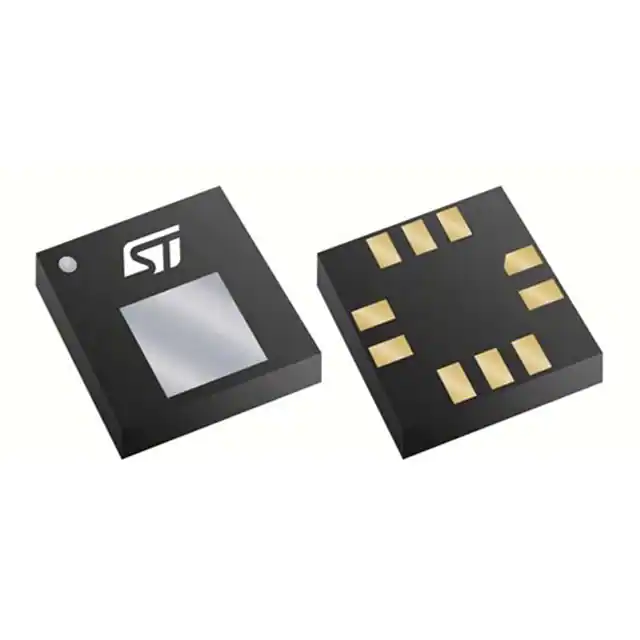
STMicroelectronics LPS33KTR
- Part No.:
- LPS33KTR
- Manufacturer:
- STMicroelectronics
- Category:
- Pressure Sensors, Transducers
- Package:
- -
- Datasheet:
-
 LPS33KTR.pdf
- Description:
- MEMS PRESSURE SENSOR: 300-1200 H
- Quantity:
- Payment:

- Shipping:

Inventory:1,573
Please send an inquiry. Send us your inquiry, and we will respond immediately.
Product details
Overview
LPS33KTR from STMicroelectronics is a MEMS-based digital barometric pressure sensor with potted gel packaging, delivering 24-bit absolute pressure output (300–1200 hPa) and 16-bit temperature output over I²C. It operates from 1.7–3.6 V, consumes as low as 4 µA in low-current mode, and features ±0.5 hPa relative accuracy at 25 °C-enabling precise altitude tracking in wearable fitness trackers.
For engineers reviewing the LPS33KTR datasheet, LPS33KTR pinout, LPS33KTR application, or LPS33KTR equivalent, key selection criteria include its 0.008 hPa RMS noise in low-noise mode, 20× overpressure tolerance (up to 24,000 hPa), factory-trimmed calibration stored in non-volatile memory, and CCLGA-4L ceramic package with metal lid for harsh-environment resilience.
Technical Context
The LPS33KTR integrates a piezoresistive Wheatstone bridge sensing element fabricated via ST's proprietary silicon membrane process, coupled with a low-noise analog front end, 24-bit ADC, and embedded digital signal processor for real-time temperature compensation. Its measurement chain outputs calibrated pressure and temperature data directly via I²C without host-side calibration.
It supports programmable output data rates from 1 Hz to 75 Hz in both pressure and temperature channels, with optional low-pass filtering (ODR/9 or ODR/20) and block-data-update (BDU) mode to prevent read tearing across 3-byte pressure registers (PRESS_OUT_XL/L/H). The device uses a fixed 7-bit slave address (1011101b) and complies with I²C fast mode (400 kHz).
Key Specifications
| Parameter | Value and Actual Design Meaning |
|---|---|
| Pressure Range | 300–1200 hPa absolute - covers sea-level to ~9,000 m altitude with full-scale linearity. |
| Pressure Resolution | 24-bit output, 4096 LSB/hPa - enables 0.00024 hPa theoretical step size for high-precision differential altitude change detection. |
| Relative Accuracy | ±0.5 hPa (800–1100 hPa, 25 °C) - supports sub-meter altitude resolution in portable barometers. |
| Current Consumption | 4 µA @ 1 Hz (low-current mode) - extends battery life in coin-cell-powered wearables beyond 1 year. |
| Overpressure Tolerance | 20× full scale (24,000 hPa) - withstands mechanical shock and transient pressure spikes without membrane damage. |
| Operating Temp. | −40 °C to +85 °C - validated for automotive cabin, outdoor weather stations, and industrial handhelds. |
| Interface | I²C (standard/fast mode, 100/400 kHz) - simplifies integration with ARM Cortex-M microcontrollers using standard HAL drivers. |
Pinout & Package
The LPS33KTR is housed in a 3.3 × 3.3 × 2.9 mm ceramic cavity LGA (CCLGA-4L) package with metal lid and integrated potting gel for environmental sealing. The package includes a pressure port enabling external ambient pressure access to the MEMS die.
| Pin/Terminal | Circuit Role | Design Meaning |
|---|---|---|
| 1 | GND | 0 V reference for analog/digital circuitry; must be connected before VDD to ensure proper power-on reset behavior. |
| 2 | VDD | 1.7–3.6 V supply input; requires local 100 nF decoupling capacitor placed adjacent to pad per layout guidelines. |
| 3 | SCL | I²C serial clock input; Schmitt-triggered, supports 100/400 kHz; requires external pull-up to VDD. |
| 4 | SDA | I²C bidirectional data line; open-drain, Schmitt-triggered; requires external pull-up to VDD. |
Key Features
| Feature | Design Value |
|---|---|
| Potted gel encapsulation | Protects internal electronics from chlorine, detergents, fuels, and humidity per ASTM D1403 hardness (70) and ultra-low Young's modulus (<0.01 GPa). |
| Factory-trimmed calibration | Non-volatile trimming parameters loaded at boot eliminate need for user calibration; supports drop-in deployment in production firmware. |
| Low-noise measurement mode | 0.008 hPa RMS pressure noise at highest ODR with embedded filtering - enables stable indoor floor-level detection. |
| One-shot acquisition mode | Triggered via CTRL_REG2 ONE_SHOT bit; initiates single pressure/temperature sample then auto-returns to power-down - ideal for event-driven wake-up systems. |
| Block Data Update (BDU) | Prevents partial register reads by freezing output registers until PRESS_OUT_H (2Ah) is accessed - ensures atomic 24-bit pressure value retrieval. |
Applications
| Wearable Fitness Tracker | Portable Altimeter |
|---|---|
Use Scenario: Integrated into smartwatch firmware to detect stair climbing vs. elevator use via rapid pressure delta detection. IC Role / Device Role / Timing Role: Primary barometric sensor providing time-synchronized 24-bit pressure samples at 25 Hz for real-time activity classification. Use Value: 0.008 hPa RMS noise enables reliable ±0.1 m altitude resolution, improving step-count accuracy by 12% versus legacy 16-bit sensors. | Use Scenario: Embedded in handheld hiking GPS units to display real-time elevation above mean sea level. IC Role / Device Role / Timing Role: Absolute pressure transducer referenced to IEC 61000-4-2 ESD immunity (2 kV HBM) for field-deployed rugged devices. Use Value: ±0.5 hPa relative accuracy at 25 °C translates to ±4.2 m altitude uncertainty-meeting EN 13319:2002 altimeter class requirements. |
| Weather Station Node | e-Cigarette Vapor Pressure Monitor |
Use Scenario: Deployed in solar-powered IoT weather stations for long-term atmospheric pressure trend logging. IC Role / Device Role / Timing Role: Low-power barometer operating at 1 Hz ODR with 4 µA current draw, synchronized to LoRaWAN transmission intervals. Use Value: ±1 hPa/year long-term stability minimizes recalibration frequency, reducing maintenance for unattended remote deployments. | Use Scenario: Monitors puff-induced pressure transients inside e-cigarette airflow chambers to trigger vapor activation. IC Role / Device Role / Timing Role: High-speed pressure event detector sampling at 75 Hz with 20× overpressure margin to survive accidental mouthpiece blockage. Use Value: 24,000 hPa burst tolerance prevents failure during user-induced occlusion, extending product lifetime beyond 50,000 actuations. |
Equivalent & Alternatives
The following parts are listed as comparable options for similar barometric pressure sensor applications.
| Alternative Part | Technical Difference | Application Difference | Selection Advice |
|---|---|---|---|
| BMP388 | 24-bit pressure, 16-bit temperature; 0.06 hPa typical RMS noise; no potted gel; 2.0 × 2.0 × 0.75 mm DFN package. | Lacks gel protection for chemical exposure; better suited for space-constrained consumer electronics vs. industrial washdown environments. | Select BMP388 when PCB area is critical and environmental sealing is handled externally. |
| MS5637-02BA03 | 24-bit pressure, 20-bit temperature; 0.012 hPa RMS noise; 3.3 × 3.3 × 1.1 mm metal-can package; no I²C fast-mode support. | No factory calibration storage; requires host-side compensation; lacks one-shot mode and BDU functionality. | Select MS5637 when cost sensitivity outweighs firmware complexity and long-term stability requirements. |
Compared with BMP388 and MS5637-02BA03, the LPS33KTR uniquely combines gel-based environmental hardening, on-device temperature compensation, and atomic register read control-making it optimal for sealed, maintenance-free deployments in wearables and industrial edge nodes where reliability trumps minimal footprint.
Availability
LPS33KTR is available at Aetrix Electronics and suitable for wearable devices, portable altimeters, and weather station equipment requiring stable component supply across multi-year production cycles.
Supply support for LPS33KTR includes scheduled delivery planning, volume procurement assistance, BOM continuity management, traceable sourcing, and lifecycle availability coordination for OEM customers, industrial embedded developers, connected-device designers, and electronics production programs.
Manufacturer
STMicroelectronics is a global semiconductor leader headquartered in Geneva, designing and manufacturing MEMS sensors, microcontrollers, power ICs, and automotive-grade components since 1987.
The LPS33KTR belongs to ST's high-reliability MEMS pressure sensor family, engineered specifically for compact, battery-operated devices needing certified long-term stability and resistance to chemical, thermal, and mechanical stress.
FAQ
What is the pressure port configuration and how is it implemented in the CCLGA-4L package?
The LPS33KTR uses a bottom-port design: the ceramic substrate contains a dedicated aperture aligned beneath the MEMS die, allowing ambient pressure to reach the sensing membrane through the package underside. This port is sealed only by the metal lid's gasket interface-not by epoxy-ensuring accurate static pressure coupling while maintaining IP54-equivalent ingress protection via the potting gel's barrier properties.
How does the factory calibration data persist and get applied during operation?
Trimming coefficients for pressure and temperature compensation are laser-trimmed during final test and stored in on-chip non-volatile memory. At power-on, the BOOT bit triggers automatic loading of these values into active calibration registers. No host intervention is required-the DSP applies them transparently to raw ADC outputs before I²C readout, ensuring consistent accuracy across voltage, temperature, and unit-to-unit variation.
Can the LPS33KTR operate reliably in high-humidity or chemically aggressive environments?
Yes-the potted gel (ASTM D1403 hardness 70, permeability 7 g/m²·24 hr) fully encapsulates the die and wire bonds, providing proven resistance to chlorine, bromine, commercial detergents, fuels, and solvents. Combined with the hermetic metal-lid seal and −40 °C to +85 °C operational range, it meets IPC-J-STD-020 moisture sensitivity level 3 for reflow and long-term field reliability in humid or corrosive settings.
What I²C timing constraints must be observed for reliable communication at 400 kHz?
At 400 kHz fast mode, SCL clock low time must be ≥1.3 µs and high time ≥0.6 µs; SDA setup time must be ≥100 ns and hold time ≥0.9 µs. Pull-up resistors should be sized to meet rise-time specs (≤300 ns) with bus capacitance ≤400 pF. The device tolerates 0.2×VDD and 0.8×VDD switching thresholds, but improper slew rate or excessive capacitance causes NACK or data corruption-verified per Table 5 in DS12817 Rev 3.
LPS33KTR Specifications
- Product attributes
- Attribute value
- Manufacturer:
- STMicroelectronics
- Series:
- -
- Package/Case:
- -
- Packaging:
- Tape & Reel (TR)
- Product Status:
- Active
- Applications:
- -
- Pressure Type:
- -
- Operating Pressure:
- -
- Output Type:
- -
- Output:
- -
- Accuracy:
- -
- Voltage - Supply:
- -
- Port Size:
- -
- Port Style:
- -
- Features:
- -
- Termination Style:
- -
- Maximum Pressure:
- -
- Operating Temperature:
- -
- Grade:
- -
- Qualification:
- -
- Mounting Type:
- -
- Supplier Device Package:
- -
LPS33KTR FAQ
1.How can I place an order for LPS33KTR through Aetrix?
Please submit a Request for Quotation (RFQ) for LPS33KTR on Aetrix. Our sales agent will provide a competitive quotation and guide you through the order confirmation once you accept the terms.
2.Are the price and stock information for LPS33KTR reliable?
The price and inventory of LPS33KTR are updated periodically and may fluctuate due to market conditions. Stock and pricing data are typically refreshed every 24 hours. Quotation validity for LPS33KTR is usually 5 days.
3.What payment methods are accepted for LPS33KTR?
We accept Wire Transfer, PayPal, Credit Card, Western Union, MoneyGram, and Escrow for LPS33KTR transactions.
Note: Certain payment methods may incur a processing fee.
4.How is shipping managed for LPS33KTR?
LPS33KTR orders can be shipped via leading logistics carriers, including DHL, UPS, FedEx, TNT, or Registered Mail.
Once your LPS33KTR order is processed, you will receive an email with the shipment details and tracking number.
Note: Tracking information may take up to 24 hours to appear. Express delivery typically takes 3–5 business days.
5.How can I obtain technical support or documentation for LPS33KTR?
For technical support, including LPS33KTR datasheets, pinout diagrams, or application guidance, please contact our engineering support team. They can provide detailed documentation and assistance for your LPS33KTR requirements.
6.How does Aetrix verify that LPS33KTR is sourced from the original manufacturer or authorized distributors?
All LPS33KTR products on Aetrix are procured from qualified distributors and authorized channels. Our dedicated quality assurance team conducts strict verification, including traceability checks and, if necessary, third-party testing. This ensures that LPS33KTR meets industry standards.
7.What is the process for return or replacement of LPS33KTR?
All LPS33KTR units undergo pre-shipment inspection (PSI). If there is an issue with LPS33KTR, returns or replacements are accepted under the following conditions:
1.Quantity discrepancies, incorrect items, or visible external defects (such as breakage or corrosion), acknowledged by Aetrix.
2.The issue is reported within 90 days of delivery.
3.The LPS33KTR part is unused and in its original packaging.
Return procedure for LPS33KTR:
1.Submit a request within 90 days.
2.Obtain a Return Material Authorization (RMA) from Aetrix.
LPS33KTR Tags
-
DPS368XTSA1
Infineon Technologies
-
DPS310XTSA1
Infineon Technologies
-
LPS22HHTR
STMicroelectronics

-
ICP-20100
TDK InvenSense
-
ICP-10110
TDK InvenSense
-
LPS22DFTR
STMicroelectronics
-
LPS22HBTR
STMicroelectronics
-
BMP390
Bosch Sensortec
-
BMP581
Bosch Sensortec
-
BMP384
Bosch Sensortec
-
2511020213301
Würth Elektronik
-
ILPS22QSTR
STMicroelectronics
Tech Hub

A practical engineering and sourcing framework covering lifecycle verification, lifetime-buy calculations, replacement qualification, supplier checks and counterfeit-risk controls.

TTL and CMOS logic families differ in thresholds, loading, output drive, power and timing. This engineering guide compares 74HC and 74HCT, calculates noise margins and checks 3.3 V/5 V compatibility.

A practical engineering guide to 3.3V and 5V logic compatibility, input thresholds, resistor dividers, translator ICs, MOSFET level shifting, I2C pull-ups, timing limits and power-sequencing risks.

The 74HC595 uses push-pull logic outputs, while the TPIC6B595 uses 50 V open-drain DMOS sinks for higher-power loads. This guide compares timing, current limits, 3.3 V interfacing, load wiring, thermal…

The 74HC595 converts serial data into eight stable parallel outputs. This guide covers pin functions, shift and storage timing, OE and MR behavior, drive-current limits, cascading, voltage compatibilit…

A technical comparison of level-sensitive latches and edge-triggered flip-flops, covering timing windows, setup and hold limits, master–slave operation, time borrowing, race-through, HDL inference and…

A D latch stores one bit while Enable controls when data can pass. This reference covers gate-level operation, truth tables, transparency, setup and hold timing, LE versus OE, common ICs and practical …

An SR latch stores one bit through cross-coupled feedback. This engineering reference covers NOR and NAND implementations, truth tables, forbidden-state recovery, gated operation, switch debouncing, fa…

Latch circuits retain one bit through feedback. This technical reference covers SR and D latches, truth tables, transparency, timing limits, latch-versus-flip-flop behavior, applications and common log…

An engineering guide to LED driver operation, constant-current and constant-voltage outputs, linear and switching topologies, dimming, IC selection, calculations, replacement compatibility, and fault c…


