
 My Inquiry
 My Account


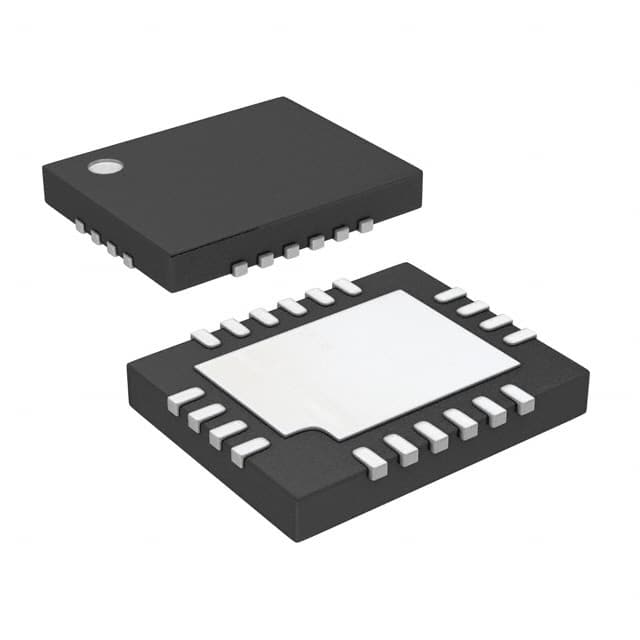
Analog Devices Inc. LTC4125IUFD#PBF
- Part No.:
- LTC4125IUFD#PBF
- Manufacturer:
- Analog Devices Inc.
- Category:
- Power Management - Specialized
- Package:
- 20-WFQFN Exposed Pad
- Datasheet:
-
 LTC4125IUFD#PBF.pdf
- Description:
- 5W AUTORESONANT WIRELESS POWER T
- Quantity:
- Payment:

- Shipping:

Inventory:233
Please send an inquiry. Send us your inquiry, and we will respond immediately.
Product details
Overview
LTC4125IUFD#PBF from Analog Devices (formerly Linear Technology) is a monolithic 5W AutoResonant wireless power transmitter IC that drives a full-bridge LC tank to deliver regulated power across an air gap. It features integrated 100mΩ MOSFETs, programmable input current limiting (0.785–0.815V threshold), NTC-based temperature monitoring, and multi-method foreign object detection. It operates in industrial temperature range (–40°C to 125°C) for medical equipment and industrial handhelds.
For engineers reviewing the LTC4125IUFD#PBF datasheet, LTC4125IUFD#PBF pinout, LTC4125IUFD#PBF application, or LTC4125IUFD#PBF equivalent, key selection considerations include resonant frequency tuning (50–250 kHz), pulse-width-modulated transmit power control, FB-pin-based load detection, thermal fault response via PTHM/NTC, and compatibility with 3V–5.5V input supplies.
Technical Context
The LTC4125IUFD#PBF implements AutoResonant switching by dynamically locking its drive frequency to the series LC tank's natural resonance-detected via feedback on the FB pin-enabling stable operation despite coil inductance drift or coupling variation. Its internal full-bridge driver uses four MOSFETs (RA–RD ≤ 150 mΩ) controlled by dual pulse-width thresholds (PTH1/PTH2) and minimum pulse width set by PTHM.
Transmit power optimization occurs via periodic linear ramping of driver pulse width, monitored using FB voltage and IMON current sense output. Fault handling integrates five independent detection paths: frequency threshold (FTH), thermistor (NTC), die temperature, FB over-range, and input current limit (ILIM = 1.175–1.225 V at IMON), each triggering immediate power halt and STAT pin release.
Key Specifications
| Parameter | Value and Actual Design Meaning |
|---|---|
| Input Voltage Range | 3V to 5.5V - supports single-cell Li-ion or USB-powered systems without external regulators. |
| Output Power Capability | Over 5W - enables high-efficiency wireless charging for mid-power medical and industrial receivers. |
| Switching Frequency Range | 50kHz to 250kHz - covers standard WPC/A4WP-compatible bands and avoids AM radio interference. |
| Integrated Switch RDS(on) | 150mΩ per MOSFET - minimizes conduction loss in full-bridge configuration with <1.5W dissipation at 5W output. |
| AutoResonant Detection | CTS/CTD capacitor-programmed - sets search settling time (1–20ms) and inter-search delay (>1s) for adaptive resonance tracking. |
| Input Current Limit Threshold | 1.175–1.225V at IMON - allows precise setting of absolute current limit (e.g., 1A with RIN/RIMON/RIS network). |
| Operating Temperature Range | –40°C to 125°C - qualified for industrial and medical environments requiring extended thermal reliability. |
Pinout & Package
Package: 20-lead (4mm × 5mm) plastic QFN, 0.75mm profile, exposed pad (Pin 21) required to be connected to GND for thermal and electrical performance.
| Pin/Terminal | Circuit Role | Design Meaning |
|---|---|---|
| IN, IN1, IN2 (Pins 1, 20, 17) | Independent supply inputs | Separate 3V–5.5V rails for logic, half-bridge A, and half-bridge B-reduces noise coupling and improves thermal distribution. |
| SW1, SW2 (Pins 19, 18) | Full-bridge center taps | Direct connection points for series LC tank; support full-bridge (SW1–SW2) or half-bridge (SW1–GND) configurations. |
| FB (Pin 13) | Resonance feedback input | Monitors rectified peak tank voltage to detect receiver load presence and determine optimum transmit power point. |
| IMON (Pin 5) | Current monitor output | Sources proportional current for external RC averaging; 0.80V threshold triggers search pause, 1.20V triggers immediate shutdown. |
| NTC (Pin 6) | Thermistor interface | Detects coil or system temperature via resistor divider; stops power if voltage falls below 33–37% of VIN (hot condition). |
| FTH (Pin 9) | Frequency threshold input | Programs max allowable resonant frequency; detects conductive foreign objects via inductance drop-induced frequency rise. |
| STAT (Pin 8) | Open-drain status indicator | Pulls low during valid power delivery; high-impedance during fault/no-receiver conditions-drives LED or MCU GPIO directly. |
Key Features
| Feature | Design Value |
|---|---|
| AutoResonant frequency lock | Maintains exact LC resonance in real time-even with temperature drift or variable coupling-eliminating manual tuning and improving efficiency across operating conditions. |
| Optimum Power Search algorithm | Performs periodic linear pulse-width sweeps to find minimal sufficient transmit power, reducing EMI, heat, and energy waste while meeting dynamic receiver load demands. |
| Dual-path foreign object detection | Combines FTH-based frequency shift detection and NTC-based thermal monitoring to reliably identify metallic intrusion or overheating before hazardous heating occurs. |
| Programmable input current limit | Configurable via IMON threshold (0.785–0.815V search / 1.175–1.225V limit) and external resistors-enables compliance with source-side safety standards and battery protection. |
| Thermally enhanced QFN package | 4mm × 5mm footprint with exposed pad delivers θJA = 43°C/W-supports continuous 5W operation without forced airflow in compact industrial PCB layouts. |
Applications
| Medical Wearables | Industrial Handhelds |
|---|---|
Use Scenario: Wireless charging of sealed, waterproof insulin pumps or ECG monitors where connectors are prohibited. IC Role / Device Role / Timing Role: Primary-side power controller managing resonant energy transfer across 3–8 mm air gaps with automatic load matching and foreign metal rejection. Use Value: Enables IP68-rated enclosures with no exposed contacts, eliminates connector wear/failure, and ensures safe operation near human tissue via NTC and FTH fault detection. | Use Scenario: Battery-powered rugged tablets used in factory floor environments with frequent cleaning and exposure to conductive dust. IC Role / Device Role / Timing Role: Full-bridge wireless transmitter regulating 5W delivery to embedded receiver while rejecting metal debris on charging surface. Use Value: Prevents localized heating from stray conductive particles, maintains consistent charge rate across varying coil alignment, and sustains operation at –40°C ambient. |
| Military Sensors | Smart Home Hubs |
Use Scenario: Recharging remote battlefield sensors deployed in harsh, unattended locations with no access to wired infrastructure. IC Role / Device Role / Timing Role: Autonomous wireless power transmitter initiating periodic power searches and resuming delivery only upon verified receiver presence and thermal safety. Use Value: Extends field deployment life by eliminating battery replacement logistics, ensures zero-power standby between searches, and prevents thermal runaway in enclosed housings. | Use Scenario: Integrated wireless charging pad inside smart speaker base, powering auxiliary modules like Zigbee radios or environmental sensors. IC Role / Device Role / Timing Role: Compact 5W transmitter co-located with audio electronics, using CTS/CTD timing to minimize EMI overlap with sensitive analog signal paths. Use Value: Reduces bill-of-materials by consolidating power delivery, avoids audible coil whine via AutoResonant frequency lock, and enables seamless "drop-and-charge" UX without alignment constraints. |
Equivalent & Alternatives
The following parts are listed as comparable options for similar wireless power transmitter applications.
| Alternative Part | Technical Difference | Application Difference | Selection Advice |
|---|---|---|---|
| BQ500212AIPWR | Fixed 115kHz switching; no AutoResonant tuning; requires external gate drivers; lower integration (no IMON/NTC/FTH). | Designed for WPC-compliant 5W receivers only; lacks multi-method foreign object detection and temperature qualification. | Choose when strict WPC compliance is mandatory and LC component tolerances are tightly controlled. |
| MP-A21 | Standalone Qi transmitter controller; supports up to 15W; includes digital communication (ASK); larger QFN (5mm × 5mm). | Requires separate MCU for firmware updates and host-level fault reporting; targets consumer electronics, not industrial/medical. | Choose for higher-power or bidirectional communication needs, but expect added design complexity and cost. |
Compared with BQ500212AIPWR and MP-A21, the LTC4125IUFD#PBF provides autonomous resonance adaptation, integrated fault sensing without external components, and industrial-grade temperature qualification-making it optimal for sealed, safety-critical, or thermally variable deployments where reliability outweighs protocol flexibility.
Availability
LTC4125IUFD#PBF is available at Aetrix Electronics and suitable for medical equipment, industrial handhelds, military sensors, and smart home hubs requiring stable component supply, long-term lifecycle assurance, and guaranteed –40°C to 125°C operation.
Supply support for LTC4125IUFD#PBF includes scheduled delivery planning, volume procurement assistance, BOM continuity management, traceable sourcing, and lifecycle availability coordination for OEM customers, industrial embedded developers, connected-device designers, and electronics production programs.
Manufacturer
Analog Devices acquired Linear Technology in 2017 and maintains its high-performance analog and power management portfolio with rigorous automotive and industrial qualification standards.
The LTC4125IUFD#PBF belongs to Linear's wireless power IC family, designed specifically for robust, self-tuning, safety-certifiable transmitters in environments where reliability, thermal resilience, and foreign object immunity are non-negotiable.
FAQ
What is the primary function of the LTC4125IUFD#PBF in a wireless power system?
The LTC4125IUFD#PBF serves as a fully integrated 5W wireless power transmitter controller. It drives a full-bridge LC tank using AutoResonant switching to match the tank's natural frequency, performs periodic Optimum Power Search to minimize delivered power while meeting receiver load, and enforces safety via NTC, FTH, FB, and IMON fault detection. The LTC4125IUFD#PBF requires no external microcontroller or complex firmware to operate autonomously.
How does the LTC4125IUFD#PBF detect and respond to foreign objects?
The LTC4125IUFD#PBF employs two independent foreign object detection methods: (1) FTH pin monitoring detects abnormal resonant frequency rise caused by conductive objects lowering tank inductance, and (2) NTC pin monitoring identifies unsafe temperature rise via thermistor voltage drop. When either condition exceeds its threshold, the LTC4125IUFD#PBF immediately halts power delivery and releases the STAT pin to high-impedance state-ensuring rapid, hardware-level safety response without software intervention.
Can the LTC4125IUFD#PBF operate with different LC tank configurations?
Yes-the LTC4125IUFD#PBF supports both full-bridge (SW1–SW2) and half-bridge (SW1–GND) topologies. Its AutoResonant engine automatically locks to the resonant frequency of any series LC network connected to SW1/SW2, accommodating inductance values from ~10 µH to >100 µH and capacitance from ~10 nF to >100 nF. The CTS and CTD pins allow adjustment of search timing to match tank Q-factor and coupling characteristics-making the LTC4125IUFD#PBF adaptable across diverse mechanical implementations.
What is the role of the IMON pin on the LTC4125IUFD#PBF?
The IMON pin on the LTC4125IUFD#PBF outputs a current proportional to input supply current, converted to a voltage using an external RIMON resistor. During Optimum Power Search, the LTC4125IUFD#PBF compares this voltage to two thresholds: 0.80V (VITH) pauses the search, and 1.20V (VILIM) triggers immediate power shutdown. This enables precise, resistor-programmable input current limiting-critical for battery protection and regulatory compliance-without requiring external op-amps or ADCs.
Does the LTC4125IUFD#PBF require external components to achieve full functionality?
Yes-the LTC4125IUFD#PBF requires external passive components for core operation: a series LC tank (LTX/CTX) between SW1 and SW2, bypass capacitors on IN/IN1/IN2, timing capacitors on CTS and CTD, current-sense resistors (RIS, RIN, RIMON), and resistor dividers for FTH, NTC, DTH, and PTHM. However, all control logic, drivers, comparators, and protection circuitry are integrated-eliminating the need for external microcontrollers, gate drivers, or discrete protection ICs required by competing solutions.
LTC4125IUFD#PBF Specifications
- Product attributes
- Attribute value
- Manufacturer:
- Analog Devices Inc.
- Series:
- -
- Package/Case:
- 20-WFQFN Exposed Pad
- Packaging:
- Tube
- Product Status:
- Active
- Applications:
- Wireless Power Transmitter
- Current - Supply:
- 1mA
- Voltage - Supply:
- 3V ~ 5.5V
- Operating Temperature:
- -40°C ~ 125°C
- Grade:
- -
- Qualification:
- -
- Mounting Type:
- Surface Mount
- Supplier Device Package:
- 20-QFN (4x5)
LTC4125IUFD#PBF FAQ
1.How can I place an order for LTC4125IUFD#PBF through Aetrix?
Please submit a Request for Quotation (RFQ) for LTC4125IUFD#PBF on Aetrix. Our sales agent will provide a competitive quotation and guide you through the order confirmation once you accept the terms.
2.Are the price and stock information for LTC4125IUFD#PBF reliable?
The price and inventory of LTC4125IUFD#PBF are updated periodically and may fluctuate due to market conditions. Stock and pricing data are typically refreshed every 24 hours. Quotation validity for LTC4125IUFD#PBF is usually 5 days.
3.What payment methods are accepted for LTC4125IUFD#PBF?
We accept Wire Transfer, PayPal, Credit Card, Western Union, MoneyGram, and Escrow for LTC4125IUFD#PBF transactions.
Note: Certain payment methods may incur a processing fee.
4.How is shipping managed for LTC4125IUFD#PBF?
LTC4125IUFD#PBF orders can be shipped via leading logistics carriers, including DHL, UPS, FedEx, TNT, or Registered Mail.
Once your LTC4125IUFD#PBF order is processed, you will receive an email with the shipment details and tracking number.
Note: Tracking information may take up to 24 hours to appear. Express delivery typically takes 3–5 business days.
5.How can I obtain technical support or documentation for LTC4125IUFD#PBF?
For technical support, including LTC4125IUFD#PBF datasheets, pinout diagrams, or application guidance, please contact our engineering support team. They can provide detailed documentation and assistance for your LTC4125IUFD#PBF requirements.
6.How does Aetrix verify that LTC4125IUFD#PBF is sourced from the original manufacturer or authorized distributors?
All LTC4125IUFD#PBF products on Aetrix are procured from qualified distributors and authorized channels. Our dedicated quality assurance team conducts strict verification, including traceability checks and, if necessary, third-party testing. This ensures that LTC4125IUFD#PBF meets industry standards.
7.What is the process for return or replacement of LTC4125IUFD#PBF?
All LTC4125IUFD#PBF units undergo pre-shipment inspection (PSI). If there is an issue with LTC4125IUFD#PBF, returns or replacements are accepted under the following conditions:
1.Quantity discrepancies, incorrect items, or visible external defects (such as breakage or corrosion), acknowledged by Aetrix.
2.The issue is reported within 90 days of delivery.
3.The LTC4125IUFD#PBF part is unused and in its original packaging.
Return procedure for LTC4125IUFD#PBF:
1.Submit a request within 90 days.
2.Obtain a Return Material Authorization (RMA) from Aetrix.
LTC4125IUFD#PBF Tags
-
TPS2511DGNR
Texas Instruments
-
UTC2000/MG
Microchip Technology
-
TUSB320HAIRWBR
Texas Instruments
-
TPS61252DSGR
Texas Instruments
-
PI5USB30216CXUAEX
Diodes Incorporated
-
SN6501DBVR
Texas Instruments
-
CYPD3177-24LQXQT
Infineon Technologies
-
SN6501QDBVRQ1
Texas Instruments
-
STUSB1600AQTR
STMicroelectronics

-
SN6505BDBVR
Texas Instruments
-
SN6501DBVT
Texas Instruments
-
TPS65150PWPR
Texas Instruments
Tech Hub

A practical engineering guide to 3.3V and 5V logic compatibility, input thresholds, resistor dividers, translator ICs, MOSFET level shifting, I2C pull-ups, timing limits and power-sequencing risks.

The 74HC595 uses push-pull logic outputs, while the TPIC6B595 uses 50 V open-drain DMOS sinks for higher-power loads. This guide compares timing, current limits, 3.3 V interfacing, load wiring, thermal…

The 74HC595 converts serial data into eight stable parallel outputs. This guide covers pin functions, shift and storage timing, OE and MR behavior, drive-current limits, cascading, voltage compatibilit…

A technical comparison of level-sensitive latches and edge-triggered flip-flops, covering timing windows, setup and hold limits, master–slave operation, time borrowing, race-through, HDL inference and…

A D latch stores one bit while Enable controls when data can pass. This reference covers gate-level operation, truth tables, transparency, setup and hold timing, LE versus OE, common ICs and practical …

An SR latch stores one bit through cross-coupled feedback. This engineering reference covers NOR and NAND implementations, truth tables, forbidden-state recovery, gated operation, switch debouncing, fa…

Latch circuits retain one bit through feedback. This technical reference covers SR and D latches, truth tables, transparency, timing limits, latch-versus-flip-flop behavior, applications and common log…

An engineering guide to LED driver operation, constant-current and constant-voltage outputs, linear and switching topologies, dimming, IC selection, calculations, replacement compatibility, and fault c…

Operational amplifier guide covering op amp basics, feedback, ideal vs real op amps, common configurations, buffer circuits, offset, bias current, gain-bandwidth, slew rate, rail-to-rail limits and sel…

Jumper cables guide covering safe connection order, red and black clamp placement, final ground connection, cable gauge, length, clamp quality, copper vs CCA cables, jump starter comparison and battery…


