
 My Inquiry
 My Account


Analog Devices Inc./Maxim Integrated MAX86141ENP+T
- Part No.:
- MAX86141ENP+T
- Manufacturer:
- Analog Devices Inc./Maxim Integrated
- Category:
- Specialized Sensors
- Package:
- Datasheet:
-
 MAX86141ENP+T.pdf
- Description:
- SENSOR - OXIMETER/HEART RATE SPI
- Quantity:
- Payment:

- Shipping:

Inventory:5,076
Please send an inquiry. Send us your inquiry, and we will respond immediately.
Product details
Overview
MAX86141ENP+T from Analog Devices is a dual-channel, ultra-low-power optical data acquisition IC for wearable health monitoring. It integrates three 8-bit LED current DACs (up to 124mA full-scale), two simultaneous 19-bit current-mode ADCs, analog/digital ambient light cancellation, and a 128-word FIFO - all in a 2.048 × 1.848 mm WLP. It enables high-accuracy SpO₂ and heart rate measurement in wrist-worn devices under strong ambient light.
For engineers reviewing the MAX86141ENP+T datasheet, MAX86141ENP+T pinout, MAX86141ENP+T application, or MAX86141ENP+T equivalent, key selection criteria include dual-channel PPG readout capability, >70dB 120Hz AC ambient rejection, 14.8–117.3μs programmable integration time, and autonomous SPI-controlled operation with <11μA optical channel current at 25sps.
Technical Context
The MAX86141ENP+T implements a continuous-time sigma-delta 19-bit current-mode ADC per channel with programmable full-scale ranges (4–32μA) and four integration times (14.8/29.4/58.7/117.3μs). Its ambient light cancellation combines analog front-end subtraction and digital post-processing to achieve >100μA DC ambient tolerance and >70dB rejection at 120Hz.
It features three independent low-dropout LED drivers with 8-bit resolution and four full-scale current ranges (31/62/93/124mA), supporting single- or multi-pulse sequences via register-programmable LED sequence control (LEDC1–LEDC6). The device operates autonomously using internal 32kHz and 10MHz oscillators, with SPI interface and interrupt-driven FIFO management.
Key Specifications
| Parameter | Value and Actual Design Meaning |
|---|---|
| Optical Channels | Dual simultaneous PPG readout paths - enables concurrent red/IR or multi-site sensing without time multiplexing overhead. |
| ADC Resolution | 19-bit current-mode sigma-delta - delivers >89dB dynamic range (white card loop-back) and >110dB for HRM with on-chip averaging. |
| LED Driver Accuracy | 8-bit DAC with ±1 LSB DNL - ensures precise, repeatable LED current control critical for ratiometric SpO₂ calculation. |
| Ambient Rejection | >70dB at 120Hz AC + >100μA DC ambient photodiode current - allows reliable operation under indoor lighting and sunlight exposure. |
| Power Efficiency | <11μA optical readout current at 25sps (LP_MODE=1) - extends battery life in coin-cell-powered wearables beyond 7 days. |
| Integration Time | Programmable 14.8 / 29.4 / 58.7 / 117.3 μs - balances motion artifact suppression, SNR, and power for HR vs. SpO₂ optimization. |
| FIFO Depth | 128-word, 3-byte entries with 5-bit tag - buffers timestamped, channel-tagged PPG samples to decouple sensor acquisition from host MCU polling latency. |
Pinout & Package
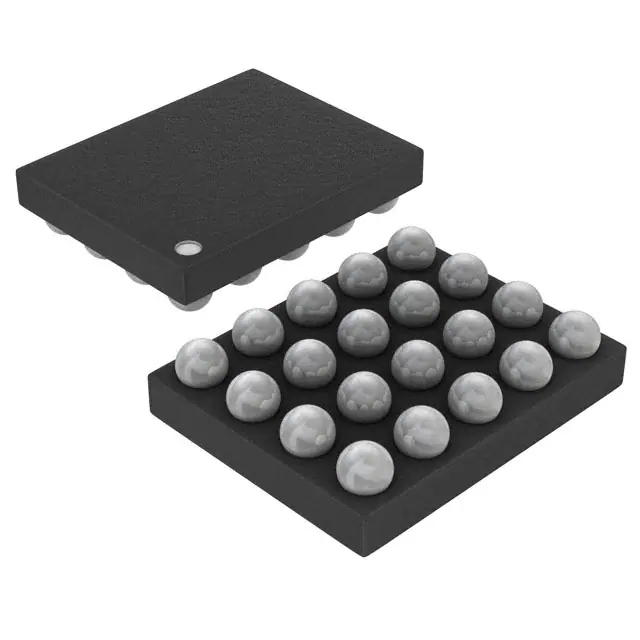
MAX86141ENP+T uses a 20-ball wafer-level package (WLP), 2.048 × 1.848 mm, 0.4 mm ball pitch, compatible with standard reflow assembly. Bump-side-down top view with A1–D5 grid layout.
| Pin/Terminal | Circuit Role | Design Meaning |
|---|---|---|
| VDD_ANA (C2) | Analog supply input | 1.7–2.0V regulated source; requires local 0.1μF + 10μF bypass to GND_ANA for ADC noise immunity. |
| VDD_DIG (C3) | Digital logic supply | 1.7–2.0V supply for SPI interface and control logic; separate from analog rail to prevent digital switching noise coupling. |
| VLED (A1) | LED driver power input | 3.1–5.5V external supply; powers all three LED drivers with low dropout compliance down to 160mV at 31mA. |
| PD1_IN (D5), PD2_IN (D4) | Photodiode cathode inputs | Dual differential-capable inputs accepting up to 65pF photodiode capacitance; each paired with dedicated AFE path. |
| LED1_DRV (D1), LED2_DRV (C1), LED3_DRV (B1) | LED current sink outputs | Three independent 8-bit current DACs; drive LED cathodes directly - anodes connect to VLED. |
| SCLK/SDI/SDO/CSB (A2–A5) | SPI interface signals | 4-wire SPI up to 4MHz; supports burst reads of 3-byte FIFO entries with automatic RD_PTR advancement. |
| INT (B2) | Programmable interrupt output | Open-drain active-low signal indicating FIFO non-empty, FIFO overflow, or conversion completion. |
| GPIO1/GPIO2 (B3/B4) | Configurable I/O pins | GPIO1 supports external sync pulse (≥5μs); GPIO2 accepts 32.768kHz clock input for sample timing reference. |
Key Features
| Feature | Design Value |
|---|---|
| Dual-channel simultaneous acquisition | Enables concurrent red/IR PPG capture for real-time SpO₂ computation without inter-channel timing skew or multiplexing delay. |
| Picket fence detect & replace | Hardware-accelerated motion artifact correction that identifies and substitutes corrupted samples using predictive interpolation. |
| Two-stage ambient cancellation | Analog subtraction + digital filtering achieves >70dB 120Hz rejection and handles >100μA DC ambient - eliminates need for mechanical shielding. |
| Autonomous low-power operation | Internal oscillators and register-configurable LP_MODE reduce optical channel current to <11μA at 25sps - no host intervention required between samples. |
| Flexible LED sequencing | 6-register LED sequence engine (LEDC1–LEDC6) supports up to 7 LED combinations per cycle - enables multi-wavelength or multi-site protocols. |
Applications
| Wrist-Worn Pulse Oximetry | Finger-Clip SpO₂ Monitor |
|---|---|
Use Scenario: Continuous blood oxygen saturation (SpO₂) and perfusion index tracking during sleep or ambulatory care. IC Role / Device Role / Timing Role: Dual-channel optical AFE acquires synchronized red (660nm) and IR (850nm) PPG waveforms; internal 19-bit ADCs resolve subtle AC/DC ratios for ratiometric SpO₂ calculation. Use Value: >110dB dynamic range and >70dB ambient rejection enable clinical-grade accuracy even under bedside lamp illumination. | Use Scenario: Clinical or home-use fingertip SpO₂ measurement with rapid (<1s) convergence and motion robustness. IC Role / Device Role / Timing Role: Single-shot dual-wavelength acquisition with 117.3μs integration time; picket fence detection replaces motion-corrupted samples in real time. Use Value: Sub-1% SpO₂ error across 70–100% saturation range due to low dark current noise (<56pA RMS) and on-chip averaging. |
| Earbud-Based Heart Rate Monitoring | Muscle Oxygen Saturation (SmO₂) |
Use Scenario: Real-time heart rate and HRV analysis in compact wireless earbuds with minimal PCB area. IC Role / Device Role / Timing Role: Ultra-compact WLP (2.05×1.85mm) hosts both optical channels and LED drivers; SPI interface minimizes trace count to host SoC. Use Value: <11μA optical channel current at 25sps extends Bluetooth earbud battery life to >10 days per charge. | Use Scenario: Sports science wearable measuring localized muscle deoxygenation during exercise using near-infrared spectroscopy (NIRS). IC Role / Device Role / Timing Role: Supports up to six LED wavelengths via external 3×2:1 mux controlled by LED sequence registers; dual ADCs capture multi-spectral reflectance simultaneously. Use Value: Programmable 4–32μA ADC full-scale range and 19-bit resolution resolve small NIR absorption changes (<0.1%) for SmO₂ quantification. |
Equivalent & Alternatives
The following parts are listed as comparable options for similar optical sensing applications.
| Alternative Part | Technical Difference | Application Difference | Selection Advice |
|---|---|---|---|
| MAX86140ENP+T | Single-channel PPG AFE; identical LED drivers, FIFO, and ambient rejection architecture but only one photodiode input path. | Suitable for cost-sensitive or space-constrained HR-only designs where dual-wavelength SpO₂ is not required. | Select MAX86140ENP+T when system only needs one optical channel and lower BOM cost is prioritized over SpO₂ capability. |
| AS7341 | 11-channel spectral sensor with 16-bit ADC; no integrated LED drivers - requires external LED control and lacks ambient cancellation circuitry. | Targeted at color/flicker sensing and basic proximity; not validated for medical-grade PPG or SpO₂ algorithms. | Choose AS7341 only for non-medical spectral analysis; MAX86141ENP+T is required for regulatory-compliant wearable oximetry. |
Compared with MAX86140ENP+T, the MAX86141ENP+T adds a second independent optical channel enabling true concurrent dual-wavelength acquisition - essential for motion-robust SpO₂ - while maintaining identical power efficiency, ambient rejection, and WLP footprint. Against AS7341, it provides purpose-built PPG signal chain integration, eliminating external driver design and ambient compensation firmware effort.
Availability
MAX86141ENP+T is available at Aetrix Electronics and suitable for wearable fitness trackers, clinical-grade pulse oximeters, and earbud-based biometric monitors requiring stable component supply, RoHS-compliant packaging, and long-term lifecycle support.
Supply support for MAX86141ENP+T includes scheduled delivery planning, volume procurement assistance, BOM continuity management, traceable sourcing, and lifecycle availability coordination for OEM customers, industrial embedded developers, connected-device designers, and electronics production programs.
Manufacturer
Analog Devices, Inc. is a global leader in high-performance analog, mixed-signal, and digital signal processing semiconductors, serving precision instrumentation, healthcare, and industrial markets.
The MAX86141ENP+T belongs to Analog Devices' wearable health sensor family, engineered specifically for ultra-low-power, high-accuracy optical biosensing in size- and battery-constrained devices - with emphasis on clinical-grade PPG performance in real-world ambient conditions.
FAQ
What is the primary function of the MAX86141ENP+T in a wearable health system?
The MAX86141ENP+T serves as a complete dual-channel optical data acquisition IC for photoplethysmography (PPG). It integrates LED drivers, photodiode signal conditioning, 19-bit ADCs, ambient light cancellation, and FIFO storage - enabling accurate, low-power SpO₂ and heart rate measurement in wristbands, earbuds, or finger clips. Its design eliminates the need for external analog front-end components while delivering clinical-grade performance.
Does the MAX86141ENP+T support simultaneous acquisition on both optical channels?
Yes, the MAX86141ENP+T supports true simultaneous dual-channel acquisition - unlike time-multiplexed alternatives. Each channel has its own dedicated 19-bit current-mode ADC, ambient cancellation path, and FIFO tagging, allowing concurrent red and IR PPG waveform capture without timing skew. This is essential for motion-robust ratiometric SpO₂ calculation and is explicitly confirmed in the device's detailed block diagram and electrical characteristics.
What are the absolute maximum ratings for VLED and VDD_ANA on the MAX86141ENP+T?
The MAX86141ENP+T specifies VLED = 3.1V to 5.5V (absolute max +6.0V), and VDD_ANA = 1.7V to 2.0V (absolute max +2.2V). Exceeding these violates Absolute Maximum Ratings and may cause permanent damage. These values are documented in the "Absolute Maximum Ratings" table on page 4 of the official datasheet, and must be respected in layout and power supply design.
How does the ambient light rejection work in the MAX86141ENP+T?
The MAX86141ENP+T employs a two-stage ambient light rejection system: analog ambient cancellation (ALC) subtracts DC and low-frequency ambient photocurrent before ADC conversion, while digital ambient cancellation filters residual 50/60Hz and transient interference in post-processing. This hybrid approach achieves >70dB rejection at 120Hz and tolerates >100μA DC ambient current - verified in the Electrical Characteristics table and Typical Operating Characteristics plots (toc03, toc04).
Can the MAX86141ENP+T drive more than three LEDs?
Yes - the MAX86141ENP+T's three LED drivers can control up to six LEDs using an external 3×2:1 analog multiplexer, as stated in the General Description. With two MAX86141ENP+T devices in controller-target mode, up to twelve LEDs are supported. This capability is enabled by the LED sequence control registers (0x20–0x22), which support commands like "LED4 (external mux control)" - confirming direct external mux coordination by the MAX86141ENP+T.
MAX86141ENP+T Specifications
- Product attributes
- Attribute value
- Manufacturer:
- Analog Devices Inc./Maxim Integrated
- Series:
- -
- Packaging:
- Tape & Reel (TR)
- Product Status:
- Active
- Sensor Type:
- Oximeter/Heart Rate
- Output Type:
- SPI
- Operating Temperature:
- -40°C ~ 85°C
- Grade:
- -
- Qualification:
- -
MAX86141ENP+T FAQ
1.How can I place an order for MAX86141ENP+T through Aetrix?
Please submit a Request for Quotation (RFQ) for MAX86141ENP+T on Aetrix. Our sales agent will provide a competitive quotation and guide you through the order confirmation once you accept the terms.
2.Are the price and stock information for MAX86141ENP+T reliable?
The price and inventory of MAX86141ENP+T are updated periodically and may fluctuate due to market conditions. Stock and pricing data are typically refreshed every 24 hours. Quotation validity for MAX86141ENP+T is usually 5 days.
3.What payment methods are accepted for MAX86141ENP+T?
We accept Wire Transfer, PayPal, Credit Card, Western Union, MoneyGram, and Escrow for MAX86141ENP+T transactions.
Note: Certain payment methods may incur a processing fee.
4.How is shipping managed for MAX86141ENP+T?
MAX86141ENP+T orders can be shipped via leading logistics carriers, including DHL, UPS, FedEx, TNT, or Registered Mail.
Once your MAX86141ENP+T order is processed, you will receive an email with the shipment details and tracking number.
Note: Tracking information may take up to 24 hours to appear. Express delivery typically takes 3–5 business days.
5.How can I obtain technical support or documentation for MAX86141ENP+T?
For technical support, including MAX86141ENP+T datasheets, pinout diagrams, or application guidance, please contact our engineering support team. They can provide detailed documentation and assistance for your MAX86141ENP+T requirements.
6.How does Aetrix verify that MAX86141ENP+T is sourced from the original manufacturer or authorized distributors?
All MAX86141ENP+T products on Aetrix are procured from qualified distributors and authorized channels. Our dedicated quality assurance team conducts strict verification, including traceability checks and, if necessary, third-party testing. This ensures that MAX86141ENP+T meets industry standards.
7.What is the process for return or replacement of MAX86141ENP+T?
All MAX86141ENP+T units undergo pre-shipment inspection (PSI). If there is an issue with MAX86141ENP+T, returns or replacements are accepted under the following conditions:
1.Quantity discrepancies, incorrect items, or visible external defects (such as breakage or corrosion), acknowledged by Aetrix.
2.The issue is reported within 90 days of delivery.
3.The MAX86141ENP+T part is unused and in its original packaging.
Return procedure for MAX86141ENP+T:
1.Submit a request within 90 days.
2.Obtain a Return Material Authorization (RMA) from Aetrix.
MAX86141ENP+T Tags

-
AS7057-BWLT WLP LF T&R
ams-OSRAM USA INC.
-
LSM6DSO32XTR
STMicroelectronics
-
AS3935-BQFT
ScioSense
-
BAF147B002-00A0
Amphenol Advanced Sensors (Thermometrics)
-
MAX86174AENE+T
Analog Devices Inc./Maxim Integrated
-
VL53L8CXV0GC/1
STMicroelectronics
-
BME680
Bosch Sensortec
-
SEN-12969
SparkFun Electronics
-
BME688
Bosch Sensortec
-
MAXM86161EFD+T
Analog Devices Inc./Maxim Integrated
-
A111-001-T&R
Acconeer AB

-
MAX30101EFD+T
Analog Devices Inc./Maxim Integrated
Tech Hub

A practical engineering guide to 3.3V and 5V logic compatibility, input thresholds, resistor dividers, translator ICs, MOSFET level shifting, I2C pull-ups, timing limits and power-sequencing risks.

The 74HC595 uses push-pull logic outputs, while the TPIC6B595 uses 50 V open-drain DMOS sinks for higher-power loads. This guide compares timing, current limits, 3.3 V interfacing, load wiring, thermal…

The 74HC595 converts serial data into eight stable parallel outputs. This guide covers pin functions, shift and storage timing, OE and MR behavior, drive-current limits, cascading, voltage compatibilit…

A technical comparison of level-sensitive latches and edge-triggered flip-flops, covering timing windows, setup and hold limits, master–slave operation, time borrowing, race-through, HDL inference and…

A D latch stores one bit while Enable controls when data can pass. This reference covers gate-level operation, truth tables, transparency, setup and hold timing, LE versus OE, common ICs and practical …

An SR latch stores one bit through cross-coupled feedback. This engineering reference covers NOR and NAND implementations, truth tables, forbidden-state recovery, gated operation, switch debouncing, fa…

Latch circuits retain one bit through feedback. This technical reference covers SR and D latches, truth tables, transparency, timing limits, latch-versus-flip-flop behavior, applications and common log…

An engineering guide to LED driver operation, constant-current and constant-voltage outputs, linear and switching topologies, dimming, IC selection, calculations, replacement compatibility, and fault c…

Operational amplifier guide covering op amp basics, feedback, ideal vs real op amps, common configurations, buffer circuits, offset, bias current, gain-bandwidth, slew rate, rail-to-rail limits and sel…

Jumper cables guide covering safe connection order, red and black clamp placement, final ground connection, cable gauge, length, clamp quality, copper vs CCA cables, jump starter comparison and battery…


