
 My Inquiry
 My Account


Microchip Technology MEC1703Q-B2-TN
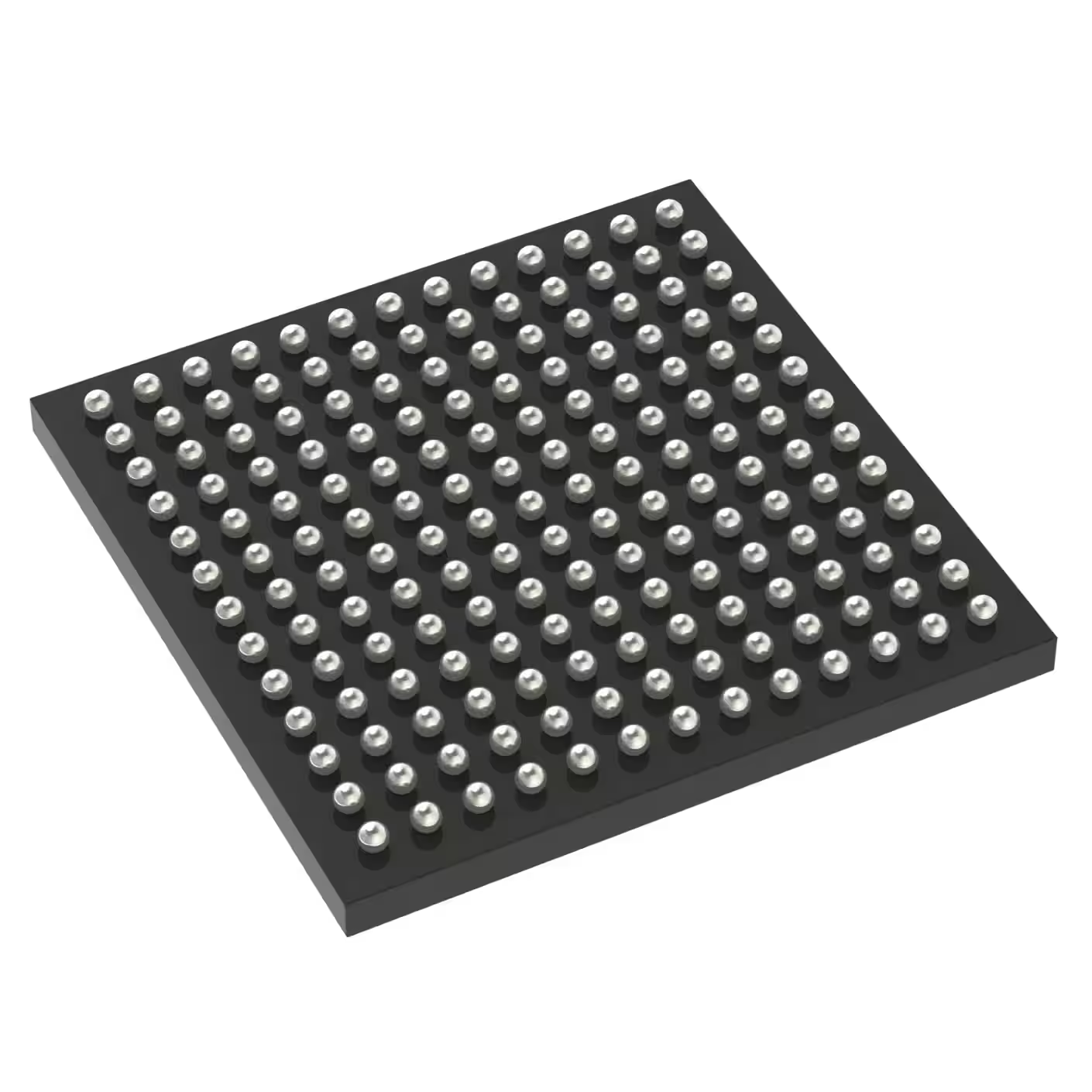
- Part No.:
- MEC1703Q-B2-TN
- Manufacturer:
- Microchip Technology
- Category:
- Application Specific Microcontrollers
- Package:
- 169-WFBGA
- Datasheet:
-
 MEC1703Q-B2-TN.pdf
- Description:
- EMBEDDED CONTROLLER 480 KB TOTAL
- Quantity:
- Payment:

- Shipping:

Inventory:3,718
Please send an inquiry. Send us your inquiry, and we will respond immediately.
Product details
Overview
MEC1703Q-B2-TN from Microchip Technology is an ARM Cortex-M4F-based embedded controller designed for notebook and tablet platform power management, keyboard scanning, and system control. It integrates 256KB–480KB SRAM, 2KB EEPROM, 16-channel 10-bit ADC, 11 PWM outputs, and hardware cryptographic engines (AES-128/192/256, SHA-1/256/384/512, RSA/ECC). It operates with LPC or eSPI host interface and supports VBAT-backed RTC, hibernation timers, and ACPI-compliant power states.
For engineers reviewing the MEC1703Q-B2-TN datasheet, MEC1703Q-B2-TN pinout, MEC1703Q-B2-TN application, or MEC1703Q-B2-TN equivalent, key selection considerations include its dual-host-interface flexibility (LPC/eSPI), battery-backed real-time clock and wake-up resources, integrated cryptographic acceleration, fan control with tachometer feedback, and 148 GPIOs with 1.8V/3.3V I/O support.
Technical Context
The MEC1703Q-B2-TN implements a full ARMv7-M architecture with hardware FPU, NVIC supporting 240 interrupt sources, and debug infrastructure including SWJ-DP, DWT, FPB, ITM, ETM, and TPIU. Its memory subsystem includes boot ROM, configurable SRAM blocks (224KB/288KB/416KB + 32KB/64KB), and 128-byte VBAT-SRAM.
It delivers mixed-signal system control via five PS/2 controllers, four SMBus 2.0 host controllers, two UARTs (one 8-pin, one 4-pin), 18×8 keyboard scan matrix, RC_ID detection, and dedicated peripherals including PECI 3.0, BC-Link, and AES/SHA/RSA cryptographic engines-all operating across VTR/VBAT suspend planes and VCC runtime supply.
Key Specifications
| Parameter | Value and Actual Design Meaning |
|---|---|
| Core | ARM Cortex-M4F with hardware FPU, 32-bit Von Neumann address space, bit-banding, and NVIC supporting 240 vectored interrupts |
| Memory | 64KB boot ROM; SRAM up to 480KB (224KB/288KB/416KB + 32KB/64KB); 2KB EEPROM; 128-byte VBAT-SRAM |
| Host Interface | LPC (19–33 MHz, 1.8V/3.3V) and Intel eSPI compliant (peripheral, virtual wire, OOB, flash channels) |
| Crypto Engine | Hardware AES (128/192/256), SHA-1/256/384/512, RSA (1024/2048-bit), ECC (up to 640-bit), TRNG, and monotonic counter |
| Timers & RTC | Four 16-bit counter/timers; two 32.768 kHz hibernation timers; 32-bit RTOS timer; VBAT-powered RTC with calendar, alarms, leap year support |
| I/O & Peripherals | 148 GPIOs (1.8V/3.3V configurable); 11 PWM outputs; 3 tachometer inputs; 16-channel 10-bit ADC (1 µs conversion); 5 PS/2 ports; 4 SMBus controllers |
| Power Management | ACPI-compliant; VTR/VBAT standby power planes; low-standby current; SMI#/SCI interfaces; fast GATEA20/CPU_RESET |
Pinout & Package
MEC1703Q-B2-TN is housed in a 169-pin WFBGA package (RoHS compliant) with 0.5 mm pitch, measuring 10 mm × 10 mm. Pin assignment follows Microchip's MEC170x family layout per DS00002206H, with dedicated banks for LPC/eSPI signals, GPIOs, power domains (VCC/VTR/VBAT), clock inputs (32.768 kHz crystal), and peripheral interfaces (PS/2, SMBus, UART, PWM, TACH).
| Pin/Terminal | Circuit Role | Design Meaning |
|---|---|---|
| VCC | Main power supply input | Runtime power plane (typically 3.3V); powers core logic, analog, PLL, and most I/O |
| VTR | Standby power supply input | VBAT-derived standby rail enabling sleep-mode operation of RTC, timers, GPIOs, and wake sources |
| VBAT | Battery backup supply input | Direct connection to coin cell; powers RTC, 128-byte SRAM, week timer, and VCI registers during main power loss |
| LCLK/LFRAME/LRESET# | LPC bus interface signals | Enable LPC host communication at 19–33 MHz; support Serial IRQ, ACPI SCI, and SMI# generation |
| eSPI_CLK/eSPI_CS#/eSPI_IO[3:0] | eSPI physical layer interface | Compliant with Intel eSPI spec; supports peripheral, virtual wire, OOB, and flash channel protocols |
| GPIO[0:147] | General-purpose I/O bank | Configurable as input/output/pull-up/pull-down; 1.8V/3.3V tolerant; glitch-filtered; drive strength/slew rate programmable |
Key Features
| Feature | Design Value |
|---|---|
| Secure Boot Architecture | Hardware root of trust with immutable boot ROM; authenticates AES-256 encrypted SPI flash images before execution |
| Integrated Fan Control | 11 PWM outputs + 3 tachometer inputs; RPM-based speed control with 3% accuracy (500–16k RPM); spin-up, ramp rate, and aging detection |
| Low-Power Wake Resources | Five VBAT-powered wake inputs; hibernation timers with 0.5 ms–128 min range; RTC alarm with sub-second precision |
| Multi-Protocol Host Interface | Simultaneous LPC and eSPI support enables flexible platform integration without hardware redesign |
| Hardware Cryptographic Acceleration | Dedicated AES/SHA/RSA/ECC engines with DMA access to SRAM; eliminates CPU overhead for secure boot, firmware updates, and TPM operations |
| Keyboard & System Control Integration | 18×8 scan matrix with push-pull drive; 4 breathing/blink PWMs; 32 scratch registers; 8042 emulation; ACPI-ECI with five instances |
Applications
| Smart Notebook Power Management | Convertible Tablet System Control |
|---|---|
Use Scenario: Managing S0–S5 power states, thermal throttling, battery charge/discharge coordination, and lid-open/closed detection in ultrabooks. IC Role / Device Role / Timing Role: Primary embedded controller executing ACPI-compliant power sequencing, real-time sensor polling (ADC, thermistors), and host communication via LPC/eSPI. Use Value: Enables instant-on responsiveness, connected standby compliance, and precise VBAT-backed RTC wake timing for scheduled tasks. |
Use Scenario: Coordinating hinge-angle sensing, mode switching (laptop/tablet), stylus proximity, and display rotation in 2-in-1 devices. IC Role / Device Role / Timing Role: Central system controller interfacing with PS/2 keyboard/mouse, GPIO-based sensors, and host via eSPI; manages wake events from accelerometers and lid switches. Use Value: Delivers deterministic low-latency response to orientation changes using hibernation timers and VBAT-powered wake inputs. |
| Enterprise Laptop Security Subsystem | Fan & Thermal Management Module |
Use Scenario: Providing hardware-enforced secure boot, firmware integrity verification, and cryptographic services for TPM 2.0 and BIOS-level attestation. IC Role / Device Role / Timing Role: Root-of-trust anchor with immutable boot ROM, AES-256 decryption, SHA-512 hashing, and RSA signature verification for firmware images. Use Value: Eliminates software-only attack vectors by offloading crypto operations to hardened hardware engines with DMA-secured SRAM access. |
Use Scenario: Regulating cooling fans based on thermal sensor readings (ADC), maintaining acoustic limits, and detecting fan failure in high-performance laptops. IC Role / Device Role / Timing Role: Dedicated thermal manager with 11 PWM outputs, 3 tachometer inputs, and RPM-based closed-loop control algorithms running autonomously. Use Value: Achieves ±3% fan speed accuracy from 500–16k RPM while reducing host CPU load through hardware-accelerated feedback and spin-up routines. |
Equivalent & Alternatives
The following parts are listed as comparable options for similar embedded controller applications.
| Alternative Part | Technical Difference | Application Difference | Selection Advice |
|---|---|---|---|
| MEC1703Q-B2-SZ | 144-pin WFBGA package; 123 GPIOs; identical feature set except reduced GPIO count and no BGPO/VCI expansion | Suitable for space-constrained designs where 148 GPIOs and 6 battery-powered outputs are not required | Select when board layout prioritizes smaller footprint over maximum I/O count and VBAT-powered output flexibility |
| MEC1703Q-B2-XY | 169-pin WFBGA package; same pin count as MEC1703Q-B2-TN but different internal routing; includes UPD dead-battery support not present in TN variant | Required for platforms needing undervoltage protection with automatic battery disconnect during deep discharge | Choose only if UPD functionality is mandatory; otherwise, TN offers identical core features at standard cost and availability |
Compared with MEC1703Q-B2-SZ and MEC1703Q-B2-XY, the MEC1703Q-B2-TN provides the highest GPIO count (148) and full VBAT-powered general-purpose output capability (6 BGPOs) within the 169-pin WFBGA family-making it optimal for complex notebook EC implementations requiring extensive sensor, LED, and peripheral interfacing without sacrificing cryptographic or thermal management performance.
Availability
MEC1703Q-B2-TN is available at Aetrix Electronics and suitable for notebook platform development, convertible tablet system integration, and enterprise laptop security subsystem design requiring stable component supply, long-term lifecycle support, and RoHS-compliant packaging.
Supply support for MEC1703Q-B2-TN includes scheduled delivery planning, volume procurement assistance, BOM continuity management, traceable sourcing, and lifecycle availability coordination for OEM customers, industrial embedded developers, connected-device designers, and electronics production programs.
Manufacturer
Microchip Technology Inc. is a leading provider of microcontroller, analog, FPGA, and security solutions, serving automotive, industrial, communications, and computing markets with differentiated silicon and development tools.
The MEC170x product line was engineered specifically for intelligent power management and system control in mobile computing platforms, combining ARM Cortex-M4F processing, hardware cryptography, and rich I/O to replace legacy 8051-based ECs in notebooks and tablets.
FAQ
What host interface protocols does the MEC1703Q-B2-TN support?
The MEC1703Q-B2-TN supports both Intel Low Pin Count (LPC) and enhanced Serial Peripheral Interface (eSPI) host protocols. It operates LPC at 19–33 MHz with 1.8V/3.3V I/O compatibility and fully complies with the Intel eSPI specification across all four channels: peripheral, virtual wire, out-of-band, and flash. This dual-interface capability allows seamless integration into legacy and next-generation platform designs without hardware modification.
Does the MEC1703Q-B2-TN include hardware cryptographic acceleration?
Yes, the MEC1703Q-B2-TN integrates dedicated hardware cryptographic engines: AES (128/192/256-bit modes), SHA-1/256/384/512 hash functions, RSA (1024/2048-bit), and ECC (up to 640-bit). These engines interface directly with SRAM via DMA and support secure boot, firmware authentication, and TPM 2.0 operations-reducing CPU overhead and improving key generation and encryption throughput compared to software-only implementations.
How much SRAM and EEPROM does the MEC1703Q-B2-TN provide?
The MEC1703Q-B2-TN provides up to 480KB of on-chip SRAM, split into two configurable blocks: one ranging from 224KB to 416KB (typically used for code), and another from 32KB to 64KB (typically used for data). It also includes 2KB of non-volatile EEPROM with single-byte read/write access, 32-byte page size, and 1,000,000 write-cycle endurance-enabling persistent storage of calibration data, configuration parameters, and firmware update metadata.
What power domains and low-power capabilities does the MEC1703Q-B2-TN support?
The MEC1703Q-B2-TN operates across three distinct power domains: VCC (runtime), VTR (standby), and VBAT (battery backup). It supports ACPI-compliant sleep states with ultra-low standby current, VBAT-powered RTC, hibernation timers (0.5 ms–128 min range), week timer, and five latched wake inputs. All critical timing and memory resources-including 128-byte SRAM and RTC registers-remain active during VCC loss, enabling reliable resume-from-suspend and scheduled wake functionality.
Can the MEC1703Q-B2-TN manage fan speed and monitor thermal sensors?
Yes, the MEC1703Q-B2-TN includes comprehensive thermal management features: eleven 16-bit PWM outputs, three tachometer inputs, and two RPM-based fan speed controllers. Each controller pairs one tach input with one PWM output and delivers 3% speed accuracy from 500–16k RPM. It supports automatic spin-up, ramp rate control, aging detection, and invalid drive monitoring-enabling autonomous, closed-loop fan regulation without host CPU intervention.
MEC1703Q-B2-TN Specifications
- Product attributes
- Attribute value
- Manufacturer:
- Microchip Technology
- Series:
- -
- Package/Case:
- 169-WFBGA
- Packaging:
- Tray
- Product Status:
- Active
- Programmable:
- Not Verified
- Applications:
- Keyboard and Embedded Controller
- Core Processor:
- ARM® Cortex®-M4
- Program Memory Type:
- -
- Controller Series:
- MEC170x
- RAM Size:
- 480K x 8
- Interface:
- ACPI, EBI/EMI, eSPI, I2C, LPC, PECI, PS/2, QSPI, SPI
- Number of I/O:
- 148
- Voltage - Supply:
- 1.71V ~ 1.89V, 3.135V ~ 3.465V
- Operating Temperature:
- 0°C ~ 70°C
- Grade:
- -
- Qualification:
- -
- Mounting Type:
- Surface Mount
- Supplier Device Package:
- 169-WFBGA (11x11)
MEC1703Q-B2-TN FAQ
1.How can I place an order for MEC1703Q-B2-TN through Aetrix?
Please submit a Request for Quotation (RFQ) for MEC1703Q-B2-TN on Aetrix. Our sales agent will provide a competitive quotation and guide you through the order confirmation once you accept the terms.
2.Are the price and stock information for MEC1703Q-B2-TN reliable?
The price and inventory of MEC1703Q-B2-TN are updated periodically and may fluctuate due to market conditions. Stock and pricing data are typically refreshed every 24 hours. Quotation validity for MEC1703Q-B2-TN is usually 5 days.
3.What payment methods are accepted for MEC1703Q-B2-TN?
We accept Wire Transfer, PayPal, Credit Card, Western Union, MoneyGram, and Escrow for MEC1703Q-B2-TN transactions.
Note: Certain payment methods may incur a processing fee.
4.How is shipping managed for MEC1703Q-B2-TN?
MEC1703Q-B2-TN orders can be shipped via leading logistics carriers, including DHL, UPS, FedEx, TNT, or Registered Mail.
Once your MEC1703Q-B2-TN order is processed, you will receive an email with the shipment details and tracking number.
Note: Tracking information may take up to 24 hours to appear. Express delivery typically takes 3–5 business days.
5.How can I obtain technical support or documentation for MEC1703Q-B2-TN?
For technical support, including MEC1703Q-B2-TN datasheets, pinout diagrams, or application guidance, please contact our engineering support team. They can provide detailed documentation and assistance for your MEC1703Q-B2-TN requirements.
6.How does Aetrix verify that MEC1703Q-B2-TN is sourced from the original manufacturer or authorized distributors?
All MEC1703Q-B2-TN products on Aetrix are procured from qualified distributors and authorized channels. Our dedicated quality assurance team conducts strict verification, including traceability checks and, if necessary, third-party testing. This ensures that MEC1703Q-B2-TN meets industry standards.
7.What is the process for return or replacement of MEC1703Q-B2-TN?
All MEC1703Q-B2-TN units undergo pre-shipment inspection (PSI). If there is an issue with MEC1703Q-B2-TN, returns or replacements are accepted under the following conditions:
1.Quantity discrepancies, incorrect items, or visible external defects (such as breakage or corrosion), acknowledged by Aetrix.
2.The issue is reported within 90 days of delivery.
3.The MEC1703Q-B2-TN part is unused and in its original packaging.
Return procedure for MEC1703Q-B2-TN:
1.Submit a request within 90 days.
2.Obtain a Return Material Authorization (RMA) from Aetrix.
MEC1703Q-B2-TN Tags
-
CYPD3175-24LQXQ
Infineon Technologies

-
SLB9672VU20FW1523XTMA1
Infineon Technologies
-
SLB9670VQ20FW785XTMA1
Infineon Technologies
-
SLB9672XU20FW1523XTMA1
Infineon Technologies
-
SLB9673XU20FW2613XTMA1
Infineon Technologies
-
CYPD3125-40LQXIT
Infineon Technologies
-
AT97SC3204-U2A1A-20
Microchip Technology
-
AT97SC3204-U2A1A-10
Microchip Technology
-
SLM9670AQ20FW1311XTMA1
Infineon Technologies
-
SLB9672XU20FW1613XTMA1
Infineon Technologies
-
SLB9672AU20FW1613XTMA1
Infineon Technologies
-
SLB9673AU20FW2613XTMA1
Infineon Technologies
Tech Hub

TTL and CMOS logic families differ in thresholds, loading, output drive, power and timing. This engineering guide compares 74HC and 74HCT, calculates noise margins and checks 3.3 V/5 V compatibility.

A practical engineering guide to 3.3V and 5V logic compatibility, input thresholds, resistor dividers, translator ICs, MOSFET level shifting, I2C pull-ups, timing limits and power-sequencing risks.

The 74HC595 uses push-pull logic outputs, while the TPIC6B595 uses 50 V open-drain DMOS sinks for higher-power loads. This guide compares timing, current limits, 3.3 V interfacing, load wiring, thermal…

The 74HC595 converts serial data into eight stable parallel outputs. This guide covers pin functions, shift and storage timing, OE and MR behavior, drive-current limits, cascading, voltage compatibilit…

A technical comparison of level-sensitive latches and edge-triggered flip-flops, covering timing windows, setup and hold limits, master–slave operation, time borrowing, race-through, HDL inference and…

A D latch stores one bit while Enable controls when data can pass. This reference covers gate-level operation, truth tables, transparency, setup and hold timing, LE versus OE, common ICs and practical …

An SR latch stores one bit through cross-coupled feedback. This engineering reference covers NOR and NAND implementations, truth tables, forbidden-state recovery, gated operation, switch debouncing, fa…

Latch circuits retain one bit through feedback. This technical reference covers SR and D latches, truth tables, transparency, timing limits, latch-versus-flip-flop behavior, applications and common log…

An engineering guide to LED driver operation, constant-current and constant-voltage outputs, linear and switching topologies, dimming, IC selection, calculations, replacement compatibility, and fault c…

Operational amplifier guide covering op amp basics, feedback, ideal vs real op amps, common configurations, buffer circuits, offset, bias current, gain-bandwidth, slew rate, rail-to-rail limits and sel…


