
 My Inquiry
 My Account


Monolithic Power Systems Inc. MP7748DF-LF
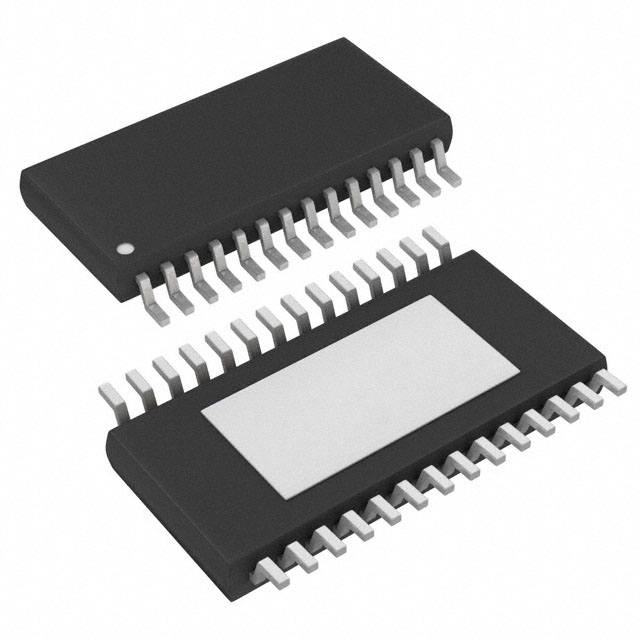
- Part No.:
- MP7748DF-LF
- Manufacturer:
- Monolithic Power Systems Inc.
- Category:
- Audio Amplifiers
- Package:
- 28-TSSOP (0.173", 4.40mm Width) Exposed Pad
- Datasheet:
-
 MP7748DF-LF.pdf
- Description:
- IC AMP CLASS D STER 50W 28TSSOP
- Quantity:
- Payment:

- Shipping:

Inventory:1,063
Please send an inquiry. Send us your inquiry, and we will respond immediately.
Product details
Overview
MP7748DF-LF from Monolithic Power Systems is a stereo Class D audio amplifier IC delivering 20W per channel into 4Ω in single-ended configuration or 50W into 6Ω in bridge-tied-load mode at 24V VDD, featuring integrated 250mΩ MOSFETs, programmable undervoltage protection (UVP), and startup/shutdown pop elimination for consumer audio systems.
For engineers reviewing the MP7748DF-LF datasheet, MP7748DF-LF pinout, MP7748DF-LF application, or MP7748DF-LF equivalent, this page provides verified electrical specifications, thermal performance data, TSSOP28-Exposed package layout guidance, and real-world BTL/SE configuration trade-offs - all critical for high-fidelity, high-efficiency audio subsystem design.
Technical Context
The MP7748DF-LF implements MPS's proprietary Analog Adaptive Modulation™ (AAM) topology with variable-frequency PWM control, enabling high linearity and fast transient response without external compensation. It integrates dual independent Class D channels, each with dedicated bootstrap (BST1/BST2), enable (EN1/EN2), and UVP (UVP1/UVP2) pins for flexible power sequencing and fault management.
Each channel operates from a single 9.5V–36V supply and includes internal thermal shutdown (150°C trip), short-circuit protection (4.5A current limit), and analog reference outputs (REF1/REF2 = VDD/2) for SE biasing. The device supports both stereo SE and mono BTL topologies via external LC filter configuration and gain-setting resistor networks.
Key Specifications
| Parameter | Value and Actual Design Meaning |
|---|---|
| Output Power (SE) | 20W per channel into 4Ω @ 24V VDD, 10% THD+N - enables compact stereo speaker drivers without heatsinks in portable docking stations. |
| Output Power (BTL) | 50W into 6Ω @ 24V VDD, 10% THD+N - delivers mono full-range output suitable for flat-panel TV subwoofers or monitor-integrated audio. |
| THD+N | 0.02% @ 1W, 8Ω SE - meets Hi-Fi line-level fidelity requirements for multimedia computers and home stereo systems. |
| Efficiency | 91% @ 19.3W, 4Ω SE - reduces thermal load and extends battery life in powered speakers and surround-sound DVD systems. |
| Switching Frequency | Up to 1MHz - allows use of smaller LC filter components while maintaining >20kHz audio bandwidth. |
| Noise Floor | 103µV A-weighted (SE), 140µV A-weighted (BTL) - ensures low-hiss operation in quiet listening environments. |
| Supply Range | 9.5V to 36V single supply - supports wide-input industrial and automotive-grade power rails without external regulators. |
Pinout & Package
The MP7748DF-LF is housed in a thermally enhanced TSSOP28-Exposed Pad package. The exposed pad must be soldered to a PCB ground plane for optimal thermal dissipation (θJC = 6°C/W). Pin numbering follows standard TSSOP top-view orientation with pin 1 at bottom-left corner.
| Pin/Terminal | Circuit Role | Design Meaning |
|---|---|---|
| 1, 14 N/C | No-connect | Internally unconnected; must remain floating or tied to GND per layout best practice. |
| 2 REF1 / 9 REF2 | Analog reference output | Provides VDD/2 bias for SE amplifier inputs; requires 10µF bypass capacitor to AGND for stability. |
| 3 IN1 / 8 IN2 | Inverting input | Differential audio input node; AC-coupled from source; non-inverting input is internally tied to REFx. |
| 4 TIMER1 / 10 TIMER2 | Pop-elimination timing | Controls startup current slew rate via external 2.2µF capacitor; sets ~20mA/350ms ramp to suppress turn-on pop. |
| 5 AGND1 / 11 AGND2 | Analog ground | Low-noise reference for internal amplifiers; must connect to PGND at single-point star ground to avoid noise coupling. |
| 6 EN1 / 12 EN2 | Channel enable | Active-high logic control (1.4V rising threshold); drives output to high-Z when low to eliminate turn-off pop. |
| 7 UVP1 / 13 UVP2 | Undervoltage detection | Programmable shutdown trigger; default 8.4V rising threshold if left NC; adjustable via external resistor divider. |
| 15–16, 22–23 VDD2 / VDD1 | Power supply inputs | Separate VDD pins per channel reduce supply crosstalk; require local 1µF X7R ceramic + bulk capacitor decoupling. |
| 17 BST2 / 24 BST1 | Bootstrap supply | Drives high-side MOSFET gate above VDD; requires 0.1µF ceramic capacitor between BSTx and SWx. |
| 18–19, 25–26 SW2 / SW1 | Switched output | PWM output nodes driving external LC filter; directly connected to speaker in BTL mode or via coupling cap in SE mode. |
| 20–21, 27–28 PGND2 / PGND1 | Power ground | High-current return path for output stage; must be routed separately from AGND and joined at single point. |
Key Features
| Feature | Design Value |
|---|---|
| Integrated 250mΩ MOSFETs | Eliminates need for external power switches, reducing BOM count and PCB area by >30% vs discrete Class D solutions. |
| Startup/shutdown pop elimination | Hardware-based current slew control via TIMERx pins prevents audible transients during power cycling in consumer devices. |
| Programmable UVP | Allows system-level brown-out protection tuning (e.g., 12V cutoff for automotive 12V systems) without firmware changes. |
| Thermal & short-circuit protection | Auto-restart after fault clearance avoids latch-up; 4.5A current limit prevents damage during speaker wire shorts. |
| AAM™ modulation topology | Delivers <0.02% THD+N at 1W while maintaining >90% efficiency - bridges gap between Class AB fidelity and Class D efficiency. |
Applications
| Portable Docking Stations | Flat Panel Monitors |
|---|---|
Use Scenario: Amplifying stereo line-level signals from laptops or tablets to drive built-in speakers in compact docking hubs. IC Role / Device Role / Timing Role: Dual-channel Class D amplifier operating in SE mode, using REF1/REF2 bias and EN1/EN2 for synchronized channel enable. Use Value: 20W/channel output enables loud, distortion-free audio without active cooling - critical for fanless enclosure designs. | Use Scenario: Delivering immersive stereo sound from HDMI/DisplayPort audio streams in slim-profile monitors. IC Role / Device Role / Timing Role: Stereo SE amplifier with integrated pop suppression, driven by digital-to-analog converter (DAC) outputs. Use Value: Low 103µV A-weighted noise floor ensures silent background during video playback - meeting premium display audio standards. |
| Surround Sound DVD Systems | Home Stereo Systems |
Use Scenario: Driving rear-channel satellite speakers in 5.1 AV receivers using compact board space. IC Role / Device Role / Timing Role: Dual independent amplifier channels configured in SE mode with separate EN1/EN2 control for zone muting. Use Value: 91% efficiency at full load minimizes heat buildup inside enclosed AV cabinets - eliminating thermal derating concerns. | Use Scenario: Serving as front-channel amplifier in entry-level stereo receivers with passive radiators. IC Role / Device Role / Timing Role: BTL-configured mono amplifier delivering 50W into 6Ω, leveraging SW1/SW2 differential output capability. Use Value: 50W BTL output provides sufficient headroom for dynamic music peaks without clipping - matching typical bookshelf speaker sensitivity. |
Equivalent & Alternatives
The following parts are listed as comparable options for similar stereo Class D audio amplifier applications.
| Alternative Part | Technical Difference | Application Difference | Selection Advice |
|---|---|---|---|
| TAS5756M from Texas Instruments | Higher integration: includes DSP, I²S interface, and volume control; 32-QFN package; 25W/channel SE into 8Ω. | Requires digital audio input (I²S), not analog; targets smart speaker OEMs needing firmware-tunable EQ and voice processing. | Select if system uses digital audio sources and requires embedded audio processing; avoid if analog-only signal chain is used. |
| MAX9744 from Maxim Integrated | Fixed 20W/channel SE output; no programmable UVP; 32-TQFN package; THD+N = 0.03% @ 1W, 8Ω. | Lacks BTL mode and independent channel enable; optimized for cost-sensitive TV audio boards with fixed 12V supply. | Select for simplified, lower-cost TV audio designs where BTL flexibility and UVP tuning are unnecessary. |
Compared with TAS5756M and MAX9744, the MP7748DF-LF uniquely balances analog input simplicity, BTL/SE configurability, and hardware-programmable UVP - making it optimal for hybrid analog/digital consumer electronics where supply voltage range varies across product SKUs.
Availability
MP7748DF-LF is available at Aetrix Electronics and suitable for portable docking stations, flat panel monitors, and home stereo systems requiring stable component supply across multi-year production cycles.
Supply support for MP7748DF-LF includes scheduled delivery planning, volume procurement assistance, BOM continuity management, traceable sourcing, and lifecycle availability coordination for OEM customers, industrial embedded developers, connected-device designers, and electronics production programs.
Manufacturer
Monolithic Power Systems (MPS) is a fabless semiconductor company specializing in high-performance analog and power ICs, with over two decades of leadership in DC/DC converters, LED drivers, and Class D audio amplifiers.
The MP7748 belongs to MPS's Class D Audio Amplifier product line, engineered specifically for high-efficiency, low-noise stereo and mono audio output in space-constrained consumer electronics - emphasizing thermal robustness, pop-free operation, and single-supply flexibility.
FAQ
What is the maximum safe operating voltage for MP7748DF-LF?
The absolute maximum supply voltage (VDD) is 40V, but the recommended operating range is 9.5V to 36V. Exceeding 36V risks permanent damage to internal MOSFETs and gate drivers. At 36V, the device delivers up to 50W in BTL mode into 6Ω with 91% efficiency, provided thermal limits (TJ ≤ 125°C) are maintained via proper PCB copper area and exposed pad soldering.
How does the programmable UVP function work without external components?
When UVP1 and UVP2 pins are left unconnected (NC), internal resistor dividers set the rising VDD shutdown threshold to 8.4V with 0.3V hysteresis. This default behavior eliminates need for external resistors in basic applications. For custom thresholds (e.g., 12V cutoff), connect UVP1/UVP2 to a resistor divider from VDD to GND, calculating RH and RL using VDD_shutdown = 4 × (RH + RL)/RL per datasheet Equation 1.
Can MP7748DF-LF drive 8Ω speakers in stereo SE mode?
Yes - it delivers 10.6W per channel into 8Ω at 24V VDD and 10% THD+N, with THD+N of 0.02% at 1W. This meets standard line-output power requirements for near-field desktop speakers. For higher output, configure one channel in BTL mode to drive a single 8Ω woofer with 40W output, while the other remains in SE for tweeter or center channel.
What LC filter values are recommended for BTL operation at 24V?
Per Table 2 in the datasheet, for 24V BTL operation with 15V/V gain, use CINT1 = 3.9nF for ~580kHz idle switching frequency. Recommended LC values are 1.5µH inductors (gapped ferrite core, 5A saturation current) and 220µF film capacitors per channel. Q-factor must be maintained between 0.7–1.0 using RLOAD = 6Ω or 8Ω to prevent passband peaking or excessive ripple.
Is thermal shutdown reversible, and how long does recovery take?
Yes - thermal shutdown is fully automatic and reversible. When junction temperature exceeds 150°C, the device disables both channels and enters hiccup mode: it attempts restart every ~500ms until TJ falls below 120°C (30°C hysteresis). Full recovery typically occurs within 2–5 seconds after ambient cooling, with no external intervention required - ensuring robust operation in enclosed enclosures.
Does MP7748DF-LF support I²S or digital audio inputs?
No - MP7748DF-LF accepts only analog differential inputs (IN1/IN2 referenced to REF1/REF2). It lacks digital interfaces, clock inputs, or internal DACs. For digital audio systems, pair it with an external stereo DAC (e.g., PCM5102A) whose analog outputs feed IN1/IN2. This analog-input architecture simplifies EMI filtering and avoids jitter-sensitive digital timing paths.
What is the purpose of the exposed pad, and how should it be connected?
The exposed pad is electrically and thermally connected to PGND and serves as the primary heat dissipation path (θJC = 6°C/W). It must be soldered to a solid internal or bottom-layer PCB ground plane covering ≥100mm², with ≥4 thermal vias (0.3mm diameter) connecting to inner ground layers. Failure to properly connect the pad causes junction temperature to exceed 125°C at <15W output, triggering thermal shutdown.
MP7748DF-LF Specifications
- Product attributes
- Attribute value
- Manufacturer:
- Monolithic Power Systems Inc.
- Series:
- -
- Package/Case:
- 28-TSSOP (0.173", 4.40mm Width) Exposed Pad
- Packaging:
- Tube
- Product Status:
- Active
- Type:
- Class D
- Output Type:
- 2-Channel (Stereo)
- Max Output Power x Channels @ Load:
- 50W x 2 @ 6Ohm
- Voltage - Supply:
- 9.5V ~ 36V
- Features:
- Depop, Short-Circuit and Thermal Protection
- Mounting Type:
- Surface Mount
- Operating Temperature:
- -40°C ~ 85°C (TA)
- Grade:
- -
- Qualification:
- -
- Supplier Device Package:
- 28-TSSOP-EP
MP7748DF-LF FAQ
1.How can I place an order for MP7748DF-LF through Aetrix?
Please submit a Request for Quotation (RFQ) for MP7748DF-LF on Aetrix. Our sales agent will provide a competitive quotation and guide you through the order confirmation once you accept the terms.
2.Are the price and stock information for MP7748DF-LF reliable?
The price and inventory of MP7748DF-LF are updated periodically and may fluctuate due to market conditions. Stock and pricing data are typically refreshed every 24 hours. Quotation validity for MP7748DF-LF is usually 5 days.
3.What payment methods are accepted for MP7748DF-LF?
We accept Wire Transfer, PayPal, Credit Card, Western Union, MoneyGram, and Escrow for MP7748DF-LF transactions.
Note: Certain payment methods may incur a processing fee.
4.How is shipping managed for MP7748DF-LF?
MP7748DF-LF orders can be shipped via leading logistics carriers, including DHL, UPS, FedEx, TNT, or Registered Mail.
Once your MP7748DF-LF order is processed, you will receive an email with the shipment details and tracking number.
Note: Tracking information may take up to 24 hours to appear. Express delivery typically takes 3–5 business days.
5.How can I obtain technical support or documentation for MP7748DF-LF?
For technical support, including MP7748DF-LF datasheets, pinout diagrams, or application guidance, please contact our engineering support team. They can provide detailed documentation and assistance for your MP7748DF-LF requirements.
6.How does Aetrix verify that MP7748DF-LF is sourced from the original manufacturer or authorized distributors?
All MP7748DF-LF products on Aetrix are procured from qualified distributors and authorized channels. Our dedicated quality assurance team conducts strict verification, including traceability checks and, if necessary, third-party testing. This ensures that MP7748DF-LF meets industry standards.
7.What is the process for return or replacement of MP7748DF-LF?
All MP7748DF-LF units undergo pre-shipment inspection (PSI). If there is an issue with MP7748DF-LF, returns or replacements are accepted under the following conditions:
1.Quantity discrepancies, incorrect items, or visible external defects (such as breakage or corrosion), acknowledged by Aetrix.
2.The issue is reported within 90 days of delivery.
3.The MP7748DF-LF part is unused and in its original packaging.
Return procedure for MP7748DF-LF:
1.Submit a request within 90 days.
2.Obtain a Return Material Authorization (RMA) from Aetrix.
MP7748DF-LF Tags
-Exposed-Pad.jpg)
-
TS34119CS RLG
Taiwan Semiconductor Corporation

-
LM386MX-1/NOPB
Texas Instruments
-
TPA711DGNR
Texas Instruments
-
LM386N-4/NOPB
Texas Instruments
-
TS4990IST
STMicroelectronics
-
PAM8302AASCR
Diodes Incorporated
-
TPA6130A2RTJR
Texas Instruments
-
TPA6111A2DGNR
Texas Instruments
-
LM4861MX/NOPB
Texas Instruments
-
LM386M-1/NOPB
Texas Instruments
-
NCS2211DR2G
onsemi
-
IS31AP2005-DLS2-TR
Lumissil Microsystems
Tech Hub

Operational amplifier guide covering op amp basics, feedback, ideal vs real op amps, common configurations, buffer circuits, offset, bias current, gain-bandwidth, slew rate, rail-to-rail limits and sel…

Jumper cables guide covering safe connection order, red and black clamp placement, final ground connection, cable gauge, length, clamp quality, copper vs CCA cables, jump starter comparison and battery…

LDO regulator guide covering low dropout voltage, power dissipation, thermal design, PSRR, output noise, capacitor stability, adjustable LDO circuits, LDO vs buck converter and datasheet selection chec…

Conditional Access Module guide covering CAM meaning, CI/CI+ interface, smart card authorization, DVB security workflow, TV and set-top box compatibility, internal electronics, ESD protection, connecto…

Guide to electronic component obsolescence covering EOL risk, PCN/PDN notices, last-time buy planning, replacement options, form-fit-function validation, counterfeit risk and BOM lifecycle management.

18650 battery guide covering lithium-ion cell basics, 3.6V/3.7V voltage, 4.2V charging, mAh and Wh capacity, protected cells, chargers, BMS, series-parallel packs, holders, welding and sourcing checks.…

Hall effect sensor guide covering working principle, linear and digital sensors, Arduino circuits, current sensing, speed detection, automotive applications, A3144 examples, signal filtering and datash…

Product Change Notification guide for electronic components, covering PCN meaning, PCN vs PDN/EOL, common change types, risk levels, form-fit-function review, engineering validation, BOM control, LTB/L…

A practical guide to blend door actuators, covering HVAC function, symptoms, location, AC and heater issues, reset and calibration, replacement cost, electrical diagnosis, compatibility checks, and rep…

Engineering guide to Raspberry Pi alternatives, covering chip-level differences, Orange Pi, ROCK, Jetson, Banana Pi, NanoPi, Compute Module, Pico, GPIO, camera, HAT compatibility, and replacement risks…


