
 My Inquiry
 My Account


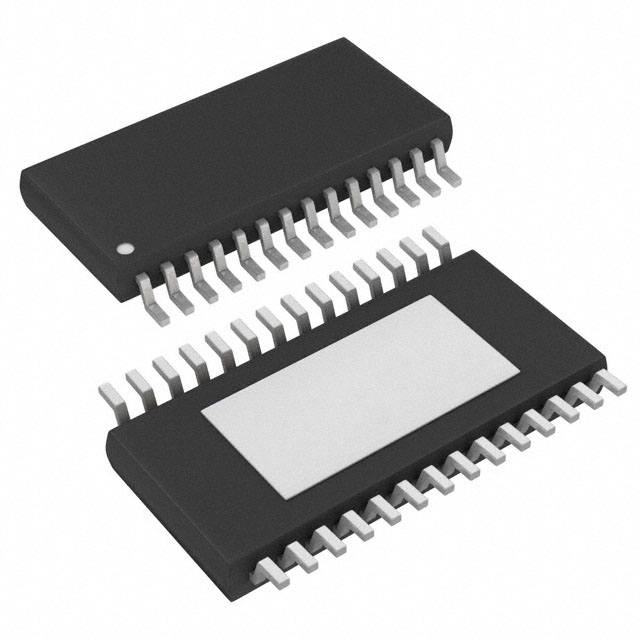
Monolithic Power Systems Inc. MP7751GF-Z
- Part No.:
- MP7751GF-Z
- Manufacturer:
- Monolithic Power Systems Inc.
- Category:
- Audio Amplifiers
- Package:
- 28-TSSOP (0.173", 4.40mm Width) Exposed Pad
- Datasheet:
-
 MP7751GF-Z.pdf
- Description:
- IC AMP CLASS D STER 36W 28TSSOP
- Quantity:
- Payment:

- Shipping:

Inventory:2,968
Please send an inquiry. Send us your inquiry, and we will respond immediately.
Product details
Overview
MP7751GF-Z from Monolithic Power Systems is a 26V, stereo bridge-tied-load (BTL) Class D audio amplifier IC delivering up to 20W per channel into 8Ω at 18V supply, featuring integrated 240mΩ MOSFETs, adjustable power limiting, automatic zero-signal shutdown, and TSSOP-28 EP packaging. It targets compact high-efficiency audio systems requiring low THD+N (0.08%), 92% efficiency at 12V/8Ω, and robust protection including thermal shutdown, short-circuit detection, and under-voltage lockout.
For engineers reviewing the MP7751GF-Z datasheet, MP7751GF-Z pinout, MP7751GF-Z application, or MP7751GF-Z equivalent, key selection criteria include its fixed 260–360kHz switching frequency, differential input architecture with programmable gain (20–36dB), open-drain /FAULT and InAbsence outputs, and precise PLIMIT-based anti-clipping control for speaker protection in battery-powered and energy-conscious designs.
Technical Context
The MP7751GF-Z implements a fixed-frequency PWM modulation scheme with stereo BTL output stage using eight internal N-channel MOSFETs-two per half-bridge-with bootstrap gate drive (BST1A/BST1B/BST2A/BST2B) enabling full enhancement of high-side switches. Its closed-loop gain is digitally selectable via GAIN0/GAIN1 pins across four discrete settings (20/26/32/36dB), while input common-mode voltage is internally biased at 2.5V for differential operation.
It integrates analog signal absence detection with user-adjustable delay (via external capacitor on Cap_D pin), a virtual rail-based power limiter (PLIMIT pin sets peak output voltage as 8× applied voltage), and coordinated fault management: /FAULT asserts low on overtemperature (>150°C trip, 130°C hysteresis) or overcurrent, forcing all outputs to high-impedance state with controlled restart sequence to suppress pop noise.
Key Specifications
| Parameter | Value and Actual Design Meaning |
|---|---|
| Supply Voltage Range | 5V to 26V single supply - supports wide-input consumer and industrial audio rails without external regulation |
| Output Power per Channel | 20W @ 18V/8Ω/10% THD - delivers full-range stereo output for mid-power active speakers and home theater front channels |
| THD+N | 0.08% @ 1kHz, 18W, 24V - ensures high-fidelity reproduction with minimal harmonic and noise distortion |
| Efficiency | 92% @ 12V/8Ω/10% THD - reduces thermal load and extends battery life in portable applications |
| Switching Frequency | 260–360kHz - enables compact LC filter design while staying above audible range and minimizing EMI |
| Input Gain Range | 20dB to 36dB (4 settings) - allows flexible matching to line-level or preamp sources without external amplification |
| Thermal Shutdown | 150°C trip, 20°C hysteresis - prevents permanent damage during sustained overload or poor heatsinking |
Pinout & Package
TSSOP-28 EP package with exposed thermal pad (EP) for enhanced heat dissipation; 0.65mm pitch, 9.7mm × 4.4mm body size, JEDEC MO-153 compliant.
| Pin/Terminal | Circuit Role | Design Meaning |
|---|---|---|
| EN (Pin 1) | Enable control input | Active-high logic interface (1.3–2.0V threshold); disables all output stages and reduces quiescent current to 130–200µA |
| /FAULT (Pin 2) | Fault status indicator | Open-drain output pulled low during overtemperature or overcurrent; shared across both channels |
| IN1A/IN1B, IN2A/IN2B (Pins 3,4,11,12) | Differential audio inputs | Internally biased at 2.5V; support single-ended use with AC coupling; input impedance 20–90kΩ depending on gain setting |
| GAIN0/GAIN1 (Pins 5,6) | Digital gain select bits | Set closed-loop gain to 20/26/32/36dB; determine feedback resistor ratio within IC |
| PLIMIT (Pin 10) | Power limit reference | Voltage sets "virtual rail" = 8× PLIMIT; directly controls maximum peak-to-peak output voltage and anti-clipping behavior |
| InAbsence (Pin 13) | Signal presence flag | Open-drain output held high during valid input; pulls low after configurable timeout (Cap_D pin) to trigger system sleep |
| BST1A/BST1B/BST2A/BST2B (Pins 17,21,22,26) | Bootstrap supply inputs | Drive high-side MOSFET gates above PVCC; require dedicated ceramic capacitors to SWx pins for reliable switching |
| SW1A/SW1B/SW2A/SW2B (Pins 18,20,23,25) | Switch node outputs | High-frequency PWM outputs feeding LC filter; must be routed with minimal loop area to reduce EMI and ringing |
Key Features
| Feature | Design Value |
|---|---|
| Integrated 240mΩ MOSFETs | Eliminates need for external power switches, reducing BOM count and PCB footprint by >30% vs discrete solutions |
| Startup/shutdown pop elimination | Controlled sequencing and soft-start circuitry suppress audible transients during enable/disable transitions |
| Adjustable power limiter (PLIMIT) | Prevents speaker damage by capping output voltage before clipping occurs-configurable via simple resistor divider |
| Automatic zero-signal shutdown | Reduces standby power to <200µA after programmable delay; critical for battery life in portable audio systems |
| Advanced EMI performance | Optimized switching edge rates and integrated filtering support FCC/CE compliance without added ferrite beads or shielding |
Applications
| TV Audio Amplification | DVD/Blu-ray Receiver |
|---|---|
Use Scenario: Integrated stereo audio amplification in slim-profile LCD/LED TVs with space-constrained mainboards. IC Role / Device Role / Timing Role: Primary Class D power stage driving 8Ω BTL speakers; replaces discrete MOSFET + controller combos with single-chip solution. Use Value: 92% efficiency minimizes heatsink requirements; fixed 325kHz switching enables small LC filters; THD+N <0.08% meets broadcast audio fidelity standards. | Use Scenario: Multi-channel AV receiver front-end amplification for stereo playback and source passthrough. IC Role / Device Role / Timing Role: Dual-channel BTL driver handling line-level inputs from DACs; gain-select pins simplify integration with variable-output sources. Use Value: Programmable 20–36dB gain accommodates diverse input levels; /FAULT output enables system-level thermal monitoring and graceful mute-on-fault behavior. |
| Active Speaker Systems | Home Theater Front Channels |
Use Scenario: Compact powered bookshelf or desktop speakers with built-in amplification and digital volume control. IC Role / Device Role / Timing Role: Final-stage power amplifier receiving analog signals from DSP or microcontroller DAC; PLIMIT pin protects tweeters from overdrive. Use Value: Adjustable power limit prevents clipping-induced dome failure; InAbsence output triggers MCU sleep mode after 30s silence, cutting system power by >95%. | Use Scenario: High-fidelity front left/right channel amplification in 5.1/7.1 home theater receivers. IC Role / Device Role / Timing Role: Stereo BTL output stage delivering 20W/channel into 8Ω loads; differential inputs reject common-mode noise from adjacent HDMI or video circuits. Use Value: 240mΩ Rds(on) MOSFETs sustain 20W output with <3.9W junction dissipation; TSSOP-28 EP package allows direct thermal pad soldering to inner copper layers. |
Equivalent & Alternatives
The following parts are listed as comparable options for similar stereo Class D audio amplifier applications.
| Alternative Part | Technical Difference | Application Difference | Selection Advice |
|---|---|---|---|
| TAS5756M from Texas Instruments | Higher integration: includes I²C control, digital audio input, and advanced processing; requires external power stage for >15W | Targets smart speakers with DSP features; not pin-compatible; needs layout redesign and firmware adaptation | Choose when digital interface, parametric EQ, or multi-band processing is required; avoid if analog-only, cost-sensitive, or space-constrained |
| TPA3116D2 from Texas Instruments | Higher output: 30W/channel @ 24V/8Ω; larger HTSSOP-32 package; no integrated signal absence detection | Designed for higher-power subwoofers or soundbars; lacks auto-shutdown and PLIMIT pin, requiring external circuitry for speaker protection | Choose for >20W/channel demand or legacy TI ecosystem compatibility; avoid if zero-signal sleep or fine-grained power limiting is mandatory |
Compared with TAS5756M and TPA3116D2, MP7751GF-Z offers optimal balance of analog simplicity, integrated protection (InAbsence, PLIMIT, /FAULT), and compact TSSOP-28 EP packaging-making it ideal for cost-sensitive, space-constrained stereo amplifiers where digital control is unnecessary and autonomous power management is critical.
Availability
MP7751GF-Z is available at Aetrix Electronics and suitable for TV audio subsystems, active speaker designs, home theater front channels, and DVD/Blu-ray receiver applications requiring stable component supply, long-term lifecycle assurance, and RoHS-compliant manufacturing.
Supply support for MP7751GF-Z includes scheduled delivery planning, volume procurement assistance, BOM continuity management, traceable sourcing, and lifecycle availability coordination for OEM customers, industrial embedded developers, connected-device designers, and electronics production programs.
Manufacturer
Monolithic Power Systems (MPS) is a fabless semiconductor company specializing in high-performance analog and power ICs, with core expertise in DC/DC conversion, LED drivers, motor drivers, and Class D audio amplifiers.
The MP7751 belongs to MPS' fully integrated Class D audio amplifier product line, engineered specifically for space-constrained consumer audio systems demanding high efficiency, low EMI, and autonomous power management without external controllers.
FAQ
What is the maximum continuous output power per channel for MP7751GF-Z?
The MP7751GF-Z delivers up to 20W per channel into an 8Ω load at 18V supply with 10% THD+N, verified per typical operating conditions in the datasheet. At 24V, peak output reaches 36W total (18W per channel), but thermal limits constrain sustained operation to 20W/channel unless heatsinking is enhanced. The adjustable PLIMIT pin allows designers to cap output to protect speakers or meet regulatory power limits.
How does the PLIMIT pin function, and what voltage range should be applied?
The PLIMIT pin sets a "virtual rail" equal to 8× the applied voltage, limiting peak-to-peak output swing to prevent clipping. For example, 1.44V on PLIMIT caps output at 23.6Vpp, yielding ~10W into 8Ω. Apply 0.5V–5.5V (within AVCC range); connect to AVCC for no limiting or use a resistor divider from AVCC to AGND. A 1μF capacitor to ground is mandatory for stability.
Can MP7751GF-Z operate with single-ended inputs, and what is the input impedance?
Yes-though optimized for differential inputs (IN1A/IN1B, IN2A/IN2B), it accepts single-ended signals referenced to AGND with AC coupling. Input impedance varies with gain setting: 20kΩ (36dB), 30kΩ (32dB), 50kΩ (26dB), or 75kΩ (20dB), with ±20% part-to-part tolerance. Minimum guaranteed impedance is 16kΩ, guiding coupling capacitor selection for corner frequencies below 20Hz.
What thermal protection mechanisms are implemented, and how does recovery work?
MP7751GF-Z includes junction temperature sensing with 150°C shutdown and 130°C hysteresis. When tripped, all MOSFETs turn off and /FAULT pulls low. Recovery requires die temperature to fall below 130°C, followed by full re-enable sequence via EN pin-preventing pop noise and ensuring safe restart. No latch-up occurs; operation resumes automatically once thermal margin is restored.
Is the TSSOP-28 EP package lead-free and RoHS-compliant?
Yes-MP7751GF-Z is fully lead-free and complies with the EU RoHS directive. The exposed thermal pad (EP) must be soldered to a large PCB copper area for thermal performance; MPS specifies minimum pad dimensions and solder stencil guidelines in the package drawing. All plating meets JEDEC J-STD-020 moisture sensitivity level 3 (MSL3).
How is the automatic shutdown triggered, and can the delay be adjusted?
Automatic shutdown activates when no audio signal exceeds 2–8mV RMS for longer than the delay set by capacitor on Cap_D (Pin 14). Delay time ≈ 1.6×10⁸ × R × C seconds, where R = 10MΩ internal pull-up. A 100nF capacitor yields ~1.6s delay; 1μF gives ~16s. Connect Cap_D to AGND to disable the feature entirely-useful in always-on applications like public address systems.
What are the recommended LC filter design constraints for BTL operation?
For BTL configuration, use symmetric LC filters per channel with characteristic frequency f₀ = 1/(2π√(LFCF)) between 30–50kHz. Maintain Q-factor 0.7–1.4 using speaker impedance (RL) per Q = RL/√(LF/CF). Select film capacitors and gapped ferrite/toroidal inductors rated for ≥5A peak current; orient all inductors identically to suppress crosstalk.
MP7751GF-Z Specifications
- Product attributes
- Attribute value
- Manufacturer:
- Monolithic Power Systems Inc.
- Series:
- -
- Package/Case:
- 28-TSSOP (0.173", 4.40mm Width) Exposed Pad
- Packaging:
- Tape & Reel (TR)
- Product Status:
- Active
- Type:
- Class D
- Output Type:
- 2-Channel (Stereo)
- Max Output Power x Channels @ Load:
- 36W x 2 @ 8Ohm
- Voltage - Supply:
- -
- Features:
- Depop, Short-Circuit Protection
- Mounting Type:
- Surface Mount
- Operating Temperature:
- -40°C ~ 125°C (TJ)
- Grade:
- -
- Qualification:
- -
- Supplier Device Package:
- 28-TSSOP-EP
MP7751GF-Z FAQ
1.How can I place an order for MP7751GF-Z through Aetrix?
Please submit a Request for Quotation (RFQ) for MP7751GF-Z on Aetrix. Our sales agent will provide a competitive quotation and guide you through the order confirmation once you accept the terms.
2.Are the price and stock information for MP7751GF-Z reliable?
The price and inventory of MP7751GF-Z are updated periodically and may fluctuate due to market conditions. Stock and pricing data are typically refreshed every 24 hours. Quotation validity for MP7751GF-Z is usually 5 days.
3.What payment methods are accepted for MP7751GF-Z?
We accept Wire Transfer, PayPal, Credit Card, Western Union, MoneyGram, and Escrow for MP7751GF-Z transactions.
Note: Certain payment methods may incur a processing fee.
4.How is shipping managed for MP7751GF-Z?
MP7751GF-Z orders can be shipped via leading logistics carriers, including DHL, UPS, FedEx, TNT, or Registered Mail.
Once your MP7751GF-Z order is processed, you will receive an email with the shipment details and tracking number.
Note: Tracking information may take up to 24 hours to appear. Express delivery typically takes 3–5 business days.
5.How can I obtain technical support or documentation for MP7751GF-Z?
For technical support, including MP7751GF-Z datasheets, pinout diagrams, or application guidance, please contact our engineering support team. They can provide detailed documentation and assistance for your MP7751GF-Z requirements.
6.How does Aetrix verify that MP7751GF-Z is sourced from the original manufacturer or authorized distributors?
All MP7751GF-Z products on Aetrix are procured from qualified distributors and authorized channels. Our dedicated quality assurance team conducts strict verification, including traceability checks and, if necessary, third-party testing. This ensures that MP7751GF-Z meets industry standards.
7.What is the process for return or replacement of MP7751GF-Z?
All MP7751GF-Z units undergo pre-shipment inspection (PSI). If there is an issue with MP7751GF-Z, returns or replacements are accepted under the following conditions:
1.Quantity discrepancies, incorrect items, or visible external defects (such as breakage or corrosion), acknowledged by Aetrix.
2.The issue is reported within 90 days of delivery.
3.The MP7751GF-Z part is unused and in its original packaging.
Return procedure for MP7751GF-Z:
1.Submit a request within 90 days.
2.Obtain a Return Material Authorization (RMA) from Aetrix.
MP7751GF-Z Tags
-Exposed-Pad.jpg)
-
TS34119CS RLG
Taiwan Semiconductor Corporation

-
LM386MX-1/NOPB
Texas Instruments
-
TPA711DGNR
Texas Instruments
-
LM386N-4/NOPB
Texas Instruments
-
TS4990IST
STMicroelectronics
-
PAM8302AASCR
Diodes Incorporated
-
TPA6130A2RTJR
Texas Instruments
-
TPA6111A2DGNR
Texas Instruments
-
LM4861MX/NOPB
Texas Instruments
-
LM386M-1/NOPB
Texas Instruments
-
NCS2211DR2G
onsemi
-
IS31AP2005-DLS2-TR
Lumissil Microsystems
Tech Hub

Operational amplifier guide covering op amp basics, feedback, ideal vs real op amps, common configurations, buffer circuits, offset, bias current, gain-bandwidth, slew rate, rail-to-rail limits and sel…

Jumper cables guide covering safe connection order, red and black clamp placement, final ground connection, cable gauge, length, clamp quality, copper vs CCA cables, jump starter comparison and battery…

LDO regulator guide covering low dropout voltage, power dissipation, thermal design, PSRR, output noise, capacitor stability, adjustable LDO circuits, LDO vs buck converter and datasheet selection chec…

Conditional Access Module guide covering CAM meaning, CI/CI+ interface, smart card authorization, DVB security workflow, TV and set-top box compatibility, internal electronics, ESD protection, connecto…

Guide to electronic component obsolescence covering EOL risk, PCN/PDN notices, last-time buy planning, replacement options, form-fit-function validation, counterfeit risk and BOM lifecycle management.

18650 battery guide covering lithium-ion cell basics, 3.6V/3.7V voltage, 4.2V charging, mAh and Wh capacity, protected cells, chargers, BMS, series-parallel packs, holders, welding and sourcing checks.…

Hall effect sensor guide covering working principle, linear and digital sensors, Arduino circuits, current sensing, speed detection, automotive applications, A3144 examples, signal filtering and datash…

Product Change Notification guide for electronic components, covering PCN meaning, PCN vs PDN/EOL, common change types, risk levels, form-fit-function review, engineering validation, BOM control, LTB/L…

A practical guide to blend door actuators, covering HVAC function, symptoms, location, AC and heater issues, reset and calibration, replacement cost, electrical diagnosis, compatibility checks, and rep…

Engineering guide to Raspberry Pi alternatives, covering chip-level differences, Orange Pi, ROCK, Jetson, Banana Pi, NanoPi, Compute Module, Pico, GPIO, camera, HAT compatibility, and replacement risks…


