
 My Inquiry
 My Account


Monolithic Power Systems Inc. MPQ1922GV-AEC1-Z
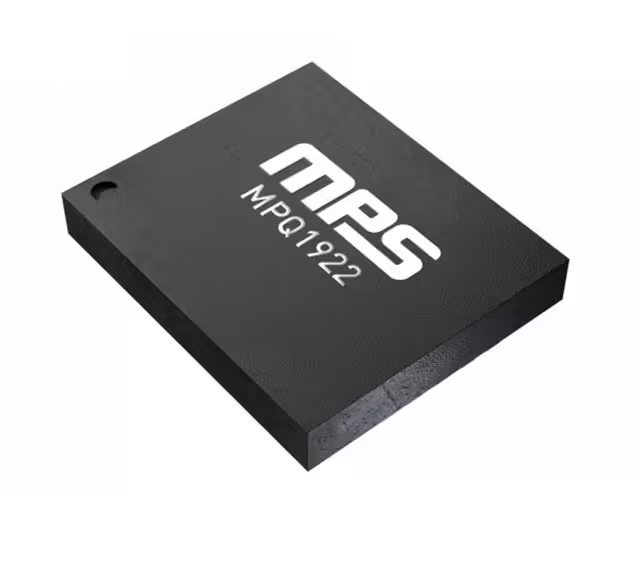
- Part No.:
- MPQ1922GV-AEC1-Z
- Manufacturer:
- Monolithic Power Systems Inc.
- Category:
- Gate Drivers
- Package:
- 22-VFQFN Exposed Pad
- Datasheet:
-
 MPQ1922GV-AEC1-Z.pdf
- Description:
- IC GATE DRVR HALF-BRIDGE 22QFN
- Quantity:
- Payment:

- Shipping:

Inventory:4,908
Please send an inquiry. Send us your inquiry, and we will respond immediately.
Product details
Overview
MPQ1922GV-AEC1-Z from Monolithic Power Systems is a 100V, single-channel half-bridge pre-driver IC for automotive motor control, featuring 3A source/4A sink gate drive, integrated current-sense amplifier, AEC-Q100 Grade 1 qualification, and thermally enhanced QFN-22 (4mm×5mm) package with wettable flanks.
For engineers reviewing the MPQ1922GV-AEC1-Z datasheet, MPQ1922GV-AEC1-Z pinout, MPQ1922GV-AEC1-Z application in BLDC/PMSM drives, or MPQ1922GV-AEC1-Z equivalent for high-voltage gate driving, this page delivers verified functional architecture, slew-rate programmability, desaturation protection thresholds, thermal shutdown behavior, and fault reporting logic - all confirmed from MPS Rev. 1.0 datasheet and official package documentation.
Technical Context
The MPQ1922 implements a dual-N-channel half-bridge pre-driver architecture with independent high-side (GH) and low-side (GL) gate outputs, driven by internal logic that enforces positive dead time and supports adaptive shoot-through prevention when slew rate is configured via RSR. Its bootstrap (BST) capacitor charging path is augmented by an auto-refreshable internal charge pump, enabling indefinite 100% duty-cycle operation under stable thermal conditions.
It integrates a four-gain-range current-sense amplifier (gain = 21–210 V/V, set by CSG-to-GND resistor), desaturation detection on both FETs (VDSTHL = 1.9V, VDSTHH = VG − 1.2V), and open-drain nFAULT reporting with latch-off behavior upon thermal or desaturation fault - all operating across −40°C to +165°C junction temperature range.
Key Specifications
| Parameter | Value and Actual Design Meaning |
|---|---|
| Supply Voltage Range | VIN up to 100V DC; enables direct integration into 48V/72V automotive power rails without external step-down. |
| Gate Drive Strength | 3A source / 4A sink peak; sufficient to rapidly charge/discharge high-Qg MOSFETs in <100ns propagation delay (tPD-LH = 100ns). |
| Current-Sense Gain | Programmable 21–210 V/V via CSG resistor; supports precise shunt-based motor phase current measurement with bidirectional capability. |
| Desaturation Thresholds | LS-FET: 1.9V fixed; HS-FET: VG − 1.2V - dynamically tracks supply, ensuring consistent overcurrent detection across input voltage range. |
| Thermal Protection | Latching thermal shutdown at TJ = 190°C; requires nSLEEP deassertion or VG removal to reset - prevents uncontrolled re-enabling after fault. |
| Slew Rate Control | Four discrete settings (RSR = 0Ω/10kΩ/30kΩ/100kΩ); adjusts pull-up/pull-down resistance to suppress EMI without external gate resistors. |
| AEC-Q100 Grade | Grade 1 (−40°C to +125°C ambient); qualified for engine bay, transmission, and chassis-mounted automotive motor control modules. |
Pinout & Package
MPQ1922GV-AEC1-Z is housed in a thermally optimized QFN-22 (4mm × 5mm) package with exposed thermal pad (EP) and wettable flank terminals for automated optical inspection (AOI) and solder joint reliability in automotive production.
| Pin/Terminal | Circuit Role | Design Meaning |
|---|---|---|
| 1 INL | Low-side control input | Pull-high to enable LS-FET; internal 350kΩ pull-down ensures safe default-off state during MCU boot or reset. |
| 2 INH | High-side control input | Pull-high to enable HS-FET; synchronized with INL to enforce dead time and prevent shoot-through. |
| 8 OUT | Half-bridge output node | HS-source/LS-drain connection point; directly interfaces with external N-MOSFET bridge and BST capacitor. |
| 9 BST | Bootstrap capacitor terminal | Connects ceramic capacitor (100nF–1µF) to OUT; supplies floating gate drive voltage for HS-FET during high-duty operation. |
| 10 GH | High-side gate drive output | Drives HS-FET gate with 3A/4A capability; includes Miller clamp during LS conduction to block false turn-on. |
| 13 GL | Low-side gate drive output | Drives LS-FET gate with same strength; actively discharges gate during HS conduction to ensure clean switching transitions. |
| 17 SR | Slew rate configuration | Resistor-to-GND sets gate drive impedance - determines EMI profile and adaptive dead-time activation. |
| 22 nFAULT | Fault status indicator | Open-drain, active-low output; latches low on thermal/desat fault; requires external pull-up for system-level fault signaling. |
Key Features
| Feature | Design Value |
|---|---|
| Integrated current-sense amplifier | Four-gain selection (21–210 V/V) via CSG resistor; supports bidirectional current sensing with CSR reference biasing. |
| Auto-refreshable bootstrap circuit | Internal charge pump + AR-pin-controlled refresh cycle maintains BST voltage >VG×0.65 even at 100% duty cycle and 125°C ambient. |
| Configurable slew rate with adaptive dead time | RSR resistor selects between full-strength (no dead time) and three adaptive modes where gate voltage monitoring enforces safe FET commutation. |
| Comprehensive fault protection | Simultaneous detection of HS/LS desaturation (2µs deglitch), UVLO on VG/BST, and thermal shutdown at 190°C - all reported via nFAULT. |
| Low-power sleep mode | nSLEEP input reduces quiescent current to 0.1µA; wake-up latency ≤0.8ms ensures rapid resumption of motor control after idle periods. |
Applications
| Automotive HVAC Blower Control | Electric Power Steering (EPS) Assist Module |
|---|---|
Use Scenario: Regulated 48V BLDC motor driving cabin air blower with variable speed and stall detection. IC Role / Device Role / Timing Role: Half-bridge pre-driver controlling external 100V N-MOSFETs; provides real-time current sensing, desaturation fault response (<2µs), and thermal shutdown at 190°C. Use Value: Enables closed-loop torque control using integrated CS amplifier gain (105 V/V with 10kΩ CSG), while AEC-Q100 Grade 1 ensures reliability in under-dash temperature cycling. | Use Scenario: Compact 72V PMSM assist motor in column-assist EPS systems requiring fast transient response and fault resilience. IC Role / Device Role / Timing Role: Pre-driver managing high-side/low-side gate timing with adaptive dead time (RSR = 30kΩ) to prevent shoot-through during rapid torque reversal. Use Value: Slew rate control reduces EMI below CISPR-25 Class 5 limits; nFAULT latching allows MCU to initiate safe stop and diagnostic logging before restart. |
| EV Onboard Charger (OBC) Cooling Fan | Automotive Active Suspension Actuator |
Use Scenario: High-reliability 100V brushed DC fan cooling SiC-based OBC power stage in battery electric vehicles. IC Role / Device Role / Timing Role: Gate driver with ENBL-enabled fast disable and 3A/4A drive strength to handle 15A stall current; uses low-power sleep mode during vehicle standby. Use Value: IGQ = 0.1µA in sleep extends battery life; wettable flank QFN-22 ensures AOI-compatible solder joints for zero-defect manufacturing in safety-critical OBC assemblies. | Use Scenario: Fast-response 48V linear actuator in semi-active suspension, requiring precise current-controlled force modulation. IC Role / Device Role / Timing Role: Current-sense pre-driver delivering 210 V/V gain (RSR = 0Ω, CSG = 0Ω) for µA-level resolution on 5mΩ shunt; supports 20kHz PWM with <300ns tPD-HL. Use Value: Desaturation threshold tracking (VDSTHH = VG − 1.2V) maintains accurate overcurrent trip across wide VIN range (48V ±15%), critical for actuator safety integrity level (ASIL-B) compliance. |
Equivalent & Alternatives
The following parts are listed as comparable options for similar half-bridge pre-driver applications.
| Alternative Part | Technical Difference | Application Difference | Selection Advice |
|---|---|---|---|
| MPQ1922GVE-AEC1-Z | Identical electrical specs; differs only in wettable flank plating (E suffix) for enhanced solder joint inspection - no functional change. | Same automotive motor control use cases; preferred where AOI or X-ray inspection of QFN solder fillets is mandated. | Select GVE variant if board assembly requires IPC-A-610 Class 3 solder joint verification; otherwise GV is functionally identical and cost-optimized. |
| MPQ1922GV-Z (non-AEC) | Same silicon die and pinout; lacks AEC-Q100 qualification testing and automotive-grade screening - not rated for −40°C to +125°C ambient. | Restricted to industrial or consumer BLDC drives where automotive reliability and temperature range are not required. | Only acceptable for non-automotive designs; cannot substitute in AEC-compliant BOMs due to missing stress test validation and failure-in-time (FIT) data. |
Compared with MPQ1922GV-AEC1-Z, the GVE variant adds manufacturability assurance without altering performance, while the non-AEC MPQ1922GV-Z omits automotive qualification - making it unsuitable for safety-critical vehicle systems despite identical gate drive capability.
Availability
MPQ1922GV-AEC1-Z is available at Aetrix Electronics and suitable for automotive BLDC motor drives, EPS assist modules, HVAC blowers, and active suspension actuators requiring stable component supply, AEC-Q100 traceability, and long-term production continuity.
Supply support for MPQ1922GV-AEC1-Z includes scheduled delivery planning, volume procurement assistance, BOM continuity management, traceable sourcing, and lifecycle availability coordination for OEM customers, industrial embedded developers, connected-device designers, and electronics production programs.
Manufacturer
Monolithic Power Systems (MPS) is a fabless semiconductor company specializing in high-performance power management ICs, with design centers in the US, China, and Taiwan, and global distribution through authorized partners.
The MPQ1922 belongs to MPS's automotive-grade gate driver product line, engineered specifically for robust, high-voltage motor control in demanding environments - emphasizing integrated protection, thermal resilience, and AEC-Q100 compliance from silicon to package.
FAQ
What is the minimum BST capacitor value required for reliable MPQ1922GV-AEC1-Z operation?
The minimum BST capacitance is calculated as CBOOT ≥ QG / (VG − VTH), where QG is the total gate charge of the external HS-FET. For typical 100V MOSFETs with QG ≈ 50nC and VG = 12V, CBOOT ≥ 100nF is recommended. Use X5R/X7R ceramic capacitors rated ≥25V; values between 100nF and 1µF ensure stable bootstrap voltage under 100% duty cycle and high-temperature operation.
How does the MPQ1922GV-AEC1-Z implement adaptive dead time, and when is it active?
Adaptive dead time activates only when slew rate is configured via RSR = 10kΩ, 30kΩ, or 100kΩ - not at RSR = 0Ω. The IC monitors GH and GL voltages in real time and delays the next FET turn-on until the previous gate voltage fully discharges below threshold, eliminating fixed-timing uncertainty. This ensures shoot-through prevention across process, voltage, and temperature variations without external timing components.
Can the current-sense amplifier measure bidirectional motor current, and how is zero-current offset set?
Yes - the current-sense amplifier supports bidirectional measurement by biasing the CSO output toward a user-defined zero-current reference via the CSR pin. Connecting CSR to a stable 2V reference (e.g., from a precision divider off VG) sets CSO = 2V at zero current; positive/negative shunt voltage produces proportional CSO deviation. Input offset is ±2.8mV max, enabling sub-100mA resolution with 5mΩ shunts.
What happens to nFAULT after a thermal shutdown event, and how is it cleared?
Upon thermal shutdown at TJ = 190°C, nFAULT latches low and remains asserted until the fault condition is removed - either by pulling nSLEEP low (to enter sleep mode), removing VG supply, or driving ENBL low. Simply cooling the die does not reset nFAULT; the device must be electrically reset to restore gate drive functionality and release nFAULT high via its external pull-up resistor.
Is the MPQ1922GV-AEC1-Z compatible with 3.3V logic microcontrollers, and what are the input thresholds?
Yes - all logic inputs (INH, INL, CSEN, nSLEEP, ENBL) accept 3.3V CMOS levels. The guaranteed high threshold VIH is 2.2V, and low threshold VIL is 0.8V, providing 1.1V noise margin at 3.3V supply. Input leakage is ±20µA, and internal 350kΩ pull-downs ensure defined states during MCU reset or I/O float, eliminating need for external biasing resistors.
Does the MPQ1922GV-AEC1-Z support 100% duty cycle operation, and what mechanism sustains the high-side gate drive?
Yes - sustained 100% duty cycle is enabled by the internal charge pump and auto-refresh circuitry. When BST voltage falls below VG × 0.65, the AR pin state (sampled at startup) determines action: if grounded, the IC automatically triggers a refresh cycle (briefly turning off HS-FET and turning on LS-FET) to recharge CBST. This maintains gate drive above threshold indefinitely, even at elevated temperatures and long on-times.
What is the maximum allowable gate resistance when using external series resistors with MPQ1922GV-AEC1-Z?
External gate resistors are discouraged when using adaptive dead time (RSR ≥ 10kΩ), as they interfere with gate voltage monitoring. If used, keep series resistance ≤5Ω and add a Schottky diode (anode to gate, cathode to GL/GH) to bypass discharge current during opposite-FET conduction. At RSR = 0Ω (full drive), external resistors up to 10Ω may be tolerated but degrade slew control and increase switching losses.
MPQ1922GV-AEC1-Z Specifications
- Product attributes
- Attribute value
- Manufacturer:
- Monolithic Power Systems Inc.
- Series:
- -
- Package/Case:
- 22-VFQFN Exposed Pad
- Packaging:
- Tape & Reel (TR)
- Product Status:
- Active
- Programmable:
- Not Verified
- Driven Configuration:
- Half-Bridge
- Channel Type:
- Independent
- Number of Drivers:
- 2
- Gate Type:
- N-Channel MOSFET
- Voltage - Supply:
- 0V ~ 100V
- Logic Voltage - VIL, VIH:
- 0.8V, 2.2V
- Current - Peak Output (Source, Sink):
- 3A, 4A
- Input Type:
- Non-Inverting
- High Side Voltage - Max (Bootstrap):
- 115 V
- Rise / Fall Time (Typ):
- -
- Operating Temperature:
- -40°C ~ 165°C (TJ)
- Grade:
- -
- Qualification:
- -
- Mounting Type:
- Surface Mount
- Supplier Device Package:
- 22-QFN (4x5)
MPQ1922GV-AEC1-Z FAQ
1.How can I place an order for MPQ1922GV-AEC1-Z through Aetrix?
Please submit a Request for Quotation (RFQ) for MPQ1922GV-AEC1-Z on Aetrix. Our sales agent will provide a competitive quotation and guide you through the order confirmation once you accept the terms.
2.Are the price and stock information for MPQ1922GV-AEC1-Z reliable?
The price and inventory of MPQ1922GV-AEC1-Z are updated periodically and may fluctuate due to market conditions. Stock and pricing data are typically refreshed every 24 hours. Quotation validity for MPQ1922GV-AEC1-Z is usually 5 days.
3.What payment methods are accepted for MPQ1922GV-AEC1-Z?
We accept Wire Transfer, PayPal, Credit Card, Western Union, MoneyGram, and Escrow for MPQ1922GV-AEC1-Z transactions.
Note: Certain payment methods may incur a processing fee.
4.How is shipping managed for MPQ1922GV-AEC1-Z?
MPQ1922GV-AEC1-Z orders can be shipped via leading logistics carriers, including DHL, UPS, FedEx, TNT, or Registered Mail.
Once your MPQ1922GV-AEC1-Z order is processed, you will receive an email with the shipment details and tracking number.
Note: Tracking information may take up to 24 hours to appear. Express delivery typically takes 3–5 business days.
5.How can I obtain technical support or documentation for MPQ1922GV-AEC1-Z?
For technical support, including MPQ1922GV-AEC1-Z datasheets, pinout diagrams, or application guidance, please contact our engineering support team. They can provide detailed documentation and assistance for your MPQ1922GV-AEC1-Z requirements.
6.How does Aetrix verify that MPQ1922GV-AEC1-Z is sourced from the original manufacturer or authorized distributors?
All MPQ1922GV-AEC1-Z products on Aetrix are procured from qualified distributors and authorized channels. Our dedicated quality assurance team conducts strict verification, including traceability checks and, if necessary, third-party testing. This ensures that MPQ1922GV-AEC1-Z meets industry standards.
7.What is the process for return or replacement of MPQ1922GV-AEC1-Z?
All MPQ1922GV-AEC1-Z units undergo pre-shipment inspection (PSI). If there is an issue with MPQ1922GV-AEC1-Z, returns or replacements are accepted under the following conditions:
1.Quantity discrepancies, incorrect items, or visible external defects (such as breakage or corrosion), acknowledged by Aetrix.
2.The issue is reported within 90 days of delivery.
3.The MPQ1922GV-AEC1-Z part is unused and in its original packaging.
Return procedure for MPQ1922GV-AEC1-Z:
1.Submit a request within 90 days.
2.Obtain a Return Material Authorization (RMA) from Aetrix.
MPQ1922GV-AEC1-Z Tags
-
ZXGD3009E6TA
Diodes Incorporated
-
1EDN7512BXTSA1
Infineon Technologies
-
UCC27517DBVR
Texas Instruments
-
MCP1416T-E/OT
Microchip Technology
-
MCP1402T-E/OT
Microchip Technology
-
MCP1415T-E/OT
Microchip Technology
-
MCP1401T-E/OT
Microchip Technology
-
IX4428NTR
Littelfuse Inc.

-
IRS2005STRPBF
Infineon Technologies
-
IRS2008STRPBF
Infineon Technologies
-
IX4310TTR
Littelfuse Inc.

-
2EDN7524RXTMA1
Infineon Technologies
Tech Hub

Operational amplifier guide covering op amp basics, feedback, ideal vs real op amps, common configurations, buffer circuits, offset, bias current, gain-bandwidth, slew rate, rail-to-rail limits and sel…

Jumper cables guide covering safe connection order, red and black clamp placement, final ground connection, cable gauge, length, clamp quality, copper vs CCA cables, jump starter comparison and battery…

LDO regulator guide covering low dropout voltage, power dissipation, thermal design, PSRR, output noise, capacitor stability, adjustable LDO circuits, LDO vs buck converter and datasheet selection chec…

Conditional Access Module guide covering CAM meaning, CI/CI+ interface, smart card authorization, DVB security workflow, TV and set-top box compatibility, internal electronics, ESD protection, connecto…

Guide to electronic component obsolescence covering EOL risk, PCN/PDN notices, last-time buy planning, replacement options, form-fit-function validation, counterfeit risk and BOM lifecycle management.

18650 battery guide covering lithium-ion cell basics, 3.6V/3.7V voltage, 4.2V charging, mAh and Wh capacity, protected cells, chargers, BMS, series-parallel packs, holders, welding and sourcing checks.…

Hall effect sensor guide covering working principle, linear and digital sensors, Arduino circuits, current sensing, speed detection, automotive applications, A3144 examples, signal filtering and datash…

Product Change Notification guide for electronic components, covering PCN meaning, PCN vs PDN/EOL, common change types, risk levels, form-fit-function review, engineering validation, BOM control, LTB/L…

A practical guide to blend door actuators, covering HVAC function, symptoms, location, AC and heater issues, reset and calibration, replacement cost, electrical diagnosis, compatibility checks, and rep…

Engineering guide to Raspberry Pi alternatives, covering chip-level differences, Orange Pi, ROCK, Jetson, Banana Pi, NanoPi, Compute Module, Pico, GPIO, camera, HAT compatibility, and replacement risks…


