
 My Inquiry
 My Account


NXP Semiconductors MPX12GP
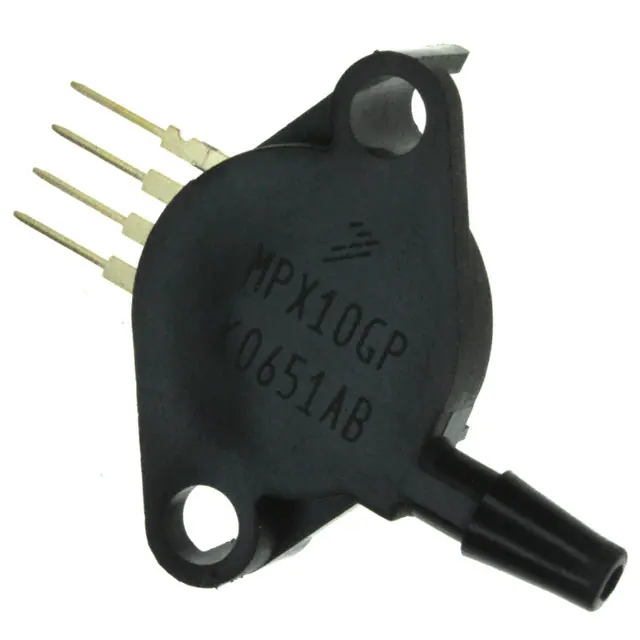
- Part No.:
- MPX12GP
- Manufacturer:
- NXP Semiconductors
- Category:
- Pressure Sensors, Transducers
- Package:
- 4-SIP Module
- Datasheet:
-
 MPX12GP.pdf
- Description:
- SENSOR 1.45PSIG 0.19" .055V
- Quantity:
- Payment:

- Shipping:

Inventory:3,266
Please send an inquiry. Send us your inquiry, and we will respond immediately.
Product details
Overview
MPX12GP from NXP Semiconductors is a silicon piezoresistive gauge pressure sensor with 10 kPa full-scale range, ratiometric voltage output, and uncompensated design requiring external temperature compensation. It delivers linear output (±5.0% VFSS linearity), operates from 3.0–6.0 Vdc supply, and features 4-pin MPAK package (Case 1320A-02) for pneumatic control and medical diagnostics applications.
For engineers reviewing the MPX12GP datasheet, MPX12GP pinout, MPX12GP application, or MPX12GP equivalent, this page provides verified technical context, pin-level circuit roles, real-world use value in leak detection and environmental control, and two validated alternative sensors with documented functional trade-offs.
Technical Context
The MPX12GP implements a single-element silicon shear-stress strain gauge integrated directly into the diaphragm, eliminating thermal expansion mismatch errors common in bonded gauges. Its ratiometric output scales linearly with supply voltage, enabling direct interface to ADCs without separate reference circuits.
It is configured as a gauge-pressure device with dedicated P1 (pressure port) and P2 (vacuum/reference) sides, requiring differential pressure application (P1 > P2). Output impedance (750–1250 Ω) and response time (1.0 ms) support fast pneumatic feedback loops without external buffering.
Key Specifications
| Parameter | Value and Actual Design Meaning |
|---|---|
| Full-Scale Pressure Range | 0–10 kPa - supports low-pressure air movement sensing in HVAC and robotics |
| Supply Voltage | 3.0–6.0 Vdc - ratiometric operation enables stable output across wide input rail variations |
| Full Scale Span (VFSS) | 45–70 mV - defines usable analog output swing at full pressure; sets minimum ADC resolution requirement |
| Offset Voltage | 0–35 mV - zero-pressure output baseline requiring calibration or offset-nulling circuitry |
| Sensitivity | 5.5 mV/kPa - fixed gain slope enabling predictable signal scaling for microcontroller firmware |
| Operating Temperature | −40 °C to +125 °C - supports industrial and automotive under-hood environments |
| Linearity Error | ±5.0% VFSS (end-point method) - defines worst-case deviation from ideal transfer function over full scale |
Pinout & Package
MPX12GP uses the MPAK surface-mount package (Case 1320A-02 / SOT1673-1), a 4-pin chip carrier with integrated pressure port on the P1 side. The package is designed for PCB mounting with silicone gel isolation protecting the die while transmitting pressure to the silicon diaphragm.
| Pin/Terminal | Circuit Role | Design Meaning |
|---|---|---|
| 1 | GND | Ground reference for both supply and output; must be low-impedance to minimize offset drift |
| 2 | +VOUT | Positive output terminal of Wheatstone bridge; voltage increases with applied P1 pressure |
| 3 | VS | Excitation supply input; powers internal resistive bridge and determines full-scale output magnitude |
| 4 | –VOUT | Negative output terminal of Wheatstone bridge; completes differential output pair for noise rejection |
Key Features
| Feature | Design Value |
|---|---|
| Patented silicon shear-stress strain gauge | Eliminates thermal expansion mismatch between gauge and diaphragm, reducing inherent TCR-induced error sources |
| Ratiometric output | Output voltage scales proportionally with VS, allowing direct connection to ADC reference rails without precision voltage references |
| Gauge pressure configuration | Single pressure port (P1) referenced to ambient/vacuum (P2), simplifying integration into open-air or vented systems |
| Low-cost chip carrier packaging | MPAK (SOT1673-1) enables automated placement and reflow soldering while maintaining media isolation via silicone gel |
Applications
| Medical Diagnostics | Leak Detection |
|---|---|
Use Scenario: Monitoring airflow resistance in portable spirometers and ventilator exhalation circuits. IC Role / Device Role / Timing Role: Gauge pressure transducer measuring differential pressure across flow restrictors to calculate respiratory flow rate. Use Value: 10 kPa range matches clinical airflow pressure drops; ±0.1% VFSS hysteresis ensures repeatable breath-by-breath measurements. |
Use Scenario: Detecting pressure decay in sealed enclosures during production test cycles. IC Role / Device Role / Timing Role: Low-range pressure monitor capturing 1–10 kPa decay profiles over 1–5 second intervals. Use Value: 1.0 ms response time captures rapid pressure changes; ratiometric output rejects supply noise in factory test fixtures. |
| Air Movement Control | Industrial Controls |
Use Scenario: Sensing fan inlet/outlet pressure differentials in HVAC ductwork for variable-speed fan control. IC Role / Device Role / Timing Role: Differential pressure sensor feeding closed-loop PID controller regulating motor speed based on system load. Use Value: −40 °C to +125 °C operating range supports outdoor unit deployment; 5.5 mV/kPa sensitivity yields >50 mV signal for 10 kPa ΔP. |
Use Scenario: Monitoring pneumatic cylinder position via chamber pressure in automated assembly machinery. IC Role / Device Role / Timing Role: Gauge pressure interface detecting actuator extension/retraction through pressure threshold crossing. Use Value: 75 kPa overpressure rating prevents damage during valve slam events; 4-pin MPAK allows compact PCB layout near solenoid drivers. |
Equivalent & Alternatives
The following parts are listed as comparable options for similar gauge pressure sensing applications.
| Alternative Part | Technical Difference | Application Difference | Selection Advice |
|---|---|---|---|
| MPXV7002DP | Differential configuration (dual ports); 2 kPa FS; compensated output; SO-8 package | Requires dual-port plumbing; suited for ultra-low-pressure differential measurement, not gauge-mode venting | Select when absolute differential accuracy <1% FS is required and external compensation is undesirable |
| MPX5700AP | 70 kPa FS; temperature-compensated and calibrated; 8-pin SOIC package | Higher pressure range and factory calibration eliminate need for external compensation networks | Select when system-level temperature compensation is impractical and 70 kPa range fits mechanical design |
Compared with MPX12GP, MPXV7002DP offers higher precision at lower pressure but requires dual-port installation and lacks gauge reference simplicity, while MPX5700AP trades raw cost and flexibility for out-of-box accuracy and extended range-making MPX12GP optimal where external compensation is already implemented and 10 kPa range is mechanically constrained.
Availability
MPX12GP is available at Aetrix Electronics and suitable for medical diagnostics equipment, industrial pneumatic controls, HVAC air movement monitoring, and robotics pressure feedback systems requiring stable component supply across multi-year production cycles.
Supply support for MPX12GP includes scheduled delivery planning, volume procurement assistance, BOM continuity management, traceable sourcing, and lifecycle availability coordination for OEM customers, industrial embedded developers, connected-device designers, and electronics production programs.
Manufacturer
NXP Semiconductors is a global semiconductor company headquartered in Eindhoven, Netherlands, specializing in secure connectivity solutions for automotive, industrial, and IoT markets.
The MPX12GP belongs to NXP's legacy MPX pressure sensor family, engineered for cost-sensitive, high-volume applications where designers implement custom signal conditioning and temperature compensation-targeting medical, pneumatic, and environmental control systems.
FAQ
What is the pressure port configuration of the MPX12GP?
The MPX12GP is a gauge pressure sensor with a single pressure port (P1) side identified by the physical port attachment on the MPAK package (Case 1320A-02); the opposite side (P2) serves as the reference/vacuum port. It must be operated with P1 > P2 per the datasheet specification, and the P1 side is clearly marked in Figure 2 and Table 5 of the MPX12 product data sheet. This configuration makes MPX12GP suitable for vented or atmospheric-referenced pressure measurements.
Does the MPX12GP include built-in temperature compensation?
No, the MPX12GP is an uncompensated sensor. Its temperature coefficient of full-scale span (−0.22 to −0.16 %VFSS/°C) and offset (±15 μV/°C) require external compensation circuitry or algorithmic correction. The MPX12GP datasheet explicitly states that manufacturers must add their own external temperature compensation and signal conditioning networks-unlike compensated variants such as MPX5700AP. This design choice preserves low cost and flexibility for MPX12GP users who control the full signal chain.
What is the maximum supply voltage the MPX12GP can tolerate?
The MPX12GP has an absolute maximum supply voltage of 6.0 Vdc per Table 4 (Operating Characteristics) and Table 3 (Maximum Ratings) in the official NXP MPX12 datasheet. Operating above this level risks permanent damage. The recommended operating range is 3.0–6.0 Vdc, and the device is ratiometric within this range-meaning output scales linearly with VS. Exceeding 6.0 Vdc violates the Absolute Maximum Rating System (IEC 60134) and may cause irreversible degradation.
Can the MPX12GP be used for differential pressure measurement?
The MPX12GP is specified and characterized exclusively as a gauge pressure sensor-not a differential device. Its internal structure and pinout (GND, +VOUT, VS, –VOUT) assume one side (P2) is exposed to ambient or vacuum reference, while pressure is applied only to P1. Although the output responds to differential pressure (P1 – P2), using it in true differential mode (e.g., pressurizing both ports) violates the datasheet's P1 > P2 condition and invalidates all published specifications including linearity, hysteresis, and temperature coefficients. For differential measurement, NXP recommends MPXV7002DP or similar dual-port parts.
What is the warm-up time specification for the MPX12GP?
The MPX12GP has a maximum warm-up time of 20 ms, defined as the time required for the output voltage to stabilize within specification after pressure stabilization and power application. This value appears in Table 4 (Operating Characteristics) under "Warm-Up Time" and reflects the thermal settling behavior of the silicon strain gauge and associated resistive network. It enables high-speed sampling in applications like leak testing or dynamic airflow monitoring where sub-100 ms cycle times are required. The MPX12GP achieves full electrical stability well before typical microcontroller ADC conversion windows.
MPX12GP Specifications
- Product attributes
- Attribute value
- Manufacturer:
- NXP Semiconductors
- Series:
- MPX12
- Package/Case:
- 4-SIP Module
- Packaging:
- Tray
- Product Status:
- Obsolete
- Applications:
- Board Mount
- Pressure Type:
- Vented Gauge
- Operating Pressure:
- 1.45PSI (10kPa)
- Output Type:
- Wheatstone Bridge
- Output:
- 0 mV ~ 55 mV (3V)
- Accuracy:
- ±5%
- Voltage - Supply:
- 3V ~ 6V
- Port Size:
- Male - 0.19" (4.93mm) Tube
- Port Style:
- Barbed
- Features:
- -
- Termination Style:
- PC Pin
- Maximum Pressure:
- 10.88PSI (75kPa)
- Operating Temperature:
- -40°C ~ 125°C
- Grade:
- -
- Qualification:
- -
- Mounting Type:
- Through Hole
- Supplier Device Package:
- -
MPX12GP FAQ
1.How can I place an order for MPX12GP through Aetrix?
Please submit a Request for Quotation (RFQ) for MPX12GP on Aetrix. Our sales agent will provide a competitive quotation and guide you through the order confirmation once you accept the terms.
2.Are the price and stock information for MPX12GP reliable?
The price and inventory of MPX12GP are updated periodically and may fluctuate due to market conditions. Stock and pricing data are typically refreshed every 24 hours. Quotation validity for MPX12GP is usually 5 days.
3.What payment methods are accepted for MPX12GP?
We accept Wire Transfer, PayPal, Credit Card, Western Union, MoneyGram, and Escrow for MPX12GP transactions.
Note: Certain payment methods may incur a processing fee.
4.How is shipping managed for MPX12GP?
MPX12GP orders can be shipped via leading logistics carriers, including DHL, UPS, FedEx, TNT, or Registered Mail.
Once your MPX12GP order is processed, you will receive an email with the shipment details and tracking number.
Note: Tracking information may take up to 24 hours to appear. Express delivery typically takes 3–5 business days.
5.How can I obtain technical support or documentation for MPX12GP?
For technical support, including MPX12GP datasheets, pinout diagrams, or application guidance, please contact our engineering support team. They can provide detailed documentation and assistance for your MPX12GP requirements.
6.How does Aetrix verify that MPX12GP is sourced from the original manufacturer or authorized distributors?
All MPX12GP products on Aetrix are procured from qualified distributors and authorized channels. Our dedicated quality assurance team conducts strict verification, including traceability checks and, if necessary, third-party testing. This ensures that MPX12GP meets industry standards.
7.What is the process for return or replacement of MPX12GP?
All MPX12GP units undergo pre-shipment inspection (PSI). If there is an issue with MPX12GP, returns or replacements are accepted under the following conditions:
1.Quantity discrepancies, incorrect items, or visible external defects (such as breakage or corrosion), acknowledged by Aetrix.
2.The issue is reported within 90 days of delivery.
3.The MPX12GP part is unused and in its original packaging.
Return procedure for MPX12GP:
1.Submit a request within 90 days.
2.Obtain a Return Material Authorization (RMA) from Aetrix.
MPX12GP Tags
-
DPS368XTSA1
Infineon Technologies
-
DPS310XTSA1
Infineon Technologies
-
LPS22HHTR
STMicroelectronics

-
ICP-20100
TDK InvenSense
-
ICP-10110
TDK InvenSense
-
LPS22DFTR
STMicroelectronics
-
LPS22HBTR
STMicroelectronics
-
BMP390
Bosch Sensortec
-
BMP581
Bosch Sensortec
-
BMP384
Bosch Sensortec
-
2511020213301
Würth Elektronik
-
ILPS22QSTR
STMicroelectronics
Tech Hub

A practical engineering guide to 3.3V and 5V logic compatibility, input thresholds, resistor dividers, translator ICs, MOSFET level shifting, I2C pull-ups, timing limits and power-sequencing risks.

The 74HC595 uses push-pull logic outputs, while the TPIC6B595 uses 50 V open-drain DMOS sinks for higher-power loads. This guide compares timing, current limits, 3.3 V interfacing, load wiring, thermal…

The 74HC595 converts serial data into eight stable parallel outputs. This guide covers pin functions, shift and storage timing, OE and MR behavior, drive-current limits, cascading, voltage compatibilit…

A technical comparison of level-sensitive latches and edge-triggered flip-flops, covering timing windows, setup and hold limits, master–slave operation, time borrowing, race-through, HDL inference and…

A D latch stores one bit while Enable controls when data can pass. This reference covers gate-level operation, truth tables, transparency, setup and hold timing, LE versus OE, common ICs and practical …

An SR latch stores one bit through cross-coupled feedback. This engineering reference covers NOR and NAND implementations, truth tables, forbidden-state recovery, gated operation, switch debouncing, fa…

Latch circuits retain one bit through feedback. This technical reference covers SR and D latches, truth tables, transparency, timing limits, latch-versus-flip-flop behavior, applications and common log…

An engineering guide to LED driver operation, constant-current and constant-voltage outputs, linear and switching topologies, dimming, IC selection, calculations, replacement compatibility, and fault c…

Operational amplifier guide covering op amp basics, feedback, ideal vs real op amps, common configurations, buffer circuits, offset, bias current, gain-bandwidth, slew rate, rail-to-rail limits and sel…

Jumper cables guide covering safe connection order, red and black clamp placement, final ground connection, cable gauge, length, clamp quality, copper vs CCA cables, jump starter comparison and battery…


