
 My Inquiry
 My Account


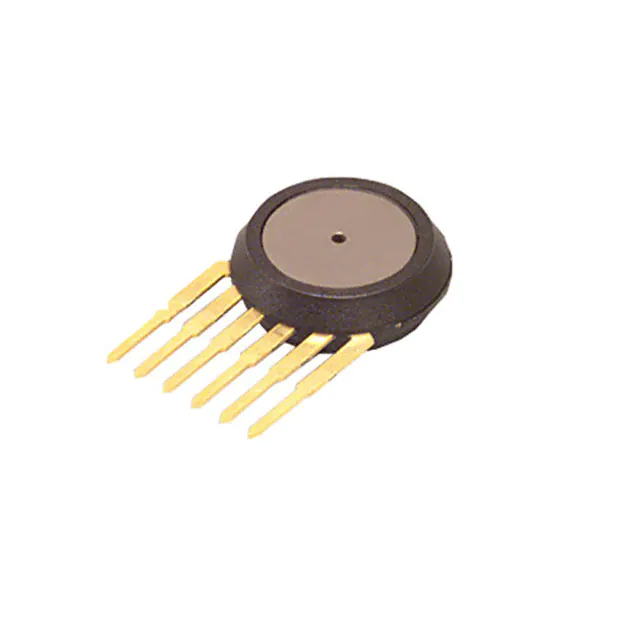
NXP Semiconductors MPX4250D
- Part No.:
- MPX4250D
- Manufacturer:
- NXP Semiconductors
- Category:
- Pressure Sensors, Transducers
- Package:
- 6-SIP Module
- Datasheet:
-
 MPX4250D.pdf
- Description:
- SENSOR 36.26PSID 4.9V
- Quantity:
- Payment:

- Shipping:

Inventory:1,760
Please send an inquiry. Send us your inquiry, and we will respond immediately.
Product details
Overview
MPX4250D from NXP Semiconductors is a monolithic silicon differential/gauge pressure sensor with on-chip signal conditioning, temperature compensation, and factory calibration. It delivers a ratiometric analog output (0.204 V to 4.909 V) over 0–250 kPa full-scale range, operates from 4.85–5.35 V supply, consumes ≤10 mA, and maintains ±1.4 % accuracy across 0 °C to 85 °C - ideal for engine manifold pressure monitoring in automotive microcontroller-based systems.
For engineers reviewing the MPX4250D datasheet, MPX4250D pinout, MPX4250D application, or MPX4250D equivalent, key selection criteria include its unibody epoxy package (Case 867), 6-pin configuration with three DNC pins, differential/gauge dual-mode capability, and compatibility with A/D inputs requiring minimal external circuitry.
Technical Context
The MPX4250D integrates a piezoresistive sensing element with thin-film metallization and bipolar signal conditioning circuitry, including two gain stages and ground-reference shift circuitry. Its patented silicon shear-stress strain gauge enables high linearity and stability under mechanical stress.
On-chip temperature compensation operates across –40 °C to +125 °C, while the ratiometric transfer function VOUT = VCC × (P × 0.00369 + 0.04) ensures output scaling remains proportional to supply voltage, simplifying system-level calibration and reducing sensitivity to VCC drift.
Key Specifications
| Parameter | Value and Actual Design Meaning |
|---|---|
| Pressure Range | 0 to 250 kPa full-scale - supports intake manifold and turbo boost pressure measurement up to ~36 psi. |
| Output Voltage Range | 0.204 V to 4.909 V at VCC = 5.1 V - directly interfaces 5 V A/D converters without level-shifting. |
| Accuracy | ±1.4 % of full-scale span (VFSS) over 0 °C to 85 °C - includes linearity, TcOffset, TcSpan, and hysteresis contributions. |
| Supply Voltage | 4.85–5.35 Vdc - ratiometric operation ensures output scaling tracks VCC, easing power rail tolerance design. |
| Supply Current | 7.0–10.0 mAdc - enables low-power embedded designs with predictable current draw. |
| Response Time | 1.0 ms (10% to 90%) - suitable for dynamic pressure events such as throttle transients. |
| Operating Temperature | –40 °C to +125 °C - qualified for under-hood automotive environments. |
Pinout & Package
MPX4250D uses the unibody epoxy package Case 867 (orderable as 98ASB42793B), featuring a stainless steel cover and fluorosilicone die coating for environmental isolation and long-term reliability in harsh media.
| Pin/Terminal | Circuit Role | Design Meaning |
|---|---|---|
| VOUT | Output voltage | Analog output proportional to applied differential/gauge pressure; requires 470 pF capacitor per Figure 5 for noise filtering. |
| GND | Ground reference | Common return path for supply and output; must be low-impedance to maintain offset stability. |
| VCC | Supply voltage input | 5.1 V ±0.25 V excitation source; powers internal amplifiers and compensation circuitry. |
| DNC | Do not connect | Pins 4, 5, and 6 are internally unused - must remain floating, not tied to GND or any trace. |
Key Features
| Feature | Design Value |
|---|---|
| Differential & gauge mode support | Single device configurable for either pressure type via port connection - reduces BOM count and layout variants. |
| Patented silicon shear-stress strain gauge | Improves mechanical robustness and long-term zero-point stability under vibration and thermal cycling. |
| On-chip temperature compensation | Eliminates need for external thermistor networks or software correction tables across –40 °C to +125 °C. |
| Durable epoxy unibody construction | Withstands exposure to oil, fuel vapor, and condensation in engine bay applications without gel degradation. |
| Ratiometric output transfer function | Enables direct interface to microcontroller ADCs referenced to same VCC rail - removes need for precision voltage references. |
Applications
| Engine Intake Manifold Pressure Monitoring | Turbocharger Boost Control |
|---|---|
|
Use Scenario: Real-time measurement of absolute or differential pressure in gasoline/diesel engine intake manifolds for air-fuel ratio calculation and ECU load estimation. IC Role / Device Role / Timing Role: Primary analog pressure transducer providing calibrated voltage output to MCU ADC channel. Use Value: Enables closed-loop fuel injection control with ±1.4 % full-scale accuracy across operating temperature, improving emissions compliance and fuel economy. |
Use Scenario: Closed-loop feedback sensing of compressed air pressure downstream of turbocharger compressor for wastegate actuation control. IC Role / Device Role / Timing Role: Differential pressure sensor measuring Pboost – Patm, delivering 1 ms response for rapid transient tracking. Use Value: Supports fast-acting boost regulation with minimal latency, preventing over-boost conditions and protecting engine components. |
| Brake Booster Vacuum Sensing | Industrial HVAC Differential Airflow Monitoring |
|
Use Scenario: Detection of vacuum level in brake booster reservoir to verify assist functionality and trigger warning indicators. IC Role / Device Role / Timing Role: Gauge-mode pressure sensor referenced to atmosphere, interfacing with vehicle body control module. Use Value: Provides fail-safe vacuum status with offset stability of ±0.5 % VFSS after 1000-hour pulsed pressure testing - critical for functional safety. |
Use Scenario: Measuring pressure drop across HVAC filters or across heat exchangers to monitor airflow and detect clogging. IC Role / Device Role / Timing Role: Differential pressure transducer installed across filter housing ports, outputting analog signal to building management controller. Use Value: Enables predictive maintenance alerts based on calibrated ΔP thresholds, reducing energy waste and service downtime. |
Equivalent & Alternatives
The following parts are listed as comparable options for similar pressure transducer applications.
| Alternative Part | Technical Difference | Application Difference | Selection Advice |
|---|---|---|---|
| MPX5700DP | Wider 0–700 kPa range; higher full-scale output (0.2–4.9 V); same 6-pin Case 867C package but different port geometry. | Designed for higher-pressure turbo and industrial hydraulic monitoring - not drop-in for 250 kPa systems due to reduced resolution. | Select MPX5700DP only when system pressure exceeds 250 kPa and higher dynamic range is required. |
| MPXV7025DP | 25 kPa full-scale range; 5 V ratiometric output; 8-pin SOIC package; integrated signal conditioning but no on-chip temperature compensation beyond 0–85 °C. | Targeted at low-pressure medical and lab instrumentation - lacks extended –40 °C to +125 °C qualification and unibody ruggedness. | Choose MPXV7025DP for cost-sensitive, low-range applications where automotive-grade temperature range and epoxy durability are not required. |
Compared with MPX5700DP and MPXV7025DP, the MPX4250D uniquely balances 250 kPa full-scale range, automotive-qualified temperature performance, unibody mechanical robustness, and factory calibration - making it optimal for engine management and industrial differential pressure sensing where reliability and accuracy are co-prioritized.
Availability
MPX4250D is available at Aetrix Electronics and suitable for automotive engine control units, turbocharger boost regulation systems, and industrial HVAC differential pressure monitoring requiring stable component supply and long-term lifecycle continuity.
Supply support for MPX4250D includes scheduled delivery planning, volume procurement assistance, BOM continuity management, traceable sourcing, and lifecycle availability coordination for OEM customers, industrial embedded developers, connected-device designers, and electronics production programs.
Manufacturer
NXP Semiconductors is a global semiconductor company specializing in secure connectivity solutions for automotive, industrial, and IoT applications, with leadership in sensor signal conditioning and embedded processing.
The MPX4250D belongs to NXP's legacy MPX series of integrated silicon pressure sensors, engineered specifically for microcontroller-based systems needing calibrated analog outputs without external compensation circuitry.
FAQ
What is the pressure media compatibility of the MPX4250D?
The MPX4250D is qualified for use with dry air as the pressure medium. Exposure to other media - including fuel, oil, or corrosive gases - may degrade long-term reliability or cause output drift. NXP explicitly states that non-dry-air media require factory consultation for compatibility validation. The fluorosilicone die coat provides limited chemical resistance, but the MPX4250D is not rated for direct contact with hydrocarbons or solvents. Always verify media compatibility before integration into final MPX4250D-based systems.
Does the MPX4250D require external temperature compensation circuitry?
No, the MPX4250D does not require external temperature compensation circuitry. It features fully integrated on-chip temperature compensation spanning –40 °C to +125 °C, covering both offset and span drift. This eliminates the need for external thermistors, lookup tables, or calibration algorithms in host firmware. The MPX4250D's internal compensation ensures ±1.4 % accuracy over 0 °C to 85 °C without additional hardware - a core design advantage confirmed in Section 8 of the official datasheet.
Can the MPX4250D be used in absolute pressure mode?
No, the MPX4250D is not specified for absolute pressure measurement. It is designed exclusively for differential and gauge pressure configurations, as stated in Section 2 ("Features") and Table 1 ("Ordering information"). Absolute pressure variants in this family carry distinct part numbers (e.g., MPX4250AP). The MPX4250D's port architecture and internal reference structure support only P1–P2 (differential) or P1–atmosphere (gauge) sensing - using it in absolute mode would yield undefined or inaccurate output.
What decoupling capacitors are required for stable operation of the MPX4250D?
The MPX4250D requires three decoupling capacitors per Figure 5 in the datasheet: a 1.0 µF bulk capacitor, a 0.01 µF ceramic capacitor, and a 470 pF output filter capacitor, all placed close to the device pins. These components suppress supply noise and reduce high-frequency output ripple, ensuring the MPX4250D meets its ±1.4 % accuracy specification. Omitting or substituting these values risks increased offset drift, reduced response fidelity, and failure to achieve published warm-up time (20 ms) and response time (1.0 ms) metrics.
Is the MPX4250D pin-compatible with earlier MPX4250 versions?
Yes, the MPX4250D is pin-compatible with the legacy MPX4250, as confirmed by the revision history noting "Revised 'MPX4250' to 'MPX4250D'" without changes to pinout, package, or electrical behavior. Both share identical Case 867 packaging, 6-pin layout, and functional pin assignments (VOUT, GND, VCC, and three DNC pins). The MPX4250D supersedes the MPX4250 with updated documentation and minor process refinements, but existing PCB layouts designed for MPX4250 will accept MPX4250D without modification.
MPX4250D Specifications
- Product attributes
- Attribute value
- Manufacturer:
- NXP Semiconductors
- Series:
- MPX4250
- Package/Case:
- 6-SIP Module
- Packaging:
- Tray
- Product Status:
- Obsolete
- Applications:
- Board Mount
- Pressure Type:
- Differential
- Operating Pressure:
- 36.26PSI (250kPa)
- Output Type:
- Analog Voltage
- Output:
- 0.2 V ~ 4.9 V
- Accuracy:
- ±1.4%
- Voltage - Supply:
- 4.85V ~ 5.35V
- Port Size:
- -
- Port Style:
- No Port
- Features:
- Temperature Compensated
- Termination Style:
- PC Pin
- Maximum Pressure:
- 145.04PSI (1000kPa)
- Operating Temperature:
- -40°C ~ 125°C
- Grade:
- -
- Qualification:
- -
- Mounting Type:
- Through Hole
- Supplier Device Package:
- -
MPX4250D FAQ
1.How can I place an order for MPX4250D through Aetrix?
Please submit a Request for Quotation (RFQ) for MPX4250D on Aetrix. Our sales agent will provide a competitive quotation and guide you through the order confirmation once you accept the terms.
2.Are the price and stock information for MPX4250D reliable?
The price and inventory of MPX4250D are updated periodically and may fluctuate due to market conditions. Stock and pricing data are typically refreshed every 24 hours. Quotation validity for MPX4250D is usually 5 days.
3.What payment methods are accepted for MPX4250D?
We accept Wire Transfer, PayPal, Credit Card, Western Union, MoneyGram, and Escrow for MPX4250D transactions.
Note: Certain payment methods may incur a processing fee.
4.How is shipping managed for MPX4250D?
MPX4250D orders can be shipped via leading logistics carriers, including DHL, UPS, FedEx, TNT, or Registered Mail.
Once your MPX4250D order is processed, you will receive an email with the shipment details and tracking number.
Note: Tracking information may take up to 24 hours to appear. Express delivery typically takes 3–5 business days.
5.How can I obtain technical support or documentation for MPX4250D?
For technical support, including MPX4250D datasheets, pinout diagrams, or application guidance, please contact our engineering support team. They can provide detailed documentation and assistance for your MPX4250D requirements.
6.How does Aetrix verify that MPX4250D is sourced from the original manufacturer or authorized distributors?
All MPX4250D products on Aetrix are procured from qualified distributors and authorized channels. Our dedicated quality assurance team conducts strict verification, including traceability checks and, if necessary, third-party testing. This ensures that MPX4250D meets industry standards.
7.What is the process for return or replacement of MPX4250D?
All MPX4250D units undergo pre-shipment inspection (PSI). If there is an issue with MPX4250D, returns or replacements are accepted under the following conditions:
1.Quantity discrepancies, incorrect items, or visible external defects (such as breakage or corrosion), acknowledged by Aetrix.
2.The issue is reported within 90 days of delivery.
3.The MPX4250D part is unused and in its original packaging.
Return procedure for MPX4250D:
1.Submit a request within 90 days.
2.Obtain a Return Material Authorization (RMA) from Aetrix.
MPX4250D Tags
-
DPS368XTSA1
Infineon Technologies
-
DPS310XTSA1
Infineon Technologies
-
LPS22HHTR
STMicroelectronics

-
ICP-20100
TDK InvenSense
-
ICP-10110
TDK InvenSense
-
LPS22DFTR
STMicroelectronics
-
LPS22HBTR
STMicroelectronics
-
BMP390
Bosch Sensortec
-
BMP581
Bosch Sensortec
-
BMP384
Bosch Sensortec
-
2511020213301
Würth Elektronik
-
ILPS22QSTR
STMicroelectronics
Tech Hub

A practical engineering guide to 3.3V and 5V logic compatibility, input thresholds, resistor dividers, translator ICs, MOSFET level shifting, I2C pull-ups, timing limits and power-sequencing risks.

The 74HC595 uses push-pull logic outputs, while the TPIC6B595 uses 50 V open-drain DMOS sinks for higher-power loads. This guide compares timing, current limits, 3.3 V interfacing, load wiring, thermal…

The 74HC595 converts serial data into eight stable parallel outputs. This guide covers pin functions, shift and storage timing, OE and MR behavior, drive-current limits, cascading, voltage compatibilit…

A technical comparison of level-sensitive latches and edge-triggered flip-flops, covering timing windows, setup and hold limits, master–slave operation, time borrowing, race-through, HDL inference and…

A D latch stores one bit while Enable controls when data can pass. This reference covers gate-level operation, truth tables, transparency, setup and hold timing, LE versus OE, common ICs and practical …

An SR latch stores one bit through cross-coupled feedback. This engineering reference covers NOR and NAND implementations, truth tables, forbidden-state recovery, gated operation, switch debouncing, fa…

Latch circuits retain one bit through feedback. This technical reference covers SR and D latches, truth tables, transparency, timing limits, latch-versus-flip-flop behavior, applications and common log…

An engineering guide to LED driver operation, constant-current and constant-voltage outputs, linear and switching topologies, dimming, IC selection, calculations, replacement compatibility, and fault c…

Operational amplifier guide covering op amp basics, feedback, ideal vs real op amps, common configurations, buffer circuits, offset, bias current, gain-bandwidth, slew rate, rail-to-rail limits and sel…

Jumper cables guide covering safe connection order, red and black clamp placement, final ground connection, cable gauge, length, clamp quality, copper vs CCA cables, jump starter comparison and battery…


