
 My Inquiry
 My Account


NXP Semiconductors MPXV10GC6U
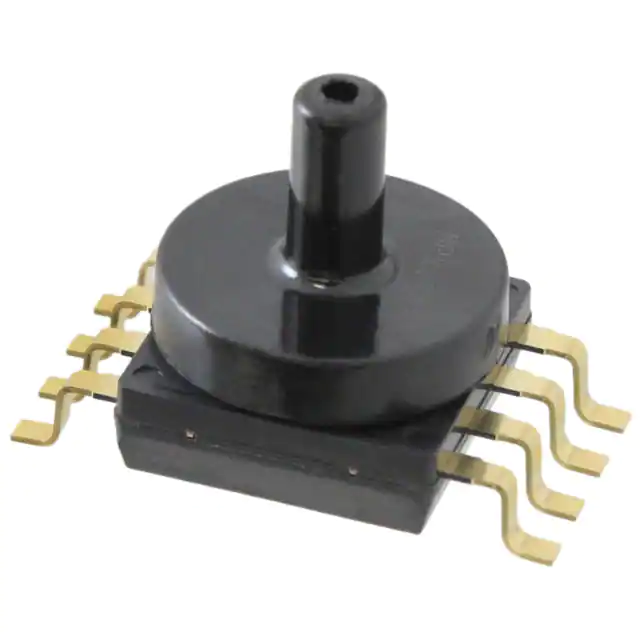
- Part No.:
- MPXV10GC6U
- Manufacturer:
- NXP Semiconductors
- Category:
- Pressure Sensors, Transducers
- Package:
- 8-SMD, Gull Wing, Top Port
- Datasheet:
-
 MPXV10GC6U.pdf
- Description:
- SENSOR 1.45PSIG 0.13" .035V
- Quantity:
- Payment:

- Shipping:

Inventory:4,729
Please send an inquiry. Send us your inquiry, and we will respond immediately.
Product details
Overview
MPXV10GC6U from NXP Semiconductors is a silicon piezoresistive gauge pressure sensor with 10 kPa full-scale range, ratiometric voltage output (20–50 mV span at 3 V supply), ±1.0 %VFSS linearity, and operating temperature range of −40 °C to +125 °C. It delivers linear analog output directly proportional to applied differential pressure (P1 > P2) and is used in pneumatic control systems requiring low-cost, uncompensated sensing with external signal conditioning.
For engineers reviewing the MPXV10GC6U datasheet, MPXV10GC6U pinout, MPXV10GC6U application, or MPXV10GC6U equivalent, this page provides verified technical context, validated pin functions, real-world use scenarios, and confirmed alternative options for pressure-sensing designs requiring 10 kPa range, SOT1854-1 packaging, and dual-output analog interface.
Technical Context
The MPXV10GC6U implements a single-element silicon shear-stress strain gauge integrated into a silicon diaphragm, eliminating thermal expansion mismatch errors common in bonded gauges. Its ratiometric output scales linearly with supply voltage (3.0–6.0 VDC), enabling direct interfacing with ADCs referenced to the same supply.
It operates exclusively in gauge configuration (P1 side exposed to pressure, P2 side vented to ambient), with pressure-side identification confirmed as "side with port attached" per Case 482A-01 mechanical drawing. Output is differential (+VOUT and –VOUT), requiring instrumentation amplifier or precision resistor network for single-ended conversion.
Key Specifications
| Parameter | Value and Actual Design Meaning |
|---|---|
| Full-Scale Pressure Range | 0–10 kPa gauge - defines maximum measurable pressure before nonlinear error exceeds specification. |
| Supply Voltage | 3.0–6.0 VDC - ratiometric operation requires stable excitation; output scales proportionally within this range. |
| Full Scale Span (VFSS) | 20–50 mV - differential output swing at full pressure; determines minimum detectable pressure resolution with given gain. |
| Linearity Error | ±1.0 %VFSS (end-point method) - worst-case deviation from ideal straight-line transfer function across 0–10 kPa. |
| Operating Temperature | −40 °C to +125 °C - specifies functional range for biasing, output stability, and reliability without derating. |
| Response Time | 1.0 ms (10%–90%) - time to settle after step pressure change; enables real-time monitoring in fast pneumatic cycles. |
| Offset Voltage | 0–35 mV at 0 kPa - zero-pressure output baseline; must be nulled or compensated in signal chain. |
| Overpressure Limit | 75 kPa - maximum transient pressure before permanent calibration shift or mechanical damage occurs. |
Pinout & Package
MPXV10GC6U uses the SOT1854-1 package (Case 482A-01), an 8-pin small-outline surface-mount housing with ported gauge pressure interface on one side. Four pins are active; remaining four are no-connect terminals.
| Pin/Terminal | Circuit Role | Design Meaning |
|---|---|---|
| 1 | GND | Reference ground for supply and output; must be low-impedance connection to minimize noise coupling. |
| 2 | +VOUT | Positive output terminal of Wheatstone bridge; voltage increases with applied pressure on P1 side. |
| 3 | VS | Excitation supply input; powers internal piezoresistive bridge and sets output scale factor. |
| 4 | –VOUT | Negative output terminal; completes differential pair; required for common-mode rejection in instrumentation amps. |
| 5–8 | n.c. | No internal connection; electrically isolated; may be left unconnected or grounded per layout best practice. |
Key Features
| Feature | Design Value |
|---|---|
| Patented silicon shear-stress strain gauge | Eliminates thermal expansion mismatch between gauge and diaphragm, reducing inherent temperature-induced offset drift. |
| Ratiometric output | Output voltage scales linearly with VS, allowing shared reference between sensor and ADC to reject supply ripple and tolerance errors. |
| Differential analog output | Provides common-mode noise immunity and higher effective resolution than single-ended outputs when paired with instrumentation amplifiers. |
| Gauge pressure configuration (P1 > P2) | Enables direct measurement of pressure relative to ambient atmosphere; P1 side identified by port attachment per Case 482A-01. |
| Uncompensated architecture | Permits custom external temperature compensation and signal conditioning, giving designers full control over accuracy vs. cost trade-offs. |
Applications
| Medical Diagnostics | Pneumatic Control Systems |
|---|---|
Use Scenario: Monitoring airway pressure in portable ventilators during inhalation/exhalation cycles. IC Role / Device Role / Timing Role: Gauge pressure transducer measuring differential pressure across breathing circuit with 10 kPa full scale. Use Value: Enables accurate breath-triggered actuation and safety cutoff at 75 kPa overpressure limit, meeting IEC 60601-1 pressure monitoring requirements. |
Use Scenario: Closed-loop regulation of compressed air pressure in automated valve manifolds for factory automation. IC Role / Device Role / Timing Role: Primary feedback element in PID-controlled pneumatic actuator system operating at ambient temperature extremes. Use Value: Delivers 1 ms response time and −40 °C to +125 °C operation, supporting rapid pressure adjustments without thermal recalibration. |
| Leak Detection | Robotics |
Use Scenario: Detecting micro-leaks in sealed medical device housings using pressure decay testing over 60-second intervals. IC Role / Device Role / Timing Role: High-stability gauge sensor measuring pressure drop from 10 kPa initial charge to sub-100 Pa thresholds. Use Value: ±0.5 %VFSS offset stability after 1000-hour pulsed cycling ensures repeatable pass/fail thresholds across production batches. |
Use Scenario: Sensing grip force in collaborative robot end-effectors using embedded air bladder pressure feedback. IC Role / Device Role / Timing Role: Compact, ported gauge sensor integrated into soft robotic actuator housing with direct P1-side exposure. Use Value: SOT1854-1 footprint and ported Case 482A-01 enable flush mounting in space-constrained gripper assemblies. |
Equivalent & Alternatives
The following parts are listed as comparable options for similar gauge pressure sensing applications.
| Alternative Part | Technical Difference | Application Difference | Selection Advice |
|---|---|---|---|
| MPX10D | Same 10 kPa range and pinout (4-pin), but in unibody thermoplastic (PPS) package (Case 344-15); lacks ported configuration. | Requires external pressure porting; less suitable for direct hose/barb integration than MPXV10GC6U's built-in port. | Select MPX10D only when board-level sealing and surface-mount simplicity outweigh need for integrated porting. |
| MPXV7002DP | Higher 2 psi (13.8 kPa) range, compensated output (0.2–4.7 V), 8-pin SOIC package; includes on-chip temperature compensation. | Delivers ready-to-use analog output without external circuitry; not pin-compatible and requires different PCB layout. | Choose MPXV7002DP when system-level calibration effort must be minimized and 13.8 kPa range suffices. |
Compared with MPX10D and MPXV7002DP, the MPXV10GC6U uniquely combines ported gauge configuration, SOT1854-1 footprint, and uncompensated flexibility-making it optimal for cost-sensitive, space-constrained designs where external compensation is already part of the signal chain.
Availability
MPXV10GC6U is available at Aetrix Electronics and suitable for pneumatic control systems, medical diagnostics equipment, leak detection instruments, and robotics requiring stable component supply with guaranteed long-term sourcing.
Supply support for MPXV10GC6U includes scheduled delivery planning, volume procurement assistance, BOM continuity management, traceable sourcing, and lifecycle availability coordination for OEM customers, industrial embedded developers, connected-device designers, and electronics production programs.
Manufacturer
NXP Semiconductors is a global semiconductor company headquartered in Eindhoven, Netherlands, specializing in secure connectivity solutions for automotive, industrial, and IoT applications.
The MPX10 Series was designed specifically for cost-sensitive, high-volume pressure sensing in industrial controls and medical devices where external signal conditioning and temperature compensation are implemented at the system level.
FAQ
What is the pressure port configuration of the MPXV10GC6U?
The MPXV10GC6U is a gauge pressure sensor with a ported configuration: the Pressure (P1) side is identified as the side with the physical port attached, per Case 482A-01 mechanical drawing. The Vacuum (P2) side is vented to ambient atmosphere, enabling measurement relative to local barometric pressure. This configuration is explicitly defined in Table 8 of the MPX10 datasheet and applies solely to the MPXV10GC6U variant.
Does the MPXV10GC6U require external temperature compensation?
Yes, the MPXV10GC6U is an uncompensated sensor: its output exhibits temperature-dependent offset and full-scale span drift (TCVoff = ±15 μV/°C; TCVFSS = −0.22 to −0.16 %VFSS/°C). External compensation-using resistive networks or microcontroller-based algorithms-is required for stable performance across −40 °C to +125 °C. Application Note AN840 documents proven methods for this purpose.
What is the meaning of "n.c." on pins 5 through 8 of the MPXV10GC6U?
Pins 5–8 of the MPXV10GC6U are designated "n.c." (no connect) in Table 2 of the datasheet, confirming they have no internal electrical connection to the die or bond wires. These terminals are electrically isolated and may be left floating, grounded, or tied to ground for mechanical stability-none affects sensor operation. This is specific to the MPXV10GC6U in Case 482A-01 and differs from 4-pin variants like MPX10D.
Can the MPXV10GC6U measure absolute pressure?
No, the MPXV10GC6U is strictly a gauge pressure sensor. It measures differential pressure between the ported P1 side and ambient-referenced P2 side. Absolute pressure measurement would require a sealed vacuum reference cavity, which the MPXV10GC6U does not contain. Datasheet Section 9.4 and Table 1 confirm MPXV10GC6U is classified under "Gauge" pressure type-not Absolute or Differential.
What is the maximum overpressure the MPXV10GC6U can withstand without damage?
The MPXV10GC6U has a specified overpressure limit of 75 kPa (Table 6), defined as the maximum pressure differential (P1 > P2) that can be applied without causing permanent calibration shift or mechanical failure. Exceeding this value risks irreversible diaphragm deformation or bond wire fatigue. Burst pressure is rated at 100 kPa, but operation beyond 75 kPa is outside guaranteed specifications.
MPXV10GC6U Specifications
- Product attributes
- Attribute value
- Manufacturer:
- NXP Semiconductors
- Series:
- MPXV10
- Package/Case:
- 8-SMD, Gull Wing, Top Port
- Packaging:
- Tube
- Product Status:
- Active
- Applications:
- Board Mount
- Pressure Type:
- Vented Gauge
- Operating Pressure:
- 1.45PSI (10kPa)
- Output Type:
- Wheatstone Bridge
- Output:
- 0 mV ~ 35 mV (3V)
- Accuracy:
- -
- Voltage - Supply:
- 3V ~ 6V
- Port Size:
- Male - 0.13" (3.18mm) Tube
- Port Style:
- Barbless
- Features:
- Temperature Compensated
- Termination Style:
- Gull Wing
- Maximum Pressure:
- 10.88PSI (75kPa)
- Operating Temperature:
- -40°C ~ 125°C
- Grade:
- -
- Qualification:
- -
- Mounting Type:
- Surface Mount
- Supplier Device Package:
- -
MPXV10GC6U FAQ
1.How can I place an order for MPXV10GC6U through Aetrix?
Please submit a Request for Quotation (RFQ) for MPXV10GC6U on Aetrix. Our sales agent will provide a competitive quotation and guide you through the order confirmation once you accept the terms.
2.Are the price and stock information for MPXV10GC6U reliable?
The price and inventory of MPXV10GC6U are updated periodically and may fluctuate due to market conditions. Stock and pricing data are typically refreshed every 24 hours. Quotation validity for MPXV10GC6U is usually 5 days.
3.What payment methods are accepted for MPXV10GC6U?
We accept Wire Transfer, PayPal, Credit Card, Western Union, MoneyGram, and Escrow for MPXV10GC6U transactions.
Note: Certain payment methods may incur a processing fee.
4.How is shipping managed for MPXV10GC6U?
MPXV10GC6U orders can be shipped via leading logistics carriers, including DHL, UPS, FedEx, TNT, or Registered Mail.
Once your MPXV10GC6U order is processed, you will receive an email with the shipment details and tracking number.
Note: Tracking information may take up to 24 hours to appear. Express delivery typically takes 3–5 business days.
5.How can I obtain technical support or documentation for MPXV10GC6U?
For technical support, including MPXV10GC6U datasheets, pinout diagrams, or application guidance, please contact our engineering support team. They can provide detailed documentation and assistance for your MPXV10GC6U requirements.
6.How does Aetrix verify that MPXV10GC6U is sourced from the original manufacturer or authorized distributors?
All MPXV10GC6U products on Aetrix are procured from qualified distributors and authorized channels. Our dedicated quality assurance team conducts strict verification, including traceability checks and, if necessary, third-party testing. This ensures that MPXV10GC6U meets industry standards.
7.What is the process for return or replacement of MPXV10GC6U?
All MPXV10GC6U units undergo pre-shipment inspection (PSI). If there is an issue with MPXV10GC6U, returns or replacements are accepted under the following conditions:
1.Quantity discrepancies, incorrect items, or visible external defects (such as breakage or corrosion), acknowledged by Aetrix.
2.The issue is reported within 90 days of delivery.
3.The MPXV10GC6U part is unused and in its original packaging.
Return procedure for MPXV10GC6U:
1.Submit a request within 90 days.
2.Obtain a Return Material Authorization (RMA) from Aetrix.
MPXV10GC6U Tags
-
DPS368XTSA1
Infineon Technologies
-
DPS310XTSA1
Infineon Technologies
-
LPS22HHTR
STMicroelectronics

-
ICP-20100
TDK InvenSense
-
ICP-10110
TDK InvenSense
-
LPS22DFTR
STMicroelectronics
-
LPS22HBTR
STMicroelectronics
-
BMP390
Bosch Sensortec
-
BMP581
Bosch Sensortec
-
BMP384
Bosch Sensortec
-
2511020213301
Würth Elektronik
-
ILPS22QSTR
STMicroelectronics
Tech Hub

A practical engineering guide to 3.3V and 5V logic compatibility, input thresholds, resistor dividers, translator ICs, MOSFET level shifting, I2C pull-ups, timing limits and power-sequencing risks.

The 74HC595 uses push-pull logic outputs, while the TPIC6B595 uses 50 V open-drain DMOS sinks for higher-power loads. This guide compares timing, current limits, 3.3 V interfacing, load wiring, thermal…

The 74HC595 converts serial data into eight stable parallel outputs. This guide covers pin functions, shift and storage timing, OE and MR behavior, drive-current limits, cascading, voltage compatibilit…

A technical comparison of level-sensitive latches and edge-triggered flip-flops, covering timing windows, setup and hold limits, master–slave operation, time borrowing, race-through, HDL inference and…

A D latch stores one bit while Enable controls when data can pass. This reference covers gate-level operation, truth tables, transparency, setup and hold timing, LE versus OE, common ICs and practical …

An SR latch stores one bit through cross-coupled feedback. This engineering reference covers NOR and NAND implementations, truth tables, forbidden-state recovery, gated operation, switch debouncing, fa…

Latch circuits retain one bit through feedback. This technical reference covers SR and D latches, truth tables, transparency, timing limits, latch-versus-flip-flop behavior, applications and common log…

An engineering guide to LED driver operation, constant-current and constant-voltage outputs, linear and switching topologies, dimming, IC selection, calculations, replacement compatibility, and fault c…

Operational amplifier guide covering op amp basics, feedback, ideal vs real op amps, common configurations, buffer circuits, offset, bias current, gain-bandwidth, slew rate, rail-to-rail limits and sel…

Jumper cables guide covering safe connection order, red and black clamp placement, final ground connection, cable gauge, length, clamp quality, copper vs CCA cables, jump starter comparison and battery…


