
 My Inquiry
 My Account


NXP Semiconductors MPXV5010GP
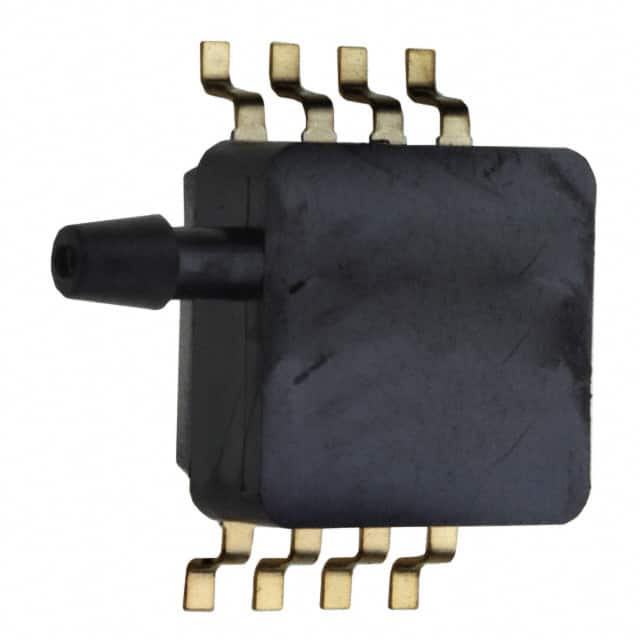
- Part No.:
- MPXV5010GP
- Manufacturer:
- NXP Semiconductors
- Category:
- Pressure Sensors, Transducers
- Package:
- 8-SMD, Gull Wing, Side Port
- Datasheet:
-
 MPXV5010GP.pdf
- Description:
- SENSOR 1.45PSIG 0.13" 4.7V 8SOP
- Quantity:
- Payment:

- Shipping:

Inventory:241
Please send an inquiry. Send us your inquiry, and we will respond immediately.
Product details
Overview
MPXV5010GP from NXP Semiconductors is a gauge-configured, monolithic silicon piezoresistive pressure sensor with on-chip signal conditioning, factory temperature compensation (–40 °C to +125 °C), and calibration. It delivers a ratiometric analog output (0.2–4.925 V at 5 V supply) over a 0–10 kPa full-scale range, with ±5.0% accuracy (VFSS) across 0–85 °C, and is housed in an SOT1693-3 small-outline package (12.06 mm × 12.06 mm × 7.62 mm). It is used in HVAC airflow monitoring and respiratory system pressure feedback.
For engineers reviewing the MPXV5010GP datasheet, MPXV5010GP pinout, MPXV5010GP application, or MPXV5010GP equivalent, this page provides verified technical context, validated pin functions, real-world use scenarios, and confirmed alternative options for pressure sensing in microcontroller-based embedded systems requiring stable, calibrated analog output.
Technical Context
The MPXV5010GP integrates a patented silicon shear-stress strain gauge with thin-film metallization and bipolar processing to generate a high-level analog output directly proportional to applied gauge pressure. Its internal circuitry includes two gain stages, ground-reference shift circuitry, and on-die temperature compensation networks that correct offset and span drift across –40 °C to +125 °C.
It operates ratiometrically with a 4.75–5.25 V supply, draws ≤10 mA, and features a 1.0 ms response time (10–90% step response) and <20 ms warm-up time. The device uses dry air as its qualified pressure medium and requires external decoupling (1.0 µF + 0.01 µF + 470 pF) per Figure 11 to meet specified performance.
Key Specifications
| Parameter | Value and Actual Design Meaning |
|---|---|
| Pressure Range | 0–10 kPa full-scale gauge pressure - defines usable differential input range before saturation or nonlinearity exceeds spec. |
| Output Voltage Range | 0.2–4.925 V at VS = 5.0 V - enables direct interface to 5 V ADCs without external amplification or level-shifting. |
| Accuracy | ±5.0% of Full Scale Span (VFSS) over 0–85 °C - includes linearity, temp hysteresis, pressure hysteresis, TcSpan, and TcOffset contributions. |
| Supply Voltage | 4.75–5.25 V DC - ratiometric operation ensures output scaling tracks supply variations, simplifying power rail design. |
| Operating Temp | –40 °C to +125 °C - supports industrial and automotive under-hood environments without external thermal management. |
| Response Time | 1.0 ms (10–90%) - suitable for dynamic pressure monitoring in breathing cycles or HVAC damper control loops. |
| Sensitivity | 450 mV/kPa nominal - yields ~4.5 V output at full scale, maximizing ADC resolution utilization. |
Pinout & Package
MPXV5010GP uses the SOT1693-3 surface-mount plastic small-outline package (8-terminal, 2.54 mm pitch, 12.06 mm × 12.06 mm × 7.62 mm body). Pin 1 is No Connect; pins 2–4 are VS, GND, and VOUT respectively; pins 5–8 are all No Connect.
| Pin/Terminal | Circuit Role | Design Meaning |
|---|---|---|
| 1 | No Connect | Internally unconnected - must be left floating or tied to GND per layout best practice; no electrical function. |
| 2 | VS | Positive supply input - accepts 4.75–5.25 V DC; requires local decoupling per Figure 11 to maintain accuracy. |
| 3 | GND | Analog ground reference - must be connected to clean system ground plane; shares return path with VOUT load. |
| 4 | VOUT | Analog output - provides ratiometric voltage proportional to pressure; drives up to 0.1 mA source current. |
| 5–8 | No Connect | Fully isolated terminals - no internal bonding; may be omitted from PCB footprint or grounded for mechanical stability. |
Key Features
| Feature | Design Value |
|---|---|
| On-chip signal conditioning | Integrated amplifier, gain staging, and reference shifting eliminate need for external op-amps or instrumentation circuits. |
| Factory temperature compensation | Compensates offset and span drift across –40 °C to +125 °C using on-die thin-film networks - reduces system-level calibration effort. |
| Gauge pressure configuration | Measures pressure relative to ambient atmosphere via single port - simplifies mounting and eliminates vacuum reference plumbing. |
| Patented silicon shear-stress strain gauge | Provides higher sensitivity and lower hysteresis vs. conventional piezoresistive elements - improves long-term repeatability in cyclic applications. |
| Durable SMT package | Thermoplastic (PPS) body with epoxy unibody construction - withstands reflow soldering and resists moisture ingress in humid environments. |
Applications
| HVAC Airflow Monitoring | Respiratory System Pressure Feedback |
|---|---|
Use Scenario: Detecting duct static pressure or filter clogging in commercial HVAC units using microcontroller-based control logic. IC Role / Device Role / Timing Role: Gauge pressure transducer providing analog voltage output proportional to differential airflow resistance. Use Value: Enables closed-loop fan speed adjustment and maintenance alerts without external signal conditioning or calibration firmware. | Use Scenario: Measuring airway pressure in portable ventilators or CPAP machines during patient inhalation/exhalation cycles. IC Role / Device Role / Timing Role: Primary pressure sensing element delivering real-time analog feedback to safety-critical pressure regulation algorithms. Use Value: Delivers sub-millisecond response and ±5.0% accuracy across clinical temperature ranges, supporting FDA-compliant pressure control. |
| Washing Machine Water Level Detection | Industrial Process Control |
Use Scenario: Inferring water volume in drum-based appliances by measuring air pressure in sealed air trap chambers. IC Role / Device Role / Timing Role: Low-range gauge sensor converting trapped air compression into calibrated voltage for MCU A/D conversion. Use Value: Replaces mechanical float switches with solid-state reliability and enables precise fill-level estimation down to ±0.5 kPa error. | Use Scenario: Monitoring low-pressure gas or liquid lines in factory automation systems where overpressure must trigger shutdown. IC Role / Device Role / Timing Role: Safety-critical pressure monitor interfaced to PLC analog inputs via signal-conditioned voltage output. Use Value: Provides factory-calibrated output with known error budget, reducing validation time for IEC 61508 SIL-2 functional safety compliance. |
Equivalent & Alternatives
The following parts are listed as comparable options for similar gauge pressure sensing applications.
| Alternative Part | Technical Difference | Application Difference | Selection Advice |
|---|---|---|---|
| MPXV5004DP | 0–4 kPa range, same SOT1693-1 package, identical pinout and compensation - lower full-scale range limits max measurable pressure. | Optimized for ultra-low-pressure applications like medical nebulizers or leak detection - not suitable for 10 kPa HVAC ducts. | Select when system pressure never exceeds 4 kPa and higher resolution at low end is prioritized over range. |
| MPXV7002DP | 0–2 kPa range, SOIC-8 package, ±2.5% accuracy - tighter error band but narrower range and different footprint. | Targets precision low-pressure biomedical devices requiring <1% error - incompatible with existing MPXV5010GP PCB layout. | Choose only if accuracy requirement exceeds ±5.0% and board redesign is acceptable. |
Compared with MPXV5010GP, MPXV5004DP offers identical architecture and pin compatibility but reduced range, while MPXV7002DP trades range and layout compatibility for improved accuracy in niche low-pressure applications - neither is a drop-in replacement without system-level recalibration or hardware revision.
Availability
MPXV5010GP is available at Aetrix Electronics and suitable for HVAC airflow monitoring, respiratory system pressure feedback, and washing machine water level detection requiring stable component supply and long-term production continuity.
Supply support for MPXV5010GP includes scheduled delivery planning, volume procurement assistance, BOM continuity management, traceable sourcing, and lifecycle availability coordination for OEM customers, industrial embedded developers, connected-device designers, and electronics production programs.
Manufacturer
NXP Semiconductors is a global semiconductor company headquartered in Eindhoven, Netherlands, specializing in secure connectivity solutions for automotive, industrial, and IoT markets.
The MPXV5010GP belongs to NXP's MPxx5010 series of integrated silicon pressure sensors, designed specifically for microcontroller-based systems requiring calibrated, temperature-compensated analog pressure output in compact SMT packages.
FAQ
What is the maximum rated pressure for MPXV5010GP?
The MPXV5010GP has a maximum pressure rating of 40 kPa (Table 5, Limiting Values). This is the absolute upper limit beyond which permanent damage may occur. Its specified full-scale operating range remains 0–10 kPa, and output saturates outside this range per Figure 12. Exceeding 40 kPa violates absolute maximum ratings and voids reliability guarantees.
Does MPXV5010GP require external signal conditioning?
No, MPXV5010GP does not require external signal conditioning. It integrates on-chip amplification, temperature compensation networks, and calibration circuitry to deliver a fully conditioned 0.2–4.925 V analog output directly proportional to applied gauge pressure. External decoupling (1.0 µF + 0.01 µF + 470 pF) is mandatory per Figure 11, but no op-amps, ADC drivers, or offset trimming are needed.
Is MPXV5010GP compatible with wet or corrosive media?
MPXV5010GP is qualified for use with dry air only. NXP explicitly states that media other than dry air "may have adverse effects on sensor performance and long-term reliability." Fluorosilicone gel isolates the die, but chemical compatibility with liquids, solvents, or aggressive gases is not guaranteed. Contact NXP for media-specific qualification data before deploying MPXV5010GP in non-dry-air environments.
What is the pin 1 function on MPXV5010GP?
Pin 1 of MPXV5010GP is a No Connect (N.C.), as confirmed in Table 4 (Pin descriptions - Small Outline packages) and Figure 7 (MPXV5010GP - SOT1693-3 - Case 1369-01). It is internally unconnected and must remain floating or optionally tied to GND for mechanical stability - it serves no electrical function in the MPXV5010GP circuit.
How does MPXV5010GP handle temperature variation?
MPXV5010GP incorporates on-die thin-film temperature compensation networks that actively correct both offset and full-scale span drift across –40 °C to +125 °C. Its accuracy specification of ±5.0% VFSS applies over 0–85 °C (Table 6), and Figure 13 shows the temperature error multiplier remains within ±3× nominal at extremes. Compensation is factory-trimmed and requires no user calibration.
MPXV5010GP Specifications
- Product attributes
- Attribute value
- Manufacturer:
- NXP Semiconductors
- Series:
- MPXV5010
- Package/Case:
- 8-SMD, Gull Wing, Side Port
- Packaging:
- Tray
- Product Status:
- Active
- Applications:
- Board Mount
- Pressure Type:
- Vented Gauge
- Operating Pressure:
- 1.45PSI (10kPa)
- Output Type:
- Analog Voltage
- Output:
- 0.2 V ~ 4.7 V
- Accuracy:
- ±5%
- Voltage - Supply:
- 4.75V ~ 5.25V
- Port Size:
- Male - 0.13" (3.17mm) Tube
- Port Style:
- Barbed
- Features:
- Temperature Compensated
- Termination Style:
- Gull Wing
- Maximum Pressure:
- 5.8PSI (40kPa)
- Operating Temperature:
- -40°C ~ 125°C
- Grade:
- -
- Qualification:
- -
- Mounting Type:
- Surface Mount
- Supplier Device Package:
- 8-SOP
MPXV5010GP FAQ
1.How can I place an order for MPXV5010GP through Aetrix?
Please submit a Request for Quotation (RFQ) for MPXV5010GP on Aetrix. Our sales agent will provide a competitive quotation and guide you through the order confirmation once you accept the terms.
2.Are the price and stock information for MPXV5010GP reliable?
The price and inventory of MPXV5010GP are updated periodically and may fluctuate due to market conditions. Stock and pricing data are typically refreshed every 24 hours. Quotation validity for MPXV5010GP is usually 5 days.
3.What payment methods are accepted for MPXV5010GP?
We accept Wire Transfer, PayPal, Credit Card, Western Union, MoneyGram, and Escrow for MPXV5010GP transactions.
Note: Certain payment methods may incur a processing fee.
4.How is shipping managed for MPXV5010GP?
MPXV5010GP orders can be shipped via leading logistics carriers, including DHL, UPS, FedEx, TNT, or Registered Mail.
Once your MPXV5010GP order is processed, you will receive an email with the shipment details and tracking number.
Note: Tracking information may take up to 24 hours to appear. Express delivery typically takes 3–5 business days.
5.How can I obtain technical support or documentation for MPXV5010GP?
For technical support, including MPXV5010GP datasheets, pinout diagrams, or application guidance, please contact our engineering support team. They can provide detailed documentation and assistance for your MPXV5010GP requirements.
6.How does Aetrix verify that MPXV5010GP is sourced from the original manufacturer or authorized distributors?
All MPXV5010GP products on Aetrix are procured from qualified distributors and authorized channels. Our dedicated quality assurance team conducts strict verification, including traceability checks and, if necessary, third-party testing. This ensures that MPXV5010GP meets industry standards.
7.What is the process for return or replacement of MPXV5010GP?
All MPXV5010GP units undergo pre-shipment inspection (PSI). If there is an issue with MPXV5010GP, returns or replacements are accepted under the following conditions:
1.Quantity discrepancies, incorrect items, or visible external defects (such as breakage or corrosion), acknowledged by Aetrix.
2.The issue is reported within 90 days of delivery.
3.The MPXV5010GP part is unused and in its original packaging.
Return procedure for MPXV5010GP:
1.Submit a request within 90 days.
2.Obtain a Return Material Authorization (RMA) from Aetrix.
MPXV5010GP Tags
-
DPS368XTSA1
Infineon Technologies
-
DPS310XTSA1
Infineon Technologies
-
LPS22HHTR
STMicroelectronics

-
ICP-20100
TDK InvenSense
-
ICP-10110
TDK InvenSense
-
LPS22DFTR
STMicroelectronics
-
LPS22HBTR
STMicroelectronics
-
BMP390
Bosch Sensortec
-
BMP581
Bosch Sensortec
-
BMP384
Bosch Sensortec
-
2511020213301
Würth Elektronik
-
ILPS22QSTR
STMicroelectronics
Tech Hub

A practical engineering guide to 3.3V and 5V logic compatibility, input thresholds, resistor dividers, translator ICs, MOSFET level shifting, I2C pull-ups, timing limits and power-sequencing risks.

The 74HC595 uses push-pull logic outputs, while the TPIC6B595 uses 50 V open-drain DMOS sinks for higher-power loads. This guide compares timing, current limits, 3.3 V interfacing, load wiring, thermal…

The 74HC595 converts serial data into eight stable parallel outputs. This guide covers pin functions, shift and storage timing, OE and MR behavior, drive-current limits, cascading, voltage compatibilit…

A technical comparison of level-sensitive latches and edge-triggered flip-flops, covering timing windows, setup and hold limits, master–slave operation, time borrowing, race-through, HDL inference and…

A D latch stores one bit while Enable controls when data can pass. This reference covers gate-level operation, truth tables, transparency, setup and hold timing, LE versus OE, common ICs and practical …

An SR latch stores one bit through cross-coupled feedback. This engineering reference covers NOR and NAND implementations, truth tables, forbidden-state recovery, gated operation, switch debouncing, fa…

Latch circuits retain one bit through feedback. This technical reference covers SR and D latches, truth tables, transparency, timing limits, latch-versus-flip-flop behavior, applications and common log…

An engineering guide to LED driver operation, constant-current and constant-voltage outputs, linear and switching topologies, dimming, IC selection, calculations, replacement compatibility, and fault c…

Operational amplifier guide covering op amp basics, feedback, ideal vs real op amps, common configurations, buffer circuits, offset, bias current, gain-bandwidth, slew rate, rail-to-rail limits and sel…

Jumper cables guide covering safe connection order, red and black clamp placement, final ground connection, cable gauge, length, clamp quality, copper vs CCA cables, jump starter comparison and battery…


