
 My Inquiry
 My Account


Nexperia USA Inc. PMEG060V050EPDAZ
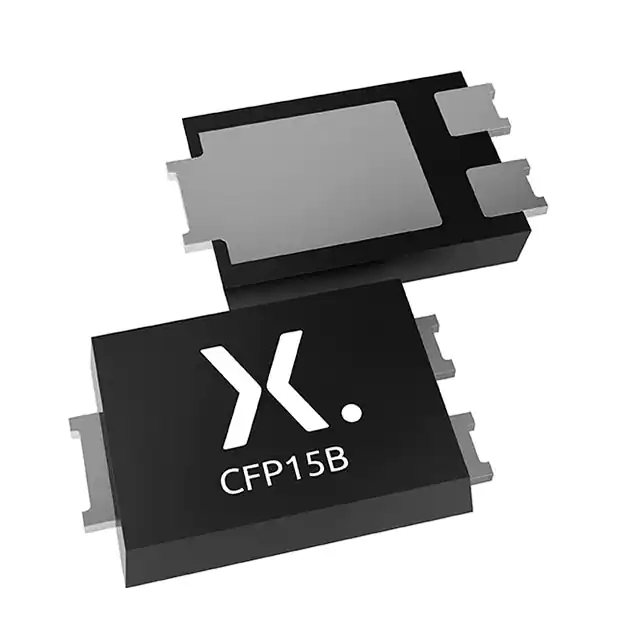
- Part No.:
- PMEG060V050EPDAZ
- Manufacturer:
- Nexperia USA Inc.
- Category:
- Single Diodes
- Package:
- TO-277, 3-PowerDFN
- Datasheet:
-
 PMEG060V050EPDAZ.pdf
- Description:
- DIODE SCHOTTKY 60V 5A CFP15
- Quantity:
- Payment:

- Shipping:

Inventory:22,528
Please send an inquiry. Send us your inquiry, and we will respond immediately.
Product details
Overview
PMEG060V050EPDAZ from Nexperia is a 60 V, 5 A planar MEGA Schottky barrier rectifier in CFP15 (SOT1289) package, featuring integrated guard ring for stress protection and clip-bonding technology for enhanced thermal performance. It delivers low forward voltage (480–560 mV at 5 A, 25 °C), ultra-thin profile (0.78 mm height), and AEC-Q101 qualification-enabling use in automotive DC/DC converters and high-efficiency power supplies.
For engineers reviewing the PMEG060V050EPDAZ datasheet, PMEG060V050EPDAZ pinout, PMEG060V050EPDAZ application, or PMEG060V050EPDAZ equivalent, key selection criteria include forward voltage at rated current, reverse leakage at 60 V, thermal resistance to solder point (3 K/W), and AEC-Q101 compliance for automotive-grade reliability.
Technical Context
This Schottky diode uses planar MEGA architecture with an integrated guard ring to suppress edge breakdown and improve ruggedness under repetitive surge conditions. Its clip-bonded construction directly connects the die to the cathode thermal pad, reducing junction-to-solder-point thermal resistance to just 3 K/W on ceramic PCBs.
The device operates as a unidirectional power rectifier with zero reverse recovery time (trr < 17 ns), enabling high-frequency switching in synchronous buck converters and freewheeling paths. It maintains stable VF below 435 mV at 5 A and 125 °C, supporting thermally constrained automotive modules.
Key Specifications
| Parameter | Value and Actual Design Meaning |
|---|---|
| VR | 60 V maximum reverse voltage - supports 48 V automotive bus systems with margin against load dump transients |
| IF(AV) | 5 A average forward current - enables continuous operation in 25 W DC/DC stages with standard FR4 layout |
| VF @ 5 A, 25 °C | 480–560 mV - reduces conduction loss by >30% vs. standard Schottkys, improving efficiency in 12 V→5 V/3.3 V conversion |
| IR @ 60 V, 25 °C | 100–400 µA - low leakage preserves battery standby life in always-on vehicle modules |
| Rth(j-sp) | 3 K/W - enables direct thermal coupling to PCB ground plane, critical for sustained 5 A operation without heatsink |
| trr | 12–17 ns - eliminates reverse recovery loss in >500 kHz switching topologies, reducing EMI and MOSFET stress |
| AEC-Q101 | Qualified - certified for automotive powertrain and body electronics per stress test requirements |
Pinout & Package
Encapsulated in CFP15 (SOT1289): ultra-thin surface-mount plastic package measuring 5.8 × 4.3 × 0.78 mm, with exposed cathode thermal pad for PCB heat sinking.
| Pin/Terminal | Circuit Role | Design Meaning |
|---|---|---|
| 1 | Anode | Primary current entry point; dual-anode configuration (Pins 1 & 2) lowers series resistance and improves current sharing |
| 2 | Anode | Second anode terminal - electrically parallel to Pin 1, used for high-current routing and thermal symmetry |
| 3 | Cathode | High-current return path and primary thermal interface; large copper tab enables direct PCB thermal conduction |
Key Features
| Feature | Design Value |
|---|---|
| Guard ring integration | Prevents premature edge breakdown under high dv/dt, extending lifetime in noisy automotive environments |
| Clip-bonding technology | Reduces bond wire inductance and thermal resistance - enables 160 A non-repetitive surge capability (IFSM) |
| Ultra-thin SMD profile | 0.78 mm max height - allows stacking in space-constrained infotainment and ADAS modules |
| AEC-Q101 qualification | Validated for automotive temperature range (−40 °C to +175 °C junction), including HTRB and TC testing |
| Low VF across temperature | 435 mV typical at 5 A and 125 °C - ensures stable efficiency over full operating range without derating |
Applications
| Automotive DC/DC Converter | Reverse Polarity Protection |
|---|---|
|
Use Scenario: 12 V to 5 V/3.3 V step-down converter in engine control unit (ECU) power management. IC Role / Device Role / Timing Role: Freewheeling diode in synchronous buck topology, conducting during low-side switch off-time. Use Value: Low VF minimizes conduction loss at 5 A peak, sustaining >92% efficiency at full load while meeting AEC-Q101 thermal cycling requirements. |
Use Scenario: Input protection circuit for telematics control unit (TCU) powered from vehicle battery. IC Role / Device Role / Timing Role: Series-blocking rectifier placed between battery input and system LDO/regulator. Use Value: 100–400 µA IR at 60 V ensures <10 µW standby dissipation, preserving battery charge during multi-week vehicle dormancy. |
| High-Efficiency SMPS | Low-Voltage Freewheeling |
|
Use Scenario: Secondary-side rectification in 48 V server PSU with GaN primary-side switching. IC Role / Device Role / Timing Role: Output rectifier handling continuous 5 A output current at 12 V. Use Value: 3 K/W Rth(j-sp) allows direct thermal coupling to 1 cm² copper pour, eliminating need for external heatsink in 1U form factor. |
Use Scenario: Inductor flyback path in portable medical pump motor driver (24 V supply). IC Role / Device Role / Timing Role: Unidirectional clamp preventing voltage overshoot during PWM turn-off. Use Value: 12 ns trr eliminates reverse recovery tail, reducing MOSFET VDS spike and EMI filter size by 40% vs. standard Schottky alternatives. |
Equivalent & Alternatives
The following parts are listed as comparable options for similar Schottky rectifier applications.
| Alternative Part | Technical Difference | Application Difference | Selection Advice |
|---|---|---|---|
| STPS5L60SF | 60 V, 5 A; VF = 520–600 mV @ 5 A, 25 °C; Rth(j-a) = 50 K/W (FR4); no AEC-Q101 qualification | Targeted at industrial SMPS - lacks automotive qualification and thermal performance for under-hood use | Select when cost sensitivity outweighs AEC-Q101 requirement and thermal constraints are relaxed |
| RB055LAM-40 | 40 V, 5 A; VF = 450 mV @ 5 A, 25 °C; Rth(j-sp) = 4.5 K/W; AEC-Q101 qualified | Limited to ≤36 V systems - insufficient reverse voltage margin for 48 V automotive transients | Choose only for 24 V battery systems where 60 V rating is unnecessary and lower VF is prioritized |
Compared with STPS5L60SF and RB055LAM-40, PMEG060V050EPDAZ uniquely combines 60 V rating, AEC-Q101 qualification, sub-500 mV VF at 5 A, and 3 K/W Rth(j-sp), making it the sole option for thermally dense, automotive-grade 48 V DC/DC designs requiring long-term reliability.
Availability
PMEG060V050EPDAZ is available at Aetrix Electronics and suitable for automotive power modules, high-efficiency DC/DC converters, and reverse polarity protection circuits requiring stable component supply across extended temperature ranges and long production lifecycles.
Supply support for PMEG060V050EPDAZ includes scheduled delivery planning, volume procurement assistance, BOM continuity management, traceable sourcing, and lifecycle availability coordination for OEM customers, industrial embedded developers, connected-device designers, and electronics production programs.
Manufacturer
Nexperia is a global semiconductor expert specializing in high-performance, reliable discrete, logic, and MOSFET devices, with leadership in automotive-qualified components and energy-efficient power solutions.
This device belongs to Nexperia's MEGA Schottky rectifier product line, engineered specifically for automotive and industrial power conversion where low VF, robust surge capability, and AEC-Q101 compliance are mandatory.
FAQ
What is the maximum junction temperature and how does it impact layout design?
The absolute maximum junction temperature is 175 °C. To sustain 5 A average current, the PCB must provide adequate thermal relief: a 1 cm² cathode pad on FR4 achieves 70 K/W Rth(j-a), while ceramic (Al₂O₃) reduces it to 40 K/W. Layout must avoid thermal isolation of Pin 3 and ensure solder mask opening under the cathode tab.
Is PMEG060V050EPDAZ suitable for synchronous rectification?
No - this is a passive Schottky rectifier, not a synchronous MOSFET controller or integrated FET. It functions as a freewheeling or output rectifier in non-synchronous topologies. For synchronous rectification, a dedicated gate driver and MOSFET pair are required; this diode serves as the baseline solution where simplicity and surge robustness are prioritized over peak efficiency.
How does the dual-anode (Pins 1 & 2) configuration affect PCB routing?
Pins 1 and 2 are internally shorted anodes, intended for parallel trace routing to halve effective series resistance and distribute thermal load. PCB layout should use identical copper width/length for both anode traces and maintain symmetry to prevent current imbalance - critical for achieving rated 5 A IF(AV) without localized heating.
What is the significance of the 160 A IFSM rating and how is it tested?
The 160 A non-repetitive peak forward surge rating is validated per IEC 60134 with 8 ms square-wave pulse at Tj(init) = 25 °C. It reflects the device's ability to survive load dump or inductive kick events in automotive systems. This rating relies on clip-bonding and thermal mass - sustained surges require verification against transient thermal impedance curves (Fig. 1–3) in the datasheet.
PMEG060V050EPDAZ Specifications
- Product attributes
- Attribute value
- Manufacturer:
- Nexperia USA Inc.
- Series:
- -
- Package/Case:
- TO-277, 3-PowerDFN
- Packaging:
- Tape & Reel (TR)
- Product Status:
- Not For New Designs
- Technology:
- Schottky
- Voltage - DC Reverse (Vr) (Max):
- 60 V
- Current - Average Rectified (Io):
- 5A
- Voltage - Forward (Vf) (Max) @ If:
- 560 mV @ 5 A
- Speed:
- Fast Recovery =< 500ns, > 200mA (Io)
- Reverse Recovery Time (trr):
- 12 ns
- Current - Reverse Leakage @ Vr:
- 400 µA @ 60 V
- Capacitance @ Vr, F:
- 175pF @ 10V, 1MHz
- Grade:
- Automotive
- Qualification:
- AEC-Q101
- Mounting Type:
- Surface Mount
- Supplier Device Package:
- CFP15
- Operating Temperature - Junction:
- 175°C (Max)
PMEG060V050EPDAZ FAQ
1.How can I place an order for PMEG060V050EPDAZ through Aetrix?
Please submit a Request for Quotation (RFQ) for PMEG060V050EPDAZ on Aetrix. Our sales agent will provide a competitive quotation and guide you through the order confirmation once you accept the terms.
2.Are the price and stock information for PMEG060V050EPDAZ reliable?
The price and inventory of PMEG060V050EPDAZ are updated periodically and may fluctuate due to market conditions. Stock and pricing data are typically refreshed every 24 hours. Quotation validity for PMEG060V050EPDAZ is usually 5 days.
3.What payment methods are accepted for PMEG060V050EPDAZ?
We accept Wire Transfer, PayPal, Credit Card, Western Union, MoneyGram, and Escrow for PMEG060V050EPDAZ transactions.
Note: Certain payment methods may incur a processing fee.
4.How is shipping managed for PMEG060V050EPDAZ?
PMEG060V050EPDAZ orders can be shipped via leading logistics carriers, including DHL, UPS, FedEx, TNT, or Registered Mail.
Once your PMEG060V050EPDAZ order is processed, you will receive an email with the shipment details and tracking number.
Note: Tracking information may take up to 24 hours to appear. Express delivery typically takes 3–5 business days.
5.How can I obtain technical support or documentation for PMEG060V050EPDAZ?
For technical support, including PMEG060V050EPDAZ datasheets, pinout diagrams, or application guidance, please contact our engineering support team. They can provide detailed documentation and assistance for your PMEG060V050EPDAZ requirements.
6.How does Aetrix verify that PMEG060V050EPDAZ is sourced from the original manufacturer or authorized distributors?
All PMEG060V050EPDAZ products on Aetrix are procured from qualified distributors and authorized channels. Our dedicated quality assurance team conducts strict verification, including traceability checks and, if necessary, third-party testing. This ensures that PMEG060V050EPDAZ meets industry standards.
7.What is the process for return or replacement of PMEG060V050EPDAZ?
All PMEG060V050EPDAZ units undergo pre-shipment inspection (PSI). If there is an issue with PMEG060V050EPDAZ, returns or replacements are accepted under the following conditions:
1.Quantity discrepancies, incorrect items, or visible external defects (such as breakage or corrosion), acknowledged by Aetrix.
2.The issue is reported within 90 days of delivery.
3.The PMEG060V050EPDAZ part is unused and in its original packaging.
Return procedure for PMEG060V050EPDAZ:
1.Submit a request within 90 days.
2.Obtain a Return Material Authorization (RMA) from Aetrix.
PMEG060V050EPDAZ Tags
-
1N4448X-TP
Micro Commercial Co
-
1N4148WX-TP
Micro Commercial Co

-
1N4148TR
onsemi
-
MMSD4148T1G
onsemi
-
MMBD914LT3G
onsemi
-
BAS16HT1G
onsemi
-
1N914BWT
onsemi
-
BAS21LT1G
onsemi
-
LL4148
onsemi
-
BAS16LT1G
onsemi
-
MMSD914T1G
onsemi
-
BAV21W-7-F
Diodes Incorporated
Tech Hub

Jumper cables guide covering safe connection order, red and black clamp placement, final ground connection, cable gauge, length, clamp quality, copper vs CCA cables, jump starter comparison and battery…

LDO regulator guide covering low dropout voltage, power dissipation, thermal design, PSRR, output noise, capacitor stability, adjustable LDO circuits, LDO vs buck converter and datasheet selection chec…

Conditional Access Module guide covering CAM meaning, CI/CI+ interface, smart card authorization, DVB security workflow, TV and set-top box compatibility, internal electronics, ESD protection, connecto…

Guide to electronic component obsolescence covering EOL risk, PCN/PDN notices, last-time buy planning, replacement options, form-fit-function validation, counterfeit risk and BOM lifecycle management.

18650 battery guide covering lithium-ion cell basics, 3.6V/3.7V voltage, 4.2V charging, mAh and Wh capacity, protected cells, chargers, BMS, series-parallel packs, holders, welding and sourcing checks.…

Hall effect sensor guide covering working principle, linear and digital sensors, Arduino circuits, current sensing, speed detection, automotive applications, A3144 examples, signal filtering and datash…

Product Change Notification guide for electronic components, covering PCN meaning, PCN vs PDN/EOL, common change types, risk levels, form-fit-function review, engineering validation, BOM control, LTB/L…

A practical guide to blend door actuators, covering HVAC function, symptoms, location, AC and heater issues, reset and calibration, replacement cost, electrical diagnosis, compatibility checks, and rep…

Engineering guide to Raspberry Pi alternatives, covering chip-level differences, Orange Pi, ROCK, Jetson, Banana Pi, NanoPi, Compute Module, Pico, GPIO, camera, HAT compatibility, and replacement risks…
Engineering guide to dynamic load response testing for high-current buck converters, covering load step setup, slew rate, Vcore undershoot, overshoot, recovery time, probe location, output capacitors a…


