
 My Inquiry
 My Account


STMicroelectronics SMP100LC-140
- Part No.:
- SMP100LC-140
- Manufacturer:
- STMicroelectronics
- Category:
- Thyristors
- Package:
- DO-214AA, SMB
- Datasheet:
-
 SMP100LC-140.pdf
- Description:
- THYRISTOR 140V 400A DO-214AA
- Quantity:
- Payment:

- Shipping:

Inventory:2,110
Please send an inquiry. Send us your inquiry, and we will respond immediately.
Product details
Overview
SMP100LC-140 from STMicroelectronics is a bidirectional thyristor surge suppressor (TSS) designed for fail-safe overvoltage protection on high-speed data lines. It features a 140 V breakover voltage (VBO), 100 A repetitive peak pulse current (10/1000 µs), 65 pF capacitance at 2 V, ≤2 µA leakage current, and 30 mA minimum holding current (IH). It is used in xDSL and Ethernet line cards to prevent signal distortion while meeting GR-1089 Core and ITU-T K20/K21 standards.
For engineers reviewing the SMP100LC-140 datasheet, SMP100LC-140 pinout, SMP100LC-140 application, or SMP100LC-140 equivalent, key selection criteria include bidirectional crowbar behavior, low capacitance for signal integrity, fail-safe short-circuit mode under fault, and compliance with telecom surge immunity standards including IEC 61000-4-5 and UL497B.
Technical Context
The SMP100LC-140 operates as a voltage-triggered bidirectional thyristor that latches into low-impedance conduction upon exceeding its static breakover voltage of 175 V (max) and dynamic breakover voltage of 180 V (max). Its fail-safe short-circuit mode ensures equipment protection even after repeated surges without degradation.
It delivers 100 A surge handling per 10/1000 µs waveform with thermal resistance Rth(j-a) = 100 °C/W and junction temperature range from –40 °C to +150 °C. The device requires no external trigger circuitry and maintains stable VBO across temperature due to integrated thermal compensation.
Key Specifications
| Parameter | Value and Actual Design Meaning |
|---|---|
| Breakover Voltage (VBO) | 175 V max static, 180 V max dynamic - defines precise clamping threshold before crowbar activation |
| Repetitive Peak Pulse Current | 100 A @ 10/1000 µs - supports multiple lightning-induced transients without degradation |
| Junction Capacitance | 65 pF @ 2 V - preserves signal integrity on 10/100/1000BASE-T Ethernet and ADSL2+ lines |
| Leakage Current | ≤2 µA @ 126 V - minimizes standby power loss and avoids false triggering |
| Holding Current (IH) | 30 mA min - ensures reliable latch-on during surge and clean turn-off after fault clearance |
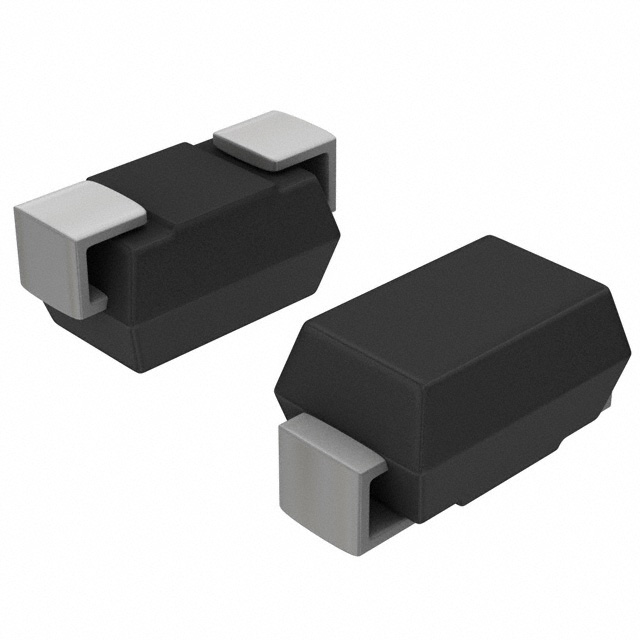
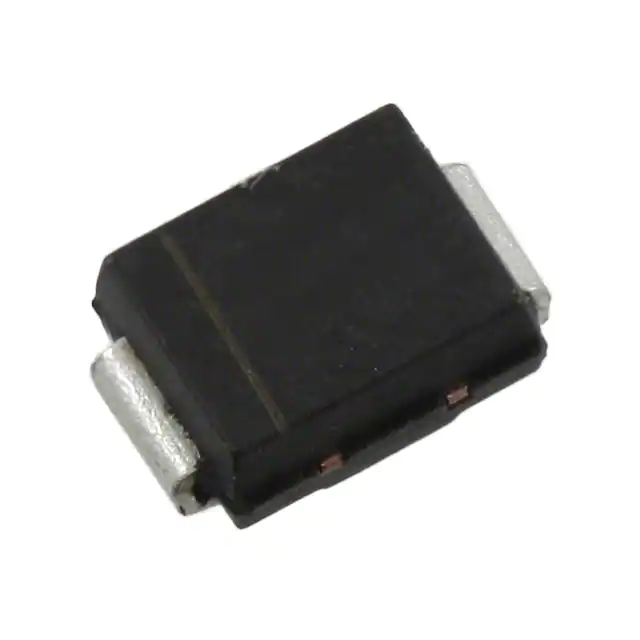
| Package | DO-214AA (SMB) - JEDEC-registered surface-mount package with UL94 V0 epoxy and lead-free plating |
Pinout & Package
Package: DO-214AA (SMB), surface-mount, two-terminal device with cathode and anode terminals. Dimensions: 3.30–3.95 mm length × 5.10–5.60 mm width × 1.90–2.45 mm height. Thermal resistance: Rth(j-l) = 20 °C/W, Rth(j-a) = 100 °C/W (with recommended footprint).
| Pin/Terminal | Circuit Role | Design Meaning |
|---|---|---|
| Anode (A) | Surge current entry point in positive half-cycle | Connects to protected line; forms bidirectional conduction path with cathode |
| Cathode (K) | Surge current return path in positive half-cycle | Completes crowbar loop; symmetric role with anode during negative transients |
Key Features
| Feature | Design Value |
|---|---|
| Bidirectional crowbar protection | Self-triggering conduction in both polarities without external bias or control |
| Fail-safe short-circuit mode | Latches permanently low-impedance during end-of-life surge events, preventing open-circuit failure |
| Low 65 pF capacitance at 2 V | Enables use on >100 Mbps data lines without measurable rise-time degradation or jitter |
| UL497B recognition & UL94 V0 epoxy | Validated for primary-side telecom surge protection with flame-retardant housing |
| GR-1089 Core & ITU-T K20/K21 compliance | Qualified for first-level (2500 V) and intra-building (1500 V) telecom surge immunity testing |
Applications
| DSL Line Cards | Ethernet PHY Interfaces |
|---|---|
Use Scenario: Protection of ADSL2+/VDSL2 line drivers against induced lightning surges on twisted-pair copper loops. IC Role / Device Role / Timing Role: Bidirectional crowbar clamping element placed between line transformer secondary and PHY IC input. Use Value: 65 pF capacitance avoids signal attenuation above 2.2 MHz; 100 A surge rating withstands GR-1089 Core Level 1 (2500 V, 10/1000 µs). | Use Scenario: Surge suppression on 100BASE-TX or 1000BASE-T magnetics secondary side in industrial switches. IC Role / Device Role / Timing Role: Fail-safe transient voltage suppressor connected across differential pairs prior to RJ45 connector. Use Value: ≤2 µA leakage prevents DC bias shift on transformer-coupled inputs; UL497B recognition supports safety certification. |
| Telecom Central Office Equipment | Building Entrance Protection Units |
Use Scenario: First-stage protection in DSLAM line cards exposed to longitudinal surges from outside plant wiring. IC Role / Device Role / Timing Role: Primary crowbar device in series with gas discharge tube (GDT) for coordinated two-stage clamping. Use Value: 140 V VRWM rating matches common telecom AC feed rejection thresholds; SMB package enables automated SMT assembly. | Use Scenario: In-line surge protection module installed at building entry point for T1/E1 or ISDN lines. IC Role / Device Role / Timing Role: Standalone bidirectional protector mounted directly on PCB with trace routing to service entrance terminals. Use Value: 175 V static VBO ensures coordination with upstream GDTs; UL94 V0 epoxy meets fire-safety requirements for wall-mounted enclosures. |
Equivalent & Alternatives
The following parts are listed as comparable options for similar thyristor surge suppressor applications.
| Alternative Part | Technical Difference | Application Difference | Selection Advice |
|---|---|---|---|
| SMCJ130CA | Unidirectional TVS diode, 130 V standoff, 100 A peak pulse, 150 pF capacitance | Lacks fail-safe short-circuit mode; degrades to open circuit after endurance limit | Select only if unidirectional protection suffices and lower capacitance is not required |
| P6SMB150A | Unidirectional TVS, 150 V standoff, 100 A peak pulse, ~200 pF capacitance | No crowbar latching; higher capacitance limits use on >10 Mbps lines | Use only for low-speed analog or power-line protection where signal integrity is non-critical |
Compared with SMCJ130CA and P6SMB150A, the SMP100LC-140 provides bidirectional crowbar action, fail-safe short-circuit behavior, and 65 pF capacitance-making it uniquely suitable for high-speed telecom data line protection where reliability and signal fidelity are jointly critical.
Availability
SMP100LC-140 is available at Aetrix Electronics and suitable for DSL line cards, Ethernet PHY interfaces, telecom central office equipment, and building entrance protection units requiring stable component supply and long-term lifecycle support.
Supply support for SMP100LC-140 includes scheduled delivery planning, volume procurement assistance, BOM continuity management, traceable sourcing, and lifecycle availability coordination for OEM customers, industrial embedded developers, connected-device designers, and electronics production programs.
Manufacturer
STMicroelectronics is a global semiconductor leader headquartered in Geneva, Switzerland, designing and manufacturing analog, power, microcontroller, and sensor solutions for industrial, automotive, and communications markets.
The SMP100LC series belongs to ST's Telecom Circuit Protector product line, engineered specifically to meet stringent GR-1089, ITU-T K20/K21, and IEC 61000-4-5 surge immunity requirements for high-data-rate copper interface protection.
FAQ
What is the fail-safe behavior of SMP100LC-140 during end-of-life surge events?
The SMP100LC-140 enters a permanent low-impedance short-circuit state when subjected to surge energy beyond its I2t rating (20 A²s at 16.6 ms). This fail-safe mode prevents open-circuit failure and maintains downstream equipment isolation, unlike TVS diodes that degrade to high-impedance.
Can SMP100LC-140 be used in AC power line protection?
No. The SMP100LC-140 is rated for signal-line protection only, with maximum continuous reverse voltage of 126 V and operating junction temperature up to +150 °C. It lacks the voltage margin, thermal mass, and creepage/clearance design required for mains AC applications.
How does SMP100LC-140 coordinate with a gas discharge tube (GDT) in two-stage protection?
When placed downstream of a GDT, the SMP100LC-140 provides fast secondary clamping after GDT ionization. Its 175 V static VBO ensures triggering only after the GDT fires (~350–500 V), limiting let-through voltage to <200 V and protecting sensitive PHY ICs.
Is SMP100LC-140 compatible with lead-free reflow soldering processes?
Yes. The device uses lead-free plating and halogen-free molding resin, with maximum lead temperature tolerance of 260 °C for 10 seconds. It complies with JEDEC J-STD-020 moisture sensitivity level (MSL) 1 and supports standard Pb-free reflow profiles.
SMP100LC-140 Specifications
- Product attributes
- Attribute value
- Manufacturer:
- STMicroelectronics
- Package/Case:
- DO-214AA, SMB
- Series:
- SMP, TRISIL™
- Packaging:
- Tape & Reel (TR)
- Product Status:
- Active
- Voltage - Breakover:
- 175V
- Voltage - Off State:
- 140V
- Voltage - On State:
- -
- Current - Peak Pulse (8/20µs):
- 400 A
- Current - Peak Pulse (10/1000µs):
- 100 A
- Current - Hold (Ih):
- 150 mA
- Number of Elements:
- 1
- Capacitance:
- 65pF
- Grade:
- -
- Qualification:
- -
- Mounting Type:
- Surface Mount
- Supplier Device Package:
- SMB
SMP100LC-140 FAQ
1.How can I place an order for SMP100LC-140 through Aetrix?
Please submit a Request for Quotation (RFQ) for SMP100LC-140 on Aetrix. Our sales agent will provide a competitive quotation and guide you through the order confirmation once you accept the terms.
2.Are the price and stock information for SMP100LC-140 reliable?
The price and inventory of SMP100LC-140 are updated periodically and may fluctuate due to market conditions. Stock and pricing data are typically refreshed every 24 hours. Quotation validity for SMP100LC-140 is usually 5 days.
3.What payment methods are accepted for SMP100LC-140?
We accept Wire Transfer, PayPal, Credit Card, Western Union, MoneyGram, and Escrow for SMP100LC-140 transactions.
Note: Certain payment methods may incur a processing fee.
4.How is shipping managed for SMP100LC-140?
SMP100LC-140 orders can be shipped via leading logistics carriers, including DHL, UPS, FedEx, TNT, or Registered Mail.
Once your SMP100LC-140 order is processed, you will receive an email with the shipment details and tracking number.
Note: Tracking information may take up to 24 hours to appear. Express delivery typically takes 3–5 business days.
5.How can I obtain technical support or documentation for SMP100LC-140?
For technical support, including SMP100LC-140 datasheets, pinout diagrams, or application guidance, please contact our engineering support team. They can provide detailed documentation and assistance for your SMP100LC-140 requirements.
6.How does Aetrix verify that SMP100LC-140 is sourced from the original manufacturer or authorized distributors?
All SMP100LC-140 products on Aetrix are procured from qualified distributors and authorized channels. Our dedicated quality assurance team conducts strict verification, including traceability checks and, if necessary, third-party testing. This ensures that SMP100LC-140 meets industry standards.
7.What is the process for return or replacement of SMP100LC-140?
All SMP100LC-140 units undergo pre-shipment inspection (PSI). If there is an issue with SMP100LC-140, returns or replacements are accepted under the following conditions:
1.Quantity discrepancies, incorrect items, or visible external defects (such as breakage or corrosion), acknowledged by Aetrix.
2.The issue is reported within 90 days of delivery.
3.The SMP100LC-140 part is unused and in its original packaging.
Return procedure for SMP100LC-140:
1.Submit a request within 90 days.
2.Obtain a Return Material Authorization (RMA) from Aetrix.
SMP100LC-140 Tags
-
TISP4015L1AJR-S
Bourns Inc.
-
TISP4015L1BJR-S
Bourns Inc.
-
SMP100LC-270
STMicroelectronics
-
TISP4240M3BJR-S
Bourns Inc.
-
SMP100LC-35
STMicroelectronics
-
SMP100LC-65
STMicroelectronics
-
SMP100LC-8
STMicroelectronics
-
TISP4P035L1NR-S
Bourns Inc.
-
TISP4350H3BJR-S
Bourns Inc.
-
TISP4011H1BJR-S
Bourns Inc.
-
SMP100LC-400
STMicroelectronics
-
P0300SALRP
Littelfuse Inc.
Tech Hub

Jumper cables guide covering safe connection order, red and black clamp placement, final ground connection, cable gauge, length, clamp quality, copper vs CCA cables, jump starter comparison and battery…

LDO regulator guide covering low dropout voltage, power dissipation, thermal design, PSRR, output noise, capacitor stability, adjustable LDO circuits, LDO vs buck converter and datasheet selection chec…

Conditional Access Module guide covering CAM meaning, CI/CI+ interface, smart card authorization, DVB security workflow, TV and set-top box compatibility, internal electronics, ESD protection, connecto…

Guide to electronic component obsolescence covering EOL risk, PCN/PDN notices, last-time buy planning, replacement options, form-fit-function validation, counterfeit risk and BOM lifecycle management.

18650 battery guide covering lithium-ion cell basics, 3.6V/3.7V voltage, 4.2V charging, mAh and Wh capacity, protected cells, chargers, BMS, series-parallel packs, holders, welding and sourcing checks.…

Hall effect sensor guide covering working principle, linear and digital sensors, Arduino circuits, current sensing, speed detection, automotive applications, A3144 examples, signal filtering and datash…

Product Change Notification guide for electronic components, covering PCN meaning, PCN vs PDN/EOL, common change types, risk levels, form-fit-function review, engineering validation, BOM control, LTB/L…

A practical guide to blend door actuators, covering HVAC function, symptoms, location, AC and heater issues, reset and calibration, replacement cost, electrical diagnosis, compatibility checks, and rep…

Engineering guide to Raspberry Pi alternatives, covering chip-level differences, Orange Pi, ROCK, Jetson, Banana Pi, NanoPi, Compute Module, Pico, GPIO, camera, HAT compatibility, and replacement risks…
Engineering guide to dynamic load response testing for high-current buck converters, covering load step setup, slew rate, Vcore undershoot, overshoot, recovery time, probe location, output capacitors a…


