
 My Inquiry
 My Account


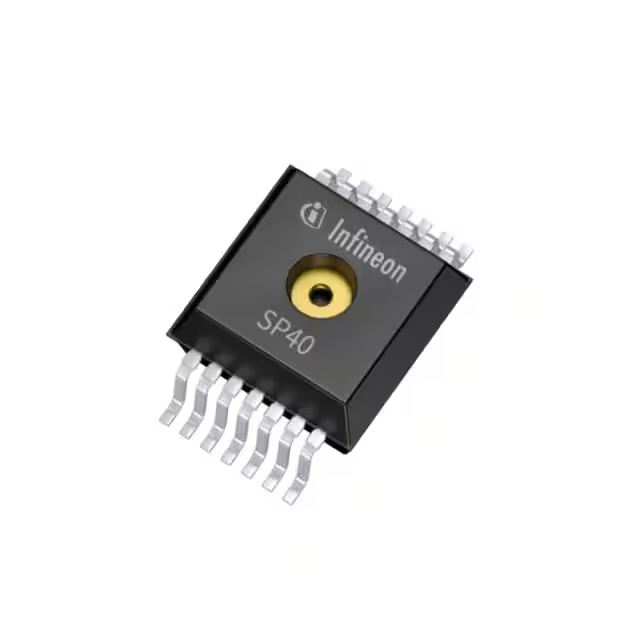
Infineon Technologies SP4001111XTMA1
- Part No.:
- SP4001111XTMA1
- Manufacturer:
- Infineon Technologies
- Category:
- Pressure Sensors, Transducers
- Package:
- -
- Datasheet:
-
 SP4001111XTMA1.pdf
- Description:
- IC TPMS & INERTIA 24DSOSP
- Quantity:
- Payment:

- Shipping:

Inventory:3,067
Please send an inquiry. Send us your inquiry, and we will respond immediately.
Product details
Overview
SP4001111XTMA1 from Infineon Technologies is an automotive-grade, fully integrated Tire Pressure Monitoring Sensor (TPMS) IC combining MEMS pressure sensing (0–140 kPa absolute), z-axis accelerometer (±2 g), temperature sensor (−40°C to +125°C), 8051 microcontroller (14 KB Flash), RF transmitter (315/433 MHz FSK/ASK), and LF receiver in a single PG-DSOSP-14 package. It enables complete in-tire sensor modules with minimal external components.
For engineers reviewing the SP4001111XTMA1 datasheet, SP4001111XTMA1 pinout, SP4001111XTMA1 application, or SP4001111XTMA1 equivalent, this device supports tire localization via angular position determination, motion-triggered wake-up, battery voltage monitoring, and programmable transmission timing for OEM TPMS compliance.
Technical Context
The SP4001111XTMA1 integrates a glass-silicon-glass MEMS pressure sensor with factory calibration, a 12-bit ADC for pressure/temperature/acceleration digitization, and a fractional-N sigma-delta PLL for precise RF carrier synthesis. Its system controller manages multi-sensor sampling sequences and state transitions between deep sleep (0.5 µA), measurement, and RF transmit modes.
Wake-up is supported by LF carrier detection (125 kHz), motion-triggered acceleration thresholding, interval timers, and GPIO events. The RF path includes Gaussian filtering, ASK ramping, Manchester encoding, and programmable output power up to +13 dBm - all controlled via on-chip registers without external RF tuning.
Key Specifications
| Parameter | Value and Actual Design Meaning |
|---|---|
| Pressure Range | 0–140 kPa absolute; calibrated for direct tire pressure readout with ±1.5 kPa accuracy over −40°C to +105°C. |
| Z-Axis Acceleration | ±2 g range with 8-bit resolution; enables motion detection, wheel rotation sensing, and angular position calculation for tire localization. |
| RF Output Frequency | 315 MHz or 433.92 MHz; selectable via configuration register; supports FSK and ASK modulation per regional TPMS standards. |
| Supply Current (Deep Sleep) | 0.5 µA typical; enables >10-year battery life with CR1632 coin cell in low-duty-cycle TPMS operation. |
| LF Receiver Sensitivity | −105 dBm at 125 kHz; detects vehicle-side LF wake-up commands through metal wheel structures. |
| Microcontroller Core | Enhanced 8051 with 14 KB Flash and 512 B RAM; executes firmware for sensor fusion, APS algorithm, and RF packet formatting. |
| Operating Temperature | −40°C to +125°C ambient; qualified per AEC-Q100 Grade 0 for direct mounting inside tire assemblies. |
Pinout & Package
SP4001111XTMA1 is housed in a 14-pin PG-DSOSP (Plastic Dual Small Outline Square Package) with exposed thermal pad, optimized for high-reliability in-tire mounting and reflow soldering. Package dimensions: 5.0 mm × 5.0 mm × 1.0 mm, pitch 0.65 mm.
| Pin/Terminal | Circuit Role | Design Meaning |
|---|---|---|
| VDD | Power supply input | Primary 2.1–3.6 V supply rail; powers all analog and digital blocks including RF PA and MCU core. |
| GND | Ground reference | Dedicated analog/digital ground pin; requires low-inductance connection to PCB ground plane for RF stability. |
| RFOUT | RF transmitter output | Unbuffered 50 Ω RF output; connects directly to matching network and antenna; supports up to +13 dBm. |
| LF_IN | LF receiver input | High-impedance 125 kHz input; interfaces with external LC tank for LF wake-up signal demodulation. |
| ACC_X | Accelerometer X-axis output | Analog output of internal x-axis sensor; not used in SP4001111XTMA1 - device uses only z-axis (ACC_Z). |
| ACC_Z | Accelerometer Z-axis output | Analog output of primary motion sensor; sampled internally for angular position and wake-up triggering. |
| TEMP | Temperature sensor output | Internal die temperature measurement; used for pressure compensation and battery health monitoring. |
| BAT | Battery voltage monitor input | Divided input for 2.1–3.6 V battery sensing; enables low-battery alerts and adaptive transmission scheduling. |
| RESET | Active-low reset input | Asynchronous hardware reset; pulls internal state machine to known initialization vector on falling edge. |
| CLKIN | Crystal oscillator input | Accepts 32.768 kHz crystal for RTC and low-power timing; also supports internal RC oscillator fallback. |
| CLKOUT | Crystal oscillator output | Drives crystal load; must be connected to external crystal's second terminal in fundamental mode. |
| TX_EN | Transmit enable control | GPIO-controlled RF PA activation; synchronizes power ramping with ASK/FSK modulation timing. |
| IO_0 / IO_1 | General-purpose I/O | Configurable as wake-up sources, status indicators, or debug interfaces; support push-pull or open-drain modes. |
| EPAD | Exposed thermal pad | Internally connected to GND; must be soldered to PCB thermal pad for thermal dissipation and EMI shielding. |
Key Features
| Feature | Design Value |
|---|---|
| Patented Glass-Silicon-Glass MEMS | Enables direct air-pressure measurement with media compatibility against moisture, oil, and rubber outgassing in sealed tire environments. |
| Angular Position Sensing (APS) | Firmware-based wheel angle calculation using z-axis acceleration phase relative to RF transmission timing - enables automatic tire location mapping without manual labeling. |
| Fractional-N Sigma-Delta PLL | Provides <10 Hz frequency resolution and <0.5 ppm stability for compliant 315/433 MHz transmission without external VCO or loop filter components. |
| Multi-Source Wake-Up Controller | Supports concurrent LF carrier detection, motion-triggered acceleration thresholds, interval timers, and GPIO events - eliminates need for external wake-up ICs. |
| Integrated Battery Voltage Sensor | Monitors CR1632 voltage in-circuit with 50 mV resolution; triggers reduced transmission duty cycle before end-of-life to extend functional lifetime. |
Applications
| Direct-Mount TPMS Sensors | OEM Wheel Assembly Integration |
|---|---|
|
Use Scenario: Mounted inside tire bead or valve stem housing for real-time pressure and temperature monitoring during vehicle operation. IC Role / Device Role / Timing Role: Primary sensor SoC performing pressure acquisition, motion-triggered wake-up, RF packet assembly, and 433 MHz transmission synchronized to wheel rotation. Use Value: Enables ISO 21844-compliant pressure reporting every 60 s at rest and every 30 s during motion, with angular position data for automatic left/right/front/rear identification. |
Use Scenario: Embedded into aluminum wheel hubs during manufacturing for factory-installed TPMS systems with zero post-assembly calibration. IC Role / Device Role / Timing Role: Autonomous sensor node executing self-test, LF-initiated wake-up, and encrypted RF transmission upon vehicle ignition or motion onset. Use Value: Eliminates manual sensor pairing; leverages APS firmware to auto-map wheel positions using acceleration phase vs. transmission timestamp - reducing assembly line commissioning time by >90%. |
| Aftermarket Valve-Based Modules | Retrofit In-Tire Sensor Kits |
|
Use Scenario: Integrated into screw-on tire valve caps for plug-and-play TPMS upgrades on legacy vehicles without factory sensors. IC Role / Device Role / Timing Role: Standalone pressure/temperature node with ultra-low quiescent current, LF wake-up reception, and ASK-modulated 315 MHz broadcast. Use Value: Achieves >7-year battery life using CR1632; LF wake-up allows vehicle ECU to trigger immediate pressure readout on demand - supporting diagnostic mode and service workflows. |
Use Scenario: Sealed, vulcanized-in tire sensor unit installed during retread or replacement for commercial fleets requiring long-term telemetry. IC Role / Device Role / Timing Role: Ruggedized environmental sensor with thermal shutdown protection (150°C), pressure drift compensation, and burst-mode RF transmission under centrifugal force. Use Value: Maintains ±2 kPa pressure accuracy after 50,000 km of highway use; internal thermal shutdown prevents latch-up during high-speed cornering or brake heat exposure. |
Equivalent & Alternatives
The following parts are listed as comparable options for similar TPMS sensor applications.
| Alternative Part | Technical Difference | Application Difference | Selection Advice |
|---|---|---|---|
| NXP SLF32000 | Uses separate ASIC + MCU architecture; lacks integrated APS firmware and fractional-N PLL; requires external crystal and RF matching. | Requires additional firmware development for angular position calculation; limited to fixed 315 MHz operation without software-selectable bands. | Choose when leveraging existing NXP toolchain and needing pin-level compatibility with legacy SLF designs - not for new APS-enabled platforms. |
| Sensata SMT300-204 | MEMS-only pressure sensor with no MCU or RF; requires external host processor, transceiver, and LF receiver - 3× more BOM cost and board area. | Used only in custom-designed TPMS modules where full architectural control is required; no motion detection or tire localization capability. | Choose only for highly specialized industrial tire monitoring where RF regulation compliance is handled externally and ultra-low unit cost outweighs integration loss. |
Compared with SP4001111XTMA1, SLF32000 offers lower integration but broader automotive qualification history, while SMT300-204 provides raw sensor flexibility at the cost of doubling design effort and failing to deliver APS or autonomous wake-up - making SP4001111XTMA1 the sole choice for production-ready, localized TPMS modules.
Availability
SP4001111XTMA1 is available at Aetrix Electronics and suitable for direct-mount TPMS sensors, OEM wheel assembly integration, and aftermarket valve-based modules requiring stable component supply across automotive production lifecycles.
Supply support for SP4001111XTMA1 includes scheduled delivery planning, volume procurement assistance, BOM continuity management, traceable sourcing, and lifecycle availability coordination for OEM customers, industrial embedded developers, connected-device designers, and electronics production programs.
Manufacturer
Infineon Technologies is a German semiconductor manufacturer specializing in power management, automotive ICs, and sensor solutions, with global R&D and wafer fabrication facilities.
SP4001111XTMA1 belongs to the SP40PLUS family - a purpose-built TPMS sensor platform designed to consolidate pressure, motion, temperature, battery, and RF functions into a single AEC-Q100 qualified die for zero-calibration, in-tire deployment.
FAQ
What is the maximum RF output power of SP4001111XTMA1 and how is it configured?
The SP4001111XTMA1 delivers up to +13 dBm RF output power in ASK mode and +10 dBm in FSK mode, configurable via the TX_POWER register (address 0x2E). Power level is set in 1 dB steps from −10 dBm to +13 dBm; actual output depends on matching network efficiency and battery voltage - verified per EN 300 220-1 for 433 MHz band compliance.
Does SP4001111XTMA1 support both 315 MHz and 433 MHz operation in the same firmware build?
Yes - RF frequency is selected dynamically at runtime via the RF_FREQ_SEL bit (register 0x2D, bit 7); setting it to '0' configures 315 MHz, '1' selects 433.92 MHz. Both bands share identical modulation schemes, timing, and register maps, enabling single-firmware global deployment with region-specific configuration.
How does the APS (Angular Position Sensing) feature determine wheel location without external magnets or encoders?
APS calculates angular position by measuring the phase shift between the z-axis acceleration waveform (peaking at top-dead-center of wheel rotation) and the RF transmission timestamp. Using internal 32.768 kHz RTC and motion-triggered sampling, it resolves position to ±15° accuracy - sufficient to distinguish front/rear and left/right axles without added hardware.
What is the recommended PCB layout practice for the EPAD thermal pad on SP4001111XTMA1?
The EPAD must be soldered to a solid 12 mm² copper thermal pad on the PCB's inner layer, connected via ≥6 thermal vias (0.3 mm diameter, filled with solder) to internal ground planes. No silkscreen or solder mask should cover the EPAD footprint - IPC-7351B DSOSP-14 land pattern must be strictly followed to ensure mechanical reliability under 100g vibration and thermal cycling.
SP4001111XTMA1 Specifications
- Product attributes
- Attribute value
- Manufacturer:
- Infineon Technologies
- Series:
- *
- Package/Case:
- -
- Packaging:
- Tape & Reel (TR)
- Product Status:
- Active
- Applications:
- Board Mount
- Pressure Type:
- -
- Operating Pressure:
- -
- Output Type:
- -
- Output:
- -
- Accuracy:
- -
- Voltage - Supply:
- -
- Port Size:
- -
- Port Style:
- -
- Features:
- -
- Termination Style:
- -
- Maximum Pressure:
- -
- Operating Temperature:
- -
- Grade:
- -
- Qualification:
- -
- Mounting Type:
- -
- Supplier Device Package:
- -
SP4001111XTMA1 FAQ
1.How can I place an order for SP4001111XTMA1 through Aetrix?
Please submit a Request for Quotation (RFQ) for SP4001111XTMA1 on Aetrix. Our sales agent will provide a competitive quotation and guide you through the order confirmation once you accept the terms.
2.Are the price and stock information for SP4001111XTMA1 reliable?
The price and inventory of SP4001111XTMA1 are updated periodically and may fluctuate due to market conditions. Stock and pricing data are typically refreshed every 24 hours. Quotation validity for SP4001111XTMA1 is usually 5 days.
3.What payment methods are accepted for SP4001111XTMA1?
We accept Wire Transfer, PayPal, Credit Card, Western Union, MoneyGram, and Escrow for SP4001111XTMA1 transactions.
Note: Certain payment methods may incur a processing fee.
4.How is shipping managed for SP4001111XTMA1?
SP4001111XTMA1 orders can be shipped via leading logistics carriers, including DHL, UPS, FedEx, TNT, or Registered Mail.
Once your SP4001111XTMA1 order is processed, you will receive an email with the shipment details and tracking number.
Note: Tracking information may take up to 24 hours to appear. Express delivery typically takes 3–5 business days.
5.How can I obtain technical support or documentation for SP4001111XTMA1?
For technical support, including SP4001111XTMA1 datasheets, pinout diagrams, or application guidance, please contact our engineering support team. They can provide detailed documentation and assistance for your SP4001111XTMA1 requirements.
6.How does Aetrix verify that SP4001111XTMA1 is sourced from the original manufacturer or authorized distributors?
All SP4001111XTMA1 products on Aetrix are procured from qualified distributors and authorized channels. Our dedicated quality assurance team conducts strict verification, including traceability checks and, if necessary, third-party testing. This ensures that SP4001111XTMA1 meets industry standards.
7.What is the process for return or replacement of SP4001111XTMA1?
All SP4001111XTMA1 units undergo pre-shipment inspection (PSI). If there is an issue with SP4001111XTMA1, returns or replacements are accepted under the following conditions:
1.Quantity discrepancies, incorrect items, or visible external defects (such as breakage or corrosion), acknowledged by Aetrix.
2.The issue is reported within 90 days of delivery.
3.The SP4001111XTMA1 part is unused and in its original packaging.
Return procedure for SP4001111XTMA1:
1.Submit a request within 90 days.
2.Obtain a Return Material Authorization (RMA) from Aetrix.
SP4001111XTMA1 Tags
-
DPS368XTSA1
Infineon Technologies
-
DPS310XTSA1
Infineon Technologies
-
LPS22HHTR
STMicroelectronics

-
ICP-20100
TDK InvenSense
-
ICP-10110
TDK InvenSense
-
LPS22DFTR
STMicroelectronics
-
LPS22HBTR
STMicroelectronics
-
BMP390
Bosch Sensortec
-
BMP581
Bosch Sensortec
-
BMP384
Bosch Sensortec
-
2511020213301
Würth Elektronik
-
ILPS22QSTR
STMicroelectronics
Tech Hub

Operational amplifier guide covering op amp basics, feedback, ideal vs real op amps, common configurations, buffer circuits, offset, bias current, gain-bandwidth, slew rate, rail-to-rail limits and sel…

Jumper cables guide covering safe connection order, red and black clamp placement, final ground connection, cable gauge, length, clamp quality, copper vs CCA cables, jump starter comparison and battery…

LDO regulator guide covering low dropout voltage, power dissipation, thermal design, PSRR, output noise, capacitor stability, adjustable LDO circuits, LDO vs buck converter and datasheet selection chec…

Conditional Access Module guide covering CAM meaning, CI/CI+ interface, smart card authorization, DVB security workflow, TV and set-top box compatibility, internal electronics, ESD protection, connecto…

Guide to electronic component obsolescence covering EOL risk, PCN/PDN notices, last-time buy planning, replacement options, form-fit-function validation, counterfeit risk and BOM lifecycle management.

18650 battery guide covering lithium-ion cell basics, 3.6V/3.7V voltage, 4.2V charging, mAh and Wh capacity, protected cells, chargers, BMS, series-parallel packs, holders, welding and sourcing checks.…

Hall effect sensor guide covering working principle, linear and digital sensors, Arduino circuits, current sensing, speed detection, automotive applications, A3144 examples, signal filtering and datash…

Product Change Notification guide for electronic components, covering PCN meaning, PCN vs PDN/EOL, common change types, risk levels, form-fit-function review, engineering validation, BOM control, LTB/L…

A practical guide to blend door actuators, covering HVAC function, symptoms, location, AC and heater issues, reset and calibration, replacement cost, electrical diagnosis, compatibility checks, and rep…

Engineering guide to Raspberry Pi alternatives, covering chip-level differences, Orange Pi, ROCK, Jetson, Banana Pi, NanoPi, Compute Module, Pico, GPIO, camera, HAT compatibility, and replacement risks…


