
 My Inquiry
 My Account


STMicroelectronics STA500
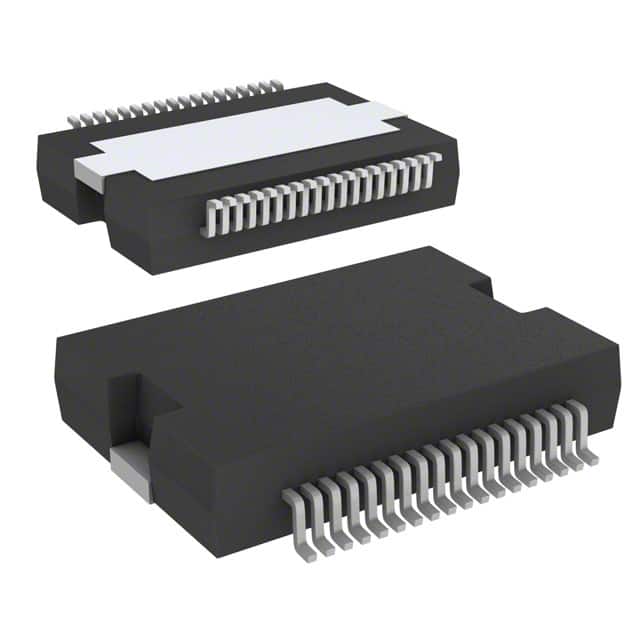
- Part No.:
- STA500
- Manufacturer:
- STMicroelectronics
- Category:
- Audio Amplifiers
- Package:
- PowerSO-36 Exposed Bottom Pad
- Datasheet:
-
 STA500.pdf
- Description:
- IC AMP D DUAL/QUAD 60W PWRSO-36
- Quantity:
- Payment:

- Shipping:

Inventory:1,278
Please send an inquiry. Send us your inquiry, and we will respond immediately.
Product details
Overview
STA500 from STMicroelectronics is a monolithic quad half-bridge audio power stage in Multipower BCD technology, configured as dual BTL (30+30W @ 8Ω) or single BTL (60W @ 4Ω), with 200 mΩ RDS(on), thermal warning (TH_WAR), and fault reporting (FAULT) outputs. It integrates complementary DMOS output stages, CMOS-compatible logic inputs, and protections including overvoltage (30–40 V), undervoltage (7 V), and thermal shutdown (150 °C).
For engineers reviewing the STA500 datasheet, STA500 pinout, STA500 application, or STA500 equivalent, key selection considerations include its 3.5 A continuous output current per half-bridge, configurable CONFIG pin for mono/dual/half-current modes, dead-time control (10–50 ns), and PowerSO-36 thermal pad package for high-power audio amplifier output stages.
Technical Context
The STA500 implements four independent half-bridge channels with matched P/N-channel DMOS outputs, enabling flexible topologies: dual stereo BTL, single high-current BTL, or binary half-current mode. Input thresholds scale with IBIAS voltage (2.7–5 V), supporting adaptive logic-level interfacing.
Protection circuitry includes open-collector FAULT and TH_WAR outputs triggered at 150 °C (shutdown) and 130 °C (warning), plus overvoltage (35 V typ) and undervoltage (7 V) lockout. The device operates from 9–30 V supply and supports 384 kHz switching with <150 ns minimum pulse width.
Key Specifications
| Parameter | Value and Actual Design Meaning |
|---|---|
| RDS(on) | 200 mΩ max per MOSFET - enables low conduction loss at 3.5 A continuous output current |
| Output Current | 3.5 A continuous per half-bridge - supports 60 W mono BTL into 4 Ω load |
| Supply Voltage | 9–30 V VCC - compatible with standard audio rail supplies; absolute max 40 V |
| Thermal Shutdown | 150 °C junction temperature - hysteresis of 25 °C ensures stable recovery |
| Dead Time | 10 ns (low-current) / 50 ns (high-current) - prevents shoot-through in bridge configurations |
| Input Threshold | VIN-H = IBIAS/2 + 300 mV - dynamically scales with bias voltage for noise-immune logic interface |
| Fault Reporting | Open-collector FAULT pin - active-low signal indicating short-circuit or thermal fault condition |
Pinout & Package
STA500 is housed in a thermally enhanced PowerSO-36 package with exposed thermal pad (Tj-case = 2.5 °C/W), designed for surface-mount assembly and high-power dissipation in audio amplifier output stages.
| Pin | Circuit Role | Design Meaning |
|---|---|---|
| 1 | GND-SUB | Substrate ground connection - must be tied to PCB thermal plane for thermal stability |
| 2–3, 8–9, 10–11, 16–17 | OUT2B, OUT2A, OUT1B, OUT1A | Half-bridge output terminals - each pair drives one speaker terminal in BTL configuration |
| 4–7, 12–15, 35–36 | VCC2B, VCC2A, VCC1B, VCC1A, VCCSIGN | Positive supply rails - separate VCC pins per half-bridge reduce supply coupling and improve PSRR |
| 5–6, 13–14, 33–34 | GND2B, GND2A, GND1B, GND1A, VSS | Negative supply/return paths - dedicated GND pins per channel minimize ground bounce |
| 21–22, 23 | VDD, IBIAS | 5 V regulator reference and input threshold scaling voltage - sets logic high/low thresholds |
| 24 | CONFIG | Configuration select - tie to VDD for single-BTL mode (double current); grounded for dual-BTL |
| 25–26 | PWRDN, TRI-STATE | Standby and high-impedance control - reduces quiescent current to 3 mA (PWRDN=0) or 22 mA (TRI-STATE=0) |
| 27, 28 | FAULT, TH_WAR | Open-collector fault indicators - require external pull-up; FAULT asserts at 150 °C, TH_WAR at 130 °C |
| 29–32 | IN1A, IN1B, IN2A, IN2B | CMOS-compatible gate drive inputs - logic levels referenced to IBIAS; support PWM or digital audio input |
Key Features
| Feature | Design Value |
|---|---|
| Quad half-bridge topology | Four independent DMOS half-bridges enable stereo BTL, mono BTL, or binary half-current reconfiguration via CONFIG pin |
| Thermal warning output | TH_WAR open-collector signal alerts system controller at 130 °C - allows proactive thermal derating before shutdown |
| Matched RDS(on) | 95% matching between P- and N-channel devices - minimizes distortion and improves channel balance in audio applications |
| Dynamic input threshold | VIN-H/VIN-L scale with IBIAS voltage - maintains noise margin across varying logic supply conditions |
| Integrated protection suite | Combines overvoltage (35 V), undervoltage (7 V), thermal shutdown (150 °C), and short-circuit current limiting (3.5–8 A) |
Applications
| Home Theater Audio Amplifier | Automotive Infotainment System |
|---|---|
|
Use Scenario: Stereo Class-D amplifier module delivering 30+30W into 8Ω speakers in compact AV receivers. IC Role / Device Role / Timing Role: Quad half-bridge output stage driven by DDX™ digital audio processor (e.g., STA304), handling final power conversion and filtering. Use Value: 200 mΩ RDS(on) and 2.5 °C/W thermal resistance enable high efficiency (>85%) and minimal heatsinking in space-constrained enclosures. |
Use Scenario: Rear-seat entertainment amplifier powering dual 4Ω speakers in automotive cabin environments. IC Role / Device Role / Timing Role: Single-BTL configured output stage (via CONFIG pin) delivering 60W into 4Ω load, synchronized to vehicle battery supply (9–16 V). Use Value: Undervoltage lockout (7 V) and overvoltage protection (35 V) ensure robust operation across automotive cold-crank and load-dump transients. |
| Professional Audio Monitor | Active Speaker Crossover Module |
|
Use Scenario: Bi-amplified studio monitor using separate STA500 channels for woofer and tweeter drivers. IC Role / Device Role / Timing Role: Dual independent half-bridge pairs driving low/mid and high-frequency sections with precise PWM timing control. Use Value: 10 ns low-current dead time and 50 ns high-current dead time prevent shoot-through while preserving audio fidelity up to 20 kHz bandwidth. |
Use Scenario: Digital active crossover board integrating DSP and analog power stage for multi-way loudspeakers. IC Role / Device Role / Timing Role: Binary-mode half-bridge driver (CONFIG=0, INxA=INxB) providing 1.75 A per channel for midrange/tweeter amplification. Use Value: CMOS-compatible inputs and scalable IBIAS-referenced thresholds simplify interface with FPGA or microcontroller-based crossover logic. |
Equivalent & Alternatives
The following parts are listed as comparable options for similar quad half-bridge audio power stage applications.
| Alternative Part | Technical Difference | Application Difference | Selection Advice |
|---|---|---|---|
| TAS5142AIDBTR | Higher RDS(on) (350 mΩ), integrated gate drivers, no CONFIG pin reconfiguration | Fixed dual-BTL only; lacks thermal warning output and IBIAS-scalable inputs | Preferred when gate driver integration reduces external component count, but requires redesign for thermal monitoring |
| IRS2092SPBF | Discrete half-bridge driver IC (no power MOSFETs), 600 V rating, no on-chip protection | Requires external high-voltage MOSFETs and discrete protection circuitry | Selected for >40 V supply systems or where discrete layout optimization is prioritized over integration |
Compared with TAS5142AIDBTR and IRS2092SPBF, STA500 uniquely combines on-die DMOS power stages, CONFIG-pin topology flexibility, and dual thermal signaling (warning + shutdown) - making it optimal for cost-sensitive, thermally constrained, and reconfigurable Class-D audio designs.
Availability
STA500 is available at Aetrix Electronics and suitable for home theater amplifiers, automotive infotainment systems, and professional audio monitors requiring stable component supply and legacy design continuity.
Supply support for STA500 includes scheduled delivery planning, volume procurement assistance, BOM continuity management, traceable sourcing, and lifecycle availability coordination for OEM customers, industrial embedded developers, connected-device designers, and electronics production programs.
Manufacturer
STMicroelectronics is a global semiconductor leader headquartered in Geneva, Switzerland, specializing in power management, analog, and automotive-grade ICs with vertical manufacturing capability.
STA500 belongs to ST's Multipower BCD audio power stage product line, engineered specifically for high-efficiency digital audio amplification in consumer and professional equipment with integrated protection and thermal intelligence.
FAQ
What is the maximum safe operating voltage for STA500?
The absolute maximum DC supply voltage on VCC pins (4, 7, 12, 15) is 40 V, but the recommended operating range is 9–30 V. Overvoltage protection triggers at 30–40 V (typical 35 V), and exceeding 40 V risks permanent damage to the DMOS output stage regardless of duration.
How does the CONFIG pin affect output current capability?
When CONFIG is tied to VDD, the device configures as a single BTL bridge with doubled current capability (7 A peak, 3.5 A continuous per side), enabling 60 W into 4 Ω. When grounded, it operates as dual independent BTL bridges (3.5 A per channel), delivering 30+30 W into 8 Ω loads.
Can STA500 be used without an external heat sink?
Yes - the PowerSO-36 package's 2.5 °C/W thermal resistance allows operation without an external heatsink up to ~4 W total power dissipation. For 60 W output applications, PCB copper area (≥10 cm² thermal pad exposure) is mandatory; forced air or aluminum heatsink is recommended above 25 W dissipation.
What logic voltage levels are required on IN1A–IN2B inputs?
Input high/low thresholds scale with IBIAS: VIN-H = IBIAS/2 + 300 mV and VIN-L = IBIAS/2 − 300 mV. With IBIAS = 3.3 V, valid logic high is ≥1.7 V and logic low is ≤0.8 V; input leakage remains <1 µA across this range.
STA500 Specifications
- Product attributes
- Attribute value
- Manufacturer:
- STMicroelectronics
- Series:
- -
- Package/Case:
- PowerSO-36 Exposed Bottom Pad
- Packaging:
- Tube
- Product Status:
- Obsolete
- Type:
- Class D
- Output Type:
- 2-Channel (Stereo) or 4-Channel (Quad)
- Max Output Power x Channels @ Load:
- 60W x 2 @ 8Ohm
- Voltage - Supply:
- 10V ~ 36V
- Features:
- Short-Circuit and Thermal Protection
- Mounting Type:
- Surface Mount
- Operating Temperature:
- 0°C ~ 70°C (TA)
- Grade:
- -
- Qualification:
- -
- Supplier Device Package:
- PowerSO-36
STA500 FAQ
1.How can I place an order for STA500 through Aetrix?
Please submit a Request for Quotation (RFQ) for STA500 on Aetrix. Our sales agent will provide a competitive quotation and guide you through the order confirmation once you accept the terms.
2.Are the price and stock information for STA500 reliable?
The price and inventory of STA500 are updated periodically and may fluctuate due to market conditions. Stock and pricing data are typically refreshed every 24 hours. Quotation validity for STA500 is usually 5 days.
3.What payment methods are accepted for STA500?
We accept Wire Transfer, PayPal, Credit Card, Western Union, MoneyGram, and Escrow for STA500 transactions.
Note: Certain payment methods may incur a processing fee.
4.How is shipping managed for STA500?
STA500 orders can be shipped via leading logistics carriers, including DHL, UPS, FedEx, TNT, or Registered Mail.
Once your STA500 order is processed, you will receive an email with the shipment details and tracking number.
Note: Tracking information may take up to 24 hours to appear. Express delivery typically takes 3–5 business days.
5.How can I obtain technical support or documentation for STA500?
For technical support, including STA500 datasheets, pinout diagrams, or application guidance, please contact our engineering support team. They can provide detailed documentation and assistance for your STA500 requirements.
6.How does Aetrix verify that STA500 is sourced from the original manufacturer or authorized distributors?
All STA500 products on Aetrix are procured from qualified distributors and authorized channels. Our dedicated quality assurance team conducts strict verification, including traceability checks and, if necessary, third-party testing. This ensures that STA500 meets industry standards.
7.What is the process for return or replacement of STA500?
All STA500 units undergo pre-shipment inspection (PSI). If there is an issue with STA500, returns or replacements are accepted under the following conditions:
1.Quantity discrepancies, incorrect items, or visible external defects (such as breakage or corrosion), acknowledged by Aetrix.
2.The issue is reported within 90 days of delivery.
3.The STA500 part is unused and in its original packaging.
Return procedure for STA500:
1.Submit a request within 90 days.
2.Obtain a Return Material Authorization (RMA) from Aetrix.
STA500 Tags
-Exposed-Pad.jpg)
-
TS34119CS RLG
Taiwan Semiconductor Corporation

-
LM386MX-1/NOPB
Texas Instruments
-
TPA711DGNR
Texas Instruments
-
LM386N-4/NOPB
Texas Instruments
-
TS4990IST
STMicroelectronics
-
PAM8302AASCR
Diodes Incorporated
-
TPA6130A2RTJR
Texas Instruments
-
TPA6111A2DGNR
Texas Instruments
-
LM4861MX/NOPB
Texas Instruments
-
LM386M-1/NOPB
Texas Instruments
-
NCS2211DR2G
onsemi
-
IS31AP2005-DLS2-TR
Lumissil Microsystems
Tech Hub

A practical engineering and sourcing framework covering lifecycle verification, lifetime-buy calculations, replacement qualification, supplier checks and counterfeit-risk controls.

TTL and CMOS logic families differ in thresholds, loading, output drive, power and timing. This engineering guide compares 74HC and 74HCT, calculates noise margins and checks 3.3 V/5 V compatibility.

A practical engineering guide to 3.3V and 5V logic compatibility, input thresholds, resistor dividers, translator ICs, MOSFET level shifting, I2C pull-ups, timing limits and power-sequencing risks.

The 74HC595 uses push-pull logic outputs, while the TPIC6B595 uses 50 V open-drain DMOS sinks for higher-power loads. This guide compares timing, current limits, 3.3 V interfacing, load wiring, thermal…

The 74HC595 converts serial data into eight stable parallel outputs. This guide covers pin functions, shift and storage timing, OE and MR behavior, drive-current limits, cascading, voltage compatibilit…

A technical comparison of level-sensitive latches and edge-triggered flip-flops, covering timing windows, setup and hold limits, master–slave operation, time borrowing, race-through, HDL inference and…

A D latch stores one bit while Enable controls when data can pass. This reference covers gate-level operation, truth tables, transparency, setup and hold timing, LE versus OE, common ICs and practical …

An SR latch stores one bit through cross-coupled feedback. This engineering reference covers NOR and NAND implementations, truth tables, forbidden-state recovery, gated operation, switch debouncing, fa…

Latch circuits retain one bit through feedback. This technical reference covers SR and D latches, truth tables, transparency, timing limits, latch-versus-flip-flop behavior, applications and common log…

An engineering guide to LED driver operation, constant-current and constant-voltage outputs, linear and switching topologies, dimming, IC selection, calculations, replacement compatibility, and fault c…


