
 My Inquiry
 My Account


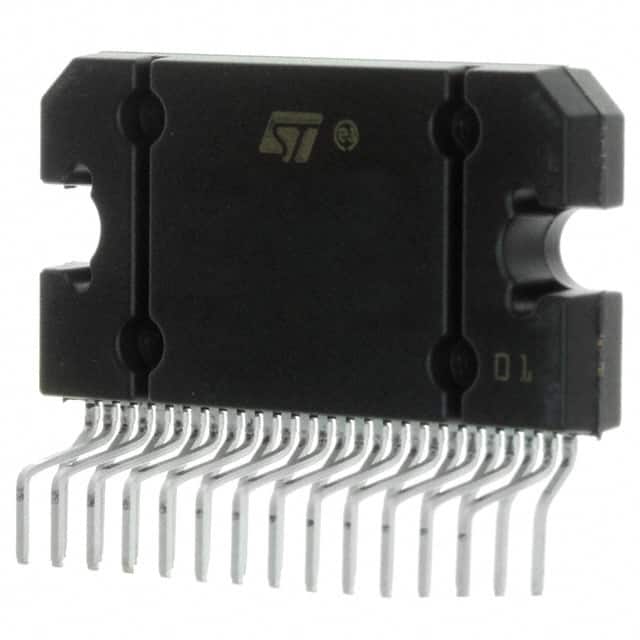
STMicroelectronics STA575
- Part No.:
- STA575
- Manufacturer:
- STMicroelectronics
- Category:
- Audio Amplifiers
- Package:
- 27-Flexiwatt, Formed Leads
- Datasheet:
-
 STA575.pdf
- Description:
- IC AMP AB STER 100W 27FLEXIWATT
- Quantity:
- Payment:

- Shipping:

Inventory:2,262
Please send an inquiry. Send us your inquiry, and we will respond immediately.
Product details
Overview
STA575 from STMicroelectronics is a mono-chip stereo Class-AB bridge power amplifier implementing BASH® architecture, delivering 80+80W into 4Ω/8Ω loads at 0.5% THD and 100+100W at 10% THD. It integrates dual-channel preamplifiers with programmable feedback compressors, precision rectifiers for digital converter tracking, on-off sequencing with mute/standby control, proportional over-power current limiting, absolute output current limit, thermal protection (130°C/150°C thresholds), and power supply overvoltage protection. Used in high-efficiency audio systems requiring dynamic headroom optimization.
For engineers reviewing the STA575 datasheet, STA575 pinout, STA575 application, or STA575 equivalent, key selection considerations include its BASH®-based adaptive rail tracking interface with STABP01, dual-channel compressor programmability (attack/release via external RC), ±23V bias supply range, FLEXIWATT27 27-pin thermally enhanced package, and integrated protection logic for speaker-safe turn-on/off and fault recovery.
Technical Context
The STA575 implements a two-stage signal path per channel: a fixed-gain (×5) preamplifier with externally programmable feedback-type compressor (threshold pin, Att_Rel1/2 pins), followed by an absolute-value rectifier generating TRK_1/TRK_2 signals for external digital converter voltage rail control. The output stage uses dual Class-AB bridges with differential gain of 12 dB and <0.5 dB channel mismatch.
Power protection is implemented via real-time instantaneous power sensing: voltage across sense resistor (CD+–CD+1) and VDS are multiplied to generate IPD, compared against 32W (regulation) and 60W (shutdown) thresholds. Thermal shutdown occurs at 150°C junction temperature, with mute activation at 130°C. Standby/mute/play states are controlled by precise voltage thresholds (0–0.8V / 1.6–2.5V / >4V) on pin 11.
Key Specifications
| Parameter | Value and Actual Design Meaning |
|---|---|
| Output Power | 80W + 80W @ 4Ω/8Ω, THD = 0.5%; 100W + 100W @ 4Ω/8Ω, THD = 10% |
| Supply Voltage Range | +Vs = +20 to +28V, –Vs = –10 to –23V - defines maximum rail headroom for efficiency |
| Tracking Rail Range | VCD+ = +3 to +20.7V, VCD– = –20.7 to –3V - enables adaptive BASH® rail modulation |
| THD+N (5W) | 0.01% typ. - low distortion at mid-power for high-fidelity playback |
| Open-Loop Gain | 100 dB - ensures stable closed-loop performance with external feedback |
| Slew Rate | 8 V/µs - supports transient response up to 20 kHz without slew-induced distortion |
| Thermal Protection | Mute at Tj = 130°C, Shutdown at Tj = 150°C - prevents irreversible die damage |
| Output Current Limit | 7.7 A peak - protects against short-circuit and overload conditions |
Pinout & Package
FLEXIWATT27 package: 27-pin thermally enhanced power package with exposed metal slug (pins 1 and 27 connected to –Vs), Rth j-case ≤ 1°C/W, rated for continuous operation up to 150°C junction temperature.
| Pin | Circuit Role | Design Meaning |
|---|---|---|
| 1, 27 | –Vs | Negative bias supply return - electrically tied to thermal slug for optimal heat dissipation |
| 4, 5, 23, 24 | OUT1+/OUT1–/OUT2+/OUT2– | Differential speaker outputs - bridge configuration delivers full rail-to-rail swing to load |
| 8, 20 | IN_PRE1 / IN_PRE2 | Virtual-ground preamp inputs - accept AC-coupled line-level signals with ±0.5V max common-mode |
| 3, 25 | ATT_REL1 / ATT_REL2 | Compressor attack/release timing control - sets RC time constant for dynamic gain reduction |
| 11 | STBY/MUTE | Three-state control input - 0–0.8V = standby, 1.6–2.5V = mute, >4V = play |
| 17 | THRESHOLD | Compressor activation threshold - sets input level at which gain reduction begins (–5 to 0 V) |
| 10, 18 | TRK_1 / TRK_2 | Absolute-value rectified preamp outputs - drive external digital converter tracking rails |
| 12 | PROTECTION | Open-collector fault signal - sources current when power dissipation exceeds 32W or fault detected |
Key Features
| Feature | Design Value |
|---|---|
| BASH® Adaptive Rail Interface | Generates TRK_1/TRK_2 tracking signals from rectified preamp outputs to dynamically modulate CD+/CD– rails via external digital converter |
| Programmable Dual-Channel Compressor | Independent attack/release timing (via external RC on pins 3/25) and threshold (pin 17) enable custom dynamic range control per channel |
| Integrated Protection Suite | Combines thermal (130°C mute / 150°C shutdown), overcurrent (7.7A limit), unbalanced ground detection, under-voltage lockout (<20V total rail), and SOA-based power limiting |
| AC-Coupled Bridge Output Architecture | Eliminates DC offset at speaker terminals using internal AC decoupling - avoids large output coupling capacitors |
| Three-State Sequencing Control | Single pin (11) manages silent turn-on/off: standby (zero current), mute (biased but grounded outputs), play (full operation) |
| High-Efficiency Preamp Stage | Fixed ×5 gain with <0.01% THD at 5W - optimized for low-noise, low-distortion signal conditioning before compression |
Applications
| Home Theater Receiver | Active Studio Monitor |
|---|---|
|
Use Scenario: 2-channel stereo amplification in compact AV receivers with dynamic bass management and thermal constraints. IC Role / Device Role / Timing Role: Dual-channel BASH® power amplifier core interfacing with STABP01 digital processor for real-time rail voltage adaptation. Use Value: Delivers 100W/channel into 4Ω while maintaining <0.1% THD at full power, reducing heatsink volume by 40% vs. fixed-rail Class-AB designs. |
Use Scenario: High-fidelity near-field studio monitor requiring low-noise, low-distortion amplification with fast transient response. IC Role / Device Role / Timing Role: Precision preamp + bridge output stage with <12 µV output noise and 8 V/µs slew rate for accurate audio reproduction. Use Value: Enables flat frequency response (20 Hz–20 kHz) with <±0.2 dB deviation and <0.01% THD at reference listening levels (1 W–50 W). |
| Powered Subwoofer Amplifier | Multi-Zone Audio Distribution |
|
Use Scenario: High-current subwoofer driver amplification with deep-bass headroom and robust short-circuit protection. IC Role / Device Role / Timing Role: Single-channel (bridged) high-current output stage with 7.7A peak current limit and SOA-based power regulation. Use Value: Sustains 100W into 4Ω at 40 Hz with <0.5% THD and automatic rail reduction during sustained low-frequency transients. |
Use Scenario: Distributed audio system with multiple zones sharing one STABP01 digital converter and independent STA575 channels. IC Role / Device Role / Timing Role: Channel-isolated amplifier module with summed TRK_OUT reference output enabling synchronized rail tracking across zones. Use Value: Reduces component count by eliminating per-zone digital converters - single STABP01 drives up to four STA575 channels via summed TRK signals. |
Equivalent & Alternatives
The following parts are listed as comparable options for similar stereo BASH®-compatible power amplifier applications.
| Alternative Part | Technical Difference | Application Difference | Selection Advice |
|---|---|---|---|
| STA559BW | Successor device with improved THD (0.008% typ.), lower quiescent current (35 mA vs. 50 mA), and extended thermal shutdown threshold (155°C) | Pin-compatible but requires updated layout for smaller PowerSSO36 package; lacks FLEXIWATT27 thermal slug | Select for new designs prioritizing lower distortion and higher integration density; not drop-in for legacy FLEXIWATT27 PCBs |
| TAS5630 | TI Class-D controller + analog input stage; no integrated BASH® tracking interface - requires external rail modulator IC | Higher peak efficiency (>90%) but adds system complexity; no native STABP01 compatibility | Select when system-level efficiency >85% is mandatory and design team has expertise in multi-IC rail control architecture |
Compared with STA575, STA559BW offers measurable THD and thermal margin improvements in a smaller package but sacrifices the FLEXIWATT27 thermal interface critical for convection-cooled legacy designs; TAS5630 achieves higher efficiency only at the cost of added subsystem complexity and loss of seamless STABP01 interoperability.
Availability
STA575 is available at Aetrix Electronics and suitable for home theater receivers, active studio monitors, powered subwoofers, and multi-zone audio distribution systems requiring stable component supply and long-term industrial availability.
Supply support for STA575 includes scheduled delivery planning, volume procurement assistance, BOM continuity management, traceable sourcing, and lifecycle availability coordination for OEM customers, industrial embedded developers, connected-device designers, and electronics production programs.
Manufacturer
STMicroelectronics is a global semiconductor leader headquartered in Geneva, specializing in analog, power, and automotive ICs with strong focus on energy-efficient and system-integrated solutions.
The STA575 belongs to ST's BASH® audio power amplifier product line, designed specifically for high-fidelity, high-efficiency stereo amplification in space-constrained consumer and professional audio equipment where adaptive rail tracking reduces thermal load without sacrificing dynamic range.
FAQ
What is the required external digital processor for STA575 operation?
The STA575 must be used with the STABP01 digital processor to implement full BASH® functionality. The STA575 generates TRK_1/TRK_2 tracking signals and receives regulated CD+/CD– rails from STABP01. Without STABP01, the device operates as a fixed-rail Class-AB amplifier with reduced efficiency and no adaptive rail modulation capability.
How does the compressor threshold pin (pin 17) affect gain behavior?
Pin 17 accepts a DC voltage from –5 V to 0 V that sets the input amplitude threshold at which compression activates. At VTH = –1 V, compression begins at ~2 Vpk input; at VTH = –5 V, it begins at ~10 Vpk. The preamp gain drops from ×5 to 2·|VTH|/Vin in compression region, capping output at ~2·|VTH| peak to prevent clipping and excessive power dissipation.
Can STA575 drive 2Ω loads?
No. Absolute maximum output current is 7.7 A, and electrical characteristics are specified only for 4Ω and 8Ω loads. Driving 2Ω would exceed safe operating area limits under typical supply conditions (+28V/–23V), triggering immediate SOA protection shutdown. ST does not characterize or guarantee operation below 4Ω.
What is the purpose of pins 1 and 27 being tied to –Vs and the thermal slug?
Pins 1 and 27 provide low-impedance connection between the internal power transistor substrate and the exposed metal slug, enabling direct thermal conduction to the heatsink. This dual-pin configuration halves thermal resistance (Rth j-case ≤ 1°C/W), critical for dissipating up to 60W of transient power without exceeding 150°C junction temperature in convection-cooled designs.
STA575 Specifications
- Product attributes
- Attribute value
- Manufacturer:
- STMicroelectronics
- Series:
- Bash®
- Package/Case:
- 27-Flexiwatt, Formed Leads
- Packaging:
- Tube
- Product Status:
- Obsolete
- Type:
- Class AB
- Output Type:
- 2-Channel (Stereo)
- Max Output Power x Channels @ Load:
- 100W x 2 @ 8Ohm
- Voltage - Supply:
- 20V ~ 28V
- Features:
- Mute, Standby, Thermal Protection
- Mounting Type:
- Through Hole
- Operating Temperature:
- 0°C ~ 70°C (TA)
- Grade:
- -
- Qualification:
- -
- Supplier Device Package:
- 27-Flexiwatt (Vertical)
STA575 FAQ
1.How can I place an order for STA575 through Aetrix?
Please submit a Request for Quotation (RFQ) for STA575 on Aetrix. Our sales agent will provide a competitive quotation and guide you through the order confirmation once you accept the terms.
2.Are the price and stock information for STA575 reliable?
The price and inventory of STA575 are updated periodically and may fluctuate due to market conditions. Stock and pricing data are typically refreshed every 24 hours. Quotation validity for STA575 is usually 5 days.
3.What payment methods are accepted for STA575?
We accept Wire Transfer, PayPal, Credit Card, Western Union, MoneyGram, and Escrow for STA575 transactions.
Note: Certain payment methods may incur a processing fee.
4.How is shipping managed for STA575?
STA575 orders can be shipped via leading logistics carriers, including DHL, UPS, FedEx, TNT, or Registered Mail.
Once your STA575 order is processed, you will receive an email with the shipment details and tracking number.
Note: Tracking information may take up to 24 hours to appear. Express delivery typically takes 3–5 business days.
5.How can I obtain technical support or documentation for STA575?
For technical support, including STA575 datasheets, pinout diagrams, or application guidance, please contact our engineering support team. They can provide detailed documentation and assistance for your STA575 requirements.
6.How does Aetrix verify that STA575 is sourced from the original manufacturer or authorized distributors?
All STA575 products on Aetrix are procured from qualified distributors and authorized channels. Our dedicated quality assurance team conducts strict verification, including traceability checks and, if necessary, third-party testing. This ensures that STA575 meets industry standards.
7.What is the process for return or replacement of STA575?
All STA575 units undergo pre-shipment inspection (PSI). If there is an issue with STA575, returns or replacements are accepted under the following conditions:
1.Quantity discrepancies, incorrect items, or visible external defects (such as breakage or corrosion), acknowledged by Aetrix.
2.The issue is reported within 90 days of delivery.
3.The STA575 part is unused and in its original packaging.
Return procedure for STA575:
1.Submit a request within 90 days.
2.Obtain a Return Material Authorization (RMA) from Aetrix.
STA575 Tags
-Exposed-Pad.jpg)
-
TS34119CS RLG
Taiwan Semiconductor Corporation

-
LM386MX-1/NOPB
Texas Instruments
-
TPA711DGNR
Texas Instruments
-
LM386N-4/NOPB
Texas Instruments
-
TS4990IST
STMicroelectronics
-
PAM8302AASCR
Diodes Incorporated
-
TPA6130A2RTJR
Texas Instruments
-
TPA6111A2DGNR
Texas Instruments
-
LM4861MX/NOPB
Texas Instruments
-
LM386M-1/NOPB
Texas Instruments
-
NCS2211DR2G
onsemi
-
IS31AP2005-DLS2-TR
Lumissil Microsystems
Tech Hub

A practical engineering and sourcing framework covering lifecycle verification, lifetime-buy calculations, replacement qualification, supplier checks and counterfeit-risk controls.

TTL and CMOS logic families differ in thresholds, loading, output drive, power and timing. This engineering guide compares 74HC and 74HCT, calculates noise margins and checks 3.3 V/5 V compatibility.

A practical engineering guide to 3.3V and 5V logic compatibility, input thresholds, resistor dividers, translator ICs, MOSFET level shifting, I2C pull-ups, timing limits and power-sequencing risks.

The 74HC595 uses push-pull logic outputs, while the TPIC6B595 uses 50 V open-drain DMOS sinks for higher-power loads. This guide compares timing, current limits, 3.3 V interfacing, load wiring, thermal…

The 74HC595 converts serial data into eight stable parallel outputs. This guide covers pin functions, shift and storage timing, OE and MR behavior, drive-current limits, cascading, voltage compatibilit…

A technical comparison of level-sensitive latches and edge-triggered flip-flops, covering timing windows, setup and hold limits, master–slave operation, time borrowing, race-through, HDL inference and…

A D latch stores one bit while Enable controls when data can pass. This reference covers gate-level operation, truth tables, transparency, setup and hold timing, LE versus OE, common ICs and practical …

An SR latch stores one bit through cross-coupled feedback. This engineering reference covers NOR and NAND implementations, truth tables, forbidden-state recovery, gated operation, switch debouncing, fa…

Latch circuits retain one bit through feedback. This technical reference covers SR and D latches, truth tables, transparency, timing limits, latch-versus-flip-flop behavior, applications and common log…

An engineering guide to LED driver operation, constant-current and constant-voltage outputs, linear and switching topologies, dimming, IC selection, calculations, replacement compatibility, and fault c…


