
 My Inquiry
 My Account


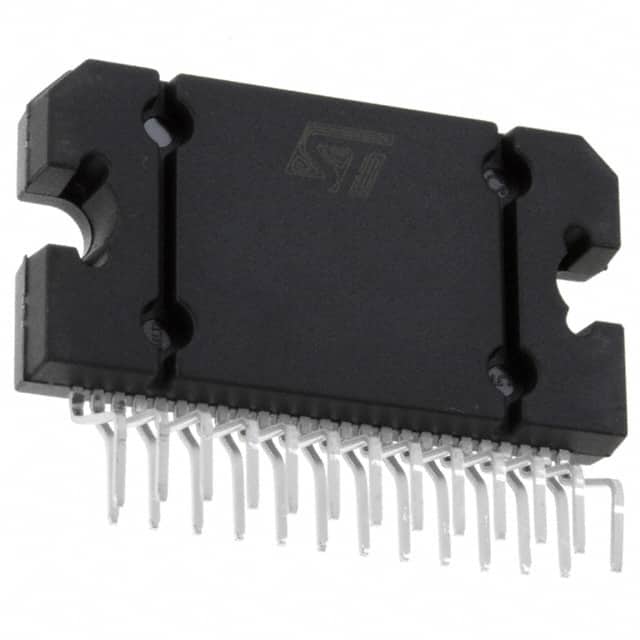
STMicroelectronics STPA001H
- Part No.:
- STPA001H
- Manufacturer:
- STMicroelectronics
- Category:
- Audio Amplifiers
- Package:
- 25-Flexiwatt, Formed Leads
- Datasheet:
-
 STPA001H.pdf
- Description:
- IC AMP AB QUAD 50W 25FLEXIWATT
- Quantity:
- Payment:

- Shipping:

Inventory:2,464
Please send an inquiry. Send us your inquiry, and we will respond immediately.
Product details
Overview
STPA001H from STMicroelectronics is a quad-channel Class AB audio power amplifier using complementary P/N-channel MOSFET output stage, delivering up to 4 × 50 W into 4 Ω and 4 × 72 W into 2 Ω at maximum supply voltage, with fixed 26 dB gain, 0.007% typical THD at 4 W, and operation down to 6 V for automotive start-stop systems.
For engineers reviewing the STPA001H datasheet, STPA001H pinout, STPA001H application, or STPA001H equivalent, this device is selected for high-fidelity car radio amplifiers requiring rail-to-rail swing, 2 Ω load drive, low pop-noise transitions during battery cranking, and integrated protections including short-circuit, thermal limiter, load dump, and automute on undervoltage.
Technical Context
The STPA001H implements a fully complementary MOSFET output stage enabling rail-to-rail voltage swing and minimized saturation losses, supporting Hi-Fi distortion performance (0.007% THD typ.) and high immunity to RF noise injection without external compensation. Its SVR pin serves triple function: reference for input bias (VCC/4), ripple rejection enhancement via external capacitor, and generation of half-supply voltage for output stage biasing.
It features dedicated protection circuitry including output DC offset detection (OD pin), clipping diagnostics (CD-DIAG), automute activation below 4.5–5.5 V supply, and soft thermal limiting that reduces output power before junction temperature reaches 150 °C. Standby and mute functions are CMOS-compatible with RC-controlled transition timing to suppress audible transients.
Key Specifications
| Parameter | Value and Actual Design Meaning |
|---|---|
| Output Power (4 Ω) | 28 W @ 14.4 V, 1 kHz, 10% THD - usable continuous output under standard automotive supply |
| Output Power (2 Ω) | 43 W @ 14.4 V, 1 kHz, 10% THD - enables high-current speaker drive without external current boosters |
| THD+N | 0.007% typ. @ 4 W, 4 Ω - meets Hi-Fi audio fidelity requirements in car infotainment systems |
| Supply Voltage Range | 6–18 V - supports full operation during engine start-stop cycles and cranking down to 6 V |
| Voltage Gain | 26 dB fixed - eliminates need for external gain-setting resistors, reducing BOM count and layout sensitivity |
| Thermal Resistance (j-case) | 1 °C/W max - enables high-power dissipation (85 W) with properly mounted heatsink in Flexiwatt25 package |
| Input Impedance | 40–70 kΩ - compatible with standard line-level audio sources without loading effects |
Pinout & Package
STPA001H uses the Flexiwatt25 (Horizontal) package - a 25-pin, thermally enhanced, through-hole power package with exposed metal tab for direct heatsink mounting. Pin numbering follows top-view orientation per Figure 4 in datasheet DocID023043 Rev 7.
| Pin/Terminal | Circuit Role | Design Meaning |
|---|---|---|
| TAB | Power Ground / Heatsink Interface | Exposed metal pad electrically connected to GND; must be soldered to heatsink for thermal and electrical integrity |
| OUT1+/OUT1− | Differential Output Channel 1 | Bridge-tied load (BTL) outputs capable of ±15 V swing into 2 Ω; no external bootstrap required |
| OUT2+/OUT2− | Differential Output Channel 2 | Independent BTL channel with identical specs to OUT1; supports dual-zone audio routing |
| OUT3+/OUT3− | Differential Output Channel 3 | Third BTL channel; shares same thermal and protection logic as other channels |
| OUT4+/OUT4− | Differential Output Channel 4 | Fourth BTL channel; enables full 4-speaker active configuration without external amplifiers |
| IN1–IN4 | Single-Ended Audio Inputs | Ground-referenced inputs accepting 0.22 μF coupling capacitors; low-frequency cutoff ~16 Hz |
| ST-BY | Standby Control Input | CMOS-compatible; <1.2 V = standby (quiescent current ≤20 μA), >2.6 V = active |
| MUTE | Mute Control Input | CMOS-compatible; <1.2 V = mute (≥80 dB attenuation), >2.6 V = play; prevents pop during state transitions |
| SVR | Supply Voltage Rejection Reference | Accepts ≥10 μF capacitor to control startup/shutdown timing and improve PSRR above 50 dB @ 100 Hz |
| OD | Offset Detector Output | Open-drain output asserting when differential output offset exceeds ±1 V; used for fault monitoring |
| CD-DIAG | Clipping Detection Output | Open-drain flag active when THD exceeds 1%; enables real-time audio integrity diagnostics |
| PW-GND1–PW-GND4 | Channel-Specific Power Grounds | Separate ground returns per channel minimize crosstalk and thermal coupling between outputs |
| S-GND / AC-GND | Signal & AC Ground Returns | Isolated ground paths prevent digital noise injection into analog signal chain |
Key Features
| Feature | Design Value |
|---|---|
| Rail-to-rail complementary MOSFET output stage | Enables full ±15 V swing into 2 Ω loads without external charge pumps or bootstrapping components |
| Automute at low supply voltage | Activates mute below 4.5–5.5 V to prevent distortion and pop noise during engine cranking or start-stop events |
| Integrated offset and clipping diagnostics | OD and CD-DIAG pins provide real-time fault signaling without external comparators or ADCs |
| Pop-noise suppression architecture | SVR-controlled soft-start/stop and mandatory mute-before-standby sequencing eliminate audible transients |
| 2 Ω load capability with thermal limiter | Delivers 43 W/channel into 2 Ω while limiting junction temperature to 150 °C via soft thermal foldback |
Applications
| Car Radio Amplifier | Start-Stop Compatible Infotainment |
|---|---|
|
Use Scenario: High-power OEM car stereo system with four full-range speakers and subwoofer support. IC Role / Device Role / Timing Role: Quad-channel Class AB audio power amplifier driving 4 Ω or 2 Ω speakers in BTL configuration. Use Value: Delivers 4 × 50 W peak power with 0.007% THD, eliminating need for external gain stages or thermal derating circuits. |
Use Scenario: Automotive head unit operating in vehicles with engine auto-stop functionality. IC Role / Device Role / Timing Role: Primary audio amplifier maintaining uninterrupted playback during battery voltage drops to 6 V. Use Value: Sustains full functionality at 6 V supply with only proportional power reduction-no mute or shutdown until <6 V threshold. |
| Battery Crank-Tolerant Audio System | Protected Multi-Zone Audio Distribution |
|
Use Scenario: Premium audio system subjected to worst-case battery cranking (6–16 V transitions in <10 ms). IC Role / Device Role / Timing Role: Power amplifier with adaptive SVR timing and automute to suppress pop during rapid supply transients. Use Value: Maintains audio continuity across cranking events without external transient suppressors or complex power sequencing. |
Use Scenario: Multi-zone vehicle audio (front/rear, driver/passenger) requiring independent channel control. IC Role / Device Role / Timing Role: Four independent BTL amplifier channels with per-channel mute, standby, and diagnostics. Use Value: Enables zone-specific muting and fault reporting via OD/CD-DIAG pins-no shared protection logic compromises. |
Equivalent & Alternatives
The following parts are listed as comparable options for similar quad-channel automotive audio amplifier applications.
| Alternative Part | Technical Difference | Application Difference | Selection Advice |
|---|---|---|---|
| TDA7388 | Class AB quad amplifier, 4 × 41 W @ 14.4 V/4 Ω, no OD/CD-DIAG pins, requires external mute timing | Lacks integrated offset/clipping diagnostics and automute; needs external RC networks for pop suppression | Lower BOM cost where diagnostics and cranking robustness are non-critical |
| STA559BW | Digital input Class D quad amplifier, 4 × 65 W @ 14.4 V/2 Ω, I²S interface, higher efficiency (~85%) | Requires digital audio source and external gate drivers; not pin-compatible; different thermal profile | Preferred for new designs prioritizing efficiency and EMI reduction over analog input simplicity |
Compared with TDA7388 and STA559BW, the STPA001H uniquely combines analog input compatibility, integrated diagnostics, and seamless 6 V operation-making it optimal for legacy analog head units needing OEM-grade cranking resilience without redesigning signal chain or protection logic.
Availability
STPA001H is available at Aetrix Electronics and suitable for automotive infotainment systems, start-stop compliant head units, and battery-crank tolerant audio modules requiring stable component supply across extended temperature and voltage ranges.
Supply support for STPA001H includes scheduled delivery planning, volume procurement assistance, BOM continuity management, traceable sourcing, and lifecycle availability coordination for OEM customers, industrial embedded developers, connected-device designers, and electronics production programs.
Manufacturer
STMicroelectronics is a global semiconductor leader headquartered in Geneva, Switzerland, specializing in automotive, industrial, and power management ICs with broad manufacturing scale and AEC-Q100 qualification expertise.
The STPA series targets high-reliability automotive audio applications, designed specifically to meet stringent OEM requirements for low-voltage operation, cranking resilience, and integrated protection-replacing discrete solutions with single-package robustness.
FAQ
What is the minimum supply voltage for continuous operation of STPA001H?
The STPA001H operates continuously down to 6 V supply voltage, maintaining full functionality including audio playback, mute/standby control, and protection features. Below 6 V, automute activates to prevent distortion; operation resumes automatically once supply rises above the 4.5–5.5 V automute release threshold.
How does the SVR pin affect startup behavior and noise suppression?
The SVR pin controls startup/shutdown timing via an external capacitor (≥10 μF). During power-on, internal resistance drops from 50 kΩ to 3 kΩ until SVR reaches VCC/4, enabling fast initial charging. This ensures pop-free transitions by synchronizing mute activation with supply ramp-up and preventing output offset transients.
Can STPA001H drive 2 Ω speakers safely, and what thermal considerations apply?
Yes, STPA001H is rated for 2 Ω loads with 43 W/channel @ 14.4 V and includes soft thermal limiting that progressively reduces output power before junction temperature reaches 150 °C. A heatsink with ≤1 °C/W case-to-ambient thermal resistance is required to sustain full 2 Ω power in ambient temperatures up to 70 °C.
What protection features are implemented, and how are they triggered?
STPA001H integrates short-circuit (to GND, Vs, or across load), overtemperature (soft limiter), load dump (up to 50 V peak), reversed battery, ESD (HBM >2 kV), and DC offset detection. Short-circuit triggers three-state output disable; thermal limiter reduces gain gradually; automute activates below 4.5–5.5 V; OD pin asserts on >±1 V offset.
STPA001H Specifications
- Product attributes
- Attribute value
- Manufacturer:
- STMicroelectronics
- Series:
- -
- Package/Case:
- 25-Flexiwatt, Formed Leads
- Packaging:
- Tube
- Product Status:
- Active
- Type:
- Class AB
- Output Type:
- 4-Channel (Quad)
- Max Output Power x Channels @ Load:
- 50W x 4 @ 4Ohm
- Voltage - Supply:
- 6V ~ 18V
- Features:
- Mute, Standby
- Mounting Type:
- Through Hole
- Operating Temperature:
- -
- Grade:
- -
- Qualification:
- -
- Supplier Device Package:
- 25-Flexiwatt (Horizontal)
STPA001H FAQ
1.How can I place an order for STPA001H through Aetrix?
Please submit a Request for Quotation (RFQ) for STPA001H on Aetrix. Our sales agent will provide a competitive quotation and guide you through the order confirmation once you accept the terms.
2.Are the price and stock information for STPA001H reliable?
The price and inventory of STPA001H are updated periodically and may fluctuate due to market conditions. Stock and pricing data are typically refreshed every 24 hours. Quotation validity for STPA001H is usually 5 days.
3.What payment methods are accepted for STPA001H?
We accept Wire Transfer, PayPal, Credit Card, Western Union, MoneyGram, and Escrow for STPA001H transactions.
Note: Certain payment methods may incur a processing fee.
4.How is shipping managed for STPA001H?
STPA001H orders can be shipped via leading logistics carriers, including DHL, UPS, FedEx, TNT, or Registered Mail.
Once your STPA001H order is processed, you will receive an email with the shipment details and tracking number.
Note: Tracking information may take up to 24 hours to appear. Express delivery typically takes 3–5 business days.
5.How can I obtain technical support or documentation for STPA001H?
For technical support, including STPA001H datasheets, pinout diagrams, or application guidance, please contact our engineering support team. They can provide detailed documentation and assistance for your STPA001H requirements.
6.How does Aetrix verify that STPA001H is sourced from the original manufacturer or authorized distributors?
All STPA001H products on Aetrix are procured from qualified distributors and authorized channels. Our dedicated quality assurance team conducts strict verification, including traceability checks and, if necessary, third-party testing. This ensures that STPA001H meets industry standards.
7.What is the process for return or replacement of STPA001H?
All STPA001H units undergo pre-shipment inspection (PSI). If there is an issue with STPA001H, returns or replacements are accepted under the following conditions:
1.Quantity discrepancies, incorrect items, or visible external defects (such as breakage or corrosion), acknowledged by Aetrix.
2.The issue is reported within 90 days of delivery.
3.The STPA001H part is unused and in its original packaging.
Return procedure for STPA001H:
1.Submit a request within 90 days.
2.Obtain a Return Material Authorization (RMA) from Aetrix.
STPA001H Tags
-Exposed-Pad.jpg)
-
TS34119CS RLG
Taiwan Semiconductor Corporation

-
LM386MX-1/NOPB
Texas Instruments
-
TPA711DGNR
Texas Instruments
-
LM386N-4/NOPB
Texas Instruments
-
TS4990IST
STMicroelectronics
-
PAM8302AASCR
Diodes Incorporated
-
TPA6130A2RTJR
Texas Instruments
-
TPA6111A2DGNR
Texas Instruments
-
LM4861MX/NOPB
Texas Instruments
-
LM386M-1/NOPB
Texas Instruments
-
NCS2211DR2G
onsemi
-
IS31AP2005-DLS2-TR
Lumissil Microsystems
Tech Hub

A practical engineering and sourcing framework covering lifecycle verification, lifetime-buy calculations, replacement qualification, supplier checks and counterfeit-risk controls.

TTL and CMOS logic families differ in thresholds, loading, output drive, power and timing. This engineering guide compares 74HC and 74HCT, calculates noise margins and checks 3.3 V/5 V compatibility.

A practical engineering guide to 3.3V and 5V logic compatibility, input thresholds, resistor dividers, translator ICs, MOSFET level shifting, I2C pull-ups, timing limits and power-sequencing risks.

The 74HC595 uses push-pull logic outputs, while the TPIC6B595 uses 50 V open-drain DMOS sinks for higher-power loads. This guide compares timing, current limits, 3.3 V interfacing, load wiring, thermal…

The 74HC595 converts serial data into eight stable parallel outputs. This guide covers pin functions, shift and storage timing, OE and MR behavior, drive-current limits, cascading, voltage compatibilit…

A technical comparison of level-sensitive latches and edge-triggered flip-flops, covering timing windows, setup and hold limits, master–slave operation, time borrowing, race-through, HDL inference and…

A D latch stores one bit while Enable controls when data can pass. This reference covers gate-level operation, truth tables, transparency, setup and hold timing, LE versus OE, common ICs and practical …

An SR latch stores one bit through cross-coupled feedback. This engineering reference covers NOR and NAND implementations, truth tables, forbidden-state recovery, gated operation, switch debouncing, fa…

Latch circuits retain one bit through feedback. This technical reference covers SR and D latches, truth tables, transparency, timing limits, latch-versus-flip-flop behavior, applications and common log…

An engineering guide to LED driver operation, constant-current and constant-voltage outputs, linear and switching topologies, dimming, IC selection, calculations, replacement compatibility, and fault c…


