
 My Inquiry
 My Account


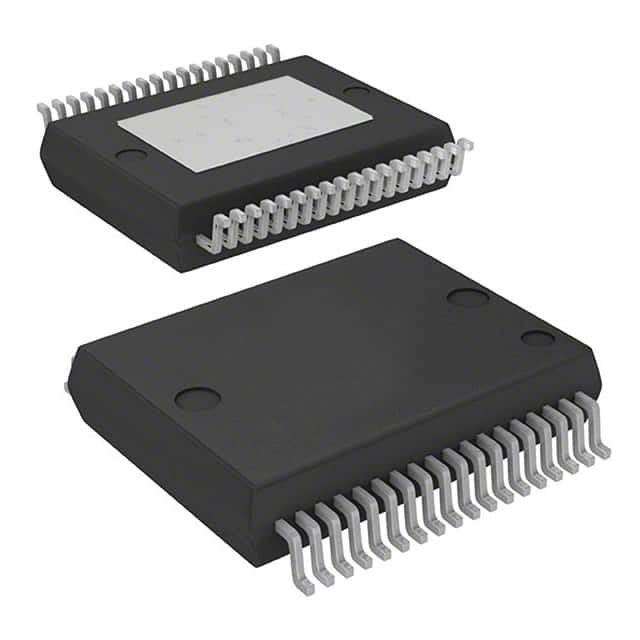
STMicroelectronics TDA7492MV13TR
- Part No.:
- TDA7492MV13TR
- Manufacturer:
- STMicroelectronics
- Category:
- Audio Amplifiers
- Package:
- 36-PowerBFSOP (0.295", 7.50mm Width)
- Datasheet:
-
 TDA7492MV13TR.pdf
- Description:
- IC AMP D MONO 50W POWERSSO36
- Quantity:
- Payment:

- Shipping:

Inventory:857
Please send an inquiry. Send us your inquiry, and we will respond immediately.
Product details
Overview
TDA7492MV13TR from STMicroelectronics is a mono BTL Class-D audio amplifier IC delivering 50 W continuous output into 6 Ω (THD = 10%, VCC = 25 V), operating from a single 10–26 V supply, with four selectable fixed gain settings (21.6–33.6 dB), differential inputs, and integrated thermal/short-circuit protection - deployed in compact home audio systems and docking stations without heatsink.
For engineers reviewing the TDA7492MV13TR datasheet, TDA7492MV13TR pinout, TDA7492MV13TR application, or TDA7492MV13TR equivalent, key selection considerations include BTL output architecture, exposed-pad PowerSSO-36 thermal performance, gain configuration via GAIN0/GAIN1 logic levels, and synchronous clocking support for multi-amplifier systems.
Technical Context
The device implements a self-oscillating Class-D modulator with internal 310 kHz switching frequency (±20 kHz), configurable via ROSC pin or external SYNCLK input. Its differential input stage provides common-mode noise rejection, while dual regulated outputs (VDDPW, VDDS) power analog and digital blocks independently.
Protection logic integrates open-drain DIAG output signaling overcurrent, thermal shutdown (>150 °C), and undervoltage/overvoltage events. Standby and mute are controlled by dedicated digital inputs with defined voltage thresholds (VINH ≥ 2.3 V, VINL ≤ 0.8 V) and sub-5 µA quiescent current in standby mode.
Key Specifications
| Parameter | Value and Actual Design Meaning |
|---|---|
| Output Power | 50 W @ 6 Ω, THD = 10%, VCC = 25 V - drives mid-range speakers in compact enclosures without thermal derating |
| Supply Range | 10–26 V single supply - compatible with 12 V/24 V DC rails in consumer and automotive accessory systems |
| Efficiency | 90% typ. @ 40 W - minimizes PCB heating and eliminates need for external heatsink |
| Gain Settings | 21.6 / 27.6 / 31.1 / 33.6 dB - selected via two-pin binary logic, enabling precise system-level sensitivity matching |
| THD+N | 0.1–0.4% @ 1 W - meets fidelity requirements for line-powered home audio and multimedia docks |
| Switching Freq | 290–330 kHz internal oscillator - places EMI above audio band and simplifies LC filter design (e.g., 33 µH + 220 nF) |
| Input Impedance | 60 kΩ differential - ensures compatibility with standard line-level sources without loading |
Pinout & Package
Delivered in PowerSSO-36 EPD (exposed pad down) package: 36-pin thermally enhanced surface-mount housing with integrated ground-plane heatsink; exposed pad must be soldered to PCB copper area for optimal thermal resistance (Rth j-case = 2 °C/W).
| Pin/Terminal | Circuit Role | Design Meaning |
|---|---|---|
| OUTP / OUTN | BTL PWM output pair | Drives speaker differentially; requires external LC low-pass filter (e.g., 22–33 µH + 220 nF) |
| GAIN0 / GAIN1 | Digital gain select inputs | Binary-coded pins setting closed-loop gain (21.6–33.6 dB); pulled high/low via MCU GPIO or resistors |
| STBY / MUTE | Power control inputs | STBY = L → full shutdown (2.5 µA IqSTBY); MUTE = L → output muted, amp active |
| DIAG | Open-drain fault indicator | Sinks current during thermal overload, short circuit, or UV/OV events - enables system-level diagnostics |
| SYNCLK | External clock I/O | Accepts or generates 250–400 kHz clock for synchronization across multiple TDA7492MV units |
Key Features
| Feature | Design Value |
|---|---|
| Differential input stage | Rejects common-mode noise from shared PCB ground or unshielded cables in docking station environments |
| Exposed-pad-down thermal design | Enables 50 W operation without heatsink via direct PCB copper conduction (Rth j-case = 2 °C/W) |
| Four-pin-configurable gain | Eliminates external feedback resistors; supports dynamic gain adjustment via microcontroller |
| Integrated protection suite | Auto-recovering thermal shutdown, cycle-by-cycle overcurrent detection, and UV/OV lockout prevent field failures |
| Master/slave clock sync | Prevents beat frequencies and EMI coupling when multiple Class-D amps operate in same enclosure |
Applications
| Home Audio Docking Station | Compact Stereo Soundbar |
|---|---|
Use Scenario: Integrated amplifier in USB-C/Bluetooth docking station powering 6 Ω full-range speaker. IC Role / Device Role / Timing Role: Mono BTL Class-D output stage with differential input buffering and 31.1 dB gain setting for line-in signal amplification. Use Value: Delivers 40 W clean output at 1% THD with no heatsink, reducing bill-of-materials and enclosure depth. | Use Scenario: Dual-channel implementation using two TDA7492MV13TRs in left/right configuration within slim soundbar chassis. IC Role / Device Role / Timing Role: Synchronized master/slave operation via shared SYNCLK to eliminate inter-channel beat interference. Use Value: Enables coherent PWM timing across channels, improving stereo imaging and lowering radiated EMI. |
| Automotive Infotainment Auxiliary Amp | IoT Smart Speaker Base Unit |
Use Scenario: Aftermarket amplifier module boosting factory head-unit output to drive rear cabin speakers. IC Role / Device Role / Timing Role: Wide 10–26 V supply range accommodates vehicle battery fluctuations (cold crank to load dump). Use Value: Maintains stable 50 W output across 12–16 V nominal operation without external DC-DC regulation. | Use Scenario: Voice-controlled smart speaker using TDA7492MV13TR as local playback amplifier for wake-word response audio. IC Role / Device Role / Timing Role: Standby mode (IqSTBY = 2.5 µA) enables ultra-low-power listening state; fast wake-up via STBY pin. Use Value: Extends battery life in portable variants while supporting <100 ms turn-on time to minimize audio latency. |
Equivalent & Alternatives
The following parts are listed as comparable options for similar mono Class-D amplifier applications.
| Alternative Part | Technical Difference | Application Difference | Selection Advice |
|---|---|---|---|
| TAS5707PAP | 32-bit I²S input, 48 kHz–192 kHz support, no differential analog input | Requires digital source interface; lacks analog gain-select flexibility | Preferred for DSP-based systems needing high-res audio decoding |
| TPA3116D2 | 40 W @ 6 Ω, 90% efficiency, HTSSOP-32 package, no exposed pad | Higher thermal resistance (Rth j-amb > 40 °C/W) mandates heatsink for >25 W | Lower-cost option where board space allows heatsink integration |
Compared with TAS5707PAP and TPA3116D2, the TDA7492MV13TR uniquely combines analog-differential input flexibility, pin-selectable gain, and heatsink-free 50 W operation in a thermally optimized PowerSSO-36 EPD package - ideal for space-constrained analog-source audio products.
Availability
TDA7492MV13TR is available at Aetrix Electronics and suitable for home audio docking stations, compact soundbars, automotive auxiliary amplifiers, and IoT smart speaker base units requiring stable component supply and long-term production continuity.
Supply support for TDA7492MV13TR includes scheduled delivery planning, volume procurement assistance, BOM continuity management, traceable sourcing, and lifecycle availability coordination for OEM customers, industrial embedded developers, connected-device designers, and electronics production programs.
Manufacturer
STMicroelectronics is a global semiconductor leader headquartered in Geneva, Switzerland, designing and manufacturing analog, mixed-signal, power, and microcontroller solutions for industrial, automotive, and consumer markets.
The TDA7492MV belongs to ST's high-efficiency Class-D audio amplifier product line, engineered specifically for compact, heatsink-free audio systems in cost-sensitive and space-constrained consumer electronics.
FAQ
What is the minimum recommended LC filter for 8 Ω loads?
The datasheet specifies a 33 µH inductor and 220 nF capacitor for 8 Ω loads, forming a second-order low-pass filter with cutoff near 60 kHz. This configuration suppresses PWM carrier energy while preserving audio bandwidth up to 20 kHz and meets EN55032 Class B conducted emissions limits.
How does the DIAG pin indicate thermal overload?
When junction temperature exceeds 150 °C, the open-drain DIAG pin pulls low (≤0.4 V) and remains asserted until temperature drops below 140 °C hysteresis threshold. External pull-up resistor (typically 10 kΩ to 3.3 V) is required to generate a logic-compatible fault signal for host monitoring.
Can GAIN0 and GAIN1 be left floating?
No - GAIN0 and GAIN1 must be actively driven high or low (0 V or 3.3 V) to ensure deterministic gain selection. Floating states may cause undefined gain, increased noise, or erratic behavior. Internal weak pull-downs are not guaranteed; external biasing via MCU GPIO or resistors is mandatory.
Is external clock synchronization mandatory for single-device operation?
No - internal oscillator mode is default and fully functional for standalone use. SYNCLK is optional and only required when synchronizing multiple TDA7492MV devices to avoid beat frequencies and reduce EMI coupling; in master mode, ROSC sets frequency (310 kHz typ.), and SYNCLK is unused.
TDA7492MV13TR Specifications
- Product attributes
- Attribute value
- Manufacturer:
- STMicroelectronics
- Series:
- -
- Package/Case:
- 36-PowerBFSOP (0.295", 7.50mm Width)
- Packaging:
- Tape & Reel (TR)
- Product Status:
- Active
- Type:
- Class D
- Output Type:
- 1-Channel (Mono)
- Max Output Power x Channels @ Load:
- 50W x 1 @ 6Ohm
- Voltage - Supply:
- 10V ~ 26V
- Features:
- Depop, Differential Inputs, Mute, Short-Circuit and Thermal Protection, Standby
- Mounting Type:
- Surface Mount
- Operating Temperature:
- 0°C ~ 70°C (TA)
- Grade:
- -
- Qualification:
- -
- Supplier Device Package:
- PowerSSO-36 EPD
TDA7492MV13TR FAQ
1.How can I place an order for TDA7492MV13TR through Aetrix?
Please submit a Request for Quotation (RFQ) for TDA7492MV13TR on Aetrix. Our sales agent will provide a competitive quotation and guide you through the order confirmation once you accept the terms.
2.Are the price and stock information for TDA7492MV13TR reliable?
The price and inventory of TDA7492MV13TR are updated periodically and may fluctuate due to market conditions. Stock and pricing data are typically refreshed every 24 hours. Quotation validity for TDA7492MV13TR is usually 5 days.
3.What payment methods are accepted for TDA7492MV13TR?
We accept Wire Transfer, PayPal, Credit Card, Western Union, MoneyGram, and Escrow for TDA7492MV13TR transactions.
Note: Certain payment methods may incur a processing fee.
4.How is shipping managed for TDA7492MV13TR?
TDA7492MV13TR orders can be shipped via leading logistics carriers, including DHL, UPS, FedEx, TNT, or Registered Mail.
Once your TDA7492MV13TR order is processed, you will receive an email with the shipment details and tracking number.
Note: Tracking information may take up to 24 hours to appear. Express delivery typically takes 3–5 business days.
5.How can I obtain technical support or documentation for TDA7492MV13TR?
For technical support, including TDA7492MV13TR datasheets, pinout diagrams, or application guidance, please contact our engineering support team. They can provide detailed documentation and assistance for your TDA7492MV13TR requirements.
6.How does Aetrix verify that TDA7492MV13TR is sourced from the original manufacturer or authorized distributors?
All TDA7492MV13TR products on Aetrix are procured from qualified distributors and authorized channels. Our dedicated quality assurance team conducts strict verification, including traceability checks and, if necessary, third-party testing. This ensures that TDA7492MV13TR meets industry standards.
7.What is the process for return or replacement of TDA7492MV13TR?
All TDA7492MV13TR units undergo pre-shipment inspection (PSI). If there is an issue with TDA7492MV13TR, returns or replacements are accepted under the following conditions:
1.Quantity discrepancies, incorrect items, or visible external defects (such as breakage or corrosion), acknowledged by Aetrix.
2.The issue is reported within 90 days of delivery.
3.The TDA7492MV13TR part is unused and in its original packaging.
Return procedure for TDA7492MV13TR:
1.Submit a request within 90 days.
2.Obtain a Return Material Authorization (RMA) from Aetrix.
TDA7492MV13TR Tags
-Exposed-Pad.jpg)
-
TS34119CS RLG
Taiwan Semiconductor Corporation

-
LM386MX-1/NOPB
Texas Instruments
-
TPA711DGNR
Texas Instruments
-
LM386N-4/NOPB
Texas Instruments
-
TS4990IST
STMicroelectronics
-
PAM8302AASCR
Diodes Incorporated
-
TPA6130A2RTJR
Texas Instruments
-
TPA6111A2DGNR
Texas Instruments
-
LM4861MX/NOPB
Texas Instruments
-
LM386M-1/NOPB
Texas Instruments
-
NCS2211DR2G
onsemi
-
IS31AP2005-DLS2-TR
Lumissil Microsystems
Tech Hub

A practical engineering and sourcing framework covering lifecycle verification, lifetime-buy calculations, replacement qualification, supplier checks and counterfeit-risk controls.

TTL and CMOS logic families differ in thresholds, loading, output drive, power and timing. This engineering guide compares 74HC and 74HCT, calculates noise margins and checks 3.3 V/5 V compatibility.

A practical engineering guide to 3.3V and 5V logic compatibility, input thresholds, resistor dividers, translator ICs, MOSFET level shifting, I2C pull-ups, timing limits and power-sequencing risks.

The 74HC595 uses push-pull logic outputs, while the TPIC6B595 uses 50 V open-drain DMOS sinks for higher-power loads. This guide compares timing, current limits, 3.3 V interfacing, load wiring, thermal…

The 74HC595 converts serial data into eight stable parallel outputs. This guide covers pin functions, shift and storage timing, OE and MR behavior, drive-current limits, cascading, voltage compatibilit…

A technical comparison of level-sensitive latches and edge-triggered flip-flops, covering timing windows, setup and hold limits, master–slave operation, time borrowing, race-through, HDL inference and…

A D latch stores one bit while Enable controls when data can pass. This reference covers gate-level operation, truth tables, transparency, setup and hold timing, LE versus OE, common ICs and practical …

An SR latch stores one bit through cross-coupled feedback. This engineering reference covers NOR and NAND implementations, truth tables, forbidden-state recovery, gated operation, switch debouncing, fa…

Latch circuits retain one bit through feedback. This technical reference covers SR and D latches, truth tables, transparency, timing limits, latch-versus-flip-flop behavior, applications and common log…

An engineering guide to LED driver operation, constant-current and constant-voltage outputs, linear and switching topologies, dimming, IC selection, calculations, replacement compatibility, and fault c…


