
 My Inquiry
 My Account


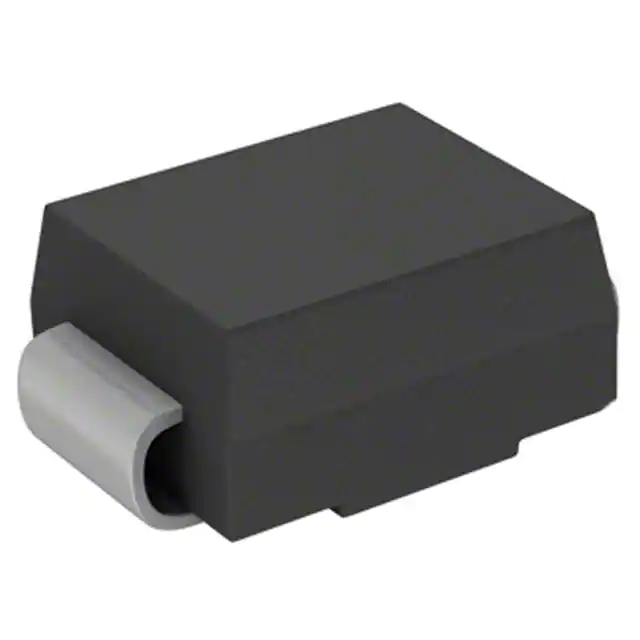
Diodes Incorporated US1B-13
- Part No.:
- US1B-13
- Manufacturer:
- Diodes Incorporated
- Category:
- Single Diodes
- Package:
- DO-214AC, SMA
- Datasheet:
-
 US1B-13.pdf
- Description:
- DIODE GEN PURP 100V 1A SMA
- Quantity:
- Payment:

- Shipping:

Inventory:4,537
Please send an inquiry. Send us your inquiry, and we will respond immediately.
Product details
Overview
US1B-13 from Diodes Incorporated is an ultra-fast surface-mount silicon rectifier diode in SMA package, rated for 100 V peak repetitive reverse voltage (VRRM), 1.0 A average rectified output current (IO), and 50 ns reverse recovery time (trr), used in high-frequency AC/DC conversion stages of switch-mode power supplies.
For engineers reviewing the US1B-13 datasheet, US1B-13 pinout, US1B-13 application, or US1B-13 equivalent, this device is selected for its low forward voltage drop (1.3 V @ 1.0 A), 30 A non-repetitive surge capability, RoHS-compliant lead-free plating, and suitability in compact, automated PCB assembly environments requiring fast switching and thermal reliability.
Technical Context
This discrete ultra-fast rectifier operates as a unidirectional current valve in bridge or single-phase half-wave configurations, with junction-to-terminal thermal resistance of 30 °C/W enabling stable operation at terminal temperatures up to +75°C. Its glass-passivated die construction ensures robustness against moisture and mechanical stress during reflow soldering.
The device exhibits 100 µA peak reverse current at +100°C and 100 V DC blocking, with typical junction capacitance of 10 pF at 1 MHz and 4 V reverse bias - parameters critical for minimizing switching losses and EMI in 50–500 kHz SMPS designs.
Key Specifications
| Parameter | Value and Actual Design Meaning |
|---|---|
| VRRM | 100 V - Maximum repetitive reverse voltage before breakdown; defines safe operating limit in flyback/freewheeling paths. |
| IO | 1.0 A @ TT = +75°C - Continuous DC output current rating under real thermal boundary conditions. |
| trr | 50 ns - Ultra-fast recovery enables efficient operation above 100 kHz without excessive switching loss. |
| VFM | 1.3 V @ IF = 1.0 A - Forward voltage directly impacts conduction loss and thermal rise in high-current paths. |
| IFSM | 30 A (8.3 ms half-sine) - Withstands inrush surges common during power-up in offline AC-DC converters. |
| RθJT | 30 °C/W - Enables accurate thermal modeling from junction to PCB pad for layout-driven cooling design. |
Pinout & Package
SMA (DO-214AC) surface-mount package: molded plastic case, UL 94V-0 flammability rating, cathode indicated by band or notch, matte tin-plated terminals, 0.064 g mass.
| Pin/Terminal | Circuit Role | Design Meaning |
|---|---|---|
| Anode | Current entry point during forward conduction | Connected to AC input or switching node; must withstand full surge current and thermal cycling. |
| Cathode | Current exit point during forward conduction | Connected to output rail or ground return; polarity marking ensures correct orientation in automated placement. |
Key Features
| Feature | Design Value |
|---|---|
| Glass passivated die | Eliminates need for hermetic sealing while maintaining high humidity resistance and long-term reliability in industrial environments. |
| Ultra-fast 50 ns recovery | Reduces reverse recovery charge (Qrr) and associated switching losses in high-frequency topologies like LLC resonant converters. |
| Lead-free, halogen-free "Green" construction | Meets EU RoHS 2 and JEDEC J-STD-020 Level 1 moisture sensitivity requirements for standard reflow profiles. |
| 30 A surge rating | Supports transient overloads without degradation, reducing need for external fusing in cost-sensitive consumer power adapters. |
Applications
| AC-DC Adapter Power Stage | USB-C PD Fast Charger Output Rectification |
|---|---|
Use Scenario: Secondary-side rectification in 20–65 W offline flyback converters powering wall adapters. IC Role / Device Role / Timing Role: Unidirectional current steering after transformer secondary winding; replaces slower general-purpose rectifiers to reduce heat and improve efficiency. Use Value: 1.3 V forward drop and 50 ns trr lower conduction + switching losses by ~12% vs. standard 1N4007 at 100 kHz, enabling smaller heatsinks. | Use Scenario: Synchronous rectification replacement in USB-C PD 3.0 compliant chargers delivering 20–45 V output. IC Role / Device Role / Timing Role: Freewheeling diode in quasi-resonant topology where gate drive timing constraints preclude active MOSFET control. Use Value: 100 V VRRM safely handles reflected transients up to 120 Vpk; 30 A IFSM absorbs capacitor charging surges during hot-plug events. |
| Industrial PLC Power Supply Input | LED Driver Bulk Rectification |
Use Scenario: Input rectification stage in DIN-rail mounted 24 V DC power supplies for programmable logic controllers. IC Role / Device Role / Timing Role: Half-wave or full-wave bridge leg component handling 50/60 Hz line frequency with high reliability across -40°C to +85°C ambient. Use Value: -65°C to +150°C operating range and 30 °C/W RθJT ensure stable performance under sustained load in enclosed enclosures without forced air. | Use Scenario: Bulk AC rectification feeding constant-current LED driver ICs in outdoor streetlight modules. IC Role / Device Role / Timing Role: Primary rectifier converting 100–277 VAC line to high-voltage DC bus prior to buck or boost regulation. Use Value: 100 µA IR at +100°C prevents significant leakage-induced standby power waste in always-on lighting systems. |
Equivalent & Alternatives
The following parts are listed as comparable options for similar ultra-fast rectifier applications.
| Alternative Part | Technical Difference | Application Difference | Selection Advice |
|---|---|---|---|
| STTH1R04U | Same 100 V VRRM, but 35 ns trr and 1.25 V VF; TO-277 package (lower RθJA). | Better suited for thermally constrained layouts needing <40 ns recovery; requires different footprint and stencil. | Select when board space allows larger TO-277 and efficiency gain justifies redesign effort. |
| MBR1100 | 100 V Schottky; 0.85 V VF but higher IR (500 µA @ 100°C); no reverse recovery. | Lower conduction loss but unsuitable for >85°C ambient due to leakage; not rated for line-frequency surge. | Prefer only in low-temperature, low-surge environments where lowest VF dominates system efficiency. |
Compared with STTH1R04U and MBR1100, US1B-13 offers balanced trade-offs: sufficient speed for 200 kHz SMPS, robust surge tolerance for line-connected equipment, and SMA footprint compatibility with high-volume pick-and-place lines - making it optimal for cost-sensitive, thermally moderate industrial and consumer power designs.
Availability
US1B-13 is available at Aetrix Electronics and suitable for AC-DC adapters, USB-C PD chargers, industrial PLC power supplies, and LED driver bulk rectification requiring stable component supply and consistent parametric performance across production lots.
Supply support for US1B-13 includes scheduled delivery planning, volume procurement assistance, BOM continuity management, traceable sourcing, and lifecycle availability coordination for OEM customers, industrial embedded developers, connected-device designers, and electronics production programs.
Manufacturer
Diodes Incorporated is a global manufacturer of discrete semiconductors and analog ICs, headquartered in Plano, Texas, with design, manufacturing, and sales operations across Asia, Europe, and North America.
The US1x series belongs to Diodes' ultra-fast rectifier product line, engineered specifically for high-efficiency, high-frequency switching power conversion in cost-sensitive consumer, industrial, and computing applications.
FAQ
What is the maximum junction temperature for US1B-13 during continuous operation?
The US1B-13 has a specified operating junction temperature range of –65°C to +150°C. For continuous operation at rated 1.0 A average current, the terminal temperature must be maintained at ≤+75°C per the derating curve. At that condition, junction temperature remains within safe limits assuming RθJT = 30 °C/W and no additional thermal resistance from PCB copper.
Can US1B-13 replace US1A-13 in an existing design?
Yes - US1B-13 is a direct upgrade from US1A-13, sharing identical SMA package, pinout, and thermal characteristics, but with higher 100 V VRRM (vs. 50 V) and slightly higher 1.3 V forward voltage (vs. 1.0 V). It is safe to substitute where reverse voltage margin is insufficient with US1A-13, provided forward loss increase is acceptable.
Is US1B-13 suitable for use in synchronous rectification circuits?
No - US1B-13 is a passive diode and cannot be actively controlled. It serves only as a freewheeling or rectifying element in non-synchronous topologies. Synchronous rectification requires externally gated MOSFETs; however, US1B-13 may be used as a backup or redundancy diode in such circuits.
Does US1B-13 meet automotive qualification standards?
No - US1B-13 is not AEC-Q101 qualified. It is rated for industrial and commercial applications only, with operating temperature range –65°C to +150°C but no automotive-specific stress testing, failure analysis, or PPAP documentation. For automotive use, Diodes' AEC-Q101-certified equivalents like the B1100Q series should be considered.
US1B-13 Specifications
- Product attributes
- Attribute value
- Manufacturer:
- Diodes Incorporated
- Series:
- -
- Package/Case:
- DO-214AC, SMA
- Packaging:
- Tape & Reel (TR)
- Product Status:
- Discontinued at Digi-Key
- Technology:
- Standard
- Voltage - DC Reverse (Vr) (Max):
- 100 V
- Current - Average Rectified (Io):
- 1A
- Voltage - Forward (Vf) (Max) @ If:
- 1 V @ 1 A
- Speed:
- Fast Recovery =< 500ns, > 200mA (Io)
- Reverse Recovery Time (trr):
- 50 ns
- Current - Reverse Leakage @ Vr:
- 5 µA @ 100 V
- Capacitance @ Vr, F:
- 20pF @ 4V, 1MHz
- Grade:
- -
- Qualification:
- -
- Mounting Type:
- Surface Mount
- Supplier Device Package:
- SMA
- Operating Temperature - Junction:
- -65°C ~ 150°C
US1B-13 FAQ
1.How can I place an order for US1B-13 through Aetrix?
Please submit a Request for Quotation (RFQ) for US1B-13 on Aetrix. Our sales agent will provide a competitive quotation and guide you through the order confirmation once you accept the terms.
2.Are the price and stock information for US1B-13 reliable?
The price and inventory of US1B-13 are updated periodically and may fluctuate due to market conditions. Stock and pricing data are typically refreshed every 24 hours. Quotation validity for US1B-13 is usually 5 days.
3.What payment methods are accepted for US1B-13?
We accept Wire Transfer, PayPal, Credit Card, Western Union, MoneyGram, and Escrow for US1B-13 transactions.
Note: Certain payment methods may incur a processing fee.
4.How is shipping managed for US1B-13?
US1B-13 orders can be shipped via leading logistics carriers, including DHL, UPS, FedEx, TNT, or Registered Mail.
Once your US1B-13 order is processed, you will receive an email with the shipment details and tracking number.
Note: Tracking information may take up to 24 hours to appear. Express delivery typically takes 3–5 business days.
5.How can I obtain technical support or documentation for US1B-13?
For technical support, including US1B-13 datasheets, pinout diagrams, or application guidance, please contact our engineering support team. They can provide detailed documentation and assistance for your US1B-13 requirements.
6.How does Aetrix verify that US1B-13 is sourced from the original manufacturer or authorized distributors?
All US1B-13 products on Aetrix are procured from qualified distributors and authorized channels. Our dedicated quality assurance team conducts strict verification, including traceability checks and, if necessary, third-party testing. This ensures that US1B-13 meets industry standards.
7.What is the process for return or replacement of US1B-13?
All US1B-13 units undergo pre-shipment inspection (PSI). If there is an issue with US1B-13, returns or replacements are accepted under the following conditions:
1.Quantity discrepancies, incorrect items, or visible external defects (such as breakage or corrosion), acknowledged by Aetrix.
2.The issue is reported within 90 days of delivery.
3.The US1B-13 part is unused and in its original packaging.
Return procedure for US1B-13:
1.Submit a request within 90 days.
2.Obtain a Return Material Authorization (RMA) from Aetrix.
US1B-13 Tags
-
1N4448X-TP
Micro Commercial Co
-
1N4148WX-TP
Micro Commercial Co

-
1N4148TR
onsemi
-
MMSD4148T1G
onsemi
-
MMBD914LT3G
onsemi
-
BAS16HT1G
onsemi
-
1N914BWT
onsemi
-
BAS21LT1G
onsemi
-
LL4148
onsemi
-
BAS16LT1G
onsemi
-
MMSD914T1G
onsemi
-
BAV21W-7-F
Diodes Incorporated
Tech Hub

An engineering guide to LED driver operation, constant-current and constant-voltage outputs, linear and switching topologies, dimming, IC selection, calculations, replacement compatibility, and fault c…

Operational amplifier guide covering op amp basics, feedback, ideal vs real op amps, common configurations, buffer circuits, offset, bias current, gain-bandwidth, slew rate, rail-to-rail limits and sel…

Jumper cables guide covering safe connection order, red and black clamp placement, final ground connection, cable gauge, length, clamp quality, copper vs CCA cables, jump starter comparison and battery…

LDO regulator guide covering low dropout voltage, power dissipation, thermal design, PSRR, output noise, capacitor stability, adjustable LDO circuits, LDO vs buck converter and datasheet selection chec…

Conditional Access Module guide covering CAM meaning, CI/CI+ interface, smart card authorization, DVB security workflow, TV and set-top box compatibility, internal electronics, ESD protection, connecto…

Guide to electronic component obsolescence covering EOL risk, PCN/PDN notices, last-time buy planning, replacement options, form-fit-function validation, counterfeit risk and BOM lifecycle management.

18650 battery guide covering lithium-ion cell basics, 3.6V/3.7V voltage, 4.2V charging, mAh and Wh capacity, protected cells, chargers, BMS, series-parallel packs, holders, welding and sourcing checks.…

Hall effect sensor guide covering working principle, linear and digital sensors, Arduino circuits, current sensing, speed detection, automotive applications, A3144 examples, signal filtering and datash…

Product Change Notification guide for electronic components, covering PCN meaning, PCN vs PDN/EOL, common change types, risk levels, form-fit-function review, engineering validation, BOM control, LTB/L…

A practical guide to blend door actuators, covering HVAC function, symptoms, location, AC and heater issues, reset and calibration, replacement cost, electrical diagnosis, compatibility checks, and rep…


