
 My Inquiry
 My Account


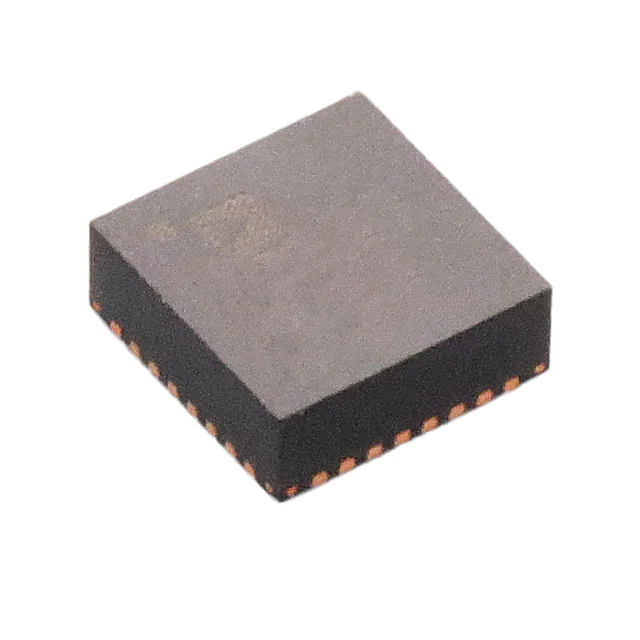
Analog Devices Inc. ADXL1005BCPZ
- Part No.:
- ADXL1005BCPZ
- Manufacturer:
- Analog Devices Inc.
- Category:
- Accelerometers
- Package:
- 32-FQFN Exposed Pad, CSP
- Datasheet:
-
 ADXL1005BCPZ.pdf
- Description:
- ACCELEROMETER ANALOG 32LFCSP
- Quantity:
- Payment:

- Shipping:

Inventory:822
Please send an inquiry. Send us your inquiry, and we will respond immediately.
Product details
Overview
ADXL1005BCPZ from Analog Devices is a single-axis, in-plane MEMS accelerometer with analog output, ±100 g full-scale range, 75 μg/√Hz noise density, dc to 23 kHz linear frequency response, and 42 kHz resonant frequency-designed for high-fidelity bearing fault detection in industrial condition monitoring systems.
For engineers reviewing the ADXL1005BCPZ datasheet, ADXL1005BCPZ pinout, ADXL1005BCPZ application, or ADXL1005BCPZ equivalent, key selection criteria include ultralow noise performance at high bandwidth, ratiometric analog output stability over temperature, self-test and overrange detection functionality, and compatibility with wireless sensing platforms requiring low quiescent current (1.0 mA typical) and fast standby recovery (<50 μs).
Technical Context
The ADXL1005BCPZ employs a polysilicon surface-micromachined proof mass suspended by compliant springs, with differential capacitive sensing and phase-sensitive demodulation to convert mechanical acceleration into a ratiometric analog voltage. Its signal chain integrates electrostatic self-test actuation, overrange detection logic, and a low-impedance output amplifier capable of driving up to 22 nF capacitive loads with external series resistance.
It operates in two distinct modes: continuous measure mode (1.0 mA @ 5 V) and standby mode (225 μA @ 5 V), with sub-50 μs wake-up time. The internal 200 kHz clock enables precise timing control but introduces spurious tones requiring band-limiting filtering above 10 kHz to prevent aliasing in digitization.
Key Specifications
| Parameter | Value and Actual Design Meaning |
|---|---|
| Full-Scale Range | ±100 g - supports high-dynamic-range vibration measurement in heavy machinery and HVAC equipment. |
| Noise Density | 75 μg/√Hz @ 100 Hz–20 kHz - enables resolution of sub-millig-level acceleration signals critical for early bearing defect detection. |
| Linear Bandwidth | dc to 23 kHz (3 dB) - captures high-frequency resonance signatures from rolling element faults without gain peaking distortion. |
| Sensitivity | 20 mV/g (ratiometric to VDD) - maintains proportional scaling across supply variations (3.0–5.25 V), simplifying ADC reference design. |
| Zero-g Output | VDD/2 - provides stable mid-supply bias point for rail-to-rail analog interfacing and differential acquisition. |
| Self-Test Delta | 420–490 mV (ratiometric) - delivers repeatable, full-path electromechanical verification without external stimulus. |
| Standby Recovery | <50 μs to 1% final value - enables burst-mode sensing in battery-powered predictive maintenance nodes. |
Pinout & Package
ADXL1005BCPZ is housed in a 32-lead, 5 mm × 5 mm × 1.8 mm LFCSP package with exposed thermal pad requiring solder connection to PCB ground plane for electrical integrity and mechanical stability.
| Pin/Terminal | Circuit Role | Design Meaning |
|---|---|---|
| XOUT (Pin 30) | Analog output voltage | Single-ended ratiometric voltage proportional to acceleration (20 mV/g), drives ≤20 MΩ resistive or ≤22 nF capacitive loads with series resistor. |
| VDD (Pin 12) | Power supply input | 3.0 V to 5.25 V single supply; powers all internal circuitry and sets output scale factor and zero-g offset. |
| VSS (Pins 13, 14, 27, 28) | Ground reference | Four dedicated ground pins minimize impedance and reduce noise coupling in high-bandwidth analog paths. |
| ST (Pin 16) | Self-test enable input | Active-high digital control (VIH ≥ 0.7×VDD); triggers full electromechanical self-test with 490 mV typical output delta. |
| STANDBY (Pin 15) | Low-power mode control | Active-high input suspends measurement and reduces current to 225 μA; recovery <50 μs ensures minimal latency in event-triggered acquisition. |
| OR (Pin 20) | Overrange indicator output | Open-drain or push-pull (per config) flag signaling instantaneous >±100 g overload; not latched, requires external capture. |
| EPAD | Thermal & electrical ground | Exposed copper pad on package underside must be soldered to solid ground plane for thermal dissipation and signal integrity. |
Key Features
| Feature | Design Value |
|---|---|
| Ultralow noise density | 75 μg/√Hz enables detection of micro-vibration signatures from incipient bearing wear before audible or thermal symptoms appear. |
| Complete electromechanical self-test | On-demand ST pin activation verifies sensor proof mass motion, capacitive transduction, and signal chain integrity in-system without external shakers. |
| Ratiometric output architecture | Output sensitivity and zero-g offset track VDD, eliminating supply-induced gain/offset errors when using same regulator for ADC reference. |
| Fast standby recovery | <50 μs transition from 225 μA standby to full 1.0 mA measurement mode supports energy-efficient burst-sampling architectures. |
| Overrange detection | Dedicated OR pin provides real-time hardware alert for >±100 g events, enabling immediate data logging or system shutdown in shock-prone environments. |
Applications
| Condition Monitoring | Predictive Maintenance |
|---|---|
Use Scenario: Continuous vibration monitoring of rotating assets such as motors, gearboxes, and pumps in industrial plants. IC Role / Device Role / Timing Role: Single-axis analog accelerometer capturing high-frequency spectral content (up to 23 kHz) for envelope analysis and Fast Fourier Transform (FFT)-based fault signature extraction. Use Value: Enables detection of early-stage bearing defects (e.g., cage fracture, roller spalling) via ultralow-noise measurement of sub-100 μg acceleration components. | Use Scenario: Wireless sensor node deployed on wind turbine gearboxes to transmit health metrics to cloud analytics platforms. IC Role / Device Role / Timing Role: Low-power MEMS sensing element operating in intermittent measure-standby cycles, synchronized with RF transmission windows. Use Value: Achieves multi-year battery life via 225 μA standby current and <50 μs wake-up, while preserving diagnostic fidelity through 75 μg/√Hz noise floor. |
| Asset Health Management | Acoustic Emission Sensing |
Use Scenario: Embedded monitoring of structural integrity in railcar wheelsets and aerospace landing gear under cyclic loading. IC Role / Device Role / Timing Role: High-temperature (−40°C to +125°C) analog vibration sensor providing dc-coupled, wideband acceleration data for strain-life modeling. Use Value: Maintains ±5% sensitivity stability across full temperature range, ensuring consistent amplitude calibration without software compensation. | Use Scenario: Detection of high-frequency stress-wave emissions from micro-crack propagation in composite pressure vessels. IC Role / Device Role / Timing Role: Wideband analog front-end capturing transient acoustic emission pulses with 42 kHz resonant response and minimal phase distortion. Use Value: Linear frequency response to 23 kHz allows accurate time-of-flight analysis and source localization of sub-millisecond AE events. |
Equivalent & Alternatives
The following parts are listed as comparable options for similar single-axis high-bandwidth MEMS accelerometer applications.
| Alternative Part | Technical Difference | Application Difference | Selection Advice |
|---|---|---|---|
| ADXL1002BCPZ | Lower full-scale range (±50 g), higher noise density (100 μg/√Hz), identical 23 kHz bandwidth and LFCSP-32 package. | Better suited for medium-g, lower-noise applications where ±100 g headroom is unnecessary. | Select ADXL1002BCPZ when system vibration amplitudes remain below ±50 g and cost optimization is prioritized. |
| ADXL1003BCPZ | Wider full-scale range (±200 g), same 75 μg/√Hz noise, extended 30 kHz linear bandwidth, and identical pinout/package. | Required for extreme shock environments (e.g., impact testing, blast monitoring) demanding >±100 g tolerance. | Choose ADXL1003BCPZ when peak accelerations exceed ±100 g but ultralow noise and high-frequency fidelity remain essential. |
Compared with ADXL1005BCPZ, ADXL1002BCPZ trades range and noise for cost efficiency in moderate-dynamic applications, while ADXL1003BCPZ extends overload capability without sacrificing noise or bandwidth-making ADXL1005BCPZ the optimal balance for bearing diagnostics where ±100 g and 75 μg/√Hz are simultaneously required.
Availability
ADXL1005BCPZ is available at Aetrix Electronics and suitable for condition monitoring, predictive maintenance, and acoustic emission sensing requiring stable component supply, long-term lifecycle support, and RoHS-compliant packaging.
Supply support for ADXL1005BCPZ includes scheduled delivery planning, volume procurement assistance, BOM continuity management, traceable sourcing, and lifecycle availability coordination for OEM customers, industrial embedded developers, connected-device designers, and electronics production programs.
Manufacturer
Analog Devices is a global leader in high-performance analog, mixed-signal, and digital signal processing semiconductors, serving industrial, automotive, communications, and healthcare markets since 1965.
The ADXL100x product line delivers ultralow-noise, wideband MEMS accelerometers optimized specifically for machine health diagnostics-emphasizing signal fidelity, temperature stability, and integrated self-test for unattended field deployment.
FAQ
What is the maximum measurable acceleration for ADXL1005BCPZ?
The ADXL1005BCPZ has a guaranteed full-scale range of ±100 g, meaning it accurately measures acceleration magnitudes up to 100 g in either direction along its sensitive x-axis. Mechanical shock survival is rated to 10,000 g per IEC 60068-2-27, but measurement linearity and specified noise performance apply only within the ±100 g range. Exceeding this causes clipping and invalidates the 75 μg/√Hz noise specification for ADXL1005BCPZ.
How does the ratiometric output of ADXL1005BCPZ affect system design?
The ADXL1005BCPZ output voltage scales directly with VDD: sensitivity is 20 mV/g × (VDD/5.0 V), and zero-g output is VDD/2. This means if the downstream ADC uses the same VDD as its reference voltage, supply-induced gain and offset errors cancel-eliminating need for precision regulators. For ADXL1005BCPZ, this ratiometric behavior simplifies power architecture and improves measurement consistency across varying supply conditions.
Can ADXL1005BCPZ be used beyond its 23 kHz 3 dB bandwidth?
Yes, ADXL1005BCPZ's output amplifier supports small-signal bandwidth up to 70 kHz, but usable measurement bandwidth is limited by sensor resonance at 42 kHz. Above 23 kHz, sensitivity increases due to peaking near resonance, introducing nonlinearity and requiring careful calibration. For reliable quantitative analysis, ADXL1005BCPZ is specified for linear operation dc to 23 kHz; operation beyond requires external anti-alias filtering and awareness of gain variation per Figure 4 in the ADXL1005BCPZ datasheet.
What is the purpose of the OR (Overrange) pin on ADXL1005BCPZ?
The OR pin on ADXL1005BCPZ is an open-drain or push-pull output that asserts instantly when sensed acceleration exceeds ±100 g. It is not latched-pulse duration matches overrange event duration-and serves as a hardware trigger for data capture, alarm generation, or system protection. Unlike the analog XOUT signal, OR provides deterministic timing for event-based response without signal conditioning, making it critical for ADXL1005BCPZ deployments in shock-prone industrial environments.
How does the self-test function work in ADXL1005BCPZ?
The ADXL1005BCPZ self-test applies electrostatic force to the proof mass via internal electrodes, inducing displacement equivalent to ~24.5 g acceleration (490 mV Δ at 5 V). Activated by driving ST pin high, it validates the entire signal path-including mechanical suspension, capacitive transduction, demodulation, and output amplification. Measured delta between normal and ST-active outputs must fall within 420–490 mV (ratiometric) per Table 1. This full-path check ensures ADXL1005BCPZ reliability in safety-critical or inaccessible installations.
ADXL1005BCPZ Specifications
- Product attributes
- Attribute value
- Manufacturer:
- Analog Devices Inc.
- Series:
- -
- Package/Case:
- 32-FQFN Exposed Pad, CSP
- Packaging:
- Tray
- Product Status:
- Active
- Type:
- Analog
- Axis:
- X
- Acceleration Range:
- ±100g
- Sensitivity (LSB/g):
- -
- Sensitivity (mV/g):
- 20
- Bandwidth:
- 42kHz
- Output Type:
- Analog Voltage
- Voltage - Supply:
- 3V ~ 5.25V
- Features:
- -
- Operating Temperature:
- -40°C ~ 125°C
- Grade:
- -
- Qualification:
- -
- Mounting Type:
- Surface Mount
- Supplier Device Package:
- 32-LFCSP (5x5)
ADXL1005BCPZ FAQ
1.How can I place an order for ADXL1005BCPZ through Aetrix?
Please submit a Request for Quotation (RFQ) for ADXL1005BCPZ on Aetrix. Our sales agent will provide a competitive quotation and guide you through the order confirmation once you accept the terms.
2.Are the price and stock information for ADXL1005BCPZ reliable?
The price and inventory of ADXL1005BCPZ are updated periodically and may fluctuate due to market conditions. Stock and pricing data are typically refreshed every 24 hours. Quotation validity for ADXL1005BCPZ is usually 5 days.
3.What payment methods are accepted for ADXL1005BCPZ?
We accept Wire Transfer, PayPal, Credit Card, Western Union, MoneyGram, and Escrow for ADXL1005BCPZ transactions.
Note: Certain payment methods may incur a processing fee.
4.How is shipping managed for ADXL1005BCPZ?
ADXL1005BCPZ orders can be shipped via leading logistics carriers, including DHL, UPS, FedEx, TNT, or Registered Mail.
Once your ADXL1005BCPZ order is processed, you will receive an email with the shipment details and tracking number.
Note: Tracking information may take up to 24 hours to appear. Express delivery typically takes 3–5 business days.
5.How can I obtain technical support or documentation for ADXL1005BCPZ?
For technical support, including ADXL1005BCPZ datasheets, pinout diagrams, or application guidance, please contact our engineering support team. They can provide detailed documentation and assistance for your ADXL1005BCPZ requirements.
6.How does Aetrix verify that ADXL1005BCPZ is sourced from the original manufacturer or authorized distributors?
All ADXL1005BCPZ products on Aetrix are procured from qualified distributors and authorized channels. Our dedicated quality assurance team conducts strict verification, including traceability checks and, if necessary, third-party testing. This ensures that ADXL1005BCPZ meets industry standards.
7.What is the process for return or replacement of ADXL1005BCPZ?
All ADXL1005BCPZ units undergo pre-shipment inspection (PSI). If there is an issue with ADXL1005BCPZ, returns or replacements are accepted under the following conditions:
1.Quantity discrepancies, incorrect items, or visible external defects (such as breakage or corrosion), acknowledged by Aetrix.
2.The issue is reported within 90 days of delivery.
3.The ADXL1005BCPZ part is unused and in its original packaging.
Return procedure for ADXL1005BCPZ:
1.Submit a request within 90 days.
2.Obtain a Return Material Authorization (RMA) from Aetrix.
ADXL1005BCPZ Tags

-
MXC4005XC
Memsic Inc.
-
MC3419
Memsic Inc.
-
MC3479
Memsic Inc.
-
MXC6655XA
Memsic Inc.
-
MC3630
Memsic Inc.
.jpg)
-
LIS2HH12TR
STMicroelectronics
-
KX122-1037
Kionix Inc.
-
LIS2DE12TR
STMicroelectronics
-
LIS2DH12TR
STMicroelectronics
-
MC3635
Memsic Inc.
-
LIS2DS12TR
STMicroelectronics

-
LIS3DHTR
STMicroelectronics
Tech Hub

A practical engineering guide to 3.3V and 5V logic compatibility, input thresholds, resistor dividers, translator ICs, MOSFET level shifting, I2C pull-ups, timing limits and power-sequencing risks.

The 74HC595 uses push-pull logic outputs, while the TPIC6B595 uses 50 V open-drain DMOS sinks for higher-power loads. This guide compares timing, current limits, 3.3 V interfacing, load wiring, thermal…

The 74HC595 converts serial data into eight stable parallel outputs. This guide covers pin functions, shift and storage timing, OE and MR behavior, drive-current limits, cascading, voltage compatibilit…

A technical comparison of level-sensitive latches and edge-triggered flip-flops, covering timing windows, setup and hold limits, master–slave operation, time borrowing, race-through, HDL inference and…

A D latch stores one bit while Enable controls when data can pass. This reference covers gate-level operation, truth tables, transparency, setup and hold timing, LE versus OE, common ICs and practical …

An SR latch stores one bit through cross-coupled feedback. This engineering reference covers NOR and NAND implementations, truth tables, forbidden-state recovery, gated operation, switch debouncing, fa…

Latch circuits retain one bit through feedback. This technical reference covers SR and D latches, truth tables, transparency, timing limits, latch-versus-flip-flop behavior, applications and common log…

An engineering guide to LED driver operation, constant-current and constant-voltage outputs, linear and switching topologies, dimming, IC selection, calculations, replacement compatibility, and fault c…

Operational amplifier guide covering op amp basics, feedback, ideal vs real op amps, common configurations, buffer circuits, offset, bias current, gain-bandwidth, slew rate, rail-to-rail limits and sel…

Jumper cables guide covering safe connection order, red and black clamp placement, final ground connection, cable gauge, length, clamp quality, copper vs CCA cables, jump starter comparison and battery…


