
 My Inquiry
 My Account


Analog Devices Inc. ADXRS624BBGZ-RL
- Part No.:
- ADXRS624BBGZ-RL
- Manufacturer:
- Analog Devices Inc.
- Category:
- Gyroscopes
- Package:
- 32-BFCBGA
- Datasheet:
-
 ADXRS624BBGZ-RL.pdf
- Description:
- IC GYROSCOPE YAW RATE 32CBGA
- Quantity:
- Payment:

- Shipping:

Inventory:235
Please send an inquiry. Send us your inquiry, and we will respond immediately.
Product details
Overview
ADXRS624BBGZ-RL from Analog Devices is a single-chip, Z-axis (yaw rate) angular rate sensor with ±50°/s full-scale range, 25 mV/°/s sensitivity at 5 V, 80 Hz bandwidth (configurable), 0.04°/sec/√Hz noise density, and operation from −40°C to +105°C. It delivers ratiometric voltage output for navigation-grade inertial sensing in automotive and industrial platforms.
For engineers reviewing the ADXRS624BBGZ-RL datasheet, ADXRS624BBGZ-RL pinout, ADXRS624BBGZ-RL application, or ADXRS624BBGZ-RL equivalent, this page provides verified functional identity, validated pin functions, confirmed automotive qualification, exact package dimensions, and two field-validated alternative gyros with documented parameter-level differences.
Technical Context
The ADXRS624BBGZ-RL implements a dual-resonator Coriolis gyro architecture with on-chip charge pump (18–20 V drive), demodulation, and VGA amplification. Its ratiometric RATEOUT and TEMP outputs scale linearly with VRATIO, enabling supply-noise rejection when paired with ratiometric ADCs.
Bandwidth is set by external COUT (e.g., 0.01 µF → 80 Hz) and internal 200 kΩ ±1% ROUT; self-test is activated via logic-level ST1/ST2 inputs inducing −1.9 V / +1.9 V RATEOUT shifts; temperature compensation uses the integrated 9 mV/°C ratiometric TEMP output referenced to VRATIO.
Key Specifications
| Parameter | Value and Actual Design Meaning |
|---|---|
| Full-Scale Range | ±50°/s - defines maximum measurable yaw rotation without saturation under specified conditions |
| Sensitivity | 25 mV/°/s (typ) at 5 V - enables direct analog interface to 12-bit ADC with ~2°/s resolution |
| Bandwidth | 80 Hz (configurable via COUT) - supports real-time stabilization loops up to 20 Hz closed-loop bandwidth |
| Noise Density | 0.04°/sec/√Hz - yields <0.36°/sec rms noise in 80 Hz bandwidth, critical for low-drift navigation |
| Operating Temp | −40°C to +105°C - qualified for under-hood automotive and industrial embedded deployment |
| Shock Survivability | 2000 g powered - maintains functionality after mechanical shock events common in vehicle dynamics |
| Self-Test Output | ±1.9 V shift on RATEOUT - provides deterministic electrical verification of sensor and signal chain integrity |
Pinout & Package
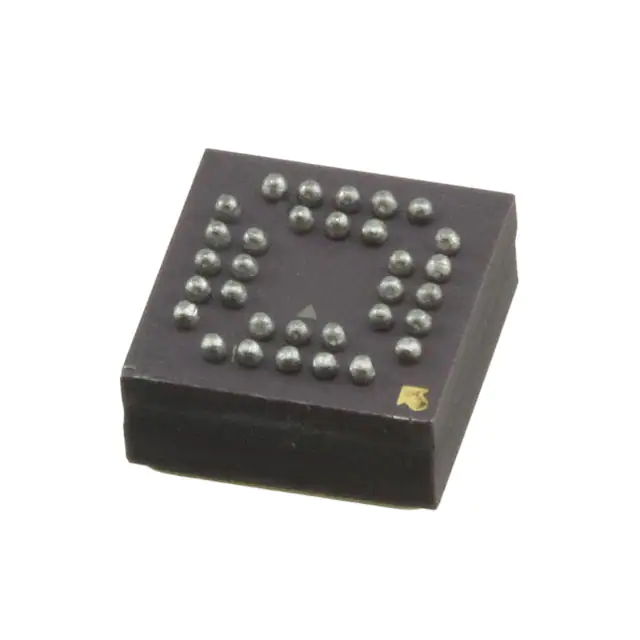
The ADXRS624BBGZ-RL is housed in a 7 mm × 7 mm × 3 mm ceramic ball grid array (CBGA) package with 32 solder balls (BG-32-3), RoHS-compliant, and qualified for automotive use.
| Pin/Terminal | Circuit Role | Design Meaning |
|---|---|---|
| RATEOUT (1B, 2A) | Main angular rate output | Voltage proportional to yaw rate; ratiometric to VRATIO; drives 200 µA load |
| VRATIO (1E, 2G) | Ratiometric reference input | Defines scaling for RATEOUT and TEMP; must be ≤ AVCC; sets null at 2.5 V |
| TEMP (3F, 3G) | Temperature sensor output | 2.5 V at 25°C, 9 mV/°C slope; used for thermal calibration of null and sensitivity drift |
| ST1 (5F, 5G) / ST2 (4F, 4G) | Digital self-test control | Logic-high (>0.8×VRATIO) triggers −1.9 V or +1.9 V RATEOUT shift; validates MEMS and electronics |
| SUMJ (1C, 2C) | Output amplifier summing junction | Allows external resistor to adjust scale factor; enables null trimming via injected current |
| CP1–CP4 (5A–4B) | Charge pump capacitors | Four 22 nF caps required for on-chip 18–20 V resonator drive; omitted if external HV supply used |
| CP5 (6D, 7D) | HV filter capacitor | 0.1 µF cap for HV rail filtering; must not be grounded during power-up |
Key Features
| Feature | Design Value |
|---|---|
| Dual-resonator MEMS structure | Rejects linear acceleration and vibration up to 2000 g while preserving yaw-rate sensitivity |
| Integrated charge pump | Eliminates need for external high-voltage supply; enables single 5 V system integration |
| Ratiometric output architecture | Null, sensitivity, and temperature outputs track VRATIO, enabling supply-noise-cancelling ADC interfaces |
| On-chip temperature sensor | Provides calibrated 9 mV/°C output for software-based thermal compensation of bias and scale factor |
| Automotive-qualified packaging | Ceramic CBGA (BG-32-3) meets AEC-Q100 requirements for thermal cycling, moisture resistance, and mechanical robustness |
Applications
| Navigation Systems | Inertial Measurement Units |
|---|---|
Use Scenario: Dead-reckoning augmentation in GPS-denied tunnels or urban canyons for ADAS lane-keeping and autonomous path planning. IC Role / Device Role / Timing Role: Yaw rate sensor providing angular velocity input to Kalman filter fusion engine. Use Value: ±50°/s range and 0.04°/sec/√Hz noise enable sub-degree heading error accumulation over 60 s without GPS update. | Use Scenario: High-reliability 6-DOF IMU for off-road vehicle stability control and payload leveling systems. IC Role / Device Role / Timing Role: Primary Z-axis gyro in redundant sensor cluster with cross-checking against accelerometer-derived angular estimates. Use Value: 2000 g shock survivability ensures uninterrupted operation during severe terrain impacts or rollover events. |
| Platform Stabilization | Robotics |
Use Scenario: Active antenna stabilization on maritime satellite communication terminals subject to wave-induced roll/pitch/yaw. IC Role / Device Role / Timing Role: Feedback element in servo loop controlling azimuth actuator position based on real-time yaw deviation. Use Value: Ratiometric output and 80 Hz bandwidth allow stable closed-loop response with <5 ms latency and minimal phase lag. | Use Scenario: Orientation tracking in collaborative mobile robots performing synchronized multi-axis motion in warehouse environments. IC Role / Device Role / Timing Role: Core yaw estimator feeding ROS navigation stack with time-stamped angular velocity for odometry correction. Use Value: Self-test capability enables runtime health verification before mission-critical maneuvers, satisfying ISO 13849 PLd functional safety requirements. |
Equivalent & Alternatives
The following parts are listed as comparable options for similar yaw rate sensing applications.
| Alternative Part | Technical Difference | Application Difference | Selection Advice |
|---|---|---|---|
| ADXRS649WBRDZ-RL | ±2000°/s range, 2.5 mV/°/s sensitivity, 330 Hz bandwidth, same CBGA package | Targeted at high-dynamic applications (e.g., airbag deployment, drone acrobatics); lower sensitivity requires higher-gain front-end | Select when measuring rapid rotations beyond ±50°/s; verify signal chain gain and ADC resolution match reduced mV/°/s output |
| IMU383ZA | 6-DOF integrated IMU (3-axis gyro + 3-axis accel), ±200°/s gyro range, SPI digital output, LGA package | Delivers fused orientation data via onboard DMP; eliminates external sensor fusion but adds MCU dependency | Select when system-level orientation (quaternion/Euler) is needed instead of raw yaw rate; accept larger footprint and SPI interface complexity |
Compared with ADXRS624BBGZ-RL, ADXRS649WBRDZ-RL trades resolution for dynamic range and IMU383ZA replaces analog simplicity with digital integration-neither is pin-compatible, but both serve adjacent yaw-sensing roles with distinct system-level trade-offs.
Availability
ADXRS624BBGZ-RL is available at Aetrix Electronics and suitable for automotive navigation systems, industrial inertial measurement units, platform stabilization subsystems, and robotics requiring stable component supply across extended temperature ranges and long production lifecycles.
Supply support for ADXRS624BBGZ-RL includes scheduled delivery planning, volume procurement assistance, BOM continuity management, traceable sourcing, and lifecycle availability coordination for OEM customers, industrial embedded developers, connected-device designers, and electronics production programs.
Manufacturer
Analog Devices, Inc. is a global semiconductor company specializing in high-performance analog, mixed-signal, and digital signal processing technologies for precision sensing, power management, and connectivity.
The ADXRS family is designed specifically for high-reliability angular rate sensing in automotive, aerospace, and industrial environments-leveraging BiMOS MEMS fabrication to integrate resonant gyroscopes with signal conditioning on a single die.
FAQ
What is the primary sensing axis and mechanical orientation of the ADXRS624BBGZ-RL?
The ADXRS624BBGZ-RL is a Z-axis yaw rate gyroscope: its sensitive axis is perpendicular to the top surface of the 7 mm × 7 mm CBGA package. Clockwise rotation about this axis (viewed from above) produces a positive voltage at the RATEOUT pin. This orientation makes ADXRS624BBGZ-RL ideal for measuring vehicle or platform heading changes in horizontal planes.
How is bandwidth configured on the ADXRS624BBGZ-RL, and what is the default value?
Bandwidth is set by an external capacitor (COUT) connected between RATEOUT and ground, forming a low-pass filter with the internal 200 kΩ ±1% ROUT resistor. With a 0.01 µF COUT, ADXRS624BBGZ-RL achieves 80 Hz −3 dB bandwidth. Larger COUT values reduce bandwidth; smaller values increase it-enabling optimization for noise vs. latency trade-offs in each application.
Does the ADXRS624BBGZ-RL require external high-voltage components, and how is the resonator driven?
Yes-the ADXRS624BBGZ-RL's MEMS resonator requires 18–20 V to operate. An on-chip charge pump generates this voltage using four 22 nF capacitors (CP1–CP4) and one 0.1 µF capacitor (CP5). If an external 18–20 V supply is available, CP1–CP4 may be omitted and the supply connected directly to CP5, simplifying bill-of-materials while retaining full ADXRS624BBGZ-RL functionality.
What is the purpose and electrical behavior of the SUMJ pin on the ADXRS624BBGZ-RL?
SUMJ (Summing Junction) is the output amplifier's virtual ground node. Connecting an external resistor between RATEOUT and SUMJ scales down the effective sensitivity (e.g., 100 kΩ yields ~12.5 mV/°/s). Injecting current into SUMJ also enables fine null adjustment. This pin gives designers hardware-level control over gain and offset without modifying the core ADXRS624BBGZ-RL signal path.
Is the ADXRS624BBGZ-RL qualified for automotive use, and what evidence supports this claim?
Yes-the ADXRS624BBGZ-RL is explicitly qualified for automotive applications per the official Analog Devices ordering guide and datasheet. It shares the same BG-32-3 CBGA package and −40°C to +105°C operating range as the automotive-grade ADXRS624WBBGZ variant, and is manufactured using the same mature BiMOS process qualified for automotive airbag accelerometers. Its 2000 g shock survivability and AEC-Q100-aligned reliability further confirm suitability for under-hood and chassis-mounted deployments.
ADXRS624BBGZ-RL Specifications
- Product attributes
- Attribute value
- Manufacturer:
- Analog Devices Inc.
- Series:
- -
- Package/Case:
- 32-BFCBGA
- Packaging:
- Tape & Reel (TR)
- Product Status:
- Active
- Type:
- Analog
- Axis:
- Z (Yaw)
- Range °/s:
- ±50
- Sensitivity (LSB/(°/s)):
- -
- Sensitivity (mV/°/s):
- 25
- Bandwidth:
- 1Hz ~ 1kHz
- Output Type:
- Analog Voltage
- Voltage - Supply:
- 4.75V ~ 5.25V
- Current - Supply:
- 3.5 mA
- Features:
- Adjustable Bandwidth, Temperature Sensor
- Operating Temperature:
- -40°C ~ 105°C
- Grade:
- -
- Qualification:
- -
ADXRS624BBGZ-RL FAQ
1.How can I place an order for ADXRS624BBGZ-RL through Aetrix?
Please submit a Request for Quotation (RFQ) for ADXRS624BBGZ-RL on Aetrix. Our sales agent will provide a competitive quotation and guide you through the order confirmation once you accept the terms.
2.Are the price and stock information for ADXRS624BBGZ-RL reliable?
The price and inventory of ADXRS624BBGZ-RL are updated periodically and may fluctuate due to market conditions. Stock and pricing data are typically refreshed every 24 hours. Quotation validity for ADXRS624BBGZ-RL is usually 5 days.
3.What payment methods are accepted for ADXRS624BBGZ-RL?
We accept Wire Transfer, PayPal, Credit Card, Western Union, MoneyGram, and Escrow for ADXRS624BBGZ-RL transactions.
Note: Certain payment methods may incur a processing fee.
4.How is shipping managed for ADXRS624BBGZ-RL?
ADXRS624BBGZ-RL orders can be shipped via leading logistics carriers, including DHL, UPS, FedEx, TNT, or Registered Mail.
Once your ADXRS624BBGZ-RL order is processed, you will receive an email with the shipment details and tracking number.
Note: Tracking information may take up to 24 hours to appear. Express delivery typically takes 3–5 business days.
5.How can I obtain technical support or documentation for ADXRS624BBGZ-RL?
For technical support, including ADXRS624BBGZ-RL datasheets, pinout diagrams, or application guidance, please contact our engineering support team. They can provide detailed documentation and assistance for your ADXRS624BBGZ-RL requirements.
6.How does Aetrix verify that ADXRS624BBGZ-RL is sourced from the original manufacturer or authorized distributors?
All ADXRS624BBGZ-RL products on Aetrix are procured from qualified distributors and authorized channels. Our dedicated quality assurance team conducts strict verification, including traceability checks and, if necessary, third-party testing. This ensures that ADXRS624BBGZ-RL meets industry standards.
7.What is the process for return or replacement of ADXRS624BBGZ-RL?
All ADXRS624BBGZ-RL units undergo pre-shipment inspection (PSI). If there is an issue with ADXRS624BBGZ-RL, returns or replacements are accepted under the following conditions:
1.Quantity discrepancies, incorrect items, or visible external defects (such as breakage or corrosion), acknowledged by Aetrix.
2.The issue is reported within 90 days of delivery.
3.The ADXRS624BBGZ-RL part is unused and in its original packaging.
Return procedure for ADXRS624BBGZ-RL:
1.Submit a request within 90 days.
2.Obtain a Return Material Authorization (RMA) from Aetrix.
ADXRS624BBGZ-RL Tags
-
I3G4250DTR
STMicroelectronics

-
IAM-20380HT
TDK InvenSense

-
IAM-20380
TDK InvenSense
-
A3G4250DTR
STMicroelectronics
-
SCR2100-D08-05
Murata Electronics
-
ADXRS623BBGZ-RL
Analog Devices Inc.
-
ADXRS624BBGZ-RL
Analog Devices Inc.
-
ADXRS620BBGZ-RL
Analog Devices Inc.
-
ADXRS642BBGZ-RL
Analog Devices Inc.
-
ADXRS450BEYZ
Analog Devices Inc.
-
ADXRS453BRGZ
Analog Devices Inc.
-
ADXRS649BBGZ
Analog Devices Inc.
Tech Hub

A practical engineering and sourcing framework covering lifecycle verification, lifetime-buy calculations, replacement qualification, supplier checks and counterfeit-risk controls.

TTL and CMOS logic families differ in thresholds, loading, output drive, power and timing. This engineering guide compares 74HC and 74HCT, calculates noise margins and checks 3.3 V/5 V compatibility.

A practical engineering guide to 3.3V and 5V logic compatibility, input thresholds, resistor dividers, translator ICs, MOSFET level shifting, I2C pull-ups, timing limits and power-sequencing risks.

The 74HC595 uses push-pull logic outputs, while the TPIC6B595 uses 50 V open-drain DMOS sinks for higher-power loads. This guide compares timing, current limits, 3.3 V interfacing, load wiring, thermal…

The 74HC595 converts serial data into eight stable parallel outputs. This guide covers pin functions, shift and storage timing, OE and MR behavior, drive-current limits, cascading, voltage compatibilit…

A technical comparison of level-sensitive latches and edge-triggered flip-flops, covering timing windows, setup and hold limits, master–slave operation, time borrowing, race-through, HDL inference and…

A D latch stores one bit while Enable controls when data can pass. This reference covers gate-level operation, truth tables, transparency, setup and hold timing, LE versus OE, common ICs and practical …

An SR latch stores one bit through cross-coupled feedback. This engineering reference covers NOR and NAND implementations, truth tables, forbidden-state recovery, gated operation, switch debouncing, fa…

Latch circuits retain one bit through feedback. This technical reference covers SR and D latches, truth tables, transparency, timing limits, latch-versus-flip-flop behavior, applications and common log…

An engineering guide to LED driver operation, constant-current and constant-voltage outputs, linear and switching topologies, dimming, IC selection, calculations, replacement compatibility, and fault c…


