
 My Inquiry
 My Account


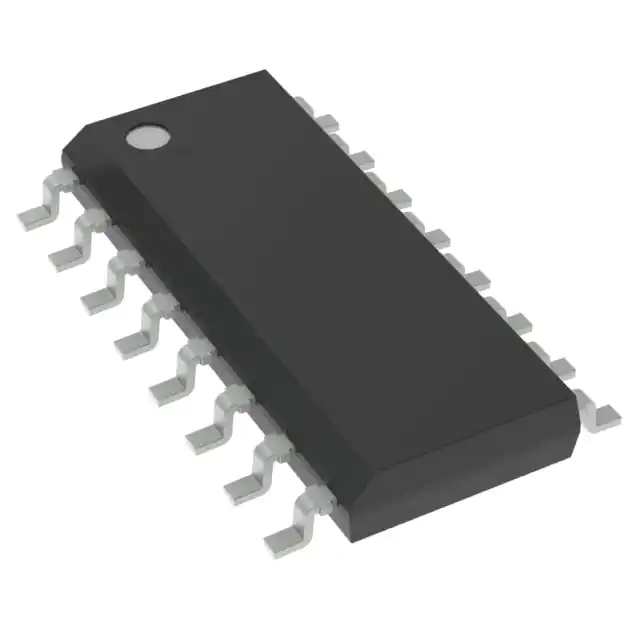
STMicroelectronics CR14-MQP/1GE
- Part No.:
- CR14-MQP/1GE
- Manufacturer:
- STMicroelectronics
- Category:
- RFID, RF Access, Monitoring ICs
- Package:
- 16-SOIC (0.154", 3.90mm Width)
- Datasheet:
-
 CR14-MQP/1GE.pdf
- Description:
- IC RFID READER 13.56MHZ 16SO
- Quantity:
- Payment:

- Shipping:

Inventory:4,447
Please send an inquiry. Send us your inquiry, and we will respond immediately.
Product details
Overview
CR14-MQP/1GE from STMicroelectronics is an ISO/IEC 14443 Type-B contactless coupler IC designed for short-range RFID reader front-ends. It implements full analog RF interface, ASK-modulated 13.56 MHz carrier generation (10% modulation), BPSK sub-carrier (847 kHz) demodulation, CRC management, and automated ST anti-collision protocol. It operates from a single 5 V ±500 mV supply and interfaces to host microcontrollers via I²C at up to 400 kHz - used in secure access terminals and disposable smart card readers.
For engineers reviewing the CR14-MQP/1GE datasheet, CR14-MQP/1GE pinout, CR14-MQP/1GE application, or CR14-MQP/1GE equivalent, key selection criteria include ISO14443-B compliance, integrated RF driver/receiver architecture, 36-byte frame register depth, chip enable addressing (E0–E2), and SO16N package compatibility with antenna matching networks.
Technical Context
The CR14-MQP/1GE integrates four functional blocks: an I²C bus controller compliant with 400 kHz timing, a bi-directional 36-byte RAM buffer for request/answer frames, a transmitter generating 13.56 MHz ASK-modulated RF output (RFOUT), and a receiver using BPSK sub-carrier demodulation on RFIN. It requires an external 13.56 MHz crystal connected between OSC1 and OSC2.
All ISO14443-B RF layer functions - including SOF/EOF framing, CRC-16 generation/check, and probabilistic anti-collision sequence execution - are hardware-managed. The host MCU controls protocol sequencing via I²C register writes (Parameter Register at 00h, I/O Frame Register at 01h, Slot Marker Register at 03h), with no firmware overhead for RF signal conditioning.
Key Specifications
| Parameter | Value and Actual Design Meaning |
|---|---|
| Supply Voltage | 5 V ±500 mV - enables direct integration with 5 V logic systems without level-shifting. |
| Carrier Frequency | 13.56 MHz - externally generated via crystal on OSC1/OSC2; defines ISO14443-B operating band. |
| Data Rate | 106 Kbit/s - full-duplex RF link speed for both PICC request and answer frames. |
| I²C Interface | 400 kHz standard-mode - supports multi-drop bus with up to 8 devices using E0/E1/E2 address pins. |
| Frame Register Size | 36 bytes - buffers complete ISO14443-B request/answer frames including SOF/EOF and CRC fields. |
| Modulation Scheme | ASK (10% modulation) transmit / BPSK (847 kHz sub-carrier) receive - meets ISO14443-B RF interface requirements. |
| CRC Function | Hardware CRC-16 generation and verification - offloads checksum computation from host MCU. |
| Anti-collision | Automated ST probabilistic scanning - resolves multiple PICCs in field without host intervention. |
Pinout & Package
CR14-MQP/1GE is housed in a SO16N (SO16 narrow) plastic small-outline package, 150 mils body width, with 16 leads and standard gull-wing lead form. Pin pitch is 1.27 mm; package conforms to JEDEC MS-012AC.
| Pin/Terminal | Circuit Role | Design Meaning |
|---|---|---|
| RFOUT | Antenna Output Driver | Generates 13.56 MHz ASK-modulated signal; connects directly to LRC antenna tank circuit. |
| RFIN | Antenna Input Filter | Receives load-modulated signal from PICC; feeds BPSK sub-carrier decoder. |
| OSC1 / OSC2 | Oscillator Interface | Accepts 13.56 MHz crystal (or external clock on OSC1 only); defines carrier timing reference. |
| SCL / SDA | I²C Serial Interface | Bi-directional 400 kHz I²C bus; SDA open-drain, SCL may be push-pull or open-drain. |
| E0 / E1 / E2 | Chip Enable Inputs | Set 3 LSBs of 7-bit I²C device address; enable up to 8 CR14s on same bus. |
| VCC / GND / GND_RF | Power & Ground | VCC = 5 V supply; GND and GND_RF must be tied together with low-inductance connection. |
| VREF | Transmitter Reference | Stabilizes ASK modulation depth; requires external decoupling capacitor per schematic. |
Key Features
| Feature | Design Value |
|---|---|
| ISO14443-B Analog Front-End | Integrated transmitter (ASK) and receiver (BPSK sub-carrier) eliminate discrete RF components. |
| Hardware Anti-collision Engine | Probabilistic slot-based scanning resolves multiple PICCs autonomously - no host timing control required. |
| 36-Byte Frame Buffer | Single-access I/O register (01h) stores full request/answer frames - simplifies host data handling. |
| Multi-Device I²C Addressing | E0–E2 pins configure unique 7-bit I²C address - enables scalable reader designs with parallel couplers. |
| CRC-16 Acceleration | Dedicated hardware computes and verifies CRC over entire frame - ensures protocol integrity at 106 Kbit/s. |
Applications
| Secure Access Terminal | Smart ID Card Reader |
|---|---|
Use Scenario: Contactless entry system for corporate offices using ISO14443-B ID cards. IC Role / Device Role / Timing Role: CR14-MQP/1GE acts as RF analog front-end, managing carrier generation, modulation, demodulation, and anti-collision - all timed to ISO14443-B frame structure. Use Value: Enables deterministic 106 Kbit/s communication with zero host MCU RF timing overhead, reducing firmware complexity and certification risk. |
Use Scenario: Desktop USB-connected smart card reader for national eID programs. IC Role / Device Role / Timing Role: Provides ISO14443-B-compliant RF coupling between host MCU and PICC; handles CRC, SOF/EOF, and slot marker sequencing. Use Value: Eliminates need for external RF transceiver ICs or discrete analog circuits - reduces BOM count and PCB area by >30%. |
| Disposable Medical Tag Reader | Public Transport Fare Validator |
Use Scenario: Handheld scanner verifying sterilization status on disposable medical instrument tags. IC Role / Device Role / Timing Role: CR14-MQP/1GE serves as low-power coupler driving compact printed antenna; manages energy-efficient polling of passive PICCs. Use Value: Single 5 V supply and integrated anti-collision allow battery-powered operation with <50 ms tag discovery latency. |
Use Scenario: High-throughput fare validator at metro station gates processing ISO14443-B transit cards. IC Role / Device Role / Timing Role: Functions as high-reliability RF interface with hardware CRC and frame buffering - critical for error-free transaction logging. Use Value: Hardware-managed 36-byte frame register ensures full command/response exchange completes within 340 µs - enabling <3 cards/sec throughput. |
Equivalent & Alternatives
The following parts are listed as comparable options for similar ISO14443-B coupler applications.
| Alternative Part | Technical Difference | Application Difference | Selection Advice |
|---|---|---|---|
| SLI13S (Infineon) | Integrated 13.56 MHz oscillator; no external crystal required. Lower supply current (3 mA vs 12 mA). | Designed for ultra-low-power portable readers; lacks E0–E2 multi-device addressing. | Select when crystal BOM reduction and battery life outweigh multi-coupler scalability needs. |
| TRF7970A (TI) | Multi-protocol (ISO14443-A/B, FeliCa, NFC Forum); includes internal LDO and digital baseband processor. | Supports host-offloaded protocol stack; requires more complex firmware but enables NFC reader flexibility. | Select when future-proofing for A/B/FeliCa/NFC interoperability justifies higher cost and design effort. |
Compared with SLI13S and TRF7970A, CR14-MQP/1GE delivers optimal balance of ISO14443-B specificity, hardware anti-collision autonomy, and multi-device I²C scalability - making it ideal for cost-sensitive, high-volume fixed-reader deployments where protocol extension is unnecessary.
Availability
CR14-MQP/1GE is available at Aetrix Electronics and suitable for secure access terminals, smart ID card readers, and public transport fare validators requiring stable component supply across industrial lifecycle horizons.
Supply support for CR14-MQP/1GE includes scheduled delivery planning, volume procurement assistance, BOM continuity management, traceable sourcing, and lifecycle availability coordination for OEM customers, industrial embedded developers, connected-device designers, and electronics production programs.
Manufacturer
STMicroelectronics is a global semiconductor leader headquartered in Geneva, Switzerland, specializing in microcontrollers, power management, and analog/mixed-signal ICs for industrial, automotive, and consumer markets.
CR14-MQP/1GE belongs to ST's contactless interface product line, engineered specifically for ISO14443-B reader applications demanding minimal host MCU involvement in RF layer operations.
FAQ
What external components are mandatory for CR14-MQP/1GE operation?
The CR14-MQP/1GE requires a 13.56 MHz crystal between OSC1 and OSC2, a decoupling capacitor on VREF, and an LRC antenna network connected to RFOUT and RFIN. Per Figure 4 of Doc ID 11922 Rev 2, C1/C2 (7 pF), C3 (22 nF), C7/C7′ (120 pF / 33 pF), and C8/C8′ (100 pF / 8 pF) form the matching network. VCC must be bypassed with C4 (22 µF) and C6 (100 nF).
How does the CR14-MQP/1GE handle multiple PICCs in its field?
It executes ST's proprietary probabilistic anti-collision algorithm via the Slot Marker Register (03h). Writing to this register initiates automatic scanning from Slot_0 to Slot_15; the CR14 hardware detects PICC responses and isolates individual devices without host CPU intervention - confirmed in Sections 7.2 and Figure 31–32 of the datasheet.
Can CR14-MQP/1GE operate with I²C buses running above 400 kHz?
No. The CR14-MQP/1GE is specified only for standard-mode I²C at ≤400 kHz, as stated in Section 4 and Table 12 (I²C AC characteristics). Attempting faster clocks violates setup/hold timing margins and risks register access corruption - no fast-mode (1 MHz) or high-speed mode support is implemented.
Is CR14-MQP/1GE pin-compatible with earlier CR14 variants like CR14-MQP/1G?
Yes. CR14-MQP/1GE uses the identical SO16N package and pinout as CR14-MQP/1G and CR14-MQP/1F. All share identical mechanical dimensions, thermal characteristics, and electrical pin functions - verified in Table 15 (package mechanical data) and Figure 3 (SO pin connections) of Doc ID 11922 Rev 2.
CR14-MQP/1GE Specifications
- Product attributes
- Attribute value
- Manufacturer:
- STMicroelectronics
- Series:
- -
- Package/Case:
- 16-SOIC (0.154", 3.90mm Width)
- Packaging:
- Tube
- Product Status:
- Obsolete
- Type:
- RFID Reader
- Frequency:
- 13.56MHz
- Standards:
- ISO 14443
- Interface:
- I2C
- Voltage - Supply:
- 5V
- Operating Temperature:
- -20°C ~ 85°C
- Grade:
- -
- Qualification:
- -
- Mounting Type:
- Surface Mount
- Supplier Device Package:
- 16-SO
CR14-MQP/1GE FAQ
1.How can I place an order for CR14-MQP/1GE through Aetrix?
Please submit a Request for Quotation (RFQ) for CR14-MQP/1GE on Aetrix. Our sales agent will provide a competitive quotation and guide you through the order confirmation once you accept the terms.
2.Are the price and stock information for CR14-MQP/1GE reliable?
The price and inventory of CR14-MQP/1GE are updated periodically and may fluctuate due to market conditions. Stock and pricing data are typically refreshed every 24 hours. Quotation validity for CR14-MQP/1GE is usually 5 days.
3.What payment methods are accepted for CR14-MQP/1GE?
We accept Wire Transfer, PayPal, Credit Card, Western Union, MoneyGram, and Escrow for CR14-MQP/1GE transactions.
Note: Certain payment methods may incur a processing fee.
4.How is shipping managed for CR14-MQP/1GE?
CR14-MQP/1GE orders can be shipped via leading logistics carriers, including DHL, UPS, FedEx, TNT, or Registered Mail.
Once your CR14-MQP/1GE order is processed, you will receive an email with the shipment details and tracking number.
Note: Tracking information may take up to 24 hours to appear. Express delivery typically takes 3–5 business days.
5.How can I obtain technical support or documentation for CR14-MQP/1GE?
For technical support, including CR14-MQP/1GE datasheets, pinout diagrams, or application guidance, please contact our engineering support team. They can provide detailed documentation and assistance for your CR14-MQP/1GE requirements.
6.How does Aetrix verify that CR14-MQP/1GE is sourced from the original manufacturer or authorized distributors?
All CR14-MQP/1GE products on Aetrix are procured from qualified distributors and authorized channels. Our dedicated quality assurance team conducts strict verification, including traceability checks and, if necessary, third-party testing. This ensures that CR14-MQP/1GE meets industry standards.
7.What is the process for return or replacement of CR14-MQP/1GE?
All CR14-MQP/1GE units undergo pre-shipment inspection (PSI). If there is an issue with CR14-MQP/1GE, returns or replacements are accepted under the following conditions:
1.Quantity discrepancies, incorrect items, or visible external defects (such as breakage or corrosion), acknowledged by Aetrix.
2.The issue is reported within 90 days of delivery.
3.The CR14-MQP/1GE part is unused and in its original packaging.
Return procedure for CR14-MQP/1GE:
1.Submit a request within 90 days.
2.Obtain a Return Material Authorization (RMA) from Aetrix.
CR14-MQP/1GE Tags

-
SL2S2602FTBX
NXP Semiconductors
-
ST25DV04K-IER6S3
STMicroelectronics
-
ST25DV04K-IER6C3
STMicroelectronics
-
LXMSJZNCMD-217
Murata Electronics

-
NT3H2111W0FTTJ
NXP Semiconductors
-
NT3H2111W0FHKH
NXP Semiconductors
-
M24LR04E-RMC6T/2
STMicroelectronics
-
ST25DV04KC-JF6D3
STMicroelectronics
-
ST25DV64KC-IE6S3
STMicroelectronics
-
ST25DV64K-IER6T3
STMicroelectronics
-
NT3H2211W0FTTJ
NXP Semiconductors
-
NT3H2211W0FHKH
NXP Semiconductors
Tech Hub

A practical engineering guide to 3.3V and 5V logic compatibility, input thresholds, resistor dividers, translator ICs, MOSFET level shifting, I2C pull-ups, timing limits and power-sequencing risks.

The 74HC595 uses push-pull logic outputs, while the TPIC6B595 uses 50 V open-drain DMOS sinks for higher-power loads. This guide compares timing, current limits, 3.3 V interfacing, load wiring, thermal…

The 74HC595 converts serial data into eight stable parallel outputs. This guide covers pin functions, shift and storage timing, OE and MR behavior, drive-current limits, cascading, voltage compatibilit…

A technical comparison of level-sensitive latches and edge-triggered flip-flops, covering timing windows, setup and hold limits, master–slave operation, time borrowing, race-through, HDL inference and…

A D latch stores one bit while Enable controls when data can pass. This reference covers gate-level operation, truth tables, transparency, setup and hold timing, LE versus OE, common ICs and practical …

An SR latch stores one bit through cross-coupled feedback. This engineering reference covers NOR and NAND implementations, truth tables, forbidden-state recovery, gated operation, switch debouncing, fa…

Latch circuits retain one bit through feedback. This technical reference covers SR and D latches, truth tables, transparency, timing limits, latch-versus-flip-flop behavior, applications and common log…

An engineering guide to LED driver operation, constant-current and constant-voltage outputs, linear and switching topologies, dimming, IC selection, calculations, replacement compatibility, and fault c…

Operational amplifier guide covering op amp basics, feedback, ideal vs real op amps, common configurations, buffer circuits, offset, bias current, gain-bandwidth, slew rate, rail-to-rail limits and sel…

Jumper cables guide covering safe connection order, red and black clamp placement, final ground connection, cable gauge, length, clamp quality, copper vs CCA cables, jump starter comparison and battery…


